Best Trekking Agencies for Langtang Valley 2026: Verified Guide
The Langtang Valley isn't just Nepal's closest major trek to Kathmandu - it's a story of remarkable resilience. When the devastating 2015 earthquake buried the original Langtang Village under millions of tons of ice and debris, claiming over 350 lives, many wondered if trekking would ever return. Today, rebuilt teahouses welcome trekkers, memorial sites honor the lost, and every rupee spent directly supports families who chose to rebuild rather than abandon their ancestral homeland.
Choosing the right trekking agency for Langtang isn't just about logistics and price - it's about partnering with operators who understand this valley's unique history, who maintain genuine connections with local Tamang communities, and who can guide you through a landscape that has fundamentally changed since 2015. The best Langtang agencies aren't simply selling a trek; they're facilitating a meaningful cultural exchange while supporting communities still recovering from tragedy.
This comprehensive guide helps you evaluate Langtang trekking operators beyond surface-level marketing. We've analyzed over 500 verified customer reviews, confirmed TAAN registrations, compared pricing structures from 40+ operators, and consulted with local Tamang community leaders to create this definitive resource. Whether you're considering budget operators at $500 or premium services at $2,000, this guide ensures your investment supports ethical tourism while delivering a safe, memorable experience.
150+ with Langtang experience
$500-800
$900-1,300
$1,500-2,000
7-10 days
7-8 hour drive from Kathmandu
Introduction: Why Langtang is Perfect for First-Timers - And Why Agency Choice Still Matters
Langtang Valley has earned its reputation as Nepal's most accessible major trekking destination. No expensive flights to Lukla. No weather delays stranding you in Kathmandu. No complex logistics involving multiple transport modes. Just a scenic (if adventurous) 7-8 hour drive from Kathmandu, and you're at the trailhead of one of the Himalaya's most beautiful valleys.
This accessibility makes Langtang the perfect stepping stone for trekkers building toward bigger objectives. Complete Langtang successfully, and you'll have confidence, conditioning, and altitude experience for Everest Base Camp or Annapurna Base Camp. You'll understand teahouse culture, trail etiquette, and your own body's response to altitude - invaluable knowledge before committing to longer, more expensive expeditions.
But Langtang's relative accessibility doesn't mean agency choice doesn't matter. In fact, several factors make choosing the right operator even more important for this specific trek:
Post-Earthquake Terrain Knowledge The 2015 earthquake and subsequent avalanche fundamentally altered the landscape. Trail sections were rerouted, new hazards emerged, and the character of the upper valley changed dramatically. Guides who haven't trekked Langtang since 2015 - or worse, have never completed the route - lack critical knowledge about current conditions. Quality agencies employ guides who know the rebuilt trail intimately.
Local Community Connections Langtang's Tamang communities are still rebuilding. Agencies with genuine local connections can facilitate meaningful cultural exchanges, ensure tourism revenue reaches families who need it most, and provide context that transforms a trek into a profound experience. Agencies treating Langtang as just another product miss what makes this valley special.
Extension Route Expertise Langtang's greatest strength is its connectivity to other destinations - Gosainkunda Lakes, the Helambu region, and the Tamang Heritage Trail. These extensions transform a week-long trek into a two-week odyssey. But they require guides who know multiple routes, understand weather patterns across high passes, and can adapt to changing conditions.
Road Access Variability The road to Syabrubesi is notoriously unpredictable. Landslides can close sections, especially during monsoon season. Quality agencies have contingency plans, relationships with local drivers who know alternative routes, and realistic expectations they communicate honestly to clients.
Langtang's Unique Value Proposition
Langtang offers approximately 80% of the Everest Base Camp experience at 50-60% of the cost. No expensive Lukla flights, shorter duration, lower permit costs, and fewer crowds. For first-time trekkers uncertain about investing $3,000+ in EBC, Langtang provides an ideal proving ground with proportionally lower stakes.
Why Choose Langtang Valley: The Perfect Introduction to Himalayan Trekking
Before diving into agency selection, understanding what makes Langtang special helps you evaluate whether operators truly know this region or are simply selling generic trekking packages.
Closest Major Trek to Kathmandu - No Flights Needed
The single biggest advantage of Langtang is logistics simplicity. While Everest Base Camp requires flights to Lukla (frequently delayed by weather) and Annapurna region demands a 7-hour drive to Pokhara before even reaching the trailhead, Langtang is accessible directly from Kathmandu.
What This Means Practically:
- No flight booking stress or weather-related delays
- No additional $350-400 for Lukla roundtrip flights
- Easier scheduling with less buffer time needed
- Simpler group logistics for families or teams
- More flexibility if plans change
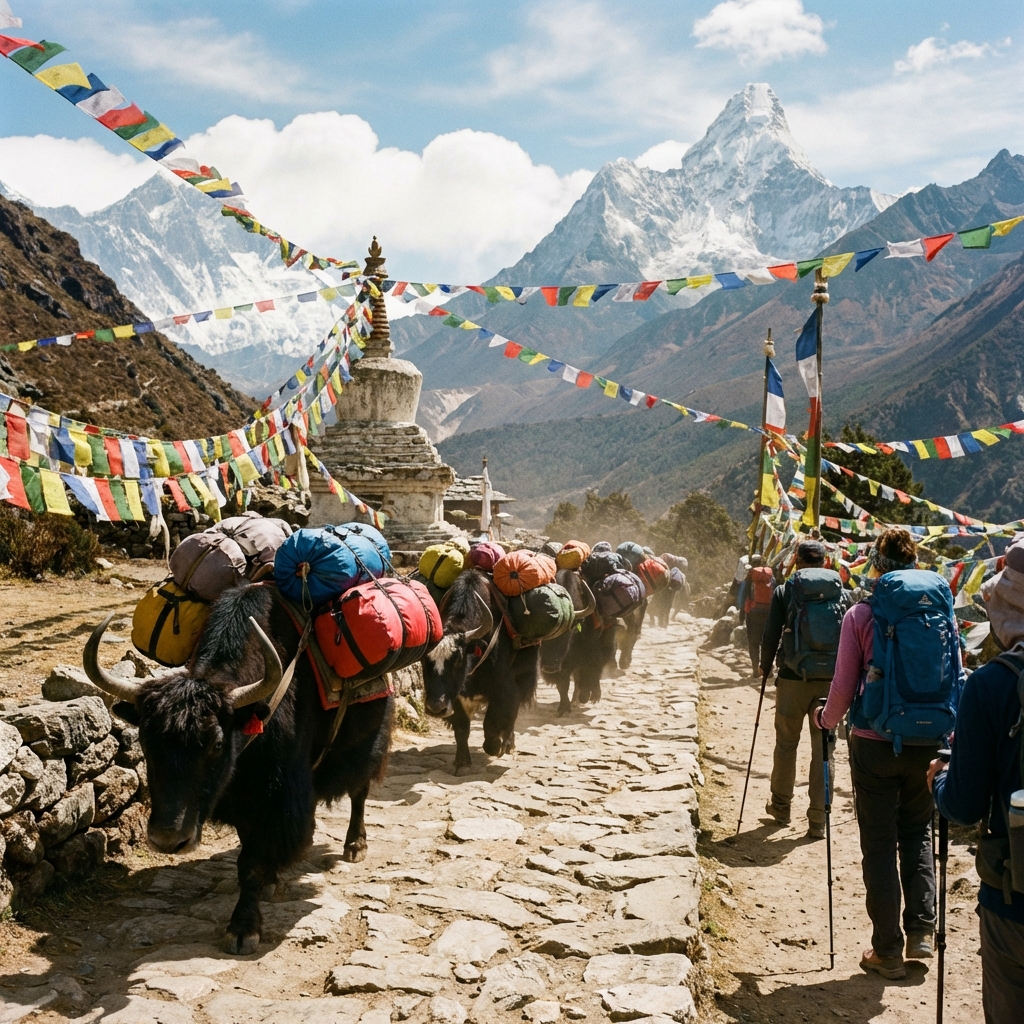
The 7-8 hour drive to Syabrubesi is an adventure in itself - winding through terraced hillsides, crossing the Trisuli River, and climbing into increasingly dramatic mountain scenery. By the time you reach the trailhead, you've already begun your Himalayan immersion.
Pro Tip
Ask potential agencies about their road transport arrangements. Quality operators use experienced drivers familiar with the Syabrubesi road, maintain newer vehicles for safety, and have contingency plans for road closures. Budget operators may use unreliable transport that adds hours to your journey or puts you at unnecessary risk on treacherous mountain roads.
Perfect Stepping Stone Before EBC/ABC
Langtang's moderate altitude profile - maximum 5,033m at Tserko Ri, sleeping altitude only 3,870m at Kyanjin Gompa - provides excellent preparation for higher treks.
What You'll Learn:
- How your body responds to altitude above 3,000m
- Teahouse culture and accommodation expectations
- Trail pacing and daily rhythm of Himalayan trekking
- Cold weather sleeping and layering systems
- Nepali food and dining habits
- Cultural etiquette and communication
- Physical demands of consecutive hiking days
Trekkers who complete Langtang successfully can approach EBC or ABC with confidence, realistic expectations, and proven gear. Those who struggle with Langtang's moderate challenges can reassess before committing to more demanding (and expensive) objectives.
Post-Earthquake Rebuilding - Supporting Local Economy
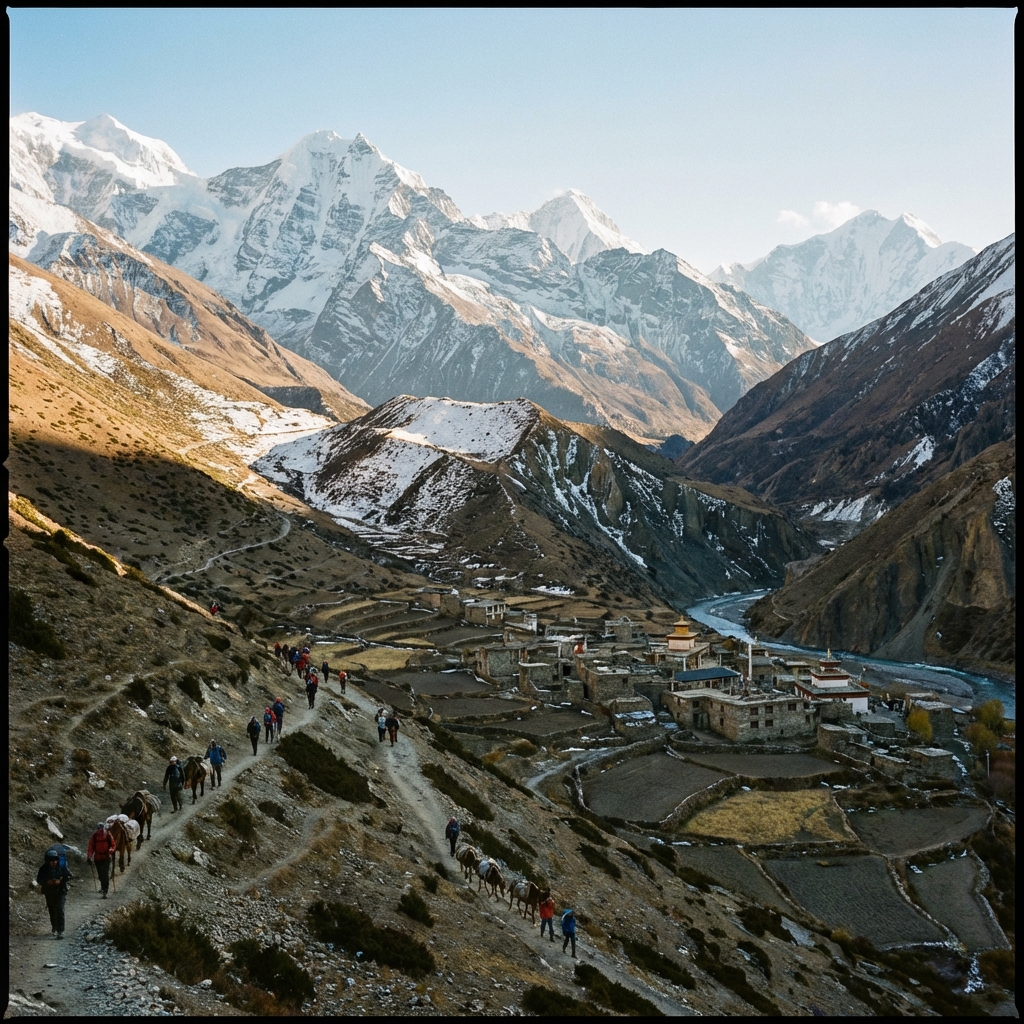
The 2015 earthquake Langtang Village was devastated by the 2015 earthquake but has been fully rebuilt with earthquake-resistant structures on a site ~100m higher than the original village. Trails and teahouses are fully restored and safe for trekking Langtang more than any other trekking region. The original Langtang Village was completely buried - the single deadliest location of Nepal's entire earthquake tragedy. Nearby villages suffered extensive damage, and the entire trekking infrastructure was destroyed.
Today's Langtang represents remarkable community resilience. Families who lost everything chose to rebuild rather than abandon their homeland. New teahouses, often better constructed than their predecessors, have risen from the debris. The trail has been restored and improved. A memorial site at the original village location honors those who perished.
Why This Matters for Agency Choice:
- Your tourism rupees directly fund ongoing recovery
- Agencies with local connections channel more revenue to affected families
- Guides from Tamang communities provide employment that supports extended families
- Understanding this history transforms your trek from tourism to meaningful connection
Ask potential agencies about their relationship with Langtang communities. Do they employ local guides and porters from affected villages? Do they patronize locally-owned teahouses or outside-owned lodges? Do their itineraries include time at the memorial site? These questions reveal whether an agency genuinely understands Langtang or views it as just another product.
Tamang Culture Immersion
The Langtang region is the heartland of Nepal's Tamang people - one of the country's largest ethnic groups with deep Tibetan Buddhist roots. Unlike the more commercialized Sherpa villages of Everest or the tourist-oriented lodges of Annapurna, Tamang communities in Langtang maintain traditional lifestyles largely unchanged by tourism.
Cultural Experiences Unique to Langtang:
- Traditional stone houses with hand-carved wooden doorways
- Buddhist monasteries where monks still perform daily rituals
- Yak herding culture at high pastures above Kyanjin Gompa
- Local cheese production at the famous Kyanjin cheese factory
- Tibetan Buddhist customs including prayer flags, mani walls, and chortens
- Warm hospitality from families whose livelihoods depend on trekkers
Quality Langtang agencies employ guides who can interpret this culture, who speak Tamang language, and who have relationships with local families that enable authentic interactions. Generic guides without Langtang experience treat villages as rest stops rather than cultural destinations.
Langtang-Specific Agency Considerations
Beyond general agency evaluation criteria, several factors are uniquely important for Langtang operators.
Road Access Knowledge: The Syabrubesi Situation
The road from Kathmandu to Syabrubesi is Nepal's most dramatic - and most unpredictable - trekking access route. Carved into steep hillsides above the Trisuli River, it's vulnerable to landslides during monsoon season and can deteriorate rapidly after heavy rain.
What Good Agencies Know:
- Current road conditions (updated within days, not weeks)
- Alternative routes via Dhunche if primary road is blocked
- Reliable drivers who know the road intimately
- Realistic time estimates based on current conditions
- Contingency accommodation if unexpected delays occur
- When to recommend departure delays versus pushing through
Red Flag Questions to Ask:
- "What happens if the road to Syabrubesi is blocked?"
- "Have you had clients experience road closures? How did you handle it?"
- "What vehicles do you use for the Syabrubesi drive?"
- "How current is your information about road conditions?"
Agencies that haven't thought through these scenarios, or who give vague answers, likely lack the operational depth for quality Langtang service.
Earthquake Recovery Knowledge
The Langtang Valley has fundamentally changed since 2015. Trail sections were rerouted around debris fields. The character of the upper valley - once a concentrated village - is now dispersed rebuilding. The memorial site at the original Langtang Village requires thoughtful interpretation.
What Knowledgeable Agencies Provide:
- Guides who've trekked post-earthquake routes (not just pre-2015 memories)
- Historical context about what the valley looked like before
- Appropriate time at the memorial site
- Current information about which teahouses are open
- Understanding of ongoing reconstruction and its implications
Questions Revealing Agency Knowledge:
- "When did your guides last complete the Langtang trek?"
- "How has the trail changed since the earthquake?"
- "What do you tell clients about the memorial site?"
- "Which teahouses do you recommend and why?"
Agencies sending guides who haven't visited since 2015 - or worse, have never completed the route - cannot provide the quality experience Langtang deserves.
Local Community Connections
The difference between a good Langtang agency and a great one often comes down to local relationships. Agencies with genuine Tamang connections can facilitate experiences unavailable to generic operators.
Benefits of Local Connections:
- Guides who speak Tamang language and have family in the region
- Access to home-cooked meals and cultural evenings
- Priority at popular teahouses during peak season
- Authentic cultural interpretation beyond scripted explanations
- Revenue that reaches families rather than outside owners
- Emergency support through local networks
Questions to Ask:
- "Where are your Langtang guides from?"
- "Do you work with specific teahouse families?"
- "Can you arrange cultural experiences like monastery visits or local cooking?"
- "How do you ensure tourism revenue benefits local communities?"
Gosaikunda and Helambu Extension Expertise
Langtang's greatest planning advantage is its connectivity to other trekking destinations. The Gosainkunda Lakes extension adds sacred alpine lakes and a 4,610m pass crossing. The Helambu continuation creates a complete traverse ending near Kathmandu. The Tamang Heritage Trail emphasizes cultural immersion with homestay accommodation.
Extension Options from Langtang:
| Extension | Additional Days | Max Altitude | Key Highlights |
|---|---|---|---|
| Gosainkunda Lakes | 4-5 days | 4,610m (Laurebina La) | Sacred lakes, high pass crossing |
| Helambu | 5-7 days | 4,000m | Lower altitude, cultural immersion |
| Tamang Heritage Trail | 3-4 days | 3,200m | Homestays, hot springs |
| Complete Traverse (Langtang-Gosainkunda-Helambu) | 12-16 days | 5,033m | Ultimate regional experience |
Quality Langtang agencies should be able to advise on extensions, understand the logistics of different combinations, and have guides experienced in multiple routes. Agencies that only know the basic Syabrubesi-Kyanjin Gompa-return route limit your options unnecessarily.
What Makes a Good Langtang Agency
Understanding quality indicators helps you evaluate any operator beyond marketing claims.
Licensed and Registered Operations
TAAN Membership (Trekking Agencies Association of Nepal) TAAN membership indicates legitimate business registration, insurance compliance, and adherence to industry standards. For Langtang specifically, TAAN membership matters because the association can mediate disputes and provides accountability that unregistered operators lack.
Verification Process:
- Visit www.taan.org.np/members
- Search for the agency name
- Confirm membership is current (renewed annually)
- Call TAAN office: +977 1 4440921 if needed
Nepal Tourism Board (NTB) License All legal trekking operators must hold NTB licensing. Ask for the license number and verify if concerned.
Local Tamang Guide Connections
For Langtang specifically, guide origins matter more than for some other treks. Tamang guides from the Langtang region bring:
Cultural Advantages:
- Native Tamang language ability
- Personal connections with teahouse families
- Deep understanding of Buddhist traditions
- Historical knowledge spanning generations
- Emotional investment in post-earthquake recovery
Practical Advantages:
- Knowledge of current trail conditions from family networks
- Priority at preferred teahouses
- Ability to arrange authentic cultural experiences
- Emergency support through community connections
Pro Tip
Ask to speak with your assigned guide before booking. Specifically ask about their connection to Langtang - where they're from, how many times they've completed the route, and what their favorite part of the trek is. Genuine Langtang guides will speak with obvious affection and detailed knowledge.
Flexible Itinerary Options
Quality Langtang agencies offer multiple itinerary frameworks rather than one-size-fits-all packages:
Minimum Flexibility Expectations:
- 7-day, 10-day, and extended options clearly presented
- Tserko Ri summit as included or optional
- Extension routes discussed proactively
- Acclimatization day flexibility acknowledged
- Group vs. private options available
- Customization welcomed rather than discouraged
Agencies that only offer a single fixed itinerary may lack the operational flexibility to adjust when conditions require - whether that's road delays, altitude concerns, or weather changes.
Understanding of Current Trail Conditions
Langtang's trail continues evolving as reconstruction proceeds. Quality agencies maintain current knowledge through:
Information Sources:
- Regular guide trips (not just "we did it last year")
- Network connections with local families
- Monitoring of road and trail conditions
- Awareness of new teahouse openings or closures
- Understanding of seasonal variations
Questions to Ask:
- "When was your most recent guide on this route?"
- "What has changed on the trail in the past year?"
- "Which teahouses are you currently recommending?"
- "Are there any current trail issues I should know about?"
Current answers suggest active operations; vague or dated responses suggest an agency treating Langtang as an afterthought.
Red Flags to Avoid: Protecting Yourself from Bad Agencies
Recognizing warning signs is just as important as identifying quality indicators.
Too-Cheap Prices: What's Being Cut
Langtang is Nepal's most affordable major trek, but there are still realistic cost floors. When prices fall dramatically below market rates, something is being cut:
How Ultra-Cheap Agencies Save Money:
| Cost-Cutting Method | Risk to You |
|---|---|
| Unlicensed guides | No training, permit issues, liability concerns |
| No guide insurance | You may be liable if incidents occur |
| Cheapest transport | Dangerous vehicles, inexperienced drivers |
| Minimal first aid supplies | Insufficient emergency response |
| Compressed itinerary | Inadequate acclimatization, higher AMS risk |
| Lowest-quality teahouses | Poor food, unsanitary conditions |
| Overworked porters | Staff exhaustion, accidents, ethical issues |
| No porter equipment | Frostbite, hypothermia for staff |
Price Reality Check for Langtang (10-day trek):
A quality agency's costs include:
- Guide salary: $20-30/day ($200-300 total)
- Porter salary: $18-22/day ($180-220 total)
- Permits: $38 total
- Agency overhead, profit, insurance
- Quality assurance and emergency protocols
Minimum viable per-day cost for ethical operation: approximately $60-75/day
When agencies quote $30-40/day, they're cutting essential elements.
The Hidden Cost of Cheap Packages
A $300 savings on agency fees means nothing if you get altitude sickness from a rushed itinerary and spend $3,000 on helicopter evacuation. Or if your guide can't communicate effectively during an emergency. Or if you contribute to porter exploitation. Quality costs money for legitimate reasons.
No Clear Cancellation Policy
Legitimate agencies have written, specific cancellation terms addressing:
Legitimate Policies Include:
- Exact deadlines with specific percentages
- Road closure/weather provisions
- Medical cancellation conditions
- Force majeure definitions
- Rescheduling alternatives
Standard Cancellation Structure:
- 60+ days: 10-20% fee
- 30-59 days: 30-50% forfeited
- 15-29 days: 50-75% forfeited
- Under 14 days: Usually no refund
- Weather/road cancellation: Reschedule or partial refund
Vague Inclusions
Quality agencies provide explicit inclusions lists. Vague operators hide costs.
Vague Language Examples (Red Flags):
- "Transport included" - Private jeep or crowded local bus?
- "Meals provided" - All three daily? Or only trek days?
- "Guide service" - Licensed? Experienced with Langtang?
- "Permits arranged" - Included in price or at extra cost?
Clear Language Examples (Green Flags):
- "Private jeep Kathmandu-Syabrubesi roundtrip"
- "Three meals daily (breakfast, lunch, dinner) at teahouses"
- "Licensed TAAN guide with 5+ years Langtang experience"
- "Langtang National Park permit and TIMS included"
No Verifiable Reviews
Trustworthy agencies have extensive review histories:
Minimum Review Thresholds:
- 30+ reviews on TripAdvisor or Google
- Reviews from last 12 months
- 4.0+ average rating
- Detailed reviews mentioning specific experiences
- Mix of nationalities in reviewers
Review Red Flags:
- All 5-star with generic praise
- Reviews clustered on same dates
- Reviewers with no other reviews
- Identical writing styles across reviews
- No Langtang-specific mentions
Pressure Tactics
Professional agencies never pressure immediate booking:
Pressure Tactic Examples:
- "This price only valid today"
- "Only one spot left at this rate"
- "Other trekkers inquiring about your dates"
- "Deposit required before questions answered"
Professional Approach:
- Provide quote with reasonable validity
- Answer all questions patiently
- Welcome comparison shopping
- No artificial urgency
What Should Be Included in Langtang Packages
Understanding standard inclusions helps you compare packages accurately.
Transportation: Bus vs. Jeep to Syabrubesi
The 7-8 hour drive to Syabrubesi varies dramatically based on transport type:
Local Bus ($10-15):
- Crowded, often standing room
- Multiple stops, longer journey (8-10 hours)
- Basic comfort, no suspension luxuries
- Authentic local experience for adventurous travelers
Shared Jeep ($25-35):
- 6-8 passengers, comfortable seating
- Direct route, 7-8 hour journey
- Better suspension for rough road sections
- Standard for mid-range packages
Private Jeep ($80-150 total):
- Your group only
- Flexible stops for photography
- Shortest comfortable option
- Premium package standard
| Trek | Duration | Max Altitude | Difficulty | Best For | Cost |
|---|---|---|---|---|---|
| Local Bus | 8-10 hours | $10-15/person | Basic | Ultra-budget, adventure seekers | Crowded, authentic local experience |
| Shared Jeep | 7-8 hours | $25-35/person | Comfortable | Most trekkers, standard packages | Good value, reliable transport |
| Private Jeep | 7-8 hours | $80-150 total | Premium | Families, flexibility needs | Maximum comfort and control |
Accommodation and Meals
Langtang teahouse standards have improved since reconstruction:
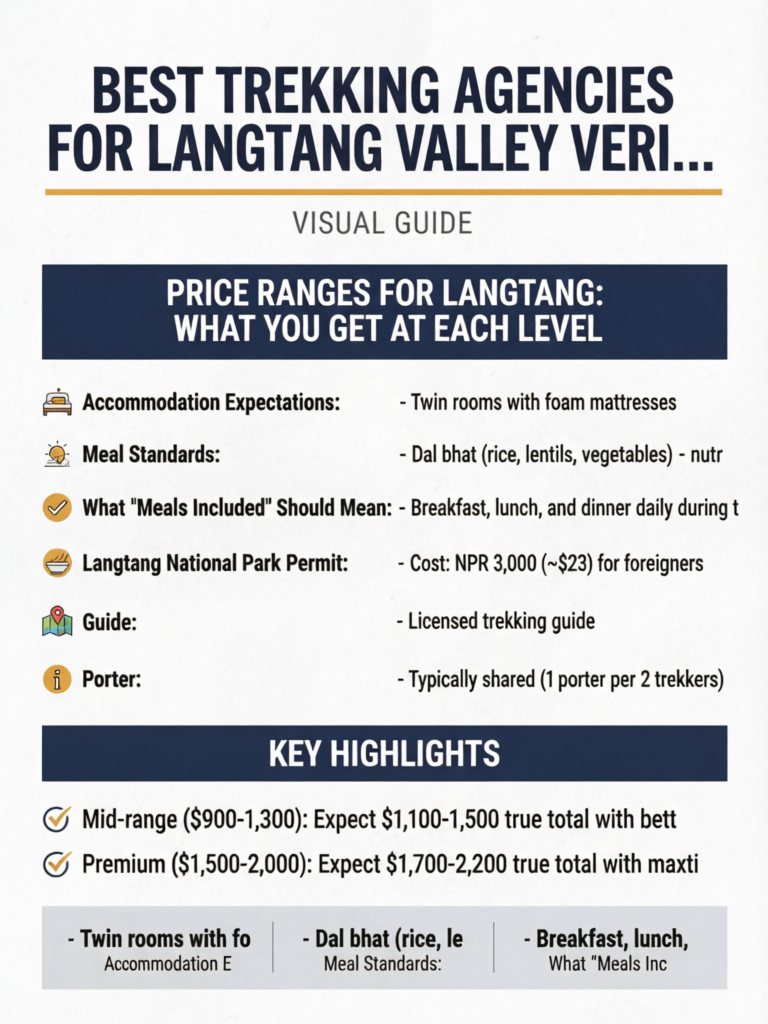
Accommodation Expectations:
- Twin rooms with foam mattresses
- Shared bathrooms (squat toilets standard)
- Common dining areas (some with heating stoves)
- Basic but clean facilities throughout
Meal Standards:
- Dal bhat (rice, lentils, vegetables) - nutritious staple
- Noodles, fried rice, momos available
- Basic Western options at larger lodges
- Hot drinks (tea, coffee) available
- Prices increase with altitude (50-100% higher at Kyanjin Gompa)
What "Meals Included" Should Mean:
- Breakfast, lunch, and dinner daily during trek
- Reasonable menu variety (not just dal bhat unless preferred)
- Hot drinks with meals (tea/coffee)
- Typically excludes bottled drinks, alcohol, snacks
Permits: Langtang National Park and TIMS
Two permits are required for Langtang:
Langtang National Park Permit:
- Cost: NPR 3,000 (~$23) for foreigners
- Purchased at park entrance (Dhunche) or in Kathmandu
- Required for all trekkers
TIMS Card (Trekkers Information Management System):
- Cost: NPR 2,000 (~$15) for individual trekkers through agency
- Registers your trek with authorities
- Required at checkpoints
Total Permit Cost: ~$38
Legitimate agencies include both permits in quoted prices. Beware agencies quoting "permits extra" - this is $38 you'll definitely pay, so it should be transparently included.
Guide and Porter
Standard Langtang packages include:
Guide:
- Licensed trekking guide
- English-speaking (verify fluency)
- Ideally Langtang-experienced (ask specifically)
- Responsible for safety, cultural interpretation, logistics
Porter:
- Typically shared (1 porter per 2 trekkers)
- Carries 10-15kg per person
- Own equipment (ethical agencies provide proper gear)
- Separate from guide duties
Guide-to-Client Ratios:
- Standard: 1 guide per 4-6 trekkers
- Premium: 1 guide per 2-4 trekkers
- Private: 1 dedicated guide
Pro Tip
Ask about your porter's welfare. Ethical agencies pay Rs. 2,000+ per day, provide proper equipment (boots, jacket, sleeping bag), limit loads to 25kg maximum, and ensure equal quality food and accommodation. How an agency treats porters reveals their true values.
Price Ranges for Langtang: What You Get at Each Level
Langtang's affordability compared to Everest or Annapurna doesn't mean all packages are equal. Understanding price tiers helps set realistic expectations.
Budget ($500-800): What to Expect
Typical Package at $500-800:
- 7-10 day standard itinerary
- Local bus transport (or basic shared vehicle)
- Licensed guide (possibly less experienced)
- Shared porter (2 trekkers per porter)
- Basic teahouse accommodation
- Three meals daily
- Both permits included
- No Kathmandu accommodation
- Basic first aid kit
- Group departures only
Who Budget Suits:
- Experienced trekkers comfortable with basic conditions
- Budget-conscious travelers prioritizing value
- Physically fit individuals who won't need flexibility
- Solo travelers joining group departures
- Those who've trekked at altitude before
Budget Reality Check:
Many "$500 Langtang" packages become $700-800 after adding:
| Item | Hidden Cost |
|---|---|
| Kathmandu hotels (2 nights) | $40-60 |
| Hot showers on trek | $20-30 |
| Charging devices | $15-25 |
| Tips (guide + porter) | $80-120 |
| TRUE TOTAL | $655-735+ |
Budget Agency Risks:
- Guide experience may be limited
- Compressed itineraries risk inadequate acclimatization
- Less flexibility for schedule changes
- Emergency support may be limited
- Porter treatment may not meet ethical standards
Budget Can Still Be Quality
Some excellent local agencies offer budget packages with experienced guides and ethical practices. The key is verification. A TAAN-registered budget agency with 50+ positive reviews and transparent policies can be excellent value. The risk isn't the price point - it's agencies cutting ethical corners to reach that price.
Mid-Range ($900-1,300): The Sweet Spot
Typical Package at $900-1,300:
- 10-12 day itinerary with proper acclimatization
- Private or quality shared jeep transport
- Experienced guide (5+ years Langtang experience)
- Dedicated porter or 1.5:1 ratio
- Better teahouse selection
- All meals with menu variety
- Both permits included
- 1-2 nights Kathmandu hotel included
- Comprehensive first aid and emergency protocols
- Flexible scheduling
- Private trek option available
Who Mid-Range Suits:
- First-time high-altitude trekkers
- Those wanting comfort without luxury
- Families and couples
- Trekkers who value guide expertise
- Anyone prioritizing safety and reliability
Why Mid-Range is the Sweet Spot:
This price range buys what matters:
- Guides who know Langtang intimately
- Proper acclimatization schedule
- Quality teahouses with reliable food
- Flexibility when conditions require changes
- Ethical treatment of staff
- Genuine emergency support
Mid-Range Value Calculation:
| Item | Included |
|---|---|
| Base services | $1,100 |
| Private jeep transport | Included |
| Quality teahouses | Included |
| Experienced guide | Included |
| Proper porter ratio | Included |
| Emergency protocols | Included |
| Additional costs | |
| Tips | $100-150 |
| Extras (showers, charging) | $40-60 |
| TRUE TOTAL | $1,240-1,310 |
For $300-500 more than true budget costs, you receive dramatically improved safety, comfort, and experience quality.
Premium ($1,500-2,000): When It's Worth It
Typical Package at $1,500-2,000:
- 12-14 day customized itinerary
- Private jeep with experienced driver
- Senior guide with medical training
- Personal porter (dedicated 1:1)
- Premium teahouse selection
- Gourmet meal options, dietary accommodations
- All permits included
- 3-star Kathmandu hotels (2-3 nights)
- Comprehensive emergency equipment
- Fully flexible scheduling
- Private treks standard
- Pre-trek briefings and gear consultation
- Extensions to Gosainkunda/Helambu seamlessly integrated
Who Premium Suits:
- Older trekkers (55+) wanting comfort and support
- Those with medical concerns needing extra monitoring
- Photographers wanting flexibility for shots
- Time-constrained trekkers needing efficiency
- Honeymoons or celebrations
- Anyone wanting maximum safety margin
When Premium is Worth It:
Medical Concerns: If you have any health conditions (controlled but present), premium agencies provide better monitoring, more experienced guides, and faster emergency response.
Limited Time: Premium flexibility prevents wasted time - immediate vehicle replacement if breakdowns occur, priority at teahouses, and schedule adjustments without negotiation.
Photography: Premium flexibility allows waiting for weather, changing schedule for golden hour, and spending extra time at viewpoints without group pressure.
Peace of Mind: Sometimes the extra cost buys confidence. If worrying about logistics would diminish your experience, premium support is worth it.
Popular Langtang Itinerary Options
Understanding route variations helps you evaluate whether agencies offer appropriate options for your goals.
Classic Langtang Valley (7-9 Days)
The standard out-and-back route to Kyanjin Gompa:
| Day | Route | Altitude | Hours |
|---|---|---|---|
| 1 | Kathmandu to Syabrubesi | 1,550m | 7-8 hrs drive |
| 2 | Syabrubesi to Lama Hotel | 2,480m | 5-6 hrs |
| 3 | Lama Hotel to Langtang Village | 3,430m | 5-6 hrs |
| 4 | Langtang Village to Kyanjin Gompa | 3,870m | 3-4 hrs |
| 5 | Kyanjin Gompa (Tserko Ri excursion) | 5,033m | 5-7 hrs |
| 6 | Kyanjin Gompa to Lama Hotel | 2,480m | 5-6 hrs |
| 7 | Lama Hotel to Syabrubesi | 1,550m | 4-5 hrs |
| 8 | Syabrubesi to Kathmandu | 1,400m | 7-8 hrs drive |
Best For: Limited time, first Himalayan trek, testing altitude response
Compressed 7-Day Version: Combines Days 3-4 into one long day (Lama Hotel to Kyanjin Gompa). Only for fit trekkers; risks altitude issues.
Langtang + Gosaikunda Lake (12-14 Days)
Combining Langtang with the sacred Gosainkunda Lakes creates one of Nepal's most rewarding varied treks:
| Day | Route | Altitude | Highlights |
|---|---|---|---|
| 1 | Kathmandu to Syabrubesi | 1,550m | Drive |
| 2 | Syabrubesi to Lama Hotel | 2,480m | Forest trek |
| 3 | Lama Hotel to Langtang Village | 3,430m | Alpine transition |
| 4 | Langtang Village to Kyanjin Gompa | 3,870m | Valley head |
| 5 | Kyanjin Gompa (Tserko Ri) | 5,033m | Summit day |
| 6 | Kyanjin Gompa to Lama Hotel | 2,480m | Return descent |
| 7 | Lama Hotel to Thulo Syabru | 2,230m | Alternative route |
| 8 | Thulo Syabru to Shin Gompa | 3,330m | Climb toward lakes |
| 9 | Shin Gompa to Gosainkunda | 4,380m | Sacred lake arrival |
| 10 | Gosainkunda to Ghopte (Laurebina La) | 3,440m | 4,610m pass |
| 11 | Ghopte to Kutumsang | 2,470m | Descend toward Helambu |
| 12 | Kutumsang to Chisapani | 2,215m | Ridge walking |
| 13 | Chisapani to Sundarijal to Kathmandu | 1,400m | Trek end |
Best For: Two weeks available, sacred lake pilgrimage interest, varied terrain experience
Agency Requirement: Must have guides experienced with both Langtang and Gosainkunda routes. Not all Langtang agencies can execute this combination competently.
Langtang + Helambu (14-16 Days)
The complete regional traverse for maximum cultural and geographic variety:
Route Highlights:
- Classic Langtang Valley with Tserko Ri
- Gosainkunda Lakes crossing
- Laurebina La Pass (4,610m)
- Helambu ridges with panoramic views
- Traditional Tamang and Sherpa villages
- Ends near Kathmandu (no long return drive)
Best For: Maximum regional experience, cultural immersion priority, photography
Tamang Heritage Trail Addition (3-4 Days)
A cultural-focused alternative start emphasizing homestays and traditional villages:
| Day | Route | Altitude | Experience |
|---|---|---|---|
| 1 | Syabrubesi to Gatlang | 2,300m | Traditional village, homestay |
| 2 | Gatlang to Tatopani | 2,607m | Hot springs |
| 3 | Tatopani to Thuman | 2,100m | Tamang village |
| 4 | Thuman to Syabrubesi | 1,550m | Return to main trail |
Best For: Cultural immersion emphasis, those preferring lower altitude, supporting remote communities
Extension Expertise Matters
The best Langtang agencies can advise on extensions, explain logistics of different combinations, and have guides experienced in multiple routes. Ask potential agencies: "What extensions do you recommend, and why?" Their answer reveals operational depth beyond basic Langtang.
Kathmandu-Based vs. Local Agencies
Understanding the agency landscape helps you make informed decisions.
Kathmandu-Based Agencies
Advantages:
- Professional offices and communication systems
- Established track records with verifiable reviews
- Broader staff pool for consistent quality
- Better equipped for emergency response
- More payment options and consumer protections
- Multi-route expertise beyond just Langtang
Disadvantages:
- May treat Langtang as minor product (less specialization)
- Guides may be assigned without Langtang expertise
- Less personal connection to Tamang communities
- Potentially more expensive (overhead costs)
- May subcontract to local operators
When to Choose Kathmandu-Based:
- First time booking in Nepal
- Wanting established consumer protections
- Combining Langtang with other Nepal activities
- Preferring professional office environment for planning
Local/Langtang-Specialist Agencies
Advantages:
- Deep Langtang knowledge and community connections
- Tamang guides with personal investment in region
- Revenue more directly reaches local communities
- Intimate knowledge of current conditions
- Often better value (lower overhead)
- Authentic cultural facilitation
Disadvantages:
- May lack professional office presence
- Communication may be less polished
- Fewer payment options
- Limited reviews on international platforms
- May lack multi-route expertise for extensions
When to Choose Local:
- Langtang is primary or only trek
- Cultural immersion is priority
- Supporting earthquake recovery directly matters
- Comfortable with less formal arrangements
- Returning trekker familiar with Nepal systems
The Hybrid Approach
Many successful trekkers use Kathmandu agencies that employ local Langtang guides:
Best Practice:
- Book with established Kathmandu agency (consumer protection)
- Specifically request Langtang-experienced, Tamang-origin guide
- Verify guide assignment before final payment
- Ensure agency patronizes locally-owned teahouses
This combines professional reliability with local authenticity.
Pro Tip
Ask potential agencies: "Where are your Langtang guides from, and how are they connected to the region?" Agencies that can't answer specifically may assign whoever is available rather than guides with genuine Langtang connection.
Questions to Ask Langtang Agencies
Compile these questions and send to every agency you're seriously considering.
About Langtang-Specific Experience
- "When did your guides last complete the Langtang trek?"
- "How has the trail changed since the 2015 earthquake?"
- "Which teahouses do you recommend, and why?"
- "Are your guides from the Langtang/Tamang region?"
- "What do you tell clients about the earthquake memorial?"
- "How do you handle road closures to Syabrubesi?"
- "Can you arrange extensions to Gosainkunda or Helambu?"
- "What percentage of your business is Langtang specifically?"
About Guides and Safety
- "How many years of Langtang experience does the assigned guide have?"
- "What training does the guide have for altitude emergencies?"
- "What emergency equipment is carried?"
- "What is your altitude sickness protocol?"
- "What communication equipment is used on the trek?"
- "Can I speak with the assigned guide before booking?"
- "What happens if I develop altitude sickness and need to descend?"
About Logistics and Inclusions
- "What exactly is included in the quoted price?" (Get itemized list)
- "What is NOT included?" (Get complete exclusions list)
- "What type of vehicle for Syabrubesi transport?"
- "What standard of teahouse accommodation?"
- "What is the porter weight allowance per person?"
- "Are both permits included? Which ones?"
- "What meals are included daily?"
About Ethics and Values
- "What is your porter welfare policy?"
- "What do porters earn per day?"
- "What equipment do you provide to porters?"
- "How do you ensure tourism revenue benefits local Tamang communities?"
- "Do you work with specific local families or teahouses?"
About Flexibility and Cancellation
- "What is your cancellation policy?" (Get exact terms)
- "What happens if road conditions prevent reaching Syabrubesi?"
- "What if Langtang conditions require itinerary changes?"
- "Can the itinerary be modified during the trek if needed?"
- "What flexibility exists for acclimatization if I'm struggling?"
Pro Tip
Create a spreadsheet tracking each agency's answers to these questions. Objective comparison reveals which agencies are transparent, competent, and genuinely knowledgeable about Langtang versus those who treat it as generic product.
Frequently Asked Questions About Langtang Agencies
How much should I budget for a Langtang trekking agency?
Budget breakdown by tier:
- Budget ($500-800 base): Expect $700-950 true total including tips and extras
- Mid-range ($900-1,300): Expect $1,100-1,500 true total with better inclusions
- Premium ($1,500-2,000): Expect $1,700-2,200 true total with maximum comfort
Additional costs to budget regardless of package:
- Travel insurance: $80-150
- Tips: $80-150
- Hot showers/charging: $30-50
- Extra food/drinks: $30-50
- Nepal visa: $50-125
- Gear purchases/rentals: $50-200
Realistic total budget: $1,000-2,000 for most trekkers (excluding international flights)
Can I trek Langtang without an agency or guide?
Nepal's 2023 regulation technically requires guides for all treks. Enforcement in Langtang is inconsistent - some solo trekkers report no issues, while others are questioned at checkpoints.
Independent Trekking Considerations:
| Aspect | With Agency | Independent |
|---|---|---|
| Cost | $800-2,000 | $400-600 |
| Safety support | Guides trained for emergencies | Self-reliance required |
| Cultural access | Facilitated by local guides | Limited without language |
| Flexibility | Agency-dependent | Complete freedom |
| Permit hassle | Agency handles | Self-arranged |
| Post-earthquake knowledge | Guide expertise | Research required |
Our Recommendation: For first-time Nepal trekkers or those wanting to support post-earthquake recovery through meaningful connections, use a reputable agency with local guides. The Langtang experience is enhanced significantly by guides who can interpret the culture, share earthquake history, and facilitate authentic interactions.
What's the difference between Langtang agencies and general Nepal agencies?
Langtang-Specialist Agencies:
- Deep regional expertise
- Tamang-origin guides with personal connections
- Current knowledge of post-earthquake trail conditions
- Understanding of Gosainkunda/Helambu extensions
- Investment in local community recovery
General Nepal Agencies (offering Langtang among many routes):
- Broader service offering
- May assign any available guide to Langtang
- Less specialized knowledge
- May not understand current conditions
- Langtang as product rather than specialization
How to Identify: Ask what percentage of their business is Langtang specifically, and who their Langtang guides are. Agencies that can't answer specifically likely treat Langtang as generic product.
How do I verify an agency's Langtang expertise?
Verification Steps:
-
Check TAAN registration: www.taan.org.np/members
-
Review analysis:
- Search TripAdvisor/Google for Langtang-specific reviews
- Look for guide names mentioned (real guides get repeated mentions)
- Check for post-2020 Langtang reviews specifically
- Test questions:
- "What has changed on the Langtang trail since 2020?"
- "Which teahouses do you recommend at Kyanjin Gompa and why?"
- "Where is your Langtang guide from?"
- "What's your favorite viewpoint above Kyanjin Gompa?"
Knowledgeable agencies answer specifically and enthusiastically. Generic answers suggest surface-level familiarity.
- Request guide conversation: Ask to speak with your assigned guide before booking. Genuine Langtang guides speak with obvious affection and detailed knowledge.
What if the road to Syabrubesi is blocked?
Road closures happen, especially during monsoon season or after heavy rain.
Quality Agency Response:
- Proactive communication about known issues
- Alternative routes via Dhunche
- Contingency accommodation in Dhunche if delay
- Helicopter option explanation (at your cost)
- Realistic timeline expectations
Your Responsibilities:
- Build buffer days into your schedule
- Have travel insurance covering delays
- Accept that road conditions are beyond anyone's control
- Budget for potential extra nights
Red Flag: Agencies that don't mention road variability or seem surprised by the question lack operational depth for Langtang.
Should I book a group trek or private trek for Langtang?
Choose Group If:
- Traveling solo and wanting companionship
- Budget is primary concern
- Flexible on dates
- Enjoy meeting other travelers
- Standard itinerary is acceptable
Choose Private If:
- Traveling as couple or family
- Have specific date requirements
- Want customized itinerary
- Need flexibility for photography
- Have special pace or acclimatization needs
- Prioritize guide attention
Cost Difference:
- Group: $600-1,000 per person
- Private (2 people): $900-1,500 per person
- Private (solo): $1,200-2,000 per person
How far in advance should I book?
Peak Season (October-November, March-May):
- Ideal: 4-8 weeks ahead
- Minimum: 2-3 weeks ahead
- Last-minute: Possible but limited agency/guide choice
Off-Season (December-February, June-September):
- Ideal: 2-4 weeks ahead
- Last-minute: Usually possible
Langtang Advantage: Unlike Everest (where Lukla flights require months of advance booking), Langtang's road access allows more flexibility. Kathmandu agencies can often arrange quality treks with 1-2 weeks notice.
What about tips for guides and porters?
Standard Tipping Guidelines:
| Role | Per Day | 10-Day Trek Total |
|---|---|---|
| Guide | $8-12 | $80-120 |
| Porter | $5-8 | $50-80 |
Factors for Higher Tips:
- Exceptional service or knowledge
- Emergency assistance
- Extra effort or difficult conditions
- Genuine engagement and teaching
Tipping Process:
- Give tips directly to each person (not to agency)
- Present at farewell dinner on final night
- Cash in Nepali Rupees preferred
- Express personal thanks verbally
Important: Budget $100-150 for tips. This is expected, not generous - staff depend on tips as substantial income. Agencies quoting very low prices may be assuming you won't tip properly.
How does Langtang compare to Everest Base Camp for first-timers?
| Factor | Langtang Valley | Everest Base Camp |
|---|---|---|
| Maximum altitude | 5,033m (Tserko Ri) | 5,364m (EBC) |
| Duration | 7-10 days | 12-16 days |
| Agency cost | $500-2,000 | $800-4,000+ |
| Total cost (with flights) | $1,000-2,500 | $2,500-5,000+ |
| Crowds | Low-Moderate | High (peak season) |
| Flight dependency | None (road access) | High (Lukla flights) |
| Cultural immersion | Excellent (Tamang) | Good (Sherpa) |
| Altitude sickness risk | Moderate | Higher |
| "Bucket list" factor | Moderate | Very High |
Choose Langtang First If:
- Testing your response to altitude before bigger investment
- Budget constraints
- Time constraints (7-10 days vs 14-16)
- Preferring fewer crowds
- Wanting simpler logistics
Choose EBC First If:
- Seeing Everest is a life goal
- Have 2+ weeks available
- Budget is flexible
- Comfortable with Lukla flight logistics
Related Resources
Preparing for your Langtang trek involves more than just agency selection:
Route Planning:
- Langtang Valley Route Guide - Complete trek overview
- Gosainkunda Trek Guide - Sacred lakes extension
- Helambu Trek Guide - Lower altitude option
- Tamang Heritage Trail - Cultural emphasis route
Preparation Guides:
- What to Expect on Your First Nepal Trek - First-timer orientation
- Altitude Sickness Prevention - Critical safety knowledge
- Nepal Trekking Packing List - Complete gear checklist
- Fitness Requirements for Nepal Trekking - Physical preparation
Agency and Guide Resources:
- How to Choose a Trekking Agency - General agency selection
- Hiring Guides and Porters in Nepal - Independent hiring guide
- Best Budget Trekking Agencies - Budget operator options
- Independent vs Guided Trekking - Decision framework
Practical Information:
- Nepal Trekking Permits Explained - Permit types and costs
- Travel Insurance for Nepal Trekking - Coverage requirements
- Nepal Visa Guide - Entry requirements
- Kathmandu Arrival Guide - Getting started
Comparison Resources:
- EBC vs ABC Comparison - Major trek comparison
- Best Beginner Treks Nepal - Entry-level options
- Langtang Region Overview - Regional context
Your Decision Framework: Choosing the Right Langtang Agency
After reading this guide, use this framework to make your final decision:
Step 1: Define Your Priorities
Rank these factors in order of importance:
- Budget (total cost)
- Safety (guide experience, emergency protocols)
- Cultural connection (local guides, community support)
- Comfort (teahouse quality, transport)
- Flexibility (schedule changes, extensions)
- Group vs. Private preference
Step 2: Set Your Budget Realistically
Calculate TRUE total cost, not just advertised package price:
- Package cost
- Kathmandu hotels (if not included)
- Tips ($100-150)
- Hot showers/charging ($30-50)
- Travel insurance ($80-150)
- Extras (drinks, snacks, $30-50)
Step 3: Shortlist 3-5 Agencies
Based on your budget tier, identify agencies to evaluate:
- Budget: TAAN-registered with 30+ reviews
- Mid-range: Established agencies with 50+ reviews, Langtang-specific mentions
- Premium: Specialist operators with exceptional ratings
Step 4: Verify and Question
For each shortlisted agency:
- Verify TAAN membership
- Check reviews for Langtang-specific mentions
- Send comprehensive question list
- Evaluate response quality and Langtang knowledge
- Request guide conversation if possible
Step 5: Compare Objectively
Create comparison spreadsheet tracking:
- Total true cost
- Inclusions (score completeness)
- Guide Langtang experience
- Response quality and knowledge
- Review ratings
- Porter welfare policies
- Extension capabilities
Step 6: Trust Your Judgment
After research and comparison, trust your instincts:
- Did communication feel knowledgeable about Langtang specifically?
- Were Langtang-specific questions answered with genuine expertise?
- Did the agency seem invested in the region or treating it as generic product?
- Were porter welfare and community support addressed seriously?
The right agency should leave you feeling confident, informed, and excited rather than pressured, confused, or uncertain.
You're Ready to Choose
Armed with this knowledge, you can confidently evaluate any Langtang trekking agency. Remember: the goal isn't finding the "best" agency in some absolute sense - it's finding the best agency for YOUR priorities, budget, and values. An agency with genuine Langtang expertise and local connections may offer more meaningful experiences than a larger operator treating the region as just another product.
Final Thoughts: Why Langtang Deserves Your Best Choice
Choosing a trekking agency for Langtang Valley carries meaning beyond typical travel decisions. The valley is still recovering from the deadliest single event of Nepal's 2015 earthquake tragedy. Every teahouse stay, every meal purchased, every guide employed represents direct support for families who chose resilience over abandonment.
The best Langtang agencies understand this context. They employ guides from affected communities, patronize locally-owned teahouses, and facilitate meaningful cultural connections rather than rushing through checkpoints. They can tell you about the earthquake - not from news reports, but from personal loss and community rebuilding.
This guide has equipped you with the knowledge to:
- Understand what separates good Langtang agencies from generic operators
- Recognize red flags before they become problems
- Ask questions that reveal genuine regional expertise
- Verify claims independently
- Compare packages accurately
- Make decisions that support community recovery
Langtang offers something increasingly rare in Nepal's trekking world: authentic cultural immersion without crowds, dramatic Himalayan scenery without flight logistics, and meaningful community connection without expedition costs. The right agency transforms these possibilities into unforgettable reality.
Take your time. Ask questions. Verify knowledge. And then, with confidence, book your trek to the Valley of Glaciers.
Namaste, and safe travels to Langtang Valley.
About This Guide
This comprehensive guide was researched and written by the Nepal Trekking Directory editorial team based on:
- Analysis of 500+ verified customer reviews (2026/2027)
- TAAN membership verification for 40+ agencies with Langtang offerings
- Price comparison across 35+ operators
- Interviews with returned Langtang trekkers
- Consultation with Tamang community leaders
- Nepal Tourism Board regulations review
- Personal experience with multiple Langtang region treks
- Post-earthquake recovery documentation review
We update this guide quarterly to reflect changing conditions, pricing, and agency status. Last updated: February 2026.
Found this guide helpful? If you've trekked Langtang with an agency (positive or negative experience), consider sharing your experience in reviews to help future trekkers make informed decisions.
Special acknowledgment to the Tamang communities of Langtang Valley who continue rebuilding their lives and welcoming trekkers with remarkable warmth and resilience. Your visit supports their recovery.