Group Trek vs Private Trek in Nepal: Complete Comparison Guide
After choosing your route -- whether it is Everest Base Camp, the Annapurna Circuit, the Langtang Valley, or any of Nepal's dozens of other trekking trails -- the next most consequential decision is how you will trek it. Joining a group on a fixed departure date, or booking a private trek on your own schedule?
This is not a trivial choice. It shapes your daily experience in fundamental ways: the pace you walk, the people you share meals with, the flexibility to take rest days or make detours, the attention your guide can give you, and -- critically -- the cost. A group trek and a private trek on the same route can feel like entirely different journeys.
Yet much of the advice online is oversimplified. "Groups are cheaper" is true on a per-person basis but ignores the nuance of what you actually get. "Private treks are more flexible" is obvious but does not address the isolation of trekking with only a guide for two weeks. The reality is more complex, and the right choice depends on your personality, your budget, your trekking partners (or lack thereof), and your priorities.
This comprehensive guide dissects every dimension of the group-versus-private decision. We cover the real cost differences with worked examples, the social dynamics that make or break group experiences, the flexibility advantages that private treks deliver, and the hybrid options that split the difference. By the end, you will know which format is right for your Nepal trek.
$800-$1,200 per person (12-14 days)
$1,500-$2,500 per person (12-14 days)
$1,200-$1,800 per person
6-14 trekkers
4-8 trekkers
1 guide per 8-14 trekkers (+ assistant)
1 guide per 1-4 trekkers
2-6 months for fixed dates
2 weeks to 3 months
Solo travelers, budget trekkers, social experience
Couples, families, flexible schedules, custom routes
What Is a Group Trek?
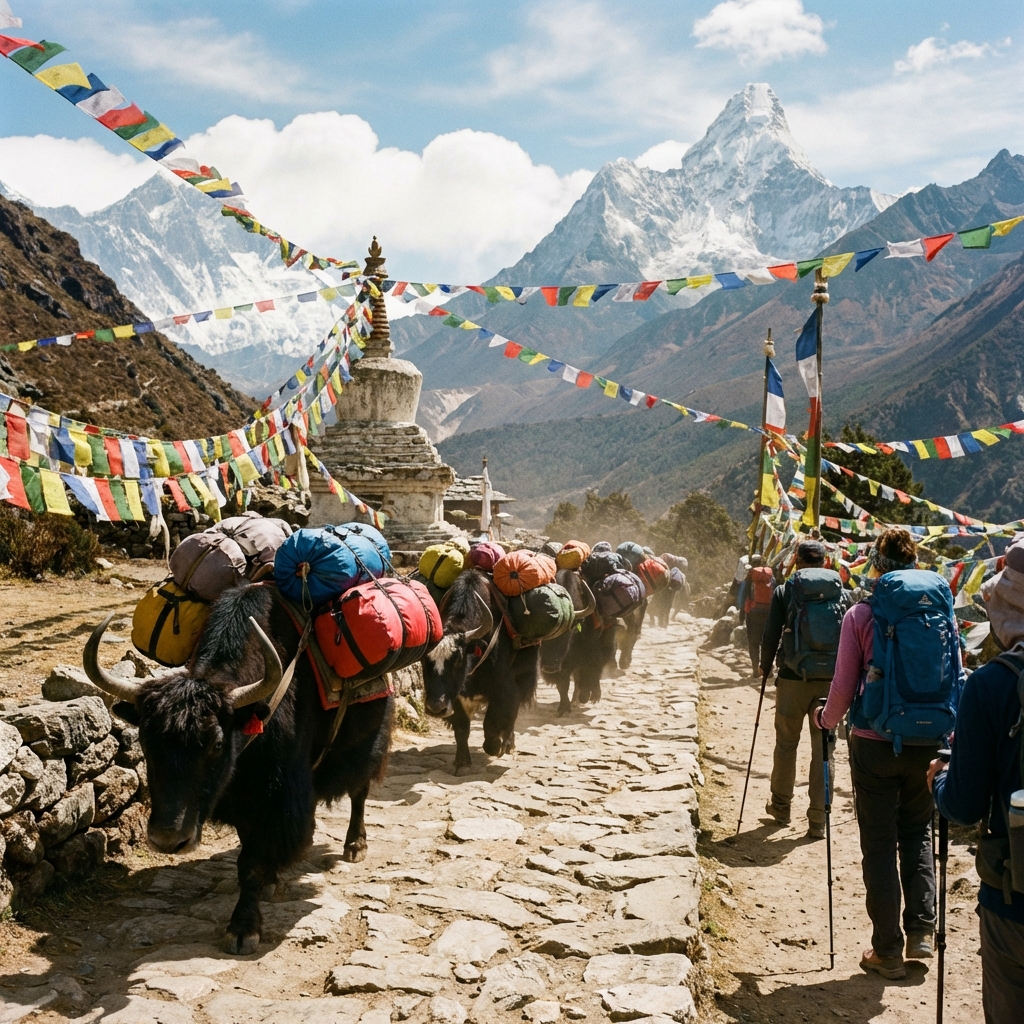
A group trek -- also called a fixed departure, scheduled departure, or join-a-group trek -- assembles individual trekkers and small parties from around the world into a single group that departs on a predetermined date and follows a set itinerary.
How It Works
- An agency publishes a departure calendar with fixed dates for popular routes (e.g., "EBC Trek departing October 5, October 12, October 19...")
- Individual trekkers or small groups book onto their preferred date
- Once the minimum group size is met (typically 2-4 people), the departure is confirmed
- Everyone follows the same itinerary, pace, and accommodation plan
- A lead guide (and often an assistant guide) manages the entire group
- Porters are shared among the group
Typical Group Composition
On a popular group trek like EBC in October, you might find:
- A mix of 6-14 trekkers from 3-8 different countries
- Age range from early 20s to late 60s
- Varied fitness levels (this is a key issue -- see below)
- Solo travelers, couples, and small friend groups combined
- Common language: English (most group treks are English-language)
Common Group Trek Routes
Group treks are most commonly available for Nepal's popular routes:
- Everest Base Camp -- the highest demand, weekly departures in peak season
- Annapurna Base Camp -- frequent departures
- Annapurna Circuit -- regular departures, though declining popularity
- Langtang Valley -- moderate demand
- Poon Hill -- frequent short trek departures
- Manaslu Circuit -- limited group departures (restricted area, guide-only requirement (no minimum group size)s)
What Is a Private Trek?
A private trek is arranged exclusively for you (and your traveling companions, if any). You choose the dates, the pace, the route variations, and the accommodation standard. Your guide works for you alone.
How It Works
- You contact an agency and specify your preferred route, dates, and requirements
- The agency assigns a dedicated guide (and porters as needed) for your party
- The itinerary is customized to your preferences -- rest days, side trips, pace adjustments
- You depart when you want, not when a group fills up
- Daily decisions (when to stop for lunch, how far to walk, whether to take a detour) are yours
Private Trek Variations
Standard Private Trek: Your guide, your porter(s), standard tea house accommodation. The most common private arrangement.
Luxury Private Trek: Premium tea houses or lodges, better food, possibly a dedicated cook, upgraded rooms. Available on popular routes with established luxury infrastructure. See our luxury trekking agencies guide.
Private with Porter Only: On well-established routes where navigation is straightforward, some experienced trekkers hire only a porter (who may also serve as a basic guide). This is cheaper but provides less cultural interaction and local knowledge. For more on this, see our guide to hiring guides and porters.
Private Camping Trek: For remote routes without tea houses or for trekkers who prefer tent-based travel. Includes guide, cook, kitchen crew, and porters. Significantly more expensive. See our camping treks guide.
Quick Comparison Table
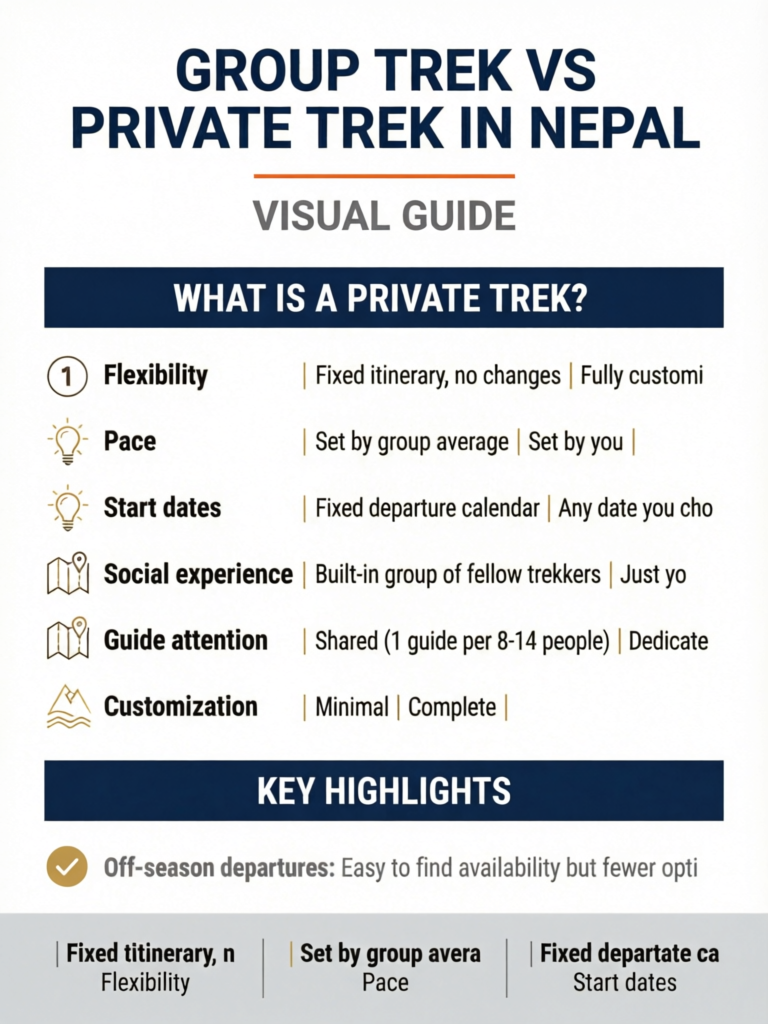
| Factor | Group Trek | Private Trek |
|---|---|---|
| Cost per person | $800-1,200 (EBC example) | $1,200-2,500 (EBC, varies by group size) |
| Flexibility | Fixed itinerary, no changes | Fully customizable |
| Pace | Set by group average | Set by you |
| Start dates | Fixed departure calendar | Any date you choose |
| Social experience | Built-in group of fellow trekkers | Just you, companions, and guide |
| Guide attention | Shared (1 guide per 8-14 people) | Dedicated (1 guide per 1-4 people) |
| Customization | Minimal | Complete |
| Booking lead time | 2-6 months (must match departure dates) | 2 weeks to 3 months |
| Cancellation policy | Strict (group depends on numbers) | More flexible (negotiate with agency) |
| Accommodation quality | Standard, chosen for groups | Your choice, from basic to luxury |
| Rest days | Pre-determined | Added as needed |
| Route variations | Not possible | Side trips, alternate paths available |
| Solo traveler friendly | Excellent | Expensive (but some prefer solitude) |
| Family friendly | Difficult (pace issues with children) | Ideal for families |
Group Trek Advantages
1. Lower Cost
This is the primary draw. By sharing the costs of guides, porters, transportation, and logistics among 8-14 people, the per-person cost drops significantly.
EBC Trek Cost Comparison (12-14 days):
| Party Size | Guide Cost (shared) | Porter Cost (shared) | Per Person Total |
|---|---|---|---|
| Group of 10 | ~$50-70/person | ~$30-50/person | $800-1,200 |
| Private (2 people) | ~$200-300/person | ~$80-120/person | $1,200-1,800 |
| Private (solo) | ~$400-600/person | ~$120-180/person | $1,500-2,500 |
A solo traveler joining a group can save $500-1,300 compared to a private trek. For budget-conscious trekkers, this difference can fund additional travel time in Nepal, gear purchases, or even a second, shorter trek.
For a complete cost breakdown of trekking in Nepal, see our Nepal trekking costs guide and budget trekking strategies.
2. Social Experience and Trail Companions
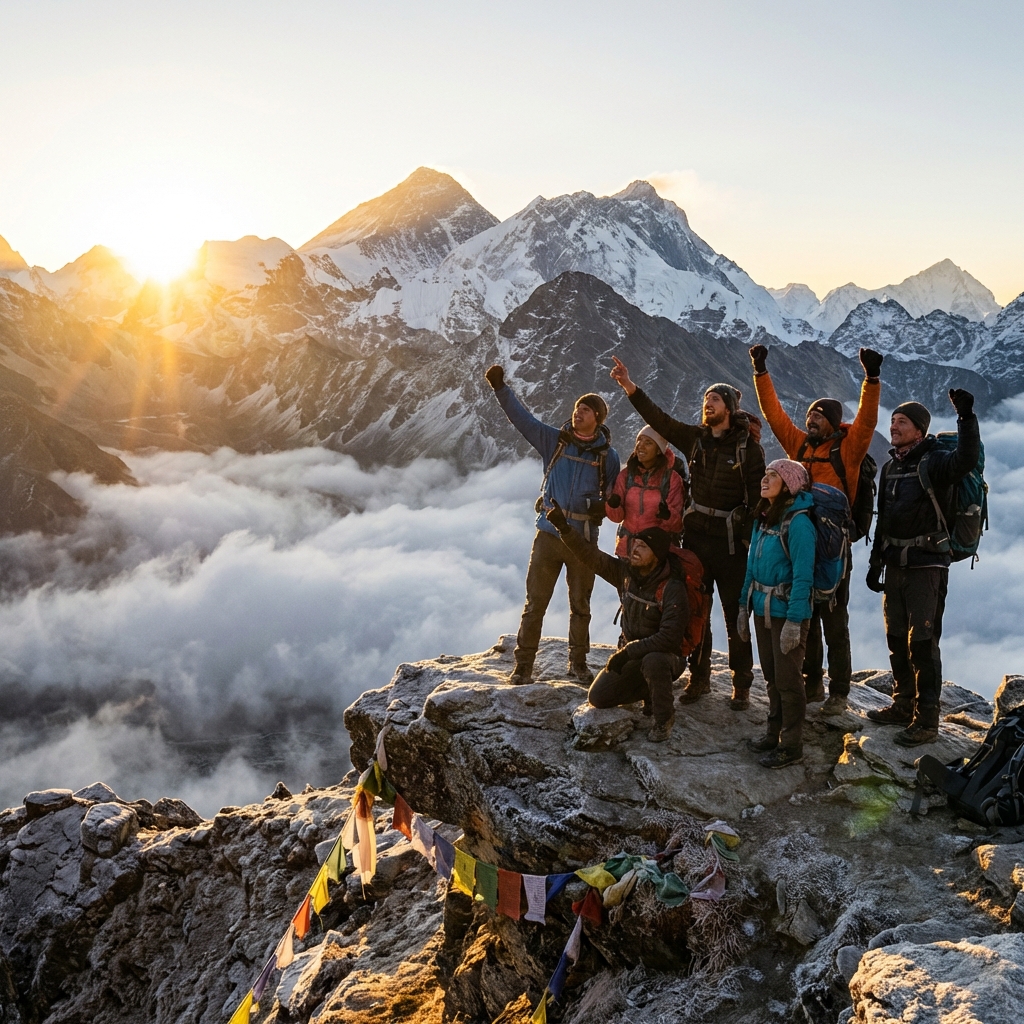
For solo travelers in particular, a group trek solves the companionship question. You will share meals, swap stories, encourage each other on tough days, and celebrate together at your destination. Many lifelong friendships have been forged on the trail to Everest Base Camp or around the Annapurna Circuit.
The social dynamic also provides practical benefits:
- Motivation on difficult days -- having others around keeps you going when fatigue sets in
- Shared knowledge -- experienced trekkers in the group share tips and advice
- Safety in numbers -- group cohesion provides an extra layer of security
- Photography -- someone to take your photo at Kala Patthar or Thorong La
3. Structured, Proven Itinerary
A group itinerary has been refined over many departures. The agency knows exactly which tea houses to book, how to pace the acclimatization days, and what the realistic daily distances are. You do not need to research or plan the logistics yourself -- you simply show up on the departure date with your gear and follow the schedule.
For first-time Nepal trekkers who may feel overwhelmed by the planning process, this structure is genuinely valuable.
4. No Minimum Planning Required
While a private trek requires communication with the agency about preferences, dates, and customizations, a group trek is essentially an off-the-shelf product. Choose a date, book it, and the rest is handled. For trekkers who prefer simplicity, this is a major advantage.
5. Single Traveler Friendly
Nepal's trekking trails are safe for solo travelers, but many people prefer not to trek alone for social, safety, or logistical reasons. A group trek is the ideal solution -- you get company without needing to find travel partners in advance. See our solo trekking guide for more on traveling alone in Nepal.
Pro Tip
Group Trek Disadvantages
1. Fixed Pace -- Too Fast or Too Slow
This is the most common complaint about group trekking. A group of 10 people will inevitably include a range of fitness levels. The guide sets a pace that accommodates the average, which means:
- Faster trekkers feel held back, waiting at rest stops and arriving at tea houses with hours of daylight to spare
- Slower trekkers feel pressured to keep up, which can lead to exhaustion, inadequate rest, and increased altitude sickness risk
- The acclimatization schedule is fixed -- if you need an extra rest day, you cannot take one without leaving the group
This pace mismatch is the single biggest source of frustration on group treks and the number one reason experienced trekkers switch to private arrangements.
2. Limited Flexibility
The itinerary is the itinerary. You cannot:
- Add an extra rest day if you are struggling with altitude
- Take a side trip to a viewpoint or village off the main trail
- Extend or shorten the trek based on how you feel
- Change accommodation if your tea house is unsatisfactory
- Adjust the schedule around weather (e.g., starting earlier to beat clouds at a viewpoint)
3. Group Dynamics Risk
Spending 12-20 days in close quarters with strangers is a social gamble. You may bond with wonderful people who enhance your experience. You may also encounter:
- Personality conflicts that make mealtimes tense
- A chronically slow walker who delays the group daily
- A fast walker who pushes the pace and makes others uncomfortable
- Cultural or communication misunderstandings
- Differing expectations about cleanliness, noise, punctuality, or alcohol consumption
You have no control over who else books onto your departure. A single difficult personality can cast a shadow over an otherwise excellent trek.
4. Fixed Dates May Not Match Your Schedule
Group departures run on published schedules. If your vacation window does not align with a confirmed departure date, you are out of luck. This is particularly challenging for trekkers with inflexible work schedules or those combining Nepal with other travel.
5. Less Personal Guide Attention
A guide managing 10-14 clients cannot give the same level of attention, instruction, and cultural interpretation as a guide dedicated to 1-2 people. On a group trek, the guide's primary job is logistical management -- ensuring everyone arrives, rooms are booked, meals are ordered. Deep cultural conversations, personalized altitude monitoring, and responsive pace adjustments are sacrificed.
Guide-to-Client Ratio Matters
When evaluating group trek operators, always ask about the guide-to-client ratio. The best agencies maintain 1 guide per 8 clients (with an assistant guide for larger groups). Some budget operators run groups of 12-14 with a single guide and no assistant -- this compromises both safety and experience quality. For more on evaluating agencies, see our agency selection guide.
Private Trek Advantages
1. Complete Flexibility
This is the defining advantage. A private trek puts you in control of every aspect of your daily experience:
- Pace: Walk as fast or slow as you like, rest when you want, extend walking hours or cut them short
- Rest days: Add acclimatization days wherever you need them -- this alone can significantly improve your altitude experience
- Side trips: Detour to a viewpoint, visit a monastery, explore a village off the main trail
- Schedule: Start at dawn to catch the mountain views before clouds roll in, or sleep in after a hard day
- Accommodation: Choose the best tea house in the village rather than the one that can accommodate 14 people
- Meals: Eat where and what you want, at your own pace
2. Dedicated Guide Attention
With a guide working for you alone (or your small group), the quality of interaction transforms:
- Deep cultural knowledge sharing -- your guide has time to explain local customs, point out flora and fauna, share personal stories
- Personalized altitude monitoring -- your guide watches specifically for your symptoms and adjusts the pace or schedule accordingly
- Language and communication -- your guide can translate local interactions, help with tea house negotiations, and facilitate authentic encounters with local people
- Flexible decision-making -- your guide can make real-time decisions based on your condition and preferences rather than managing group consensus
3. Custom Start Dates
No waiting for a fixed departure. You choose when to go, whether that is the first Saturday in October or a random Wednesday in March. This is invaluable for trekkers with rigid vacation schedules, those combining Nepal with other destinations, or those who want to avoid the peak-season crowds.
4. Personalized Acclimatization
This is arguably the most significant health and safety advantage of private trekking. On a group trek, if you need an extra acclimatization day at Namche Bazaar but the group is moving on, you either leave the group or push through discomfort. On a private trek, you simply tell your guide you need another day.
Proper acclimatization is the single most important factor in trek enjoyment and safety. The ability to customize your altitude schedule around your body's response is a genuine health advantage. For more on acclimatization, see our altitude sickness prevention guide.
5. Choice of Accommodation Quality
On popular routes like EBC, the quality difference between the best tea house in a village and the worst can be substantial. Group treks typically book mid-range accommodation that can handle large parties. Private trekkers can choose the top-rated lodge in each village -- warmer rooms, better food, cleaner facilities, more character.
For those interested in the luxury end, several operators now offer premium lodge-to-lodge trekking on the EBC and Annapurna routes. See our luxury trekking guide and best lodges in the Everest region.
Private Trek Disadvantages
1. Higher Cost
The unavoidable trade-off. A private trek costs more per person because you cannot spread fixed costs (guide wages, transport logistics) across a large group.
For a solo traveler on EBC, the private premium is substantial: $1,500-2,500 compared to $800-1,200 for a group. The gap narrows as your party grows:
| Party Size | Private Cost Per Person (EBC) | Group Cost Per Person |
|---|---|---|
| Solo | $1,500-2,500 | $800-1,200 |
| 2 people | $1,200-1,800 | $800-1,200 |
| 3-4 people | $1,000-1,500 | $800-1,200 |
| 5-6 people | $900-1,300 | $800-1,200 |
At 5-6 people, the cost difference between private and group becomes negligible, and you retain full flexibility.
2. Solo Social Experience
If you trek privately as a solo traveler, your daily companionship is limited to your guide. While Nepali guides are generally warm, knowledgeable, and excellent company, the relationship is inherently a professional one. You may miss the camaraderie of shared suffering, trail banter, and communal dinners that define the group experience.
That said, you will still meet other trekkers at tea houses in the evenings. The trails are social environments, and conversations happen naturally over dal bhat and hot lemon. But the depth of connection is typically less than with a group you travel with daily.
3. More Planning and Communication Needed
A private trek requires more back-and-forth with your agency to define the itinerary, preferences, special requirements, and expectations. You need to communicate clearly about your fitness level, desired pace, accommodation preferences, and any dietary restrictions. This planning process is not difficult, but it requires more engagement than simply booking a group departure date.
4. Guide Quality Matters Even More
On a group trek, a mediocre guide is partially compensated for by the social experience of the group. On a private trek, your guide IS your experience. A knowledgeable, personable, English-fluent guide transforms a private trek into an unforgettable journey. A disengaged, uncommunicative, or poorly trained guide makes it a lonely slog.
This means you must invest more effort in vetting your agency and specifically requesting an experienced guide. See our hiring guides and porters guide for detailed advice on ensuring guide quality.
Pro Tip
The Hybrid Option: Best of Both Worlds
Many experienced Nepal trekkers opt for a hybrid approach that captures benefits of both formats.
Small Group of Friends (2-4 People) Booking a Private Trek
This is the sweet spot for many trekkers. You get:
- Complete flexibility and pace control (private trek advantage)
- Built-in social companionship (group trek advantage)
- Cost per person approaches group rates at 3-4 people
- Consistent fitness levels if you choose traveling partners wisely
- Shared decision-making about rest days, detours, and pace
If you can find 1-3 compatible trekking partners, a private trek for 2-4 people is arguably the best trekking format available.
Group Trek With a Private Porter
Some budget trekkers join a group for the social experience and lower cost but hire their own porter privately. This gives you:
- Group pace and social benefits
- Dedicated porter carrying your gear (no sharing or coordination issues)
- Slightly more comfort and personal support
- Marginal cost increase ($15-25/day for a private porter)
Small Fixed-Departure Groups (4-8 People)
Some premium agencies run smaller group departures with a maximum of 6-8 trekkers instead of 10-14. These offer a middle ground:
- Lower cost than fully private (but more than large groups)
- Better guide attention than large groups
- More cohesive group dynamics
- Often a higher caliber of fellow trekkers (premium agencies attract more experienced clients)
Look for agencies that explicitly cap their group sizes and refuse to overbook. See our top trekking agencies directory for operators known for quality small-group departures.
How Group Size Affects Experience
Group size is one of the most underappreciated factors in trek quality. Here is how different sizes play out in practice:
2-4 People: The Ideal Size
- Guide can give near-personal attention to each trekker
- Group is nimble -- decisions are made quickly
- Tea house booking is easy (rooms always available)
- Pace alignment is likely (fewer fitness level variations)
- Strong social bonds form naturally
- Trail impact is minimal
5-8 People: The Good Range
- Enough people for good social dynamics without overwhelming logistics
- Guide attention is adequate with an assistant guide
- Tea house booking is manageable
- Some pace variation is likely but can be managed with lead/sweep structure
- Diverse perspectives and personalities enrich the experience
9-12 People: Getting Large
- Guide attention becomes diluted -- assistant guide is essential
- Tea house booking becomes challenging in popular villages
- Significant pace variations are almost guaranteed
- Social dynamics become more complex (sub-groups may form)
- Trail congestion increases (the group occupies a larger stretch of trail)
- Decision-making is slow (waiting for the slowest member at every junction)
13+ People: Too Large
- Guide attention is minimal -- logistics dominate the guide's role
- Tea houses may not have enough rooms, leading to split accommodation or lower-quality alternatives
- Pace problems are severe -- the fastest trekker may arrive 2-3 hours before the slowest
- Social dynamics fragment into cliques
- The group feels like a tour rather than an adventure
- Negative impact on other trekkers sharing the trail
Avoid Oversized Groups
If an agency is offering a group departure with 14+ trekkers and a single guide, think carefully before booking. The experience quality degrades significantly with large groups, and safety can be compromised when one guide is responsible for too many clients in a remote, high-altitude environment. Ask the agency about their maximum group size and whether it is strictly enforced.
Finding Fixed Departure Calendars
Where to Look
Most established trekking agencies publish their fixed departure calendars on their websites, typically 6-12 months in advance. Key sources:
- Agency websites: Look for "fixed departures," "scheduled treks," or "join a group" sections
- Trekking comparison platforms: Several websites aggregate departures from multiple agencies
- Kathmandu noticeboards: If you are already in Nepal, agencies in Thamel and Lazimpat post upcoming departures on notice boards
- Online trekking forums: Communities on Reddit (r/nepal, r/trekking), TripAdvisor forums, and Facebook groups often have trekkers looking for group-mates
Peak Season Availability
The most popular departure windows fill first:
- EBC October departures: May be full 3-4 months in advance
- Annapurna October departures: Typically fill 2-3 months in advance
- Spring (March-April) departures: Slightly less competitive, but still book early
- Off-season departures: Easy to find availability but fewer options
Minimum Group Size
Most agencies require a minimum of 2-4 confirmed bookings before a departure is "guaranteed." If the minimum is not met, you may be:
- Offered an alternative date
- Moved to another agency's group
- Given the option to convert to a private trek (usually at an additional cost)
- Refunded
Always ask about the agency's minimum group policy and what happens if the departure does not reach minimum numbers.
When to Choose a Group Trek
A group trek is the right choice when:
- Budget is your primary concern and you want to minimize cost per person
- You are traveling solo and want built-in companionship for 2-3 weeks
- You are trekking a popular, well-established route (EBC, ABC, Langtang, Poon Hill)
- You have flexible travel dates that can match a fixed departure calendar
- You prefer a structured, pre-planned experience with minimal decision-making required
- You enjoy meeting people from different countries and backgrounds
- It is your first Nepal trek and you want the security and structure of a guided group
- You are traveling during peak season when trails are busy regardless of your format
When to Choose a Private Trek
A private trek is the right choice when:
- You have specific dates that do not match group departure calendars
- You are trekking as a couple and want an intimate experience
- You have a family with children -- kids need flexible pacing, more rest stops, and custom itineraries. See our trekking with families guide
- Your group has mixed fitness levels and needs a flexible pace
- You want to trek off-the-beaten-path routes where group departures do not exist
- You prioritize luxury or premium accommodation and want to choose your own lodges
- You have altitude concerns and want the ability to add rest days as needed
- You value deep cultural interaction with your guide and local communities
- You are trekking in the off-season when group departures may not run
- You are an experienced trekker who knows what you want and does not need the structure of a group
Tips for Choosing the Right Group Trek Operator
- Verify TAAN registration -- legitimate agencies are registered with the Trekking Agencies' Association of Nepal. See our TAAN verification guide
- Ask about maximum group size -- the best operators cap at 8-10 and enforce it
- Confirm guide-to-client ratio -- 1 guide per 8 clients (with assistant for larger groups) is the minimum standard
- Read recent reviews -- focus on reviews from the last 12 months from trekkers with similar profiles to yours
- Ask what happens if minimum group size is not met -- get the policy in writing
- Inquire about the guide's experience -- how many times have they led this specific route?
- Understand what is included -- permits, meals, accommodation, airport transfers, domestic flights
- Clarify the cancellation and refund policy -- critical for international travelers with flight bookings
- Ask about porter treatment -- ethical agencies pay fair wages and limit porter loads. See our porter ethics guide
- Compare at least 3 agencies before committing -- for guidance on the top operators, see our trekking agency directory
Tips for Negotiating Private Trek Packages
- Get quotes from at least 3 agencies -- prices vary significantly, and competition works in your favor
- Be specific about inclusions -- list exactly what you want included (meals, accommodation grade, internal flights, permits, airport transfers)
- Negotiate for 2+ people -- the per-person cost drops significantly with each additional trekker
- Ask about off-season discounts -- December-February and June-August treks can be 20-30% cheaper
- Request a named guide -- do not accept "we will assign a guide" -- ask for a specific person with relevant experience
- Clarify the porter arrangement -- how many porters, what weight limit, are they properly equipped?
- Discuss contingency plans -- what if weather forces a route change? What if you need to evacuate?
- Get the agreement in writing -- a clear, written itinerary with all inclusions, exclusions, and prices prevents misunderstandings
- Do not pay 100% upfront -- standard practice is 20-30% deposit with the balance paid on arrival in Kathmandu
- Ask about emergency equipment -- first aid kit, communication device, emergency oxygen (for high-altitude treks)
For comprehensive agency evaluation advice, see our detailed how to choose a trekking agency guide and best budget trekking agencies.
Frequently Asked Questions
Is it safe to join a group trek with strangers?
Yes. Group trekking with established agencies is very safe. You are in a supervised environment with an experienced guide, on well-established trails, surrounded by other trekkers. The group dynamic actually adds a safety layer -- more eyes watching for altitude sickness symptoms, more people to help in an emergency. Choose a TAAN-registered agency with good reviews and you will be in good hands. For more on safety, see our solo trekking safety guide.
Can I leave a group trek early if I am not enjoying it?
In theory, yes -- you are free to leave at any point. In practice, this creates logistical complications: you lose the remainder of your package fee (typically non-refundable), you need to arrange your own return transportation and accommodation, and you may be in a remote location without easy exit. Discuss the early departure policy with your agency before booking.
What if I am much faster or slower than the group?
This is the most common group trek frustration. If you are significantly faster, you will spend a lot of time waiting. If you are significantly slower, you will feel constant pressure. Some agencies handle this well by using a lead guide and a sweep guide (one at the front, one at the back), allowing the group to spread out. Others insist the group stays together, which frustrates everyone. Ask your agency about their pacing policy before booking.
Can I request a specific group composition?
Generally, no. Agencies do not match groups by age, fitness, or nationality. Some premium operators curate groups more carefully (e.g., "active adventurers under 40" or "senior trekkers with experienced pacing"), but this is rare. What you can do is communicate your fitness level and expectations honestly so the agency places you in an appropriate departure.
How much should I tip the group guide and porters?
For group treks, tips are typically pooled from all group members. Standard amounts are $15-20/day for the lead guide, $10-15/day for the assistant guide, and $8-12/day for each porter, divided among the group. For a detailed guide to tipping etiquette, see our tipping guides and porters guide.
Is a private trek worth the extra cost for a couple?
In our view, yes -- for most couples. The per-person premium for a private trek with 2 people ($1,200-1,800 vs $800-1,200 for a group on EBC) buys you complete flexibility, a dedicated guide, the ability to travel at your own pace, and a more intimate experience. For a once-in-a-lifetime trip like EBC, the additional $400-600 per person is well spent. Budget-conscious couples who prioritize saving money over flexibility may still prefer a group.
Can I book a private trek once I arrive in Kathmandu?
Yes. Walk-in bookings with agencies in Thamel are common, especially outside peak season. You can visit several agencies, compare quotes, and book a private trek for departure within a few days. However, during peak season (October-November), last-minute bookings may result in less experienced guides (the best ones are committed months ahead) and limited availability at popular tea houses. For important treks, booking 2-4 weeks in advance is recommended.
Are group treks available for remote routes like Upper Mustang or Dolpo?
Very few agencies run fixed group departures for remote routes due to low demand and logistical complexity. Manaslu Circuit has some group options (the restricted area permit no longer no longer requires a minimum group size (solo trekkers allowed with licensed guide)). Upper Mustang has occasional small group departures. For most remote routes, private trekking is the only practical option.
What is the best group size for a group trek?
Based on trekker feedback and our analysis, the ideal group size is 4-8 people. This provides enough social interaction without the logistical challenges of larger groups. Groups of 6 seem to be the sweet spot -- small enough for personalized attention, large enough for good group dynamics.
Can I switch from a group trek to a private trek mid-trip?
This is extremely uncommon and logistically difficult. Once a group trek has departed, the guide and porter arrangements are set. If you want to break away from the group, you would need to independently hire a new guide and manage your own logistics. It is far better to make the group-vs-private decision before departure.
Our Recommendation: How to Decide
Here is a simple decision framework:
Choose a GROUP trek if: You are a solo traveler on a budget who wants social companionship, you are trekking a popular route during peak season, and you are comfortable with a fixed schedule and shared pace.
Choose a PRIVATE trek if: You are trekking as a couple or small group, you have specific date requirements, you want flexibility in pace and itinerary, you are trekking a less common route, or you prioritize quality of experience over cost savings.
Choose a HYBRID approach if: You can assemble 3-4 compatible friends for a private trek (best of both worlds at near-group pricing), or you want to join a small-group departure with a premium agency that caps group size at 6-8 people.
Whatever you choose, the most important factors are the quality of your guide and the reputation of your agency. A great guide on a group trek is better than a mediocre guide on a private trek. Invest your research time in choosing the right operator, and the rest will follow.
For route-specific agency recommendations, see our guides for EBC agencies, ABC agencies, Langtang agencies, and our broader how to choose a trekking agency resource.