
Khopra Ridge Difficulty Assessment: How Hard Is the Trek?
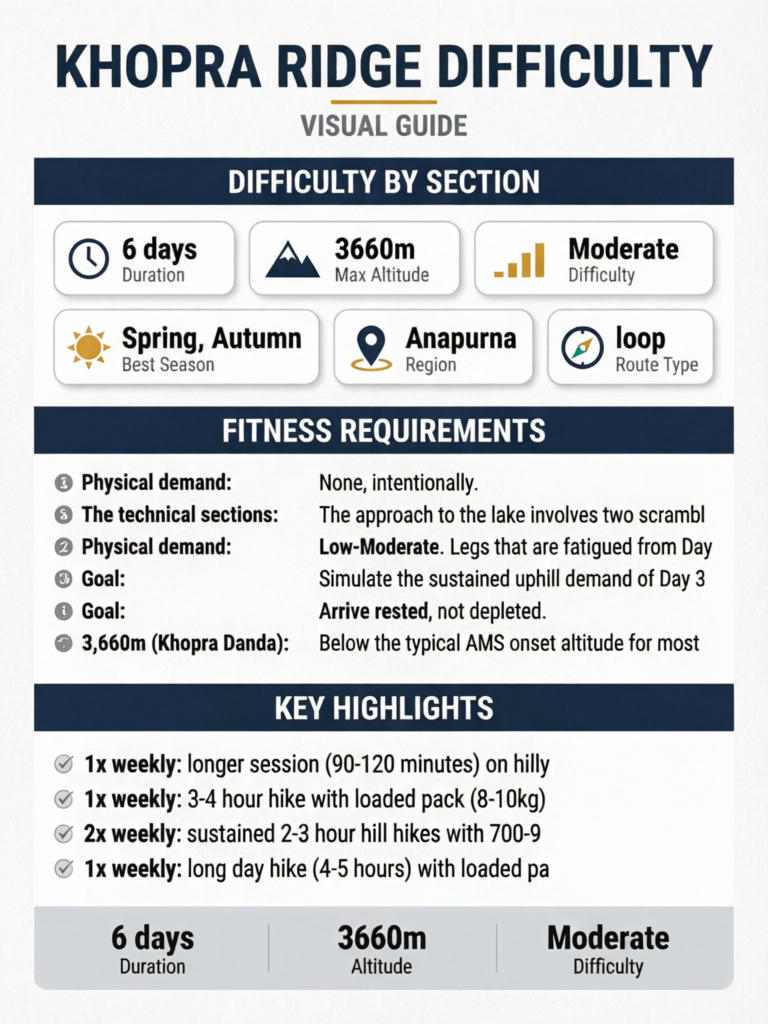
This Khopra Ridge difficulty assessment rates the trek Moderate — harder than Poon Hill, easier than Annapurna Base Camp. The rating reflects the Day 3 ascent to Khopra Danda (3,660m), which gains 1,460m in a single day, and the optional Khayer Lake extension, which adds a challenging 1,000m climb to 4,660m. The base route without Khayer Lake is well within most fit trekkers' capabilities.
Moderate
Day 3: Swanta to Khopra Danda (3,660m), 1,460m gain
Khayer Lake extension (1,000m gain, 4,660m)
Low (Khayer Lake trail is more challenging)
3,660m (Khopra Ridge)
4,660m (Khayer Lake)
Low at 3,660m; moderate at 4,660m
~95% (base route)
Difficulty by Section
Day 1: Pokhara to Ghorepani (Moderate)
The Ulleri staircase (Day 2 approach from Nayapul — if starting same day) involves a sustained steep climb. This is the same challenge as Poon Hill trekkers face — significant but manageable.
Day 2: Poon Hill sunrise, descent to Swanta (Easy-Moderate)
Light in terms of total elevation gain, but a long day. Poon Hill ascent is minimal (350m). Descent to Swanta (1,010m) is gentle on the cardiovascular system but requires care on steep downhill sections.
Day 3: Swanta to Khopra Danda (Hard for the day)
This is the defining day. 1,460m of elevation gain from 2,200m to 3,660m in one day. The standard daily safe altitude gain guideline (500m sleeping altitude above 3,000m) is technically exceeded on this single push. However:
- The approach spends several hours in the 2,200-3,000m zone before reaching the critical altitude
- Khopra Danda at 3,660m is below the AMS risk threshold for most fit trekkers
- The trail is well-defined and the gradient, while sustained, is not extreme
Who finds Day 3 difficult: Trekkers with limited hiking experience, those carrying heavy packs, people at low fitness levels, or anyone who has eaten or slept poorly on Days 1-2.
Strategy: Start early (7:00 AM from Swanta). Eat a good breakfast. Pace conservatively on the lower sections and don't rush the upper ridge.
Day 4: Khayer Lake Optional Extension (Moderate-Hard)
Khayer Lake (4,660m) is the trek's most challenging section. The ascent from Khopra Danda (3,660m) involves 1,000m of elevation gain on a trail that is steep and loose in places. The upper approach has some scrambling sections.
AMS risk: Significant — jumping from 3,660m sleep altitude to 4,660m day hike altitude is more than recommended. Most fit trekkers manage without symptoms, but altitude-sensitive individuals may experience headache or nausea.
Technical difficulty: The trail to Khayer Lake is more challenging than the standard Khopra route. It requires careful footing on loose terrain and is not recommended in wet, icy, or poor visibility conditions.
Skip the lake if: You have any AMS symptoms at Khopra, weather is poor, or you are not confident on steep, loose terrain.
Daily Trekking Hours and Trail Terrain
A large part of the Khopra Ridge difficulty is simply time on your feet. Most days run 5-7 hours of actual walking, with Day 3 (Swanta to Khopra Danda) and the optional Khayer Lake day stretching toward 7-8 hours including breaks. The total trek covers roughly 64km over six days.
Trail surface, day by day:
- Stone steps: The Ulleri staircase (Day 1) and the Ghorepani descent (Day 6) are built stone — even underfoot but punishing on knees over thousands of steps.
- Forest path: Days 1-2 wind through rhododendron and oak forest with roots, soft soil, and occasional mud.
- Open ridge: The upper Day 3 climb to Khopra Danda is exposed alpine ridge — firm but wind-blown, with no tree cover for shelter.
- Loose rock and scree: The Khayer Lake trail above 4,000m turns to loose scree with two short scrambling passages. This is the only genuinely technical terrain on the trek.
The trek is not technically difficult in the mountaineering sense — no ropes, fixed lines, or glacier travel on the base route. The challenge is sustained uphill effort, exposure on the ridge, and careful footing on the Khayer Lake extension.
How Season Changes the Difficulty
The same trail can feel like a different trek depending on when you go. For a full month-by-month breakdown see best time for Khopra Ridge.
- Autumn (Sep-Nov): The easiest conditions. Stable weather, dry trails, and clear Dhaulagiri views. The exposed ridge is comfortable; the Khayer Lake scramble is dry. Crowds are higher around Ghorepani but thin past Swanta.
- Spring (Mar-May): Comfortable temperatures and rhododendron blooms. Afternoon haze and occasional pre-monsoon storms can make the exposed Day 3 ridge harder; carry rain layers.
- Winter (Dec-Feb): Significantly harder. Snow on the upper ridge and the Khayer Lake trail makes Day 3 and the lake extension demanding; microspikes become essential and the lake is often impassable. Lodges at Khopra may be closed or minimally staffed.
- Monsoon (Jun-Aug): The most difficult and least recommended. Slippery forest descents, leeches below 3,000m, cloud-obscured views, and a real slip risk on the loose Khayer Lake terrain. Most trekkers should avoid it.
Mental and Emotional Demands
Khopra Ridge is as much a mental test as a physical one. Unlike the busy Poon Hill and Annapurna Base Camp trails, the route past Swanta is quiet and at times genuinely isolated — you may pass only a handful of other trekkers across Days 3-5. The exposed ridge, limited lodging, and distance from medical help mean motivation has to come from within, especially on the long Day 3 climb when the summit feels slow to arrive.
This isolation is part of the appeal, but be honest with yourself about it. Trekkers who thrive on the social energy of busier trails sometimes find the solitude harder than the elevation. A guide is valuable here not just for navigation but for steady pacing and morale on the harder days.
Fitness Requirements
Minimum for Base Route (No Khayer Lake)
- Walk 4-5 hours daily with light pack without significant fatigue
- Climb 500-600m of elevation gain in a session
- Day 3's 1,460m gain is achievable but demands fitness preparation
Recommended for Khayer Lake Extension
- Comfortable hiking 5-6 hours daily
- Previous experience at 4,000m+
- No altitude sensitivity issues
- Good physical conditioning
Comparison Table
| Trek | Duration | Max Alt | Day 3 Gain | AMS Risk | Overall |
|---|---|---|---|---|---|
| Poon Hill | 4-5 days | 3,210m | ~400m | Low | Easy |
| Khopra Ridge | 6 days | 3,660m | 1,460m | Low | Moderate |
| ABC | 11 days | 4,130m | ~920m | Low-Moderate | Moderate |
| Mardi Himal | 7 days | 4,500m | ~595m | Low-Moderate | Moderate |
For deeper comparisons, see the Annapurna Base Camp difficulty assessment and the Mardi Himal difficulty assessment. If you are weighing the full Khopra trip, the Khopra Ridge 6-day itinerary lays out the day-by-day logistics.
Common Difficulties and Solutions
| Problem | Day | Solution |
|---|---|---|
| Fatigue on Ulleri steps | Day 1 | Slow pace; multiple rest stops |
| Altitude headache at Khopra | Day 3 | Ibuprofen; extra hydration; rest |
| Knee pain on descents | Days 2, 5, 6 | Trekking poles; anti-inflammatories |
| AMS at Khayer Lake | Day 4 | Descend immediately if severe; skip lake |
| Getting lost near Khopra junction | Day 2 | Guide strongly recommended; check with Ghorepani locals |
Complete Day-by-Day Breakdown (All 6 Days)
Beyond the broad strokes above, here is what each day of the full itinerary actually feels like underfoot.
Day 1: Pokhara (820m) to Ghorepani (2,860m) — Distance: 13km, Gain: 2,040m
From the trailhead (Nayapul, 1,070m): The first 2 hours are flat-to-gradual along the Modi Khola riverbank. Pleasant, warm, easy walking. Then Ulleri arrives.
The Ulleri staircase is 3,280 stone steps ascending 500m in roughly 90 minutes. Every Ghorepani trekker faces it. At sea level fitness, expect to stop every 10-12 minutes. The steps are well-built and even, so the challenge is purely cardiovascular, not technical. Most first-timers underestimate this section.
Beyond Ulleri, the gradient eases through rhododendron and oak forest (Banthanti, 2,250m) before a moderate ascent to Ghorepani at 2,860m. Total elevation gain for Day 1 is substantial — 2,040m from Nayapul — but spread over 6-7 hours of walking.
Physical demand: Cardiovascular, sustained. The Ulleri section separates prepared trekkers from underprepared ones quickly.
What makes it manageable: You're at low altitude where fitness matters more than acclimatization. Slow pace and multiple breaks solve the problem for almost everyone.
Day 2: Ghorepani to Poon Hill (3,210m) sunrise, then to Swanta (2,200m) — Distance: 16km, Net loss: 660m
The 4:30 AM pre-dawn start for Poon Hill is cold but brief — a 45-minute climb of 350m to the viewpoint tower. This is the day's easiest challenge. The Annapurna sunrise panorama from Poon Hill is legitimate; don't skip it.
After returning to Ghorepani for breakfast, the day changes character. The trail toward Swanta leaves the main Poon Hill route at Deurali and descends into less-traveled forest. There are several route junctions where the signage is inconsistent — this is where guides earn their keep. The descent to Swanta involves steep sections through forest, requiring careful footwork on roots and loose stones.
Physical demand: Light on cardiovascular load. The 1,010m descent to Swanta is gentle on lungs but creates knee fatigue, particularly for trekkers not using poles.
Knee management: Use poles on the descent. Tighten pole straps so the poles can absorb downhill impact rather than just providing balance.
Day 3: Swanta (2,200m) to Khopra Danda (3,660m) — Distance: 12km, Gain: 1,460m
The crux of the trek. Start no later than 7:00 AM — ideally 6:30 AM with a packed breakfast or very early lodge meal. The temperature is cold at departure but the first 90 minutes through forest at the lower elevations is comfortable. By 10:00 AM the trail emerges into open rhododendron terrain with improving views.
The final 2-3 hours of the climb, from roughly 3,000m to Khopra Danda at 3,660m, are fully exposed on the ridge. Wind can be a factor — have a wind layer accessible. The views of Dhaulagiri begin appearing at around 3,200m and expand dramatically as you gain the ridge. Most trekkers find the scenery sustaining on the final push.
Physical demand: The hardest day on the trek. Sustained cardiovascular effort for 5-7 hours. The gain is nearly triple an ideal acclimatization day's recommended altitude increase. Most healthy trekkers complete it without AMS — the 3,660m endpoint is below the typical AMS onset threshold — but the fatigue is real.
Why it works despite the gain: The first 4-5 hours of walking are below 3,000m, where the body is not under significant altitude stress. The rapid gain happens in the final 2 hours above 3,000m, and you're stopping at 3,660m rather than pushing higher. The key is arriving early enough to rest and hydrate before sunset.
Day 4 Option A: Rest Day at Khopra Danda (3,660m)
For trekkers following the standard 6-day itinerary without the Khayer Lake extension, Day 4 at Khopra Danda is a rest and views day. You've earned it. Wander the ridge. The Dhaulagiri (8,167m) face is the dominant view — closer and more imposing than from any other standard trekking point in Nepal. Annapurna South appears to the east. On clear mornings, the 360° panorama is extraordinary.
Physical demand: None, intentionally.
Day 4 Option B: Khayer Lake Extension (3,660m to 4,660m) — Distance: 16km round trip, Gain: 1,000m
This is a full, hard day. Departure by 6:00 AM from Khopra Danda. The trail climbs through increasingly rocky terrain above the treeline. The first 400m of gain is on a reasonable trail; the upper 600m narrows and steepens.
The technical sections: The approach to the lake involves two scrambling passages — not exposed climbing, but requiring hands-on-rock movement for 5-10 minutes each. These are challenging in wet or icy conditions. They are manageable for any fit, confident trekker in dry autumn conditions.
At 4,660m: The lake itself sits in a glacially carved bowl surrounded by cliffs. The religious significance (sacred to both Hindu and Buddhist traditions) is immediately apparent. The atmosphere at altitude — thin air, high silence, dramatic rock faces — is unlike anything on the lower route.
The descent: Knees again. The steep descent back to Khopra Danda requires careful attention. Rushing the descent is how ankle injuries happen on this section.
Physical demand: High. More demanding than Day 3 in terms of technical attention required, though shorter in total hours. Altitude effect at 4,660m means exertion feels significantly harder than equivalent output at 3,000m.
Day 5: Khopra Danda (3,660m) to Ghorepani (2,860m) — Distance: 10km, Loss: 800m
A recovery day in terms of physical demand. The descending ridge walk back toward Ghorepani offers reversed views — now looking back at Khopra Danda from below. The 800m descent takes 4-5 hours, giving ample time for lunch in Bayeli and an afternoon arrival at Ghorepani.
Physical demand: Low-Moderate. Legs that are fatigued from Days 3 and 4 will feel the sustained descent. Poles are useful.
Day 6: Ghorepani (2,860m) to Pokhara via Nayapul — Distance: 13km descent, Loss: 1,790m
The final day mirrors Day 1 in reverse — with worse consequences for knees. The descent from Ghorepani through Ulleri and back to Nayapul is 1,790m of downhill. After 5 days of cumulative fatigue, this is harder than it sounds. Trekkers with pre-existing knee problems often report Day 6 as the most uncomfortable day of the entire trek.
Physical demand: Knees and hip flexors. Low cardiovascular load but high joint stress.
Mitigation: Anti-inflammatory medication (ibuprofen) the night before is reasonable. Poles on all downhill sections. Slow, deliberate foot placement on the Ulleri steps — rushing them increases the risk of a slip.
Training Recommendations: 4-8 Week Pre-Trek Plan
The Day 3 climb of 1,460m is the gating challenge. Training specifically for sustained uphill effort is more valuable than general gym fitness.
Weeks 1-2: Foundation
Goal: Establish a cardio base and get the legs used to sustained hiking.
- 3x weekly: 45-60 minute brisk walks or hikes with 200-400m elevation gain
- 1x weekly: longer session (90-120 minutes) on hilly terrain
- If using trekking poles, practice with them during training — technique matters
- Begin wearing your trekking boots during training (critical for break-in)
Weeks 3-4: Build Intensity
Goal: Simulate the sustained uphill demand of Day 3.
- 3x weekly: stair climbing sessions (30-45 minutes) or hilly hikes with 400-600m gain
- 1x weekly: 3-4 hour hike with loaded pack (8-10kg)
- Focus on maintaining a sustainable pace — the goal is to hike for hours, not to spike heart rate briefly
- Add squats and lunges for quad and glute strength (critical for both uphill and descent)
Weeks 5-6: Peak Training
Goal: Build confidence for the full-day effort of Day 3 and the optional lake day.
- 2x weekly: sustained 2-3 hour hill hikes with 700-900m gain
- 1x weekly: long day hike (4-5 hours) with loaded pack
- Practice early-morning starts (6:30-7:00 AM departures mirror actual trek conditions)
- Reduce pack weight toward actual target — don't train heavy and hike light
Weeks 7-8: Taper
Goal: Arrive rested, not depleted.
- Reduce volume by 40%
- Maintain one weekly moderate hike to keep legs active
- Focus on sleep quality and hydration
- Finalize gear and break in boots completely
Minimum fitness benchmark: If you can comfortably complete a 3-hour hike with 800m of gain and arrive feeling tired but functional, you're ready for the Khopra Ridge base route.
Altitude Sickness on Khopra Ridge
Altitude sickness (Acute Mountain Sickness, AMS) is less of a concern on Khopra Ridge than on Everest or Annapurna Circuit, but it is not zero — particularly at Khopra Danda (3,660m) and especially at Khayer Lake (4,660m).
Understanding the Altitude Thresholds
3,000m: Where altitude physiology begins to matter. Breathing becomes slightly more labored. Sleep quality often decreases. Most fit individuals feel fine but notice they're working harder.
3,660m (Khopra Danda): Below the typical AMS onset altitude for most trekkers, but the rapid gain on Day 3 means the body hasn't had time to acclimatize properly. Some trekkers experience mild symptoms — headache, disturbed sleep, reduced appetite.
4,660m (Khayer Lake): Significantly higher. Above 4,000m, AMS risk is meaningfully elevated. The single-day excursion from 3,660m to 4,660m and back does not allow overnight acclimatization — you're pushing above your sleeping altitude, which is the most common trigger for AMS.
Symptoms Specific to This Route
At Khopra Danda (3,660m), watch for:
- Headache that doesn't resolve with ibuprofen and hydration
- Nausea without an obvious food-poisoning cause
- Unusual fatigue — more than expected from the day's exertion
- Poor sleep quality with periodic waking (very common at this altitude; alone is not alarming)
At Khayer Lake (4,660m), watch for:
- Increasing headache during ascent (mild headache is normal; worsening headache is a warning sign)
- Loss of coordination (Ataxia — a serious sign, descend immediately)
- Breathlessness at rest (normal to be breathless when moving, not when sitting)
- Confusion or unusual behavior (another serious sign requiring immediate descent)
Prevention
Hydration: Drink 3-4 liters of water daily on the trek. Dehydration worsens altitude symptoms. Avoid alcohol at altitude (alcohol worsens hypoxia and disrupts sleep).
Pace: Day 3's rapid gain is the main acclimatization challenge. Start slowly — the temptation to make good time early usually results in blowing up before the ridge. The guideline "climb high, sleep low" doesn't apply here (you sleep at Khopra), so the only mitigation is pace management.
Diamox (Acetazolamide): The standard prophylactic medication for AMS. Common dosing: 125-250mg twice daily, starting 24 hours before major altitude gain. Consult your physician before departure — Diamox is a sulfonamide and is contraindicated for sulfa allergy. It causes increased urination (manageable) and tingling in extremities (common, not dangerous). For full dosing detail, see the Diamox altitude sickness guide and the broader altitude sickness prevention and treatment guide.
Ibuprofen: 400-600mg for altitude headache at Khopra. Ibuprofen is effective for mild AMS headache and is safer for altitude use than acetaminophen alone. Do not use to mask symptoms while pushing higher.
Treatment
Mild AMS at Khopra (3,660m): Rest the following day. Drink water. Ibuprofen for headache. Do not ascend to Khayer Lake until symptoms fully resolve.
Moderate AMS at Khopra: Descend 500-1,000m. Do not attempt to sleep through worsening symptoms. Descent is the only reliable treatment.
Severe AMS or HACE/HAPE: Descend immediately. Contact your guide and the Kathmandu agency emergency line. Helicopter evacuation from the Khopra region is possible but requires clear weather — this is why insurance matters.
The Golden Rule of Altitude
Never ascend to the next sleeping altitude if you have AMS symptoms. This rule applies to the Khayer Lake day trip — if you have a headache at Khopra Danda, do not attempt the lake. One day of patience saves you from a potential evacuation. The Himalayan Rescue Association emergency clinic in Jomsom is 3+ hours away from the Khopra area.
Gear Requirements by Difficulty Level
The right gear makes the difficult sections manageable. This is specifically calibrated for Khopra Ridge.
Essential for All Trekkers (Base Route)
| Item | Why It Matters on Khopra Ridge |
|---|---|
| Trekking poles | Day 1 Ulleri ascent, Day 3 ridge climb, Day 6 descent — all significantly easier with poles |
| Mid-ankle trekking boots (broken in) | Day 3's loose trail sections require ankle support; don't use trail runners for this route |
| Down jacket | Khopra Danda evenings reach -5°C in autumn; temperatures drop further in winter |
| Sleeping bag (-10°C rated) | Community lodge blankets are inadequate at altitude in cold months |
| Headlamp | 6:00 AM pre-dawn starts on Day 1 and Poon Hill |
| Water purification (tablets or filter) | Lodge water should be purified; carry 2L capacity minimum |
| Rain layers | Afternoon rain is possible even in dry season; mandatory in shoulder months |
Additional for Khayer Lake Extension
| Item | Why It's Needed |
|---|---|
| Microspikes or crampons (Oct-Nov) | Upper Khayer Lake trail can have ice and snow; required Nov-Feb |
| Gaiters | Snow and loose scree on upper trail |
| Warm gloves (not liner gloves) | Wind chill at 4,660m is significant; thin gloves are inadequate |
| Sun protection (high SPF) | UV intensity at 4,660m is extreme; reflection off snow amplifies it |
| Emergency bivy or space blanket | If weather changes suddenly above 4,000m, you need a plan |
Who Should and Should Not Do This Trek
Well-Suited For
Intermediate hikers ready for a step up from Poon Hill. If you've done Poon Hill or a similar 4-5 day trek and want a more demanding experience, Khopra Ridge is the logical next step. The route covers terrain that is definitively harder than Poon Hill without requiring the commitment of an 11-day ABC trek.
Experienced trekkers who want off-the-beaten-path atmosphere. Once you leave Ghorepani toward Swanta on Day 2, the trail population drops sharply. Days 3-5 often involve crossing other parties only occasionally — a different experience than the continuous parade on ABC approach trails.
Trekkers interested in community-based tourism. The community lodge system on this route is one of the best-functioning examples in Nepal. Your trekking fees directly fund the communities you're passing through. See the Khopra Ridge cost breakdown for the financial structure.
Photography-focused trekkers. The Dhaulagiri north face view from Khopra Danda is arguably the most dramatic view per effort ratio of any standard Nepal trek. No helicopter, no technical climbing — just a moderate 6-day walk for a view that rivals high-altitude expedition camps.
Not Well-Suited For
Complete beginners with no hiking background. Day 3's 1,460m gain will overwhelm a trekker who has never done sustained uphill hiking. Poon Hill (using a jeep to Ghorepani) is a better starting point.
Anyone with current cardiac, respiratory, or orthopedic conditions. The altitude and daily elevation gains put stress on cardiovascular and musculoskeletal systems. Clear medical clearance from your doctor is required, not optional.
Altitude-sensitive individuals doing Khayer Lake. If you have a history of AMS at altitudes above 3,500m, Khayer Lake at 4,660m carries real risk. The base Khopra route at 3,660m may still be feasible with careful pacing.
Trekkers unwilling to turn back. The most dangerous trekkers are those who push through worsening symptoms. If you know from experience that you tend to ignore pain signals or compete with other trekkers, this is a risk factor. A guide with authority to insist on descent is valuable for this personality type.