
Best Time for the Khopra Ridge Trek
The best time for the Khopra Ridge trek is October and April. October delivers the clearest post-monsoon skies and the sharpest Dhaulagiri views, while April adds peak rhododendron blooms along the lower trail. November is an excellent, quieter alternative; June to August (monsoon) should be avoided.
The Khopra Ridge shares the Annapurna region's broad seasonal pattern — autumn and spring are the prime seasons — but has unique characteristics driven by its ridge position and the Khayer Lake extension. The exposed Dhaulagiri-facing ridge at Khopra Danda (3,660m) catches different weather patterns than the sheltered Annapurna sanctuary, and its 360-degree ridge vantage over Dhaulagiri, Annapurna South, Nilgiri and Machhapuchhre rewards trekkers who time the Khopra Ridge trek for clear-sky months. If you are still choosing a route, see how it stacks up against the ABC trek and the broader best time to trek the Annapurna region.
October, April, November
Late March to mid-April
October, November (post-monsoon clarity)
October, April (stable weather for high route)
June-August (monsoon)
November (low crowds, good views)
Autumn (September-November)
October: Best Overall
Post-monsoon clarity, stable high-pressure systems, and the best long-distance views. From Khopra Danda, Dhaulagiri's towering north face fills the western skyline with crystal clarity. Views extend to Nilgiri and Annapurna South simultaneously.
Khayer Lake: October is the best month for the Khayer Lake extension. Stable weather, low chance of snow on the upper trail, excellent visibility at 4,660m.
Crowds: Lower than ABC or Poon Hill, but Ghorepani sees peak traffic. Once past Ghorepani to Swanta, you'll often be alone.
November: Excellent Second Choice
Still outstanding weather with fewer crowds than October. Temperatures drop at Khopra Danda — cold nights (-8°C to -12°C). Views remain excellent. Mountain clarity sometimes even better than October as the air becomes crisper.
Khayer Lake in November: Possible but requires awareness — early snowfall can make the upper trail treacherous. Check conditions at Khopra Danda before ascending.
Spring (March-May)
April: Rhododendron Spectacular
The trail from Nayapul to Ghorepani and from Ghorepani toward Swanta passes through some of the Annapurna region's most spectacular rhododendron forests. April brings the peak bloom — crimson, pink, and white flowers covering the entire hillside from 1,500-3,000m. Combined with mountain views that remain reasonably clear before monsoon clouds build, April is arguably the most beautiful month aesthetically.
Khayer Lake in April: Good conditions. Occasional snow possible but usually manageable. Assess conditions at Khopra Danda before committing to the lake.
March: Variable but Good
Later March (after the 15th) is generally reliable. Early rhododendron blooms at lower elevations. Views variable — some outstanding days, some cloud.
May: Late Spring
Warm, occasional afternoon thunderstorms. Remaining blooms at higher elevations. Good in mornings; clouds typical after noon.
Winter (December-February)
Cold but clear. Khopra Danda at 3,660m can have temperatures of -15°C at night. Khayer Lake is usually snow-covered and treacherous in January-February — avoid the extension in these months unless conditions are specifically confirmed favorable.
Best for: Experienced cold-weather trekkers who want near-empty trails and dramatic winter mountain scenery.
Monsoon (June-August): Avoid
Heavy rain, leeches, and cloud-obscured views. The Dhaulagiri face that makes Khopra unique is invisible for weeks at a time. Not recommended.
Seasonal Summary
| Month | Views | Flowers | Khayer Lake | Crowds | Overall |
|---|---|---|---|---|---|
| January | Good | None | Avoid | Very low | ★★★ |
| February | Good | None | Avoid | Very low | ★★★ |
| March | Variable | Beginning | Possible | Low | ★★★★ |
| April | Good | Peak | Good | Low-Med | ★★★★★ |
| May | Variable | Fading | Good | Low | ★★★ |
| June | Poor | None | Risky | Very low | ★ |
| July | Poor | None | Avoid | Very low | ★ |
| August | Poor | None | Avoid | Very low | ★ |
| September | Good | None | Good | Medium | ★★★★ |
| October | Best | None | Best | Medium | ★★★★★ |
| November | Very Good | None | Possible | Low | ★★★★★ |
| December | Good | None | Risky | Very low | ★★★ |
Month-by-Month Detailed Breakdown
The broad seasonal picture above does not capture the granular variations within each month. Here is what each month actually looks like at Khopra Danda elevation (3,660m) based on historical patterns and lodge manager reports.
January
January is the coldest month at Khopra Danda. Night temperatures typically drop to -12°C to -18°C at the ridge. Daytime temperatures above the ridge reach 5-10°C in sun but drop sharply in wind and shadow. The trail from Nayapul to Ghorepani is passable in good conditions; above Ghorepani the trail may have compacted snow from December snowfall.
Trail conditions: Ice is possible on shaded north-facing sections above 2,500m. Microspikes are useful from Swanta upward.
Lodge availability: Ghorepani lodges are open. Swanta community lodge is usually open with reduced menu. Khopra Danda community lodges may operate with 1-2 staff only — confirm with your agency before January travel.
Photography: January's still, cold air produces extraordinary sharpness. Zero atmospheric haze. The light is low-angle and golden. Sunrise on Dhaulagiri from Khopra in January is among the best photographic opportunities on the route.
Recommendation: Fine for experienced cold-weather trekkers with proper winter gear (-20°C sleeping bag, full down outerwear). Skip Khayer Lake.
February
Similar to January but with slightly warming days. Early-February conditions match January. Late February (after the 20th) sees the first hints of warming — not rhododendrons yet, but the deep freeze is breaking.
Permit note: February sees very few trekkers. ACAP permit offices in Pokhara are open and uncrowded. Permits take 15-20 minutes to obtain.
Views: Reliably excellent. The pre-monsoon haze hasn't arrived yet. Dhaulagiri clarity is outstanding.
Trail ice: More likely in February than March due to accumulated snowpack. The upper Khayer Lake trail is inaccessible without mountaineering gear in most February years.
Recommendation: Good for confident cold-weather trekkers. Avoid Khayer Lake. Budget accommodation costs are lower (some lodges offer discounts in low season). See the cost breakdown for seasonal price variations.
March
March is the transition month. Early March (weeks 1-2) can still be cold with lingering snow at altitude. Late March (weeks 3-4) sees rapid warming and the first rhododendrons blooming at 1,500-2,000m on the approach trail.
Rhododendrons: The lower elevations (Nayapul to Ulleri) see early blooms from mid-March. Peak bloom at 2,500-3,000m — the stretch from Ghorepani toward Deurali — typically arrives in late March at the earliest, more often April.
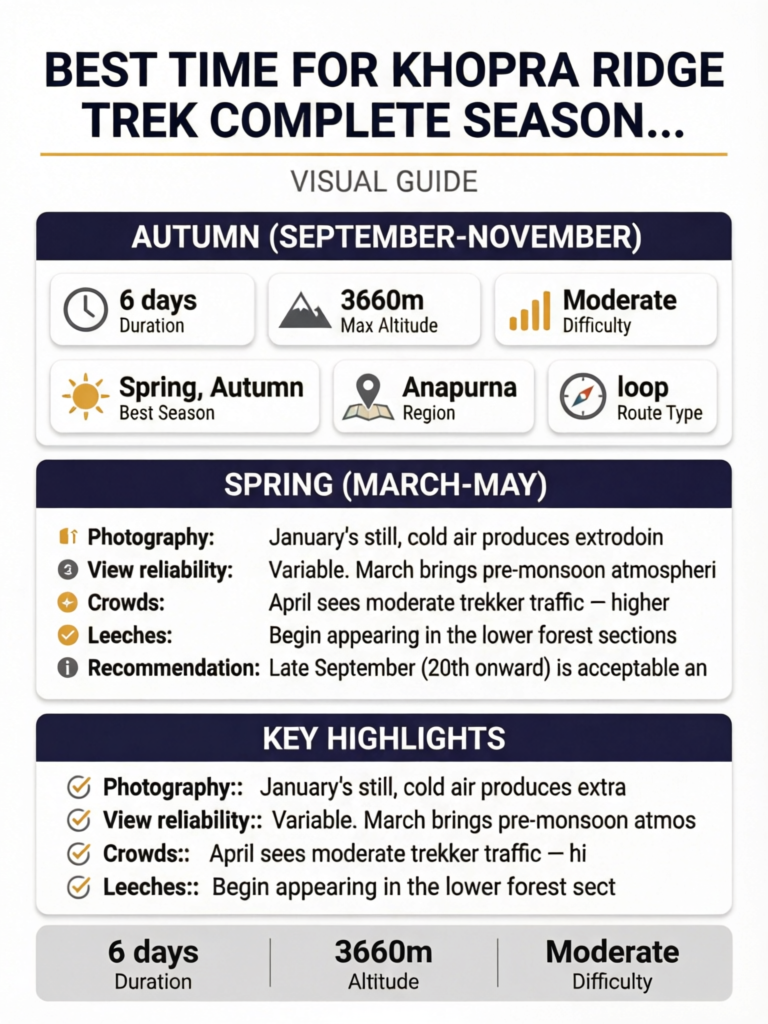
View reliability: Variable. March brings pre-monsoon atmospheric instability. Some weeks produce exceptional clarity; others feature a persistent whitish haze that softens distant peaks. The Dhaulagiri views from Khopra are less sharp in March than October-November.
Khayer Lake: Possible in late March if winter snowpack has cleared. Check with community lodge managers at Khopra Danda — they will know current upper trail conditions.
Recommendation: Good, especially for the lower trail experience. Weather gamble compared to April. Book flexible itineraries with rest-day buffer in case of poor conditions.
April
April is co-equal with October as the best month for Khopra Ridge, with a different character. The dominant experience is color — the rhododendron bloom at 2,000-3,000m coincides with clear morning skies and comfortable daytime temperatures of 12-18°C at Khopra Danda.
Rhododendron peak: Mid-April is the peak bloom window at Khopra Ridge elevations. The trail from Ghorepani to Swanta passes through crimson Rhododendron arboreum forests that are visually extraordinary. This bloom is specifically why April rivals October for overall experience.
Morning clarity: April mornings before 9:00 AM offer reliably clear views. By 11:00 AM-noon, cumulus clouds begin building over the high peaks. Dhaulagiri clarity in April mornings approaches October quality. Afternoons are cloudier.
Temperatures: Comfortable for walking. No ice concerns above 3,000m in most April years. Nights at Khopra Danda are cold (-2°C to -5°C) but manageable with a proper sleeping bag.
Khayer Lake: April is the second-best month for Khayer Lake after October. Snow from winter has typically cleared by early April. Stable morning windows for the ascent and descent before afternoon clouds arrive.
Crowds: April sees moderate trekker traffic — higher than November, lower than October. The Khopra portion of the route is quiet even in April because the split from the Poon Hill route reduces foot traffic sharply.
Recommendation: Strongly recommended, particularly for trekkers who prioritize aesthetic beauty (flowers + mountains) over pure clarity.
May
May is late spring, warm and variable. The rhododendrons are past peak at most elevations (some remaining blooms above 3,000m into May). View windows are shorter — morning clarity before 8:00-9:00 AM is reliable; afternoon clouds are standard.
Trail conditions: Warm and comfortable at lower elevations. Upper ridge at Khopra can still be cool in early morning. No ice concerns.
Leeches: Begin appearing in the lower forest sections (below 1,800m) from mid-May onward. Not dangerous but unpleasant. Pack salt or leech socks if trekking in late May.
Khayer Lake: Good conditions in early May. Late May sees increasing instability and occasional afternoon thunderstorms at high altitude that make the exposed Khayer Lake approach risky.
Recommendation: Fine for early May. Second half of May, consider shifting to the autumn season if schedule allows.
June, July, August: Monsoon Season
The Southwest Monsoon arrives in Nepal typically in the first week of June and retreats in mid-September. During monsoon, rainfall at Khopra Ridge region averages 300-500mm per month. The Dhaulagiri face — the defining feature of the route — is cloud-obscured for the majority of days. Trail conditions deteriorate. Leeches are present throughout the forest sections.
The specific problem for Khopra: Unlike some protected valleys that maintain clear windows during monsoon (Mustang, upper Kali Gandaki), Khopra Ridge is fully exposed to monsoon weather from both south and west. There is no effective rain shadow here. The views that make the trek worthwhile are simply not available for extended periods.
Exception: Experienced trekkers who specifically want monsoon forest photography (lush greenery, waterfalls, dramatic cloud formations) can find value in late June or early September, targeting clear windows between rain spells. But this is not recommended for first-timers.
Leeches: Common throughout the lower forest sections from June through late September. Brown land leeches are found on vegetation and trail surfaces. They are harmless but distressing for many trekkers. If monsoon trekking is unavoidable, leech socks (thin nylon socks worn over regular socks and tucked into gaiters) prevent most attachment.
September
September is the monsoon tail. Early September (weeks 1-2) is still monsoon-influenced with frequent rain and poor visibility. Late September (weeks 3-4) sees the monsoon retreating — clearer windows, drying trails, reducing leeches.
The post-monsoon transition: The first post-monsoon clarity days (typically late September) are often extraordinary — the trail vegetation is intensely green from months of rain, and the first clear mountain views after the grey season have an emotional impact that's hard to replicate in October when the views are normal.
Risk: Weather in September is less predictable than October. A week of late monsoon can disrupt itineraries. Build a 1-2 day buffer into September itineraries.
Khayer Lake in September: Possible in late September if trail conditions are clear. Early September is too risky.
Recommendation: Late September (20th onward) is acceptable and increasingly popular for its off-peak pricing and the post-monsoon green landscape.
October
October is the peak month for clarity and stability. High-pressure systems dominate the Annapurna region through most of October. Dhaulagiri views from Khopra Danda are at their sharpest. The air carries none of the pre-monsoon haze or monsoon moisture.
Ghorepani crowds: October is peak season for the Poon Hill circuit — Ghorepani can be packed. The split to Swanta on Day 2 provides immediate separation from the main crowd.
Khayer Lake: The single best month for Khayer Lake. Stable weather, reliable morning clarity, no snow on the upper trail, firm footing throughout.
Temperature: October is comfortable — daytime 10-15°C at Khopra Danda, nights -3°C to -8°C. Not extreme cold, not warm. Ideal for sustained hiking.
Recommendation: Book 3 months in advance for October treks. Peak demand with peak conditions.
November
November offers the best balance of views, temperatures, crowds, and cost. Views are very good (sometimes better than October as air becomes drier). Crowds on the Poon Hill circuit drop noticeably. Agencies begin offering light off-season discounts.
Cold: The main consideration. Nights at Khopra Danda in November drop to -8°C to -15°C. A proper sleeping bag (-10°C to -15°C rated) is essential. Some trekkers underestimate November cold and regret it.
Lodge availability: All lodges open, but some reduce menu options in late November.
Khayer Lake: Possible in early November. Snowfall becomes increasingly likely from mid-November. Check conditions at Khopra Danda specifically before attempting the extension in November.
Recommendation: Excellent choice, particularly for trekkers flexible on dates and willing to pack for cold. Less competition for lodges and guides than October.
December
December is cold winter trekking. Temperatures at Khopra Danda regularly reach -15°C to -18°C at night. The views are consistently excellent (cold, clear air). Very few trekkers on the route.
Gear requirement: -20°C sleeping bag. Full down outerwear. Balaclava, vapor barrier liners. This is serious cold-weather territory.
Lodge situation: Some smaller lodges may close or operate with skeleton staff. Confirm with your agency that Swanta and Khopra Danda lodges are operational before a December booking.
Khayer Lake in December: High risk. Winter snowpack builds from early December. The upper trail is icy and the exposed scrambling sections are dangerous without technical mountaineering equipment. Skip the extension in December.
Recommendation: For experienced cold-weather trekkers who prefer solitude and don't mind cold. Everyone else: choose October, November, or April.
Temperature Data by Month at Khopra Danda (3,660m)
These temperatures are based on historical altitude-adjusted Nepal Department of Meteorology data and community lodge operator reports. Individual days can vary significantly from averages.
| Month | Avg Daytime High | Avg Nighttime Low | Extreme Low Recorded | Rain/Snow |
|---|---|---|---|---|
| January | 4°C (39°F) | -14°C (7°F) | -22°C (-8°F) | Occasional snow |
| February | 6°C (43°F) | -12°C (10°F) | -18°C (0°F) | Occasional snow |
| March | 10°C (50°F) | -6°C (21°F) | -14°C (7°F) | Rare |
| April | 14°C (57°F) | -2°C (28°F) | -8°C (18°F) | Rare |
| May | 16°C (61°F) | 3°C (37°F) | -2°C (28°F) | Occasional rain |
| June | 15°C (59°F) | 8°C (46°F) | 2°C (36°F) | Heavy rain |
| July | 14°C (57°F) | 9°C (48°F) | 4°C (39°F) | Very heavy rain |
| August | 14°C (57°F) | 9°C (48°F) | 4°C (39°F) | Very heavy rain |
| September | 13°C (55°F) | 5°C (41°F) | 0°C (32°F) | Moderate rain |
| October | 11°C (52°F) | -3°C (27°F) | -10°C (14°F) | Rare |
| November | 7°C (45°F) | -10°C (14°F) | -18°C (0°F) | Occasional snow |
| December | 4°C (39°F) | -14°C (7°F) | -22°C (-8°F) | Occasional snow |
Note on wind chill: Khopra Danda is an exposed ridge. Wind frequently adds a felt-temperature reduction of 5-10°C below the values above. The October reading of -3°C nighttime can feel like -10°C or colder in wind. Factor this into sleeping bag selection.
Precipitation Data
Rainfall at Khopra Danda (3,660m elevation data, approximated from regional meteorological stations):
| Month | Avg Monthly Precipitation | Rainy Days | Notes |
|---|---|---|---|
| January | 15mm | 2-3 days | Light snow possible |
| February | 20mm | 3-4 days | Light snow possible |
| March | 30mm | 4-5 days | Rain below 3,000m |
| April | 45mm | 6-7 days | Afternoon showers |
| May | 90mm | 10-12 days | Pre-monsoon instability |
| June | 280mm | 18-22 days | Monsoon onset |
| July | 380mm | 22-26 days | Peak monsoon |
| August | 350mm | 21-25 days | Peak monsoon |
| September | 180mm | 14-18 days | Monsoon retreat |
| October | 30mm | 3-4 days | Mostly clear |
| November | 15mm | 2-3 days | Very dry |
| December | 12mm | 2-3 days | Light snow possible |
Afternoon Weather Pattern
On Khopra Ridge, the standard mountain weather pattern applies: mornings are clearer than afternoons. Cloud formation typically begins at 10:00-11:00 AM from valley mist and increases through the afternoon. Plan summit views and ridge walks for before 9:00 AM. The Poon Hill sunrise visit on Day 2 aligns with this pattern perfectly. At Khopra Danda, sunset views on the Dhaulagiri face are often outstanding as afternoon clouds dissolve before dusk.
Photography Conditions by Season
Khopra Ridge's photographic appeal centers on the Dhaulagiri north face — a wall of ice and rock rising 8,167m above sea level, viewed from the ridge at roughly 12km horizontal distance. The photography conditions vary dramatically by season.
October: Peak Clarity, Contrasty Light
October's post-monsoon atmosphere is the clearest of the year. Visibility at Khopra Danda can extend 200-300km. The Dhaulagiri massif appears sharp and three-dimensional with no atmospheric softening. Midday light is harsh (typical for high altitude), making golden hour (6:00-8:00 AM and 5:00-7:00 PM) the primary shooting window.
Best shots: Sunrise alpenglow on Dhaulagiri from the east-facing Khopra ridge. The face turns pink-red at first light in a sequence that changes quickly — be on the ridge 30 minutes before sunrise. Dhaulagiri's north face is west-facing, meaning afternoon light catches it and creates dramatic shadow play. Evening light in October is excellent for Dhaulagiri.
April: Flowers Plus Mountains
April's photographic advantage is compositional: rhododendron flowers in foreground with mountain peaks behind. This combination — peak-season blooms at 2,500-3,000m with remaining mountain clarity — is not replicable at any other time of year. The bloom window is approximately April 5-20 at peak elevations.
Best shots: Forest rhododendron compositions on the Ghorepani-Deurali section (Day 2) with mountain backdrop. Textured cloud formations over Annapurna South in afternoon (clouds are more photogenic than blank blue sky for landscape depth). Sunrise on Poon Hill in April catches early blooms and mountain alpenglow simultaneously.
November: Crystal Air, Cold Colors
November's air is the driest of the year. Zero haze. The cold temperatures and low sun angle produce a characteristic light quality — colder, more blue-toned than October, but extraordinarily sharp. Long-distance views extend further than October in many November years.
Best shots: Wide-angle full panoramas from Khopra Danda ridge. The reduced crowds mean you can set up tripods and wait for light without obstruction. Star photography at Khopra Danda in November is exceptional — the cold, dry air at 3,660m with minimal light pollution produces outstanding Milky Way conditions.
January-February: Winter Light
Low-angle winter sun at high latitudes produces long golden-hour windows. The snow-dusted peaks and occasional frost crystals on vegetation create winter landscape conditions not available in other seasons. For photographers willing to handle cold (-15°C at night), winter offers unique images.
Best shots: Frost patterns on lodge windows at dawn. Footprints in snow on the upper trail with mountain backdrop. The winter-specific blue-grey light quality in early morning is unique to this season.
Monsoon: Creative Possibilities
The monsoon is not for mountain photography (clouds win). But for forest photography, waterfalls, and dramatic cloud formations, June-September offers conditions unavailable in dry season. The lower trail (Nayapul to Ulleri) transforms with rushing streams and intensely green vegetation.
Best shots: Long-exposure waterfall photography on the lower approach trail. Dramatic cloud formation sequences over the ridge (when rain pauses). Lush green forest floor compositions.
Sunrise vs. Sunset at Khopra
Khopra Danda's ridge runs roughly north-south, with Dhaulagiri to the west. This means Dhaulagiri is lit by sunrise only in early morning alpenglow (indirect eastern light touching the west face briefly at dawn) and more directly by late afternoon sun. Sunset light on Dhaulagiri is stronger and more dramatic than sunrise light. Plan your evening at Khopra to be on the ridge at 4:00-5:00 PM.
Community Lodge Availability by Season
Not every community lodge on the Khopra Ridge route operates at full capacity year-round. This has practical implications — arriving at a closed lodge at 3,660m is not a minor inconvenience.
| Location | Peak Season (Oct, Apr) | Shoulder (Mar, Nov, Sep) | Low Season (Dec-Feb) | Monsoon (Jun-Aug) |
|---|---|---|---|---|
| Ghorepani | All lodges open, fully staffed | All open | 70% open | 50% open |
| Swanta | Community lodge open | Open | Open with reduced menu | Sometimes closed |
| Bayeli | Open | Open | Sometimes closed | Usually closed |
| Khopra Danda | Full community lodge open | Open | 1-2 lodges open (confirm) | Usually closed |
| Khayer Lake (viewpoint only) | Accessible | Accessible Oct-Mar limits | Inaccessible | Not recommended |
Action required: For December, January, February, and June-September treks, confirm lodge availability with your agency before departure. If Swanta lodge is closed, the next option is continuing to a lower teahouse — which changes the Day 2 schedule. If Khopra Danda lodge has reduced capacity, booking in advance via agency is essential.
Peak season booking: In October, Ghorepani lodges can be fully booked by mid-afternoon for walk-in trekkers. Agencies booking ahead hold reservations. Solo independent trekkers in October should depart Nayapul by 9:00 AM to reach Ghorepani by 3:00-4:00 PM and secure a room.
Confirm Khopra Danda Lodge in Winter
The community lodges at Khopra Danda (3,660m) operate with reduced or suspended service in deep winter (January-February). A trekker who reaches the ridge to find the lodge closed has a serious problem — the nearest alternative is 3-4 hours downhill. Always confirm through your agency or by phone (lodges have mobile contact numbers with your guide) before committing to a winter summit day.
Special Events and Festivals
Several festivals affect trekker logistics on the Khopra Ridge approach and in Pokhara.
Tihar / Diwali (October-November, exact dates vary by lunar calendar)
Tihar falls in late October or early November depending on the lunar calendar. It is Nepal's second-largest festival after Dashain. During Tihar, domestic travel peaks — buses to Nayapul and jeeps fill up. Lodge staff in Ghorepani may take a day or two away for family celebrations.
Practical impact: Book Pokhara accommodation and transport to Nayapul at least 5 days in advance of Tihar dates. The festival period (3-5 days) itself is actually beautiful on the trail — lodges decorate with oil lamps, and Ghorepani is festive. But getting there requires planning.
Dashain (September-October, 15-day festival)
Nepal's largest festival typically falls in October (varies by lunar calendar). The week before and the week of Dashain sees massive domestic travel. International trekkers are largely unaffected at trail level — community lodge staff remain to serve trekkers. However, Pokhara-to-Nayapul transport is disrupted as local buses run reduced schedules during Dashain.
Practical impact: If your trek starts during Dashain week, arrange private transport to Nayapul with your agency. Don't rely on the local bus schedule.
Holi (February-March, spring festival)
Holi falls in late February or early March. It is celebrated in Pokhara with water and colored powder. For trekkers passing through Pokhara during Holi: this is a joyful but chaotic street celebration. Keep camera gear protected and expect a festive welcome from local children.
Trail impact: None above Nayapul.
Rhododendron Festival (Ghorepani-Poon Hill, April)
Ghorepani hosts an informal rhododendron season celebration in April that coincides with peak bloom. Not an official government festival but recognized by local lodges. Expect slightly higher Ghorepani lodge prices and more organized flower photography tours during this window.
Cost Variation by Season
Lodge prices on the Khopra Ridge route are ACAP-standardized and do not vary by season. The variation occurs in agency packages, Pokhara accommodation, and guide day rates.
| Season | Months | Agency Package Change | Pokhara Hotel | Guide Day Rate | Overall Trip Cost |
|---|---|---|---|---|---|
| Peak Autumn | Oct-Nov | Base rate | +20-30% over base | Base | Highest |
| Peak Spring | Mar-Apr | Base rate | +15-25% over base | Base | High |
| Shoulder Autumn | Sep | -5-10% | Base | Base | Medium-High |
| Shoulder Spring | Feb, May | -10-15% | -10-15% | -5% | Medium |
| Low/Winter | Dec-Jan | -20-25% | -20-30% | -10% | Low |
| Monsoon | Jun-Aug | -30-40% | -30-40% | -15% | Lowest |
Total trip cost range by season (mid-range guided, 6 days including Pokhara):
- Peak (October, April): $900-1,300
- Shoulder (March, November, September): $780-1,100
- Low (December-February): $650-900
- Monsoon (June-August): $550-800 (not recommended despite low price)
For a complete breakdown of what drives these costs, see the Khopra Ridge cost breakdown.
The November Sweet Spot
November is the best value month for Khopra Ridge: views nearly match October quality, lodge availability is complete, agency packages begin discounting, and Pokhara accommodation has dropped from peak pricing. Trekkers with schedule flexibility who can choose between October and November should seriously consider November, provided they pack for cold nights (-10°C to -15°C at 3,660m).
Spring vs Autumn: Which Is Better for Khopra Ridge?
Both seasons are excellent, and the right choice depends on what you value most. Choose autumn (October-November) for the clearest, sharpest Dhaulagiri views and the most reliable Khayer Lake window. Choose spring (April) if you want rhododendron forests in full bloom and slightly warmer nights, accepting that afternoon haze can soften distant peaks.
| Factor | Spring (Mar-May) | Autumn (Sep-Nov) |
|---|---|---|
| Mountain clarity | Good mornings, afternoon haze builds | Best of the year (Oct peak) |
| Rhododendrons | Peak bloom mid-April | None |
| Khayer Lake access | Good (Apr-May) | Best (Oct), good (Sep) |
| Night temperatures at 3,660m | Milder (-2°C to -5°C in Apr) | Colder (-8°C to -15°C by Nov) |
| Crowds on Poon Hill section | Moderate | Higher in Oct, lower in Nov |
| Stability of weather windows | Less predictable pre-monsoon | More stable high-pressure |
Bottom line: For pure scenery and photography, autumn edges ahead. For colour, atmosphere and a gentler climate, spring wins. Trekkers torn between the two who can travel late should consider November — see the November sweet-spot note above. For a wider seasonal comparison across Nepal, read spring vs autumn trekking in Nepal.
Is Khopra Ridge Worth Trekking in Winter?
December and early January offer clear skies and empty trails, but temperatures at Khopra Danda (3,660m) drop to -15°C or below at night, and Khayer Lake is typically frozen and may be inaccessible. The community lodges remain partially open but with reduced services. For experienced trekkers with proper cold-weather gear, winter Khopra offers spectacular Dhaulagiri views in perfect solitude.
Frequently Asked Questions
When is the best time to trek Khopra Ridge?
October and April are the best months. October offers the clearest post-monsoon skies for Dhaulagiri views, while April brings rhododendron blooms along the lower trail. November is excellent and less crowded.
Can I reach Khayer Lake in any season?
Khayer Lake (4,500m) is best attempted in October-November or April-May when the trail is clear and weather stable. The lake freezes in winter and the trail can be snow-covered and dangerous. During monsoon, the steep approach trail is slippery and visibility is poor.
How does Khopra Ridge weather compare to the ABC trek?
Both share the Annapurna region's seasonal pattern, but Khopra's exposed ridge position makes it windier. The ridge at 3,660m is more weather-exposed than the sheltered Annapurna Sanctuary. Wind chill at Khopra can be 5-10°C colder than comparable altitudes on the ABC trail.
Are the community lodges open year-round?
Most community lodges on the Khopra Ridge route operate from late September through May. During monsoon (June-August), some lodges close or operate with minimal staff. In deep winter (January-February), the Khopra Danda lodge may have limited availability. Confirm with the ACAP office in Pokhara before trekking.
Is September too early for the Khopra Ridge trek?
Late September can work, but expect afternoon clouds and occasional rain as the monsoon fades. Mountain views may be limited compared to October. The trail is lush and green, and the community lodges are open.
How cold does Khopra Ridge get at night?
At Khopra Danda (3,660m), nights range from -2°C to -5°C in April up to -14°C average (extreme -22°C) in December and January. Wind chill on the exposed ridge often subtracts another 5-10°C. Pack a sleeping bag rated to at least -10°C for autumn and -20°C for winter — see the sleeping bag temperature guide.
Is spring or autumn better for the Khopra Ridge trek?
Autumn (October-November) offers the clearest Dhaulagiri views and the most reliable Khayer Lake conditions. Spring (April) trades some clarity for peak rhododendron blooms and milder nights. Both are top-tier; choose autumn for photography, spring for colour and atmosphere.
Do I need permits, and does the season affect them?
Yes — the Khopra Ridge trek requires an ACAP permit and a TIMS card, and fees are the same year-round. The only seasonal difference is queue length: permit offices in Pokhara are busiest in October and quietest in winter (15-20 minutes). Book your trek through a verified local agency and they will arrange both.
Plan your Khopra Ridge trek for the right month
Tell us your dates and we'll match you with a verified local agency who knows the current trail, lodge and Khayer Lake conditions for your season.