



Annapurna Base Camp Trek in July and the Best Time to Go in 2026
The Annapurna Base Camp trek in July is possible but not recommended: July is the peak of Nepal's monsoon, with rain falling for roughly 70-80% of the day, cloud-blocked mountain views, slippery trails, and leeches in the lower forests. The best time for the Annapurna Base Camp trek is October and November (clearest skies) or late March through April (rhododendron blooms) — these months give you the stable weather and Himalayan views that July cannot.
The ABC trek is accessible year-round, but the difference between seasons is dramatic. October offers crystalline skies and the most stable weather. April explodes with rhododendron blooms. December brings snow to the sanctuary and near-empty trails. June, July, and August send monsoon rain for most of the day. If your only available dates fall in July, this guide explains exactly what you are signing up for — and what to do to make a monsoon trek work.
This guide gives you the real picture for every month — not just "spring and autumn are good" but specifically what July looks like during the monsoon, what October feels like vs November, whether March is worth the chance of snowfall, and which week of April offers the best combination of flowers and clear skies. For wider planning across all of Nepal, pair this with our Nepal trekking seasons overview and the best time to trek the Annapurna region.
The Two Distinct ABC Seasons (Pre-Monsoon and Post-Monsoon)
When you plan a trek to Annapurna Base Camp, it helps to think in two distinct seasons rather than twelve separate months. The Annapurna region has a pre-monsoon (spring) season running roughly March through May, and a post-monsoon (autumn) season running late September through November. These are the two windows when stable weather, open lodges, and Himalayan visibility line up — and they bracket the monsoon (June-August) and the cold, quiet winter (December-February).
- Pre-monsoon (March-May): Warming temperatures, rhododendron blooms peaking in late March-April, and building afternoon cloud as May approaches the monsoon. Mornings are usually clear; haze increases through the season.
- Post-monsoon (late Sep-Nov): Air washed clean by the monsoon, the most stable high-pressure systems of the year, and the clearest, longest mountain views. October is the headline month; November trades a little warmth for thinner crowds.
The monsoon sits between these two seasons. The Annapurna Base Camp trek in July falls squarely in the wettest part of that gap, which is why this page treats July separately and in detail below.
Plan around the staircase, not just the weather
The ABC trail is famously made of stone staircases — long, relentless climbs and descents between Tikhedhunga, Ghorepani, Ulleri, and Chhomrong. The season you pick changes how hard those steps feel: dry stone in October versus wet, slick steps in July is a completely different trek. Whichever month you choose, arrive fully trained for sustained stair climbing — see the 8-week ABC training plan and the ABC difficulty assessment.
October, November, April
Late March to mid-April (blooms from 1,500m to 3,500m)
January, February, June-August
May-June (pre-monsoon)
October-November (post-monsoon)
December-February, June-August (20-40% savings)
June-August (wettest, not recommended)
December-February (cold but doable)
June, July (peak monsoon)
March-May
September-November
Quick Answer: The Best Months for ABC
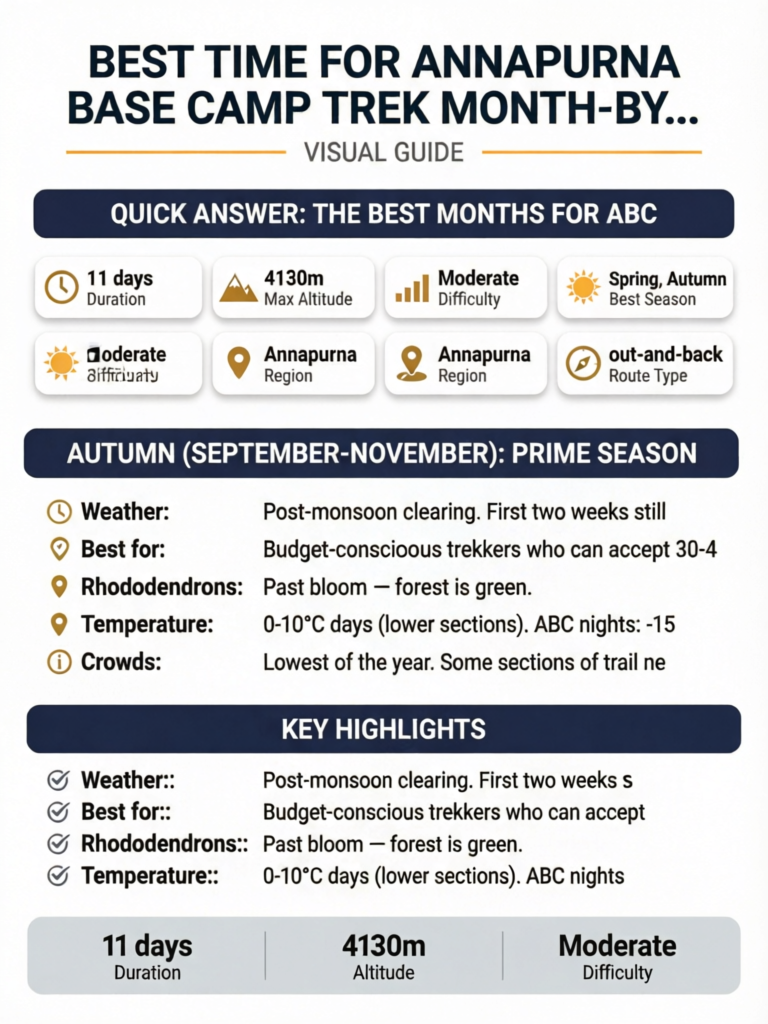
| Priority | Best Choice | Second Choice |
|---|---|---|
| Best overall weather | October | November |
| Best photography | October, late March-April | April |
| Best flowers | Late March-April | Early May |
| Fewest crowds | January-February | June (but wet) |
| Budget travel | December-February | June-August (wet) |
| Winter/snow experience | December-January | February |
Autumn (September-November): Prime Season
September: Shoulder Autumn
Weather: Post-monsoon clearing. First two weeks still see occasional rain (monsoon tail), but third and fourth weeks are increasingly stable. Vegetation is lush and green from the monsoon.
Temperature: 15-25°C days (lower sections), 5-15°C days (sanctuary). Nights: 0-5°C at ABC.
Crowds: Moderate and building. Shoulder season discounts available early in the month.
Best for: Budget-conscious trekkers who can accept 30-40% rain chance in exchange for lower prices and fewer crowds.
October: The Peak Month
Weather: Best of the year. Post-monsoon air has been washed crystal clear. Stable high-pressure systems dominate. Visibility from ABC can extend 100+ kilometers to Dhaulagiri and beyond.
Temperature: 10-20°C days (lower sections), 2-12°C days (sanctuary). Nights: -2°C to -8°C at ABC.
Crowds: Highest of the year. October is Nepal's most popular trekking month globally. Lodges in popular spots (Ghorepani, Chhomrong, MBC) can be full by mid-afternoon. Book ahead.
Rhododendrons: Past bloom — forest is green.
Best for: Those who want the best possible mountain views and are comfortable with (or enjoy) the social trekking community.
November: Excellent Alternative
Weather: Still excellent. Clear mornings, possible afternoon cloud in lower sections. Snow possible at ABC and MBC by late November.
Temperature: 8-18°C days (lower). Noticeably colder than October — 0°C to -5°C nights at MBC by late month.
Crowds: Drops significantly from October peak. Mid-November is an excellent sweet spot — good weather, fewer crowds.
Best for: Those who missed October or prefer a quieter trail. Late November requires more cold-weather gear.
Winter (December-February): Cold and Quiet
December: Transitional Winter
Weather: Clear skies (winter is actually drier than spring). Cold, particularly in the sanctuary. Snow possible above 3,000m by late December.
Temperature: 5-15°C days (lower). Sanctuary nights: -10°C to -15°C at ABC.
Crowds: Low. December is one of the quietest months. Lodges above Chhomrong may operate on reduced schedules.
Challenges: Cold gear required. Some lodges at MBC and ABC close between December and February — confirm with your agency.
Best for: Experienced trekkers who want near-solitude and dramatic snow-covered sanctuary views.
January-February: Coldest Months
Weather: Cold but often crystal clear. The sanctuary receives less snow than you might expect (rain shadow effect). Temperatures are the year's lowest.
Temperature: 0-10°C days (lower sections). ABC nights: -15°C to -20°C.
Crowds: Lowest of the year. Some sections of trail nearly empty.
Challenges: Serious cold gear mandatory (sleeping bag -15°C minimum). Some high lodges closed. Trail can be icy above 3,000m.
Best for: Adventurous trekkers comfortable with very cold conditions who want empty trails and dramatic winter scenery.
Winter Lodge Closures
Check in advance which lodges operate in December-February. The teahouses at MBC and ABC sometimes close during the coldest months. Your agency should confirm lodge availability before departure.
Spring (March-May): Rhododendron Season
Spring is one of the two prime trekking windows for ABC, offering warming temperatures after winter, spectacular rhododendron blooms, and generally stable weather. Each spring month has distinct characteristics that can significantly affect your experience.
Spring Weather Overview
Temperature Range at ABC (4,130m):
- March: High 4°C, Low -8°C
- April: High 8°C, Low -4°C
- May: High 14°C, Low 0°C
Precipitation: Low in March, moderate in April-May with increasing afternoon clouds Visibility: Excellent mornings, afternoon clouds develop (especially May) Trail Conditions: Dry and clear, some snow possible in early March above 3,500m
March: Spring Opening
Weather: Increasingly warm. Rain chance growing but still relatively dry early in the month. Unpredictable — can have perfect clear days or post-snowfall cloud.
Temperature: Warming rapidly. 15-25°C days lower sections. ABC: High 4°C, Low -8°C.
Rhododendrons: Begin blooming at lower elevations (1,500-2,000m) late March. The blooms at Ghorepani (2,860m) peak in late March.
Crowds: Building from February low. Not yet peak.
Best for: Early spring trekkers who can accept variable weather in exchange for first rhododendron blooms and relatively low crowds.
Pro Tip
Late March (last week) is one of the best times for ABC—you get improving spring weather, the beginning of rhododendron blooms, excellent visibility, and significantly fewer crowds than April. Lodges are all open, and you can often negotiate better rates than peak season.
April: Rhododendron Peak
Weather: Good overall. Afternoon clouds common — mornings typically clear. Rain possible but usually brief.
Temperature: Warm. 18-28°C days (lower sections). ABC: High 8°C, Low -4°C. Sleeping bag rated -10°C usually sufficient.
Rhododendrons: Peak bloom at all elevations from 1,500-3,500m. The forests between Tikhedhunga and Ghorepani are spectacular — deep crimson, pink, and white rhododendrons covering the entire hillside. This is Nepal trekking at its most visually dramatic.
Crowds: High. Second busiest period after October. Lodges in Ghorepani can be as busy as October.
Best for: Anyone who wants the rhododendron experience. The single best month for combining flowers and weather.
Rhododendron Viewing Zones
The best rhododendron forests on the ABC trek are found between 2,000m-3,500m elevation. Prime viewing zones include: the trail from Ghandruk to Chomrong, the ascent from Chomrong to Sinuwa, the ridge from Sinuwa to Bamboo, and scattered groves from Bamboo to Deurali. Peak bloom is typically late March to mid-April, though exact timing varies by elevation and annual weather patterns.
May: Late Spring
Weather: Increasingly unstable. Pre-monsoon conditions — hot and humid in lower sections, frequent afternoon thunderstorms. Rain chance increases significantly.
Temperature: Hot lower down (25-32°C), warm in sanctuary (ABC: High 14°C, Low 0°C).
Rhododendrons: Past peak at most elevations. Some blooming above 3,500m.
Crowds: Dropping as weather becomes less predictable.
Best for: Those who want warmth, some remaining flowers, and lower crowds than April, accepting more rain risk.
Pro Tip
If trekking in May, start your daily walks as early as possible—ideally by 6:30-7:00 AM. The clearest views and best mountain visibility occur before 10:00 AM. By midday, clouds often roll in, obscuring peaks. This early start pattern is crucial for summit day to ABC.
Monsoon (June-August): High Risk
June-August: The Wet Season
Weather: Nepal's monsoon brings rain for 70-80% of the day. The Annapurna region receives some of Nepal's heaviest rainfall — the sanctuary corridor between Bamboo and ABC becomes a waterfall zone. Paths are slippery, leeches are prevalent in lower forests, views are almost entirely cloud-obscured.
Can you do ABC in monsoon? Technically yes. Some lodges remain open. But views of the Annapurna peaks — the entire reason to go — are almost entirely blocked by cloud for weeks at a time.
Who treks in monsoon: A small number of experienced trekkers who prioritize the lush, dramatic waterfalls and empty trails over mountain views. Also trekkers with fixed dates who cannot reschedule.
Best for: Only consider if monsoon trekking with waterfalls and empty trails appeals more than mountain views. For most trekkers, avoid June-August.
Annapurna Base Camp Trek in July: The Honest Picture
July sits in the heart of the monsoon, and it is the wettest, most cloud-bound month on the entire ABC calendar. If you trek to Annapurna Base Camp in July, expect rain on most days, valleys filled with cloud by mid-morning, and only fleeting glimpses of the surrounding peaks. The Annapurna Sanctuary forms a tight amphitheatre that traps moisture, so the upper corridor between Bamboo and ABC frequently disappears into mist for days at a stretch.
Temperature: Warm and humid. Lower sections (Nayapul to Chhomrong) sit around 20-28°C by day and stay muggy at night. The sanctuary stays milder than winter — ABC days around 8-14°C, nights rarely below freezing. The cold is not the problem in July; the wet is.
Rainfall: This is the heaviest rainfall window of the year for the Annapurna region. Mornings are sometimes drier, with the heaviest downpours arriving in the afternoon and overnight. Early starts matter even more than usual.
Views: Poor to occasionally fair. You may get a clear half-hour after a heavy overnight storm, but reliable, sustained mountain views are rare. Trekkers who go to ABC for the panorama are usually disappointed in July.
Crowds: Very low. Trails are near-empty and lodges have rooms to spare, so you will not need to book tea houses in advance and can often negotiate lower rates.
Best for: Experienced, weather-tolerant trekkers, keen photographers chasing dramatic clouds and waterfalls, and people with fixed July dates who cannot reschedule. Botanists and forest lovers enjoy the lush, green sanctuary at its most alive.
July Trekking Hazards on the ABC Route
The two biggest risks in July are slippery trails (stone staircases between Tikhedhunga, Ghorepani, and Chhomrong become treacherous when wet) and leeches in the lower forests between Nayapul and Bamboo. There is also a higher chance of landslides, swollen river crossings, and flight or road delays on the Kathmandu-Pokhara and Pokhara-trailhead legs. Build buffer days into your itinerary and never push on through a major storm.
Pro Tip
If you must trek ABC in July, do three things: (1) start walking by 6:30-7:00 AM to capture the drier morning window and any brief clear views; (2) carry salt, anti-leech socks, and treat boots and gaiters for leeches before the lower forest sections; and (3) waterproof everything inside your pack with dry bags — see our rain gear guide and dry bags and stuff sacks guide. A pack cover alone is not enough in monsoon rain.
Should you choose July at all? For most international trekkers, the honest answer is no — shifting your trip even three to four weeks later into a clearing September, or earlier into May, transforms your odds of seeing the mountains. But if July is genuinely your only window, ABC remains more doable than higher, more exposed routes like Everest Base Camp because the sanctuary is lower (4,130m) and sheltered. For a rain-shadow alternative in the same region, the Annapurna Circuit and Upper Mustang stay drier on their northern, leeward side. See our dedicated monsoon trekking in Nepal guide and trekking Nepal in July for the full monsoon strategy.
What a Typical Day Looks Like on the ABC Trek in July
Planning the Annapurna Base Camp trek in July means planning your day around the rain rather than around distance. The pattern repeats almost daily through the monsoon:
- Pre-dawn to mid-morning (5:30-10:00 AM): The driest and clearest window. This is when you walk and when any mountain views appear. Leave at first light and aim to reach your next lodge before the heaviest weather builds.
- Midday to evening (11:00 AM-6:00 PM): Cloud closes in and the heaviest, most sustained rain typically arrives. Forest sections turn humid and leech-prone; stone staircases become slick.
- Overnight: Frequent heavy downpours. Trails, river levels, and the access roads to the trailhead can change overnight, which is why buffer days matter.
This is the opposite of October, when you can walk comfortably most of the day. In July, an early, short day beats an ambitious, late one every time.
How July Affects the Trail and Your Fitness
The ABC route is a staircase trek, and wet stone changes everything about how those steps feel. In July the long descents — Ghorepani down to Tadapani, the drop into the Modi Khola gorge, and the steep section below Chhomrong — demand far more care and leg control than in the dry season. Trekking poles and boots with aggressive wet-rock grip become genuinely important rather than optional. If you are unsure whether your conditioning is up to monsoon stair work, build your base with the 8-week ABC training plan and read the ABC difficulty assessment before committing to July dates.
Hot springs are a July silver lining
After a wet day on the trail, the natural Jhinu Danda hot springs below Chhomrong are one of the few things that get better in the monsoon — they are warm, far less crowded than in peak season, and a welcome way to ease tired legs. It is a small but real reason some monsoon trekkers enjoy the lower Annapurna Sanctuary corridor.
June and August: The Monsoon Shoulders
June opens the monsoon: the first half can still deliver warm, partly clear days before the rains fully set in, making early June marginally better than July. Pre-monsoon haze and afternoon thunderstorms are common.
August is wet but improving toward month-end. By late August the monsoon begins to weaken, and the last week can preview the clearing that arrives in September. Vegetation is at its lushest and greenest. As with July, leeches and slick trails are the main hazards, and views remain unreliable until the monsoon lifts.
Month-by-Month Quick Reference
| Month | Weather | Crowds | Views | Flowers | Score |
|---|---|---|---|---|---|
| January | Cold/clear | Very Low | Excellent | None | ★★★ |
| February | Cold/clear | Very Low | Excellent | None | ★★★ |
| March | Variable | Low-Med | Good | Beginning | ★★★★ |
| April | Good | High | Good | Peak | ★★★★★ |
| May | Unstable | Medium | Variable | Fading | ★★★ |
| June | Monsoon | Low | Poor | None | ★★ |
| July | Monsoon | Very Low | Poor | None | ★ |
| August | Monsoon | Very Low | Poor | None | ★ |
| September | Clearing | Medium | Good | None | ★★★★ |
| October | Excellent | Very High | Best | None | ★★★★★ |
| November | Good | Medium | Very Good | None | ★★★★★ |
| December | Cold/clear | Low | Excellent | None | ★★★ |
Best Time for the ABC Trek by Goal
The single best time for the Annapurna Base Camp trek depends on what matters most to you. Use this to match the month to your priority rather than defaulting to the generic "spring or autumn" advice.
| Your priority | Best window | Why |
|---|---|---|
| Clearest mountain views | October, then November | Post-monsoon air is washed crystal clear; visibility from ABC can reach 100+ km |
| Rhododendron blooms | Late March to mid-April | Peak bloom from 1,500m to 3,500m across the lower forests |
| Fewest crowds with good weather | Mid-November, late March | Stable conditions after the October and April peaks pass |
| Warmest sanctuary temperatures | May, then June | Pre-monsoon warmth, ABC highs up to 14°C in May |
| Budget and solitude | December-February, June-August | 20-40% savings, near-empty trails (winter cold or monsoon wet) |
| Snow and winter scenery | December-January | Snow-covered sanctuary, dramatic but cold (-15°C to -20°C nights) |
| Forced July/monsoon dates | Late August into September | The monsoon weakens late August; September clears progressively |
If you are still deciding between regions and seasons, compare ABC against Everest in our EBC vs ABC comparison and the spring vs autumn trekking guide.
What to Pack for Each ABC Season
Gear needs shift dramatically across the year, and packing for the wrong season is the most common reason trekkers are uncomfortable on ABC.
- Autumn (Sep-Nov): Layering system, a sleeping bag rated to -10°C (warmer for late November), light down jacket, and a sun hat for bright high-altitude days.
- Winter (Dec-Feb): Serious cold-weather kit — a sleeping bag rated to -15°C minimum, heavy down jacket, insulated gloves, and microspikes for icy sections above 3,000m.
- Spring (Mar-May): Versatile layers for warm lower days and cold sanctuary nights, plus rain protection for increasing afternoon showers from April onward.
- Monsoon (Jun-Aug, including July): Full waterproofs, quick-dry clothing, dry bags for everything in your pack, anti-leech socks and salt, and sturdy boots with good wet-rock grip. Spare dry socks are worth their weight in July.
For a complete year-round kit, see the ABC complete packing checklist and the layering system for Nepal trekking.
Best Time to Add Poon Hill and Photography to Your ABC Trek
Many trekkers combine Annapurna Base Camp with the Poon Hill viewpoint, and the best month for the combination is slightly different from ABC alone. Poon Hill (3,210m) is famous for sunrise over Dhaulagiri, the Annapurnas, and Machapuchare — and that sunrise depends entirely on clear skies.
- For Poon Hill sunrise + ABC: October and November give the most reliable clear sunrises; late March to mid-April adds rhododendron forests on the climb to Poon Hill, which are spectacular in spring.
- For rhododendrons specifically: Late March-April, when the Ghorepani-Poon Hill ridge is in full bloom.
- Avoid for Poon Hill: June-August, when cloud usually erases the sunrise entirely.
If photography is your priority, the same logic applies more sharply: the post-monsoon air (October-November) delivers the cleanest light and longest visibility — visibility from ABC can extend 100+ kilometers — while spring offers colour from the blooms at the cost of more afternoon haze. Plan the photogenic add-on alongside the main trek using the Poon Hill and ABC extension guide and the best photography treks in Nepal.
Crowd Management Tips
For peak season (October, April) trekking without feeling crowded:
- Start early each day: Be on the trail by 7 AM. The main crowds move 9 AM-3 PM.
- Arrive at lodges by 2 PM: Popular lodges fill up. Early arrival secures better rooms.
- Ghorepani: The most crowded single village on ABC. Accept it or go via Ghandruk direct.
- Chhomrong to ABC: Significantly less crowded than the Ghorepani section, even in peak season.
When Is the Best Month to Trek Annapurna Base Camp?
October is the single best month for the ABC trek, offering the most stable weather, clearest mountain views, and comfortable temperatures. November is nearly as good with slightly fewer crowds. April delivers stunning rhododendron blooms (the Annapurna Sanctuary forest is spectacular in spring) with good but slightly less predictable weather. March is the budget-friendly alternative with lower lodge prices and fewer trekkers, though occasional snowfall above 3,500m is possible. The months to avoid are June, July, and August — the monsoon — when rain and cloud dominate. If you only have July, treat it as a monsoon trek and plan accordingly.
Once you have your window, work out the rest of your plan with the ABC 11-day itinerary, the ABC cost breakdown, and the ABC difficulty assessment. When you are ready, book with a verified local agency through our best ABC trekking agencies guide.
Frequently Asked Questions
Can you do the Annapurna Base Camp trek in July?
Yes, the trek is physically possible in July, but it is not recommended. July is the wettest month of the monsoon, with rain on most days, cloud-blocked mountain views, slippery stone trails, and leeches in the lower forests. Some tea houses stay open and trails are nearly empty, so July works for experienced, weather-tolerant trekkers with fixed dates — but most people should choose October-November or late March-April instead. See our monsoon trekking guide before committing.
What is the best time for the Annapurna Base Camp trek?
The best time for the ABC trek is October and November for the clearest skies and most stable weather, or late March through April for rhododendron blooms with good (slightly less predictable) weather. October is the single best month overall. March is the budget-friendly alternative with fewer crowds.
Is July or September better for ABC?
September is clearly better. Early September still carries the monsoon tail, but the second half of the month clears progressively, bringing lush green scenery with increasingly stable weather — whereas July is the peak of the monsoon with the heaviest rain and the worst visibility. If your options are July or September, wait for September.
How bad are leeches on the ABC trek in monsoon?
Leeches are common in July and August in the lower, damp forests between Nayapul and Bamboo, especially after rain. They are harmless but unpleasant. Carry salt or anti-leech spray, treat boots and gaiters before forest sections, and check your legs at each break. They thin out above roughly 2,500m where it is cooler and drier.
Can I trek ABC in December or January?
Yes, but prepare for cold temperatures (-10°C to -20°C at ABC), shorter daylight hours, and some lodge closures above Deurali. The trail is generally clear of snow below 3,500m. Winter trekking offers solitude and crystal-clear views. See our best winter treks guide for more details.
Is monsoon season (June-August) possible for ABC?
It is possible but not recommended. Heavy rain, leeches on the lower trail, cloud-obscured mountain views, and trail erosion make monsoon trekking unpleasant. If you must trek during monsoon, the Annapurna Circuit is a better choice because the Manang side sits in a rain shadow.
What is the best month to see rhododendrons on the ABC trek?
Late March to mid-April is peak rhododendron season. The forests between 1,500m and 3,500m explode in red, pink, and white blooms. The section between Ghorepani and Tadapani is particularly spectacular.
How crowded is the ABC trek in October?
October is peak season and the trail will be busy, particularly the Ghorepani-Poon Hill section. Tea houses fill up quickly -- arrive by 2 PM or book in advance. The sanctuary section (above Chhomrong) is less crowded than the lower trail.
Does weather differ between the ABC and EBC treks in the same month?
Yes. The Annapurna Sanctuary has a warmer microclimate than the Khumbu due to its lower altitude and sheltered amphitheater geography. ABC in October averages 3-5°C warmer than EBC. However, the Annapurna region receives slightly more precipitation than the Everest region.
Is August any better than July for the ABC trek?
Only marginally, and mostly at the very end of the month. July and August are both peak monsoon, with heavy rain, leeches, and cloud-blocked views. The difference is that the monsoon begins to weaken in late August, so the last week can preview the clearing weather of September. If you are choosing between the two, late August edges out July — but September is far better than either.
What gear do I need for the ABC trek in July?
For a July monsoon trek, prioritise full waterproofs (jacket and trousers), dry bags to waterproof everything inside your pack, quick-dry clothing, boots with good wet-rock grip, trekking poles for slick descents, and anti-leech socks plus salt for the lower forests. Spare dry socks are worth their weight. The cold is not the issue in July — the wet is. See the rain gear guide and dry bags guide.
How many days does the ABC trek take, and does the season change it?
The standard Annapurna Base Camp trek runs about 11 days at altitude up to 4,130m. The season does not change the core itinerary, but in the monsoon you should add buffer days for rain delays, swollen river crossings, and possible flight or road disruption on the Kathmandu-Pokhara legs. Plan the schedule with the ABC 11-day itinerary.
Is there snow at Annapurna Base Camp, and when?
Snow is most likely at ABC and Machhapuchhre Base Camp from late November through February, and occasionally in early March above 3,500m. The sanctuary receives less snow than you might expect thanks to a partial rain-shadow effect, but December-February nights drop to -15°C to -20°C, so winter trekkers need serious cold-weather gear and should confirm lodge openings in advance.
Planning your ABC dates?
The best time for the Annapurna Base Camp trek is October-November or late March-April. Once you have picked your window, a verified local agency can lock in lodges and permits (ACAP and TIMS) and adjust the itinerary for the season — including buffer days if you are trekking in the monsoon shoulder.