
Annapurna Base Camp Trek Cost: Complete 2026 Budget Breakdown
The Annapurna Base Camp trek cost is $750-$3,200+ per person for an 11-day journey, with most first-time guided trekkers spending $1,200-1,800. Budget independent trekkers can complete the trek for $750-1,100, while premium guided packages run $2,000-3,200+. This comprehensive guide breaks down every Annapurna base camp trekking cost — permits, guide, porter, transport, accommodation, food, gear, and hidden expenses — so you can build an accurate budget before you book.
$750-1,100 (11 days)
$1,200-1,800 (11 days)
$2,000-3,200+ (11 days)
$25-40 (budget), $50-80 (mid-range)
$40-50
$5-80 round trip
$25-$35 /day
7-12 days on trail
How Much Does the Annapurna Base Camp Trek Cost in 2026?
The ABC trek cost depends on five factors: trek duration, your support level (independent, local guide, or full agency), transport choice, season, and how you book. A trek that starts and ends in Pokhara costs less than a Kathmandu-based itinerary, and a direct route through Chhomrong is cheaper than a longer loop via Ghorepani and Poon Hill, which adds extra meal, room, and guide days.
| Trek Style | Cost (Per Person) | Duration | Best For |
|---|---|---|---|
| Budget Independent | $750-1,100 | 9-11 days | Self-organised trekkers using basic teahouses, local buses, minimal extras |
| Standard Guided | $1,200-1,800 | 10-12 days | Most international trekkers wanting guide, permits, meals, accommodation, transport |
| Comfort / Premium | $2,000-3,200+ | 10-12 days | Private guide, best lodges, private transport, 4-star Pokhara stay |
| Short from Pokhara | $500-900 | 5-7 days | Trekkers on a tight schedule starting directly from Pokhara |
The single biggest cost difference between trek styles comes from service level, not permits. Permits are a small fixed cost ($40-50); the real spread comes from guide and porter days, transport choice, and how comfortable your lodges and meals are. Most trekkers notice their daily budget climb sharply after Chhomrong — around Bamboo, Deurali, Machhapuchhre Base Camp, and Annapurna Base Camp — where meals, rooms, charging, and hot drinks all cost more at altitude.
The short answer
Plan $1,200-1,800 for a typical guided 11-day Annapurna Base Camp trek. Go independent and trek frugally to land near $800-1,000. Want private guides and the best lodges? Budget $2,500+. None of these include international flights to Nepal.
ABC's Cost Advantage
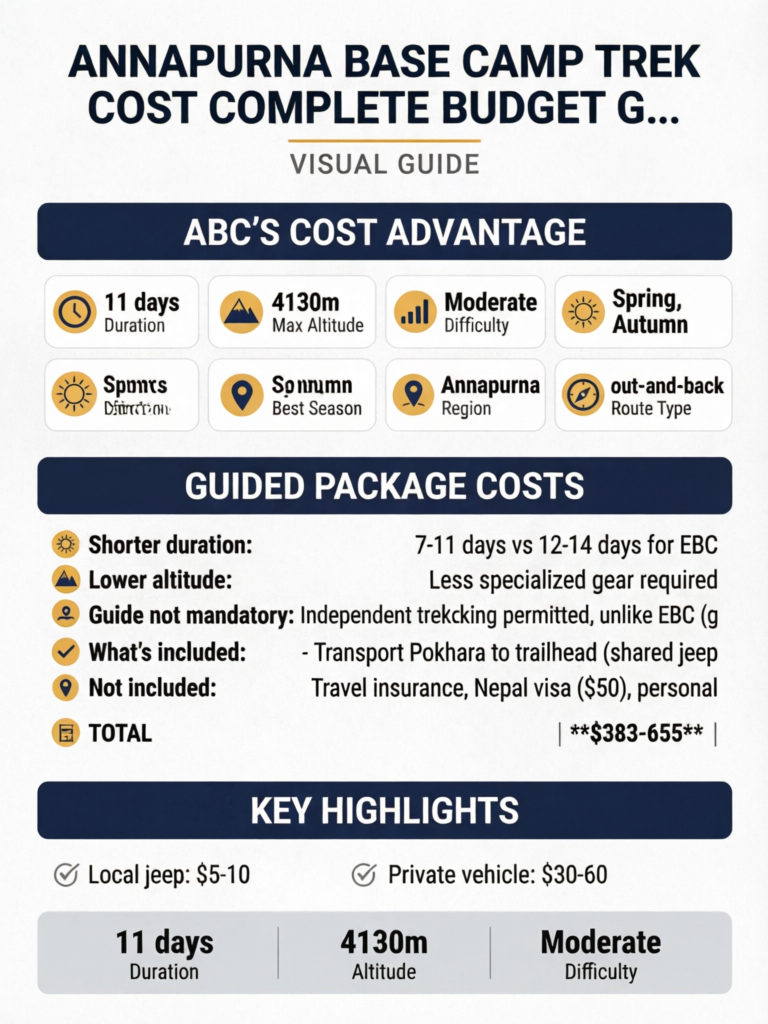
ABC is significantly cheaper than EBC because:
- No expensive flights: Start with a $5-15 bus from Pokhara, vs $350-400 Lukla flights
- Shorter duration: 7-11 days vs 12-14 days for EBC
- Lower altitude: Less specialized gear required
- Guide mandatory since April 2023: independent trekking with a mandatory licensed guide is no longer permitted (mandatory guide rule since April 2023), unlike EBC (guide mandatory since 2026)
Result: ABC costs 40-60% less than EBC for comparable mountain scenery. For a full side-by-side, see our EBC vs ABC comparison and the Everest Base Camp cost breakdown.
Local Agency vs International Operator Cost
Where you book changes the price more than almost any other single factor. The same 11-day trek can cost $750 with a Pokhara-based agency or $2,499 with an overseas operator — for nearly identical logistics on the ground.
| Booking Channel | Typical 11-Day Cost | What You Get |
|---|---|---|
| Local Nepali agency (budget) | $400-500 | Bare-bones package, shared guide, basic teahouses |
| Local Nepali agency (standard) | $750-1,200 | Licensed guide, porter, permits, meals, transport |
| Local Nepali agency (luxury) | $1,800-2,000+ | Private guide, best lodges, private transport |
| International operator | $1,499-2,499 | Same on-ground services, marked up via a Nepal sub-contractor |
International operators almost always subcontract the actual trek to a local Nepali company, then add a margin for marketing and overseas support. The cost is roughly double what local operators charge — and many international packages exclude experienced guides or permits, so always check inclusions line by line. Booking with a verified local agency keeps more money in Nepal and usually delivers the same guides and teahouses. See our guide to the best ABC trekking agencies and how to choose a trekking agency.
Pro Tip
When comparing two quotes, ignore the headline price. Compare line by line: number of guide days, porter included or not, permits included, Pokhara hotel nights, transport type (shared vs private), and whether tips and insurance are excluded. Two "$1,200" packages can differ by $400 in real value.
Guided Package Costs
Budget Package ($700-1,100)
What's included:
- Transport Pokhara to trailhead (shared jeep)
- ACAP and TIMS permits
- Shared guide (3-4 trekkers per guide)
- 9-11 nights teahouse accommodation
- 3 meals daily
- Shared porter for group
Not included: Travel insurance, Nepal visa ($50), personal expenses, tips ($100-150), hot showers, charging, snacks
Mid-Range Package ($1,100-1,700)
What's included (everything above plus):
- Experienced guide with first aid certification
- Individual porter
- Better teahouse selection
- Private jeep transport
- 2 nights Pokhara hotel (3-star)
- Jhinu hot springs visit included
Premium Package ($1,800-3,000+)
What's included (everything above plus):
- Private guide
- Personal porter
- Best available lodges
- 4-star Pokhara resort
- Satellite phone backup
- Full flexibility, no fixed pace
For the top-end experience and what it buys, read our ABC luxury trek guide.
Independent Trekking Costs ($600-1,000)
| Category | Budget | Cost Range |
|---|---|---|
| Permits (ACAP + TIMS) | Self-obtained | $40-50 |
| Transport (local bus) | Pokhara to Nayapul | $5-15 round trip |
| Accommodation (9 nights) | Budget teahouses | $30-80 |
| Food (10 days) | Dal bhat focus | $180-280 |
| Hot showers (3-4) | Strategic | $8-15 |
| Charging + WiFi | Minimal | $15-25 |
| Snacks | Minimal | $20-40 |
| Pokhara hotel (2 nights) | Budget | $25-50 |
| Contingency | Weather, extras | $60-100 |
| TOTAL | $383-655 |
Add guide independently ($20-30/day × 9 days = $180-270 + $80-120 tip): Total $643-1,045
Since the April 2023 rule, you cannot legally trek the Annapurna Conservation Area entirely solo — a licensed guide is required. "Independent" here means you arrange permits, transport, and a freelance guide yourself rather than buying a packaged tour, which is where the savings come from. For the full picture, see independent vs guided trekking and hiring guides and porters in Nepal.
Annapurna Base Camp Trek Cost Breakdown by Category
The total ABC trek budget covers several distinct categories: the ACAP permit, guide support, porter service, meals, accommodation, transport between Pokhara and the trailhead, extra trail services like charging and hot showers, travel insurance, and gear. Understanding each separately is the single best way to avoid budget surprises on the trail.
Transport: ABC's Big Cost Advantage
Pokhara to Nayapul trailhead:
- Local bus: $3-5 (1.5 hours) — cheapest option
- Tourist bus: $8-15 — comfortable, scheduled
- Shared jeep: $10-20 per person — faster
- Private jeep: $40-70 one way — ideal for groups
Return from Jhinu Danda/Nayapul:
- Local jeep: $5-10
- Private vehicle: $30-60
Total round-trip transport: $6-130 depending on style
Shared jeeps from Pokhara to Siwai, Jhinu Danda, or Hile keep the budget low, while private vehicles increase the total. Road condition, fuel prices, group size, and departure timing all affect the price. Compare to EBC's mandatory $350-400 round-trip Lukla flights. See our Kathmandu-Pokhara transport guide and jeep transport for trek access.
Permits: $40-50 Total
ACAP Permit: $30 (NPR 3,000, tax included) — available at the ACAP office in Pokhara (Damside, near the bus park), at the Nepal Tourism Board in Kathmandu, or online via the NTNC e-permit system. TIMS Card: $10-20 (individual) or $10 (agency-booked).
Important details that catch trekkers out:
- Online payment adds a 2.9% gateway charge (Visa/MasterCard), but the permit is emailed to you instantly — no counter visit needed.
- Counter payment is cash only, at the Pokhara or Kathmandu permit office, with passport in hand.
- Permits issued at the trail check-post (Birethanti) cost double. Always arrange your ACAP before you start walking.
- SAARC nationals (including Indian citizens) pay a reduced ACAP of NPR 1,000 (about $7-8) instead of NPR 3,000.
TIMS enforcement on the ABC route is inconsistent — it is not always issued or checked — but the saving is small, so most agencies arrange both permits in advance. No restricted-area permit is required for ABC, unlike Manaslu or Nar-Phu. Full details in our ACAP permit guide and TIMS card guide.
Accommodation Costs by Section
| Section | Altitude | Room Cost | Notes |
|---|---|---|---|
| Nayapul to Chhomrong | 1,540-2,170m | $2-5/night | Best facilities |
| Bamboo to Deurali | 2,310-3,230m | $4-8/night | Good but basic |
| MBC to ABC | 3,700-4,130m | $6-12/night | Very basic, coldest |
Total accommodation (9 nights): $35-80 budget, $60-130 mid-range
Rooms are cheap because teahouses make their margin on food — many lodges expect you to eat dinner and breakfast where you sleep. In peak months (March-April, October-November), teahouses in Chhomrong, Bamboo, Himalaya, Deurali, MBC, and ABC fill quickly, and last-minute private rooms become hard to get. Booking ahead and starting early each day reduces the risk of sharing a room or sleeping in the dining hall. See tea house trekking explained and tea house amenities by altitude.
Food Costs: $20-40 Per Day
Dal bhat budget (lower sections): $5-7 per meal, unlimited refills Dal bhat budget (MBC/ABC): $9-12 per meal
Daily food budget:
- Budget (dal bhat x2 + simple breakfast): $15-22
- Standard (mixed menu): $22-32
- Comfortable (full menu): $32-45
Total food (10 days): $150-450
Food is the largest variable cost on the trail, and prices climb the higher you go because everything is carried up by porter or mule. Sticking to dal bhat (with its free refills) is the cheapest way to stay fuelled. Bottled drinks, hot showers, and imported snacks are where budgets quietly blow out. See our dal bhat trekking guide and typical tea house menu prices.
Guide and Porter (Independent Hire)
Licensed guide:
- $20-25/day (freelance) to $30-35/day (experienced)
- 9 days trek: $180-315
- Tip: $80-120
Porter:
- $18-22/day
- 9 days: $162-198
- Tip: $70-100
Guide + porter for 2 trekkers (shared):
- $180-225 per person for trek + tips
Over a 10-14 day trek, guide fees add roughly $250-490 and a porter adds $150-280. Guide support is most valuable after Chhomrong, where the trail narrows, weather shifts fast, and rooms are scarce — a good guide manages pacing and secures lodging. Always confirm your agency insures its guides and porters; ethical staff treatment is a sign of a reputable operator. See porter ethics and responsible trekking and tipping guides and porters.
Gear Costs
ABC's 4,130m maximum requires less specialized gear than EBC or Annapurna Circuit.
| Essential Item | Budget | Mid-Range |
|---|---|---|
| Down jacket (-10°C) | $60-100 | $120-200 |
| Sleeping bag (-10°C) | $55-90 | $110-180 |
| Waterproof jacket | $50-80 | $100-170 |
| Trekking boots | $60-100 | $130-190 |
| Trekking poles | $18-30 | $40-70 |
| Total new gear | $243-400 | $500-810 |
Rent in Pokhara: Down jacket + sleeping bag + poles = $45-80 for 10 days.
Renting in Pokhara is the smart move if you trek only once — a quality down jacket and sleeping bag for the cold MBC/ABC nights cost a fraction of buying new. See rent vs buy gear in Kathmandu, Pokhara gear shopping and rental, and the complete trekking gear list.
Travel Insurance: $85-200
Required coverage: Trekking to 5,000m (ABC is 4,130m, but helicopter evacuation from anywhere in the region covers higher altitudes)
- Budget: World Nomads Standard ($90-120), Safety Wing ($85-110)
- Mid-range: World Nomads Explorer ($130-160)
A single helicopter evacuation from the Annapurna Sanctuary can cost thousands of dollars, so insurance that explicitly covers high-altitude trekking and helicopter rescue is non-negotiable. See our travel insurance for Nepal trekking guide.
Nepal Visa Cost
Most trekkers buy a 30-day tourist visa on arrival at Kathmandu airport for $50 (15-day is $30, 90-day is $125). This is separate from your trek budget and applies to nearly all nationalities except Indian citizens, who do not require a visa to enter Nepal. See our Nepal visa guide.
Hidden Costs ($100-200 Total)
| Cost | Amount | Notes |
|---|---|---|
| Hot showers (7-8 total) | $18-32 | $2-4 each |
| WiFi (daily) | $18-25 | $2-3/day |
| Charging (daily) | $12-20 | $1.50-2.50/day |
| Snacks | $25-50 | Buy in Pokhara, 3x cheaper |
| Jhinu hot springs | $5-10 | Entry fee |
| Nepal visa | $50 | 30 days |
| Tips | $100-180 | Guide + porter |
| Pokhara hotel (2-3 nights) | $30-120 | Budget-mid range |
These "small" charges are exactly what city-dwellers underestimate — a hot shower, a WiFi pass, and a phone charge can each cost double or triple their city price at altitude because the fuel and electricity are carried or generated on-site. For the complete list, see hidden costs of Nepal trekking.
ABC Trek Cost for Indian Citizens & SAARC Nationals
Indian and other SAARC trekkers pay noticeably less than Western trekkers, mainly on permits and visa:
- No Nepal visa fee: Indian nationals do not need a visa to enter Nepal (carry a valid passport or voter ID).
- Reduced ACAP permit: NPR 1,000 for SAARC nationals vs NPR 3,000 for other foreigners — a saving of about $15.
- Cheaper flights: Direct flights from Indian cities to Kathmandu are short and competitively priced.
A typical guided ABC trek for an Indian citizen booking with a local Nepali agency lands around INR 60,000-1,10,000 ($720-1,320) for the land package, excluding international flights. Independent Indian trekkers who arrange a freelance guide and self-cater can do the trek for noticeably less. Tips, meals, accommodation, transport, and guide/porter rates are the same as for other trekkers — the savings are concentrated in the visa and permit lines.
Indian trekkers — bring rupees, but the right ones
Nepal does not accept Indian notes above INR 100 in many places. Carry small-denomination Indian rupees or exchange to Nepali rupees in Pokhara before the trail, since there are no ATMs once you start walking. See our ATMs, cash & money guide.
ABC Trek Cost for Nepali Trekkers
Domestic Nepali trekkers pay the least of all. The ACAP permit for Nepali citizens is a token fee (NPR 100), there is no visa cost, and many trek independently with a freelance guide or with friends who know the route. The main costs are transport, teahouse rooms and meals, and any guide/porter support. A self-organised Nepali trekker can complete ABC for NPR 25,000-45,000 ($190-340) excluding gear, which is why the Annapurna trail sees heavy domestic traffic in peak season — and why rooms from Chhomrong to ABC fill so fast.
Annapurna Base Camp Trek Cost Per Day
On a budget independent trek, expect to spend $25-40 per day on the trail for accommodation, three meals, and basic extras. Mid-range guided treks average $50-80 per day including guide fees. Premium packages with the best lodges and private guides run $80-120+ per day.
| Style | Per Day (On Trail) | Covers |
|---|---|---|
| Budget independent | $25-40 | Room, 3 meals, minimal extras (carry own pack) |
| Mid-range guided | $50-80 | Above + guide fee, occasional comfort spend |
| Premium guided | $80-120+ | Best lodges, private guide, full flexibility |
These daily costs are significantly lower than Everest Base Camp because there is no expensive Lukla flight and the trail duration is shorter. Use the daily figure as a sanity check: multiply by your trekking days, then add fixed one-off costs (permits, transport, insurance, visa, gear) for a complete estimate.
Cost of Side Trips & Itinerary Variations
ABC pairs naturally with several add-ons, and each changes the total cost:
- ABC + Poon Hill loop (12-14 days): The most popular extension. Adds 2-3 trek days, so budget an extra $100-200 in food, rooms, and guide days. See our ABC + Poon Hill combination trek.
- ABC + Mardi Himal (13 days): Combines the Sanctuary with the ridge views of Mardi. Adds roughly $150-250. See the Mardi Himal cost breakdown.
- Short ABC from Pokhara (5-7 days): Drive deep to Siwai/Jhinu to cut days. Costs $500-900 — the cheapest fully guided option. See the ABC 7-day fast-track itinerary.
- Helicopter return from ABC: A 1-day fly-out skips the descent but adds a major premium — shared charters start in the hundreds of dollars per person and scale up for private flights. Covered in our ABC luxury trek guide.
For the standard timing, see the ABC 11-day itinerary and the ABC 10-day itinerary.
Budget Examples
Budget Independent (Total: ~$1,000)
- No guide, carry own pack
- Local bus transport: $10
- Permits: $50
- Accommodation (9 nights): $50
- Food (10 days): $220
- Extras: $50
- Gear rental: $60
- Insurance: $100
- Pokhara hotel (2 nights): $30
- Contingency: $80
- TOTAL: $650-750 + Nepal visa $50 = ~$800
Mid-Range Guided (Total: ~$1,500)
- Mid-range agency package: $1,100
- Extras + snacks: $80
- Insurance: $130
- Tips: $150
- Pokhara hotel: $80
- Contingency: $100
- TOTAL: $1,640
Premium (Total: ~$2,500)
- Premium agency package: $2,000
- Insurance: $180
- Extras: $120
- Tips: $180
- Contingency: $100
- TOTAL: $2,580
What Trekkers Actually Spend
Self-reported totals from 2026/2027 trekker surveys cluster around three figures:
- Frugal independent trekkers: $800-1,000 all-in (excluding flights to Nepal), trekking with a freelance guide, eating dal bhat, taking local buses.
- Typical guided trekkers: $1,300-1,700 booking a standard local-agency package and adding tips, insurance, and a couple of comfortable Pokhara nights.
- Comfort-focused trekkers: $2,300-2,800 with private guides, the best available lodges, and private transport.
The gap between "what the package costs" and "what you actually spend" is almost always tips, insurance, visa, snacks, and Pokhara nights — the lines packages exclude. Budget an extra $300-450 on top of any package quote for these.
Why ABC Cost Estimates Differ So Much Online
If you have seen everything from $400 to $2,500 quoted for the "same" trek, here is why:
- Different durations. A 5-day Pokhara-based trek and a 14-day Poon Hill loop are both "ABC" but cost very differently.
- Independent vs packaged. Self-organised trekkers quote only their on-trail spend; agencies quote an all-inclusive package.
- Local vs international booking. A Nepali agency price and an overseas operator price can differ by 2x for identical logistics.
- What's excluded. Many quotes drop tips, insurance, visa, international flights, and personal spending.
- Season. Peak-season agency packages run 10-20% higher than off-season.
When you compare numbers, always normalise for duration, booking channel, and inclusions — otherwise you are comparing apples to helicopters.
Money-Saving Strategies
- Take local bus to Nayapul (save $30-60 vs private vehicle)
- Trek independently with a freelance guide (save $400-600 vs an agency package)
- Dal bhat strategy: lunch and dinner = unlimited refills, cheapest nutrition
- Buy snacks in Pokhara: 3x cheaper than on trail
- Bring a power bank: eliminates charging fees ($15-20 saving)
- Obtain permits yourself in Pokhara: saves $5-15 markup and avoids the double check-post fee
- Trek in shoulder season (Sept/Dec): 10-20% lower rates
- Book with a verified local agency instead of an international operator: same trek, roughly half the price
- Rent your down jacket and sleeping bag in Pokhara rather than buying new gear you'll use once
For the full money playbook, see budget trekking in Nepal and the complete Nepal trekking costs guide.
Common Budget Mistakes to Avoid
Before the trek:
- Forgetting that international flights to Nepal are not in any package price.
- Booking through an overseas operator without comparing a local-agency quote.
- Buying expensive gear you'll use once instead of renting in Pokhara.
- Underestimating travel insurance — and not checking it covers helicopter rescue.
On the trail:
- Not carrying enough cash — there are no ATMs past Pokhara.
- Ignoring the dal bhat rule and paying à la carte for every meal.
- Paying for daily WiFi and charging instead of a power bank and a Nepal SIM card.
- Skipping tips in the budget — guides and porters rely on them.
How Much Does It Cost to Climb Annapurna?
Note the difference between trekking to Annapurna Base Camp (4,130m, covered on this page, $750-3,200) and climbing Mount Annapurna I (8,091m), which is a full mountaineering expedition. Climbing the summit costs $25,000-$60,000+ per person, including a climbing permit (around $1,800 in spring for foreign climbers), expedition logistics, Sherpa support, oxygen, and weeks on the mountain — a completely different undertaking from the base camp trek. Most travellers searching "how much does it cost to climb Annapurna" want the base camp trek, which this guide covers in full.
Frequently Asked Questions
Ready to plan your Annapurna Base Camp trek?
Get matched with a verified local Annapurna agency and a transparent, all-inclusive ABC quote — no overseas markup.