
Mardi Himal Trek Cost: Full 2026 Budget Breakdown
The Mardi Himal trek cost is $550-750 for a budget independent trek, $850-1,300 for a mid-range guided trek, and $1,300-1,900 for a premium package — all for the standard 7-day itinerary including permits, transport, food, and accommodation. Daily on-trail spending runs $20-35 (budget) to $50-80 (premium). It is one of the cheapest Annapurna-region treks because there are no domestic flights.
The Mardi Himal trek is one of Nepal's best-value short treks. At 7 days total, it delivers outstanding close-up views of the Annapurna range for $550-1,800 per person — significantly less than the Annapurna Base Camp or Annapurna Circuit for comparable mountain scenery. The shorter duration, easy road access from Pokhara, and no domestic flights required keep costs low while the quality of the experience remains exceptional. This guide covers every line item, plus how to choose between a Mardi Himal trek package and trekking independently.
$550-750 (7 days)
$850-1,300 (7 days)
$1,300-1,900 (7 days)
$20-35 (budget) to $50-80 (premium)
$40-50
$8-25 round trip
$25-$35 /day
$3-8/night
Mardi Himal Trek Package Costs (Guided)
A Mardi Himal trek package bundles permits, transport, guide, porter, teahouse accommodation, and meals into one price. Packages range from $550-800 (budget) to $1,300-1,800 (premium), depending on guide seniority, porter inclusion, and Pokhara hotel standard. Booking a package with a verified local agency removes the logistics of arranging permits and transport yourself.
Budget Package ($550-800)
Included:
- Transport Pokhara to Kande (shared)
- ACAP and TIMS permits
- Shared guide
- 5 nights teahouse accommodation
- 3 meals daily
- Shared porter (optional)
Not included: Nepal visa, international flights, travel insurance, personal expenses, tips
Mid-Range Package ($850-1,200)
Included (all above plus):
- Experienced private or small-group guide
- Individual porter
- Better teahouse selection where available
- 2 nights Pokhara hotel (3-star)
- Private transport Pokhara-Kande
Premium Package ($1,300-1,800)
Included (all above plus):
- Senior private guide
- Personal porter
- Best available lodges
- 4-star Pokhara hotel
- Full flexibility on itinerary
- Pre-departure consultation
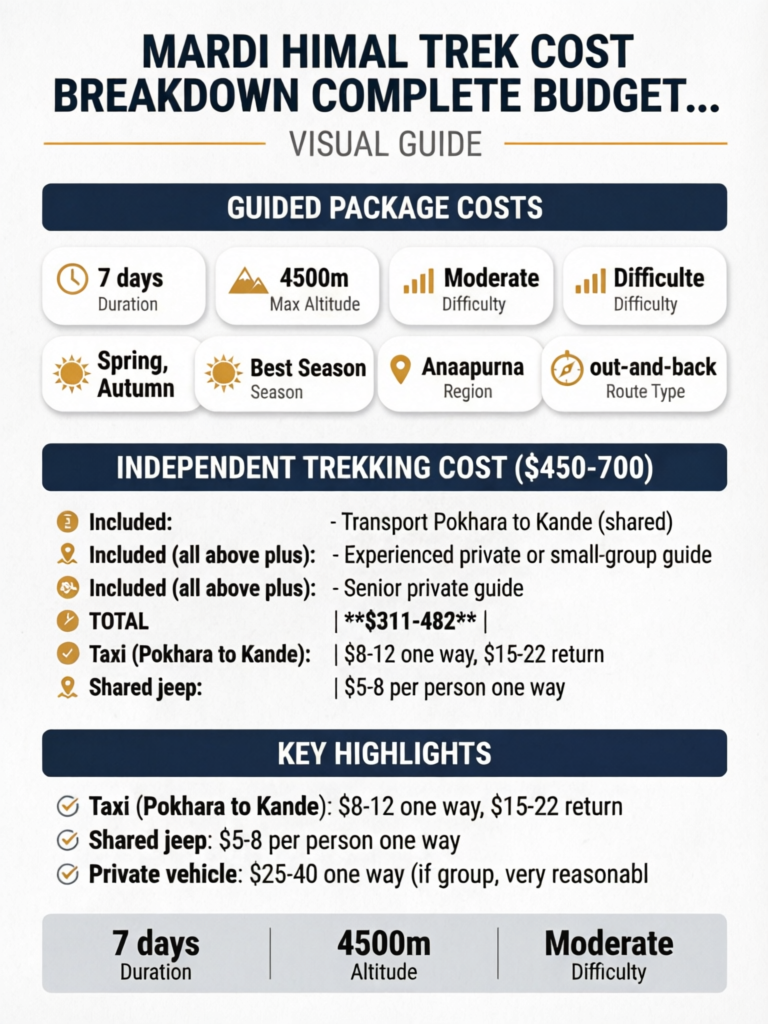
Independent Trekking Cost ($450-700)
| Category | Cost Range |
|---|---|
| ACAP + TIMS permits | $40-50 |
| Transport Pokhara-Kande-Pokhara | $20-40 |
| Accommodation (5 nights) | $20-40 |
| Food (6 days) | $140-200 |
| Hot showers (2-3) | $6-12 |
| Charging + WiFi | $10-15 |
| Snacks | $15-25 |
| Pokhara hotel (2 nights) | $20-40 |
| Contingency | $40-60 |
| TOTAL | $311-482 |
Add independent guide hire ($25-$35 /day × 5 days = $100-140 + $50-80 tip): Total $461-702
Transport ($20-40 Round Trip)
Mardi Himal's Pokhara trailhead proximity is a major cost advantage.
- Taxi (Pokhara to Kande): $8-12 one way, $15-22 return
- Shared jeep: $5-8 per person one way
- Private vehicle: $25-40 one way (if group, very reasonable)
Total transport budget: $20-40 round trip — some of Nepal's cheapest trekking access.
Permits: $40-50
Same as ABC: ACAP ($30) + TIMS ($10-20). Get in Pokhara — quick and easy.
Food Costs
| Section | Daily Budget |
|---|---|
| Low Camp - High Camp | $15-25/day |
| High Camp (3,580m) | $20-30/day |
| Upper Viewpoint (4,500m, lunch) | $10-15 (lunch only) |
Total food (5-6 trail days): $100-180 budget, $150-250 standard
Dal bhat available at all camps. Above High Camp, menu is limited — bring snacks.
Guide and Porter (Independent Hire)
Guide: $20-28/day × 5 days = $100-140 + $50-80 tip Porter: $18-22/day × 5 days = $90-110 + $40-60 tip Combined (2 trekkers sharing): $120-180 per person
Gear Rental Costs
Most trekkers visiting Mardi Himal already own basic trekking gear. However, if you are arriving in Pokhara without cold-weather equipment, the city's Lakeside district has a well-developed gear rental market along New Road and Damside. Rental quality varies considerably — inspect items before paying.
| Gear Item | Rental Cost/Day | Rental Cost (5 days) | Notes |
|---|---|---|---|
| Sleeping bag (-10°C rated) | NPR 150-250 ($1.10-1.90) | NPR 750-1,250 ($5.50-9.50) | Essential for High Camp Nov-Mar |
| Down jacket (600-fill) | NPR 200-350 ($1.50-2.70) | NPR 1,000-1,750 ($7.50-13) | Necessary above 3,000m in cool seasons |
| Trekking poles (pair) | NPR 150-200 ($1.10-1.50) | NPR 750-1,000 ($5.50-7.50) | Highly recommended for descent |
| Crampons / microspikes | NPR 200-300 ($1.50-2.30) | NPR 1,000-1,500 ($7.50-11.50) | Only if snow above 3,000m (Dec-Feb) |
| Trekking boots (mid-weight) | NPR 300-500 ($2.25-3.80) | NPR 1,500-2,500 ($11-19) | Verify fit carefully — blisters are costly |
| Rain jacket / poncho | NPR 100-200 ($0.75-1.50) | NPR 500-1,000 ($3.75-7.50) | Essential in monsoon shoulder seasons |
| Duffel bag (60L) | NPR 100-150 ($0.75-1.15) | NPR 500-750 ($3.75-5.50) | If using a porter |
Total gear rental estimate (5 days, core items): NPR 3,000-5,500 ($22-42)
Gear Rental Quality Warning
Lakeside Pokhara rental shops range from well-maintained gear with branded items (North Face, Mammut copies, or originals) to low-grade Chinese knock-offs that fail in cold weather. For sleeping bags especially, test the zipper, check the loft, and smell the bag before renting. A malfunctioning sleeping bag at High Camp (3,580m) on a cold night is a serious problem. Pay the extra NPR 50-100 per night for a good bag.
For a full breakdown of rental prices and shop locations, see our Pokhara gear shopping and rental guide. If you plan to trek again in Nepal within 2-3 years, purchasing a sleeping bag and down jacket in Thamel (Kathmandu) is often better value than repeated rentals. Quality down jackets cost $40-80 for Nepal-made versions, and sleeping bags $50-100. Buying beats renting after roughly 2 treks.
Travel Insurance Costs
Travel insurance is not optional for trekking in Nepal at altitude. It is a non-negotiable cost. A fall, altitude illness, or injury on the upper ridge can require a helicopter rescue costs $1,800-$5,000 depending on location (EBC to Lukla $1,800-$2,500, EBC to Kathmandu $4,500-$5,000) — an expense that insurance covers and self-paying does not.
What Your Policy Must Cover for Mardi Himal
- Trekking altitude: Minimum 5,000m coverage (the trek reaches 4,500m; policies rated to 4,500m only may refuse high-altitude claims)
- Helicopter evacuation: Critical. This is how rescues happen in the Annapurna region
- Medical treatment: In-country treatment at Pokhara or Kathmandu hospitals
- Trip cancellation/delay: Useful if permits are delayed or flights are disrupted
- Baggage loss: Standard inclusion — useful but less critical for trekking
What Mardi Himal Insurance Does NOT Need to Cover
- Technical climbing (Mardi Himal trek does not require climbing equipment or roping)
- High-altitude mountaineering (this is a trekking route, not a peak ascent)
- Evacuation above 6,000m (the trek stays below 4,500m)
Insurance Cost by Provider Type
| Policy Type | Approximate Cost (7-14 days) | Coverage Level |
|---|---|---|
| Budget backpacker policy (World Nomads Standard) | $60-90 | Trekking to 4,500m, basic evacuation |
| Standard adventure policy (World Nomads Explorer) | $100-140 | Trekking to 6,000m, full evacuation |
| Comprehensive travel + adventure (AIG, Allianz) | $120-200 | Full medical, evacuation, cancellation |
| Annual multi-trip adventure policy | $300-500/year | Best value for multiple Nepal trips |
Recommended minimum budget: $90-140 for a solo trekker on a 10-14 day Nepal trip covering Mardi Himal.
Recommended Providers (2026)
- World Nomads Explorer Plan — most widely used by Nepal trekkers, clear altitude coverage language, fast claims
- True Traveller (UK-based) — excellent altitude coverage, competitive for European trekkers
- SafetyWing — budget option that covers Nepal trekking; verify altitude limits in policy documents
- Global Rescue — membership-based evacuation service, not full insurance but an excellent complement to a basic policy
Verify Your Policy's Altitude Limit
Many standard travel policies cover "adventure activities" to 3,000m or 4,000m only. Mardi Himal Upper Viewpoint is at 4,500m. If your policy caps at 4,000m, you may be uninsured at the most critical point of the trek. Read the policy document — not just the summary — before purchasing. The words "trekking at altitude" in a policy description do not guarantee 4,500m coverage.
Hidden Costs
| Cost | Amount |
|---|---|
| Hot showers (2-3 total) | $6-12 |
| WiFi (limited above Low Camp) | $8-12 total |
| Charging | $8-12 total |
| Snacks | $15-30 (buy in Pokhara) |
| Nepal visa (if not already counting) | $50 |
| Tips (guide + porter) | $90-160 |
| Pokhara hotel (2-3 nights) | $30-100 |
How Much Cash Should You Carry?
There are no ATMs anywhere on the Mardi Himal trail — the last reliable cash machines are in Pokhara Lakeside. Withdraw everything you need before you leave, and carry it in small Nepali rupee notes for teahouses, tips, and snacks.
- Independent, no guide: carry $300-350 (NPR 40,000-47,000) per person for 5-6 trail days, plus contingency
- With a porter: add $100-130 for the porter fee and tip
- With a guide: add $150-200 for the guide fee and tip
- Solo with guide and porter: carry roughly $500-550
Teahouses, transport, and permits are all cash-only. Card payment is not accepted on the trail, and mobile wallets (eSewa, Khalti) require a Nepali bank account most foreign trekkers do not have. Budget an extra 10% buffer for weather delays or an unplanned extra night at High Camp.
Where to Withdraw
Pokhara Lakeside ATMs (Nabil, Global IME, NIC Asia) dispense up to NPR 35,000 per transaction with a fee of around NPR 500. Withdraw in two transactions if you need more, and split your cash between your daypack and a hidden money belt before you start trekking.
Exit Route Cost: Siding vs. Out-and-Back
Most Mardi Himal itineraries descend the way they came (back to Kande), but many trekkers exit via Siding village, a different valley that returns to Pokhara by jeep. This changes your transport cost slightly:
- Kande return (out-and-back): local bus or shared jeep, NPR 100-800 per person
- Siding exit: the jeep from Siding to Pokhara is longer and rougher, NPR 1,000-1,500 per person (or split a private jeep ~NPR 6,500 across the group); walking 45 minutes down to lower Siding gets you a cheaper pickup
The Siding exit adds little to your total budget but gives you a loop instead of retracing the trail — worth the small extra transport cost for the scenery and Gurung villages along the descent.
Tipping Etiquette
Tipping is expected and economically significant for your guide and porter. These professionals earn their base daily rate as a minimum wage — tips represent genuine additional income and are standard practice across all Nepal trekking routes.
How Much to Tip
Guide (5 trail days):
- Budget tip: $40-50 total
- Standard tip: $50-70 total (roughly equivalent to 2 days' base wage)
- Excellent service: $70-100 total
- Per trekker (if shared guide): divide the above amounts accordingly
Porter (5 trail days):
- Budget tip: $30-40 total
- Standard tip: $40-55 total
- Excellent service: $55-75 total
Teahouse staff: Not commonly tipped at individual meal stops, but leaving NPR 50-100 (around $0.40-0.75) per night at lodges you've stayed at for 2+ nights is appreciated and becoming more common among experienced trekkers.
Tipping Logistics
Carry tipping money in Nepali rupees (NPR), not USD. While guides understand USD value, receiving local currency is more practical for them. Organize tip money in separate envelopes before the final day. The appropriate moment to tip is at the end of the trek at the trailhead or at your Pokhara hotel, not at individual camps en route.
Who Receives Tips
If you booked through an agency, confirm whether your guide is an agency employee or a freelancer. Agency guides may share a portion of their tips with the office — a practice some trekkers prefer to avoid by booking directly with independent certified guides. Ask your agency before departure how tipping works within their system.
Cost Variation by Season
Mardi Himal teahouse prices and service costs fluctuate meaningfully across seasons. Peak season (October, April) brings full teahouse operations with broader menus and more staff. Off-season brings lower prices but reduced services.
| Season | Months | Accommodation | Food | Guide Availability | Crowd Level |
|---|---|---|---|---|---|
| Peak Spring | Late March - Early May | Full price ($5-10/night) | Full menu, standard prices | High (book ahead) | Low-Medium |
| Shoulder Spring | Early March, Late May | -10 to -15% | Standard | Good availability | Low |
| Peak Autumn | October - Early November | Full price ($5-10/night) | Full menu, standard prices | High (book ahead) | Low-Medium |
| Shoulder Autumn | Late Sept, Mid-Late Nov | -10 to -15% | Reduced menu | Good availability | Low |
| Winter | December - February | -20 to -30% | Very limited menu | Limited guides | Very low |
| Monsoon | June - August | -25 to -35% | Minimal menu | Scarce (guides avoid) | Near zero |
Key insight: Winter and monsoon discounts exist but represent false economy for most trekkers. Lower teahouse prices are offset by higher gear requirements (winter), dangerous trail conditions (both), and the risk of being the only guests at a lodge where the cook may not bother to prepare a full menu.
The genuine savings window is the shoulder season: early March or late November, when all teahouses are open, guides are available, and prices are 10-15% below peak. These months offer real savings without the service compromises of off-season. For a month-by-month view of weather and crowds, see our guide to the best time for the Mardi Himal trek.
Sample 7-Day Daily Expense Log
This represents a real mid-range trekker budget for Mardi Himal: private guide hired independently, eating well, staying comfortable, carrying own daypack.
| Day | Location | Accommodation | Food | Extras | Daily Total |
|---|---|---|---|---|---|
| Day 1 | Pokhara → Kande → Low Camp | $6 | $22 (3 meals, snacks) | $8 transport, $4 permits admin | $40 |
| Day 2 | Low Camp → Forest Camp | $5 | $24 | $3 hot shower, $3 charging | $35 |
| Day 3 | Forest Camp → High Camp | $7 | $28 (prices rise) | $4 WiFi, $2 charging | $41 |
| Day 4 | High Camp → Upper Viewpoint → High Camp | $7 | $30 (limited menu, higher cost) | $4 snacks (bought Pokhara) | $41 |
| Day 5 | High Camp → Low Camp | $5 | $24 | $3 hot shower | $32 |
| Day 6 | Low Camp → Kande → Pokhara | $45 hotel | $25 (Pokhara restaurant dinner) | $8 transport, $5 Lakeside shopping | $83 |
| Day 7 | Pokhara rest day | Included | $20 (café meals) | $15 souvenirs, $10 massage | $45 |
5-day trail subtotals: Accommodation $30, Food $128, Extras $23 = $181 Pokhara days: $128 Guide (5 days × $25/day): $125 Guide tip: $60 Permits: $50 Total: ~$544 without insurance/visa; ~$704 with insurance ($110) and visa ($50)
This aligns with the "Budget Guided" range of $700-850 — the difference between individuals will be food choices (dal bhat vs. multiple Western dishes) and how many hot showers you take.
Budget Examples
Budget Independent (~$700 total)
- No guide, carry own pack
- Local transport: $20
- Permits: $50
- Accommodation (5 nights): $30
- Food (6 days): $160
- Extras: $40
- Gear rental: $40
- Insurance: $100
- Pokhara (2 nights): $25
- Nepal visa: $50
- Contingency: $50
- TOTAL: ~$565 (+ $50 visa = $615)
Mid-Range Guided (~$1,100 total)
- Agency package: $900
- Insurance: $110
- Extras + tips: $120
- Pokhara hotel: $60
- Contingency: $60
- TOTAL: $1,250
What's Worth Spending More On vs. Saving On
Not all trekking costs deliver equal value. The following breakdown reflects feedback from trekkers who have completed Mardi Himal across different budget levels.
Worth Spending More On
A good guide ($25-30/day vs. $18-20/day): An experienced Mardi Himal guide knows the specific weather patterns on the upper ridge, the best viewpoint timing, which teahouses to trust, and what acclimatization signs to watch for. The $30-50 extra for a reputable guide versus the cheapest available is one of the best investments in your trek's outcome.
Quality sleeping bag rental or purchase: High Camp at 3,580m in October or November reaches -5°C to -12°C at night. A thin or malfunctioning sleeping bag means a miserable, sleepless night before your summit push to Upper Viewpoint. Spend NPR 250 per night on a quality rental, not NPR 100 on a thin bag.
Snacks bought in Pokhara before departure: Chocolate, energy bars, nuts, and electrolytes cost 3-5x as much at High Camp compared to Pokhara supermarkets. Spending $10-15 in Pokhara on snacks before departure saves $20-30 on trail and ensures availability.
Travel insurance at the correct altitude level: The $40 difference between a policy covering 4,000m and one covering 5,000m is irrelevant if you need an evacuation from 4,500m with the wrong policy.
Where You Can Safely Save
Accommodation upgrades on trail: Mardi Himal teahouses are uniformly basic — paying for the "better room" at most camps yields marginal improvement. The real accommodation upgrade is at Pokhara hotels post-trek.
Porter if you're fit: The Mardi Himal trail is well-maintained and relatively short (5 hours max per day). If you are physically fit and your pack is under 8kg, carrying it yourself is entirely manageable and saves $90-120. Many trekkers who hire porters on ABC or Circuit opt to carry their own pack on Mardi Himal.
WiFi and charging: Above Low Camp, connectivity is unreliable regardless of what you pay. Save the data and device-charging fees for Pokhara.
Souvenirs on trail: Handmade crafts at High Camp are beautiful and tempting, but the same items are available in Pokhara's Lakeside at lower prices. Note what you want, buy after the trek.
Common Budget Mistakes
Underestimating food costs at altitude: Trekkers budget dal bhat prices from Pokhara restaurants ($2-3) and apply them to High Camp menus. At 3,580m, dal bhat costs $5-7, pizza costs $7-10, and a simple breakfast is $4-6. Plan for $25-35/day at High Camp, not $15-18.
Forgetting Pokhara as a cost center: Two nights in Pokhara pre/post trek adds $50-150 depending on hotel standard and how many lakeside restaurants you visit. Many first-time trekkers only budget for trail costs.
Buying low-quality gear in a rush: Arriving in Pokhara without a down jacket and purchasing the cheapest one at a Lakeside shop the evening before departure is expensive and risky. Quality mid-layer gear purchased before traveling, or rented from reputable shops, performs far better than rushed low-cost purchases.
Not budgeting for contingency: Weather holds, guides get sick, trails flood. A 10% contingency fund ($50-100 for most budgets) prevents a minor disruption from becoming a financial crisis.
Tips as an afterthought: Trekkers who don't plan for tipping arrive at the trailhead with no cash in the right denominations and short-change their guide and porter. Budget NPR 6,000-10,000 per guide and NPR 4,000-7,000 per porter, and carry it in small notes.
Skipping insurance to save money: The math is simple: a helicopter evacuation from High Camp to Pokhara costs approximately $2,500-4,000. Appropriate insurance costs $90-140. No rational budget decision makes skipping insurance worthwhile.
Over-converting currency in advance: Changing large amounts of USD to NPR before confirming your plans locks you into a fixed exchange and can leave you with surplus currency. Change enough for permits and initial trail days in Pokhara; your guide can advise on how much cash to carry above.
Money-Saving Tips
1. Trek in shoulder season (late March or early November). Teahouses are fully open, guides available, and trail prices are 10-15% lower than peak weeks. Temperature conditions are still very comfortable.
2. Eat dal bhat for at least one meal per day. Dal bhat is typically NPR 450-600 ($3.40-4.50) at teahouses and includes unlimited rice refills. A Western breakfast + dal bhat for lunch saves $8-12 per day versus three Western meals.
3. Share a porter with another trekker. A porter carrying two trekkers' bags costs each trekker $9-11/day instead of $18-22/day. On Mardi Himal, two trekkers sharing one porter is entirely feasible given the pack weights.
4. Buy snacks in Pokhara. A chocolate bar at Pokhara Lakeside costs NPR 60-80 ($0.45-0.60). The same bar at High Camp costs NPR 200-300 ($1.50-2.25). Carry a full supply of trail snacks from Pokhara.
5. Use shared jeep transport from Pokhara. A shared jeep to Kande costs NPR 600-800 per person ($4.50-6) versus NPR 1,200-1,800 for a private taxi. The 45-minute ride is not meaningfully more comfortable in a private vehicle.
6. Book permits yourself in Pokhara. ACAP and TIMS permits can be obtained directly at the Tourism Board office in Pokhara (near the lake) in 30-60 minutes. Agency booking adds a service fee of NPR 500-1,000 ($4-8) per permit with no practical benefit.
7. Stay in Pokhara's Damside area (not Lakeside). Damside offers guesthouses at $6-12/night versus Lakeside's $15-35/night for comparable quality. It's quieter, a 10-minute walk from Lakeside restaurants, and saves $15-40 on your Pokhara accommodation bill.
8. Hire a guide directly, not through an agency. Reputable independent certified guides hired directly in Pokhara charge $25-$35 /day versus the $30-40/day built into most agency packages. Verify certification (Nepal Tourism Board guide license), experience (ask for 3+ references), and English level before booking. See our list of vetted Mardi Himal trekking agencies if you would rather book a complete package.
9. Carry a refillable water bottle and purification tablets. Bottled water on trail costs NPR 100-200 ($0.75-1.50) per bottle and creates plastic waste. A bottle of iodine tablets costs NPR 100 in Pokhara and purifies 50+ liters of stream water. On a 5-day trek, the savings are NPR 1,000-2,000 ($7.50-15).
10. Take the afternoon bus back from Kande, not a private taxi. The Kande to Pokhara local bus runs until late afternoon, costs NPR 100-150 per person, and takes the same road as a taxi. Saving NPR 800-1,200 on the return leg requires only timing your descent correctly.
Mardi Himal vs ABC: Value Comparison
| Factor | Mardi Himal | Annapurna Base Camp |
|---|---|---|
| Duration | 7 days | 11 days |
| Max altitude | 4,500m | 4,130m |
| Budget guided cost | $850-1,200 | $1,200-1,800 |
| Mountain views | Close-up Machapuchare | Sanctuary amphitheatre |
| Crowds | Very low | Moderate |
| Value | Exceptional | Very good |
Verdict: Mardi Himal offers exceptional value for shorter trips. If you have 7 days, it may deliver better value-per-day than any other Annapurna region trek.
Frequently Asked Questions
How much does the Mardi Himal trek cost in total?
A budget independent Mardi Himal trek costs $550-750, a mid-range guided trip costs $850-1,300, and a premium package runs $1,300-1,900. All figures are for the standard 7-day itinerary including permits, transport, food, and accommodation.
Do I need to fly anywhere for the Mardi Himal trek?
No. The trailhead at Kande is just 1 hour by road from Pokhara. No domestic flights are needed, which is one of the main reasons the Mardi Himal trek is significantly cheaper than treks requiring Lukla flights.
What permits do I need and how much do they cost?
You need an ACAP permit ($23-30) and a TIMS card ($10-20). Both are obtained at the tourism office in Pokhara before departure. Total permit cost is approximately $40-50.
Is tipping expected on the Mardi Himal trek?
Yes. Standard tipping is 10-15% of the guide's total fee, typically NPR 1,000-2,000 per day split between guide and porter. Tips are given at the end of the trek and are an important part of guide and porter income.
How much cash should I bring for the Mardi Himal trek?
There are no ATMs on the trail, so withdraw everything in Pokhara first. Carry about $300-350 if trekking independently, $400 with a porter, $450 with a guide, and roughly $500-550 with both — all in small Nepali rupee notes, plus a 10% buffer for delays.
Can you do the Mardi Himal trek without a guide?
Yes. The trail is well-marked and the route is short, so fit, experienced trekkers can do it independently and save the guide fee. As of 2026, however, a licensed guide is officially required for most trekking routes in Nepal, so hiring a guide directly ($25-35/day) keeps you compliant and is still cheaper than most agency packages.
How much is the cheapest Mardi Himal trek?
The cheapest realistic Mardi Himal trek is roughly $300-450 on the trail alone (food, permits, transport, accommodation) if you trek independently, share a room and porter, and eat dal bhat. Adding insurance, a Pokhara hotel, and the Nepal visa brings a true budget total to around $550-650.