
The Mardi Himal trek shares the Annapurna region's general seasonal pattern but has some unique characteristics. The exposed ridgeline between High Camp and Upper Viewpoint is significantly more wind-exposed than the sheltered Annapurna sanctuary, making wind as important as precipitation in seasonal planning.
October, April, November
Late March to early April (below 3,000m)
October-November
December-February (ridge can be severe)
June-August
November, early October
Seasonal Overview
Autumn (September-November): Best Season
October: Peak season. Post-monsoon clarity. Views from Upper Viewpoint (4,500m) can extend to Dhaulagiri in the west and Manaslu to the east. Comfortable temperatures. Low wind at ridge camps. Highly recommended.
November: Excellent. Less crowded than October. Views still outstanding. Temperatures drop at High Camp — nights become cold (-5°C to -10°C). Wind on the upper ridge increases. Need solid insulation.
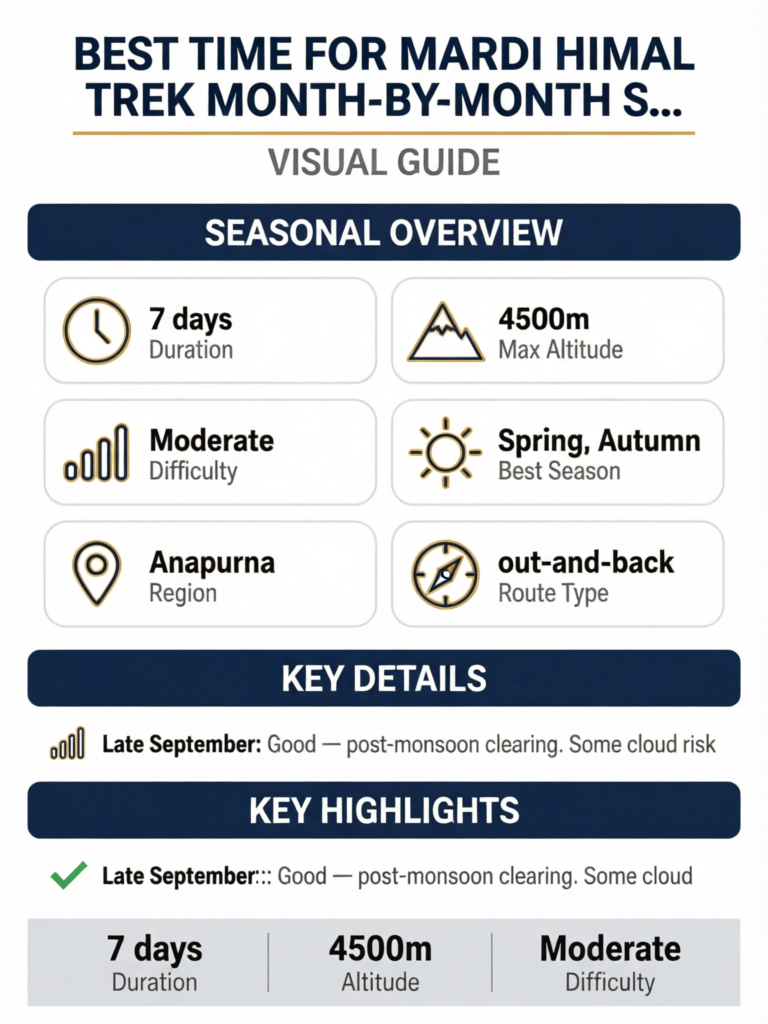
Late September: Good — post-monsoon clearing. Some cloud risk in first week of month.
Spring (March-May): Rhododendron Season
April: Outstanding. The ridge from Kande to Low Camp passes through one of Nepal's most spectacular rhododendron forests. April brings the peak bloom (deep crimson, pink, white) from 1,500-2,900m. Combined with clear mountain views before monsoon clouds build, April is arguably the most beautiful month on this trail.
March: Variable. Can be excellent or cloudy. Later March (post-20th) generally better. Early rhododendron blooms at lower elevations.
May: Warm and occasionally dramatic. Afternoon clouds common. Some remaining bloom at higher elevations. Good views in mornings, clouds typical after noon.
Winter (December-February)
December: Cold but clear. Ridge wind can be strong and cold at High Camp and Upper Viewpoint. Views are excellent when wind is low. Not recommended for inexperienced cold-weather trekkers.
January-February: Significant wind risk on the upper ridge. Upper Viewpoint can have strong, dangerous winds. For experienced cold-weather trekkers with adequate gear only. Trail may have icy sections above 3,000m.
Ridge Wind Warning
The Mardi Himal upper ridge (High Camp to Upper Viewpoint) is significantly more exposed to wind than the sheltered Annapurna sanctuary trail. Winter months (December-February) can bring sustained winds of 50-80km/h on the upper ridge, making the section above High Camp challenging or dangerous. Check conditions with local teahouse operators before ascending.
Monsoon (June-August): Avoid
Heavy rain, cloud-obscured views, and leeches in the lower forest. Not recommended for most trekkers.
Month-by-Month Quick Reference
| Month | Weather | Views | Flowers | Crowds | Recommended |
|---|---|---|---|---|---|
| January | Cold/windy | Good | None | Very low | Experienced only |
| February | Cold/windy | Good | None | Very low | Experienced only |
| March | Variable | Variable | Beginning | Low | Yes (late March) |
| April | Good | Good | Peak | Low-Medium | Yes ★★★★★ |
| May | Unstable | Variable | Fading | Low | Yes (early May) |
| June | Monsoon | Poor | None | Very low | No |
| July | Monsoon | Poor | None | Very low | No |
| August | Monsoon | Poor | None | Very low | No |
| September | Clearing | Good | None | Medium | Yes (late Sept) |
| October | Excellent | Best | None | Medium | Yes ★★★★★ |
| November | Good | Very Good | None | Low-Med | Yes ★★★★ |
| December | Cold/windy | Good | None | Very low | Experienced only |
Month-by-Month Detailed Breakdown
January
January is the coldest month on the Mardi Himal trail. Daytime temperatures at High Camp (3,580m) hover between -3°C and +4°C, while nights drop to -12°C to -18°C. The upper ridge above High Camp can be bitterly cold with sustained winds that make the exposed section genuinely hazardous. Teahouses remain open but operate with minimal staff and a stripped-down menu — expect dal bhat and little else at the higher camps. Skies are frequently crystal clear when wind is not active, and the views from High Camp can be stunning in still air. This month suits only trekkers with solid cold-weather camping experience, high-quality sleeping gear rated to -20°C, and full crampons or microspikes for the icy upper trail sections.
February
February carries similar conditions to January with one notable improvement: the winds sometimes ease in the second and third weeks of the month as the winter jet stream begins its seasonal shift northward. Some experienced trekkers specifically target late February for an uncrowded winter experience with better wind odds than January. Snow cover above 3,000m is possible and the forest trail between Kande and Low Camp can have icy patches in morning shade. Teahouses are operational but expect limited food variety and solo or near-solo trekking conditions. The rhododendron trees are bare, and there are no other compensating visual rewards beyond the mountain views themselves — which, on a clear day, are exceptional.
March
March is a transitional month with high variability, particularly in the first half. Early March (1st-15th) can deliver excellent spring clarity or frustrating cloud and some residual winter cold. The second half of March shifts decisively toward stable conditions. Rhododendron buds begin appearing at lower elevations (1,500-2,200m) from mid-March, with early blooms by month's end at the most sheltered south-facing slopes below Low Camp. Temperatures are noticeably warmer than February, making the high camps more comfortable. Trekking crowds are very light throughout March. This is one of the best months for experienced trekkers who prefer solitude and are willing to accept some weather variability in exchange for lower crowds and the start of the rhododendron season.
April
April is jointly the best month on the Mardi Himal trail alongside October, but for entirely different reasons. The rhododendron forest between Kande and Low Camp explodes into bloom from late March through mid-April, with peak color typically around the first two weeks of April. The forest canopy from 1,800-2,900m is layered with crimson, pink, and white blooms — among the finest rhododendron displays in the Annapurna region. Combined with pre-monsoon clarity that still delivers reliable mountain views in the mornings, April creates a trail experience that no other Annapurna route offers at comparable cost. Temperatures are comfortable at all elevations, crowds remain low relative to the trail's quality, and teahouses operate full menus. April is the recommended starting point for first-time Mardi Himal trekkers.
May
May offers warm conditions and the tail end of the rhododendron bloom at higher elevations (2,500-3,200m). The main trade-off is afternoon cloud buildup that becomes more pronounced as the month progresses toward monsoon onset. Morning views are generally very good, but the characteristic instability of pre-monsoon Nepal means afternoon storms are more frequent than in April. The practical strategy in May is to aim for an early morning summit push to Upper Viewpoint — starting from High Camp no later than 6:00 AM — to reach the viewpoint before clouds build after 10:00 AM. Early May (1st-15th) is significantly more reliable than late May. Trekkers who can commit to an early alpine start find May a rewarding, crowd-free month.
June
June marks the onset of the monsoon. The lower rhododendron forest fills with leeches, the trail becomes muddy and slippery, and clouds persistently obscure the mountain views that define Mardi Himal's appeal. Teahouses remain technically open but staff is minimal and the trail may have some sections of overgrowth or water damage. For most trekkers, there is no compelling reason to visit in June. The views that make the 4,500m climb worthwhile simply are not visible through monsoon clouds, making the physical effort unrewarding.
July
July is the height of the monsoon. Rainfall in the Pokhara region can exceed 800mm for the month — the heaviest precipitation of the year. The Mardi Himal trail from Kande to Forest Camp sees heavy daily rain, mist, and dense cloud. Upper Viewpoint is rarely visible even from High Camp. Leeches are active throughout the forest zone. Some trekkers complete the route in July for the experience of a monsoon forest — the lower trail is genuinely beautiful in the rain, with waterfalls, mossy trees, and dramatic cloud — but the mountain payoff at the top is absent. Not recommended for trekkers whose primary objective is mountain views.
August
August is marginally drier than July in some years as the monsoon begins its slow retreat, but remains firmly in the wet season. Cloud cover over the upper ridge is near-continuous. The Nepal Tourism Board sees its lowest permit numbers for Annapurna region treks in August. Teahouse operators use August for maintenance and repairs. If you must trek in August for unavoidable reasons, the lower forest section (Kande to Low Camp) remains walkable and the rhododendron forest has a lush monsoon quality that is genuinely attractive — just manage your expectations about summit visibility and plan for wet gear and trail conditions.
September
September is divided. The first two weeks often carry monsoon characteristics — cloud, rain, and poor visibility — while the second half of September typically sees the monsoon retreating and the first extended clear windows of autumn. Late September (20th onward) can be outstanding, with the post-monsoon atmosphere delivering some of the year's clearest mountain views. The trail is freshly washed and green, waterfalls are at full flow, and trekker numbers are low because many visitors wait for October. For trekkers willing to monitor the weather forecast and be flexible on start date, the last week of September offers October-quality views with significantly lower trail traffic.
October
October is the gold standard month for Mardi Himal. The monsoon has retreated fully, autumn high-pressure systems deliver week-long stable weather windows, and the mountain views from Upper Viewpoint are at their absolute best. The panorama from 4,500m on a clear October morning — Annapurna South, Hiunchuli, Machapuchare directly overhead, Annapurna I in the background — is among the finest mountain viewpoints in Nepal accessible without technical climbing. Temperatures are ideal at all elevations: cool and crisp at the high camps, warm in the lower forests. Even in October, Mardi Himal's crowd numbers are a fraction of nearby Poon Hill or ABC — High Camp teahouses rarely see more than 15-20 trekkers at a time. There is no better month to be on this trail.
November
November is the second-best month, offering conditions almost as good as October with meaningfully fewer trekkers. The main difference from October is temperature: nights at High Camp reach -10°C to -15°C in November, requiring a proper sleeping bag (minimum -10°C rated) and a down jacket. Daytime views remain excellent through most of November, with some years delivering particularly crisp visibility as cold dry air descends from the north. By late November, the upper ridge begins to feel genuinely cold and the wind can have a bite to it. The rhododendron forest is bare, but the gold and red of deciduous undergrowth offers its own seasonal beauty. Trekkers who prioritize quietness and don't mind cold nights should consider November their primary option.
December
December sits at the borderline of the viable season. Conditions can be excellent in the first two weeks — cold, clear, and windless — or difficult with sustained ridge winds by mid-month. The upper trail above High Camp may have ice and some sections require careful footing. Teahouses remain open in December and are well-heated by the standards of the trail, but food variety is reduced and hot water for showers is less reliable. The mountain views on clear days are spectacular, and the absence of any other trekkers creates a profound sense of solitude. For experienced cold-weather trekkers who specifically seek a December mountain experience, Mardi Himal can deliver — but the weather window must be confirmed with local teahouse operators before committing to the upper ridge.
Temperature Data by Month and Elevation
All temperatures are approximate based on meteorological data and teahouse operator reports. Individual days vary significantly. Wind chill at High Camp and Upper Viewpoint is not reflected here — actual perceived temperatures on exposed ridge sections can be 8-12°C lower than air temperature in strong wind.
| Month | Low Camp (2,985m) Day | Low Camp Night | High Camp (3,580m) Day | High Camp Night | Upper Viewpoint (4,500m) Day |
|---|---|---|---|---|---|
| January | 4°C | -4°C | -1°C | -12°C | -8°C |
| February | 6°C | -3°C | 1°C | -10°C | -6°C |
| March | 10°C | 2°C | 6°C | -5°C | 0°C |
| April | 15°C | 6°C | 10°C | 0°C | 5°C |
| May | 18°C | 9°C | 13°C | 4°C | 8°C |
| June | 20°C | 13°C | 15°C | 7°C | 10°C |
| July | 20°C | 14°C | 15°C | 8°C | 11°C |
| August | 20°C | 14°C | 14°C | 7°C | 10°C |
| September | 18°C | 11°C | 12°C | 4°C | 7°C |
| October | 15°C | 5°C | 9°C | -2°C | 3°C |
| November | 9°C | -1°C | 4°C | -8°C | -3°C |
| December | 5°C | -3°C | -1°C | -12°C | -7°C |
Precipitation Data by Month
The Pokhara region receives among the highest annual rainfall in Nepal due to its position at the base of the Annapurna massif. The Mardi Himal trail lies in the rain shadow's outer zone — slightly drier than Pokhara's lake district but still significantly wetter than the Kali Gandaki rain shadow.
| Month | Precipitation Character | Trail Impact | Upper Ridge Visibility |
|---|---|---|---|
| January | Minimal (0-20mm) | Dry, possibly icy above 3,000m | Excellent on clear days |
| February | Low (10-30mm) | Dry to slightly damp | Good to excellent |
| March | Low-moderate (30-60mm) | Occasional rain days | Variable |
| April | Moderate (60-100mm) | Some rain afternoons | Good mornings, variable afternoons |
| May | High (100-180mm) | Regular afternoon rain | Good mornings only |
| June | Very high (400-600mm) | Heavy daily rain, leeches | Poor to none |
| July | Heaviest (500-700mm) | Saturated trails, streams high | None |
| August | Very high (450-600mm) | Wet trails, mist | None to poor |
| September | Declining (200-350mm) | Improving, some wet sections | Variable to good (late Sept) |
| October | Low (30-80mm) | Dry, excellent | Best of year |
| November | Very low (10-30mm) | Dry | Excellent |
| December | Very low (5-20mm) | Dry, potentially icy | Good to excellent |
Photography and Lighting Conditions
Mardi Himal is a significantly better photography location than its relative obscurity suggests. The ridge alignment provides direct views of Machapuchare (Fishtail) from the east, creating compositions unavailable from the Annapurna sanctuary itself where Machapuchare's symmetry is disrupted.
Golden Hour and Blue Hour
Upper Viewpoint (4,500m): The summit faces west-northwest, making it an exceptional location for both sunrise and the hour after. At sunrise, alpenglow lights Annapurna South and Annapurna I in deep orange and red before transitioning to gold — typically a 20-30 minute window. Sunset lighting is more complex: from Upper Viewpoint, late afternoon sun does not directly illuminate the south face of the massif, making it better for atmospheric haze shots than color photography. The optimal photography moment at Upper Viewpoint is 30-45 minutes before and after sunrise.
High Camp (3,580m): More accessible for overnight stays, High Camp's eastward-facing position captures Machapuchare in full profile at sunrise. The peak's perfect pyramid shape is most clearly defined at High Camp than at any other accessible point in the Annapurna region. Dawn is the primary photography window — clouds typically begin building by 10:00 AM even in stable weather.
Forest sections (below 3,000m): The rhododendron forest between Kande and Low Camp is at its photographic best in soft morning or afternoon light, not midday. April's bloom under diffuse morning cloud (not direct harsh sun) creates the best flower photography conditions — similar to a natural light box effect from the overcast sky.
Cloud Patterns by Season
October and November: The most photographic season. High-pressure systems create low-humidity air with deep blue skies and sharp mountain definition. Morning clarity is guaranteed for 4-5 day stretches. Afternoon cumulus sometimes builds over the high peaks but rarely obscures the lower ridge where High Camp is positioned.
April: Morning clarity is excellent, but cumulus builds from the valleys by 11:00 AM and can create dramatic cloud-mountain compositions in the afternoon. April light is warmer and slightly more golden than October's cooler blue light — preferred by some landscape photographers.
Winter (December-January): The lowest humidity air of the year creates extraordinary atmospheric clarity. Mountain profiles appear almost too sharp. Alpenglow is intense. The trade-off is the wind, which limits time on the exposed upper ridge.
Best Angles and Compositions
- Machapuchare from High Camp at sunrise: The classic Mardi Himal shot. The peak's triangular profile rises directly above the camp in near-perfect symmetry.
- Looking back down the ridge from Upper Viewpoint: The ridgeline drops sharply away toward the Pokhara valley, with layers of forested ridges below and often cloud inversions filling the lowland valleys.
- Rhododendron blooms with Annapurna South in background: Achievable from the upper forest zone (2,500-3,000m) in early April. Requires a telephoto lens (200mm+) for the peak.
- Teahouse at High Camp at blue hour: The single teahouse structure against the dark sky with mountain silhouettes — a minimalist composition unique to this trail.
Teahouse Availability by Season
Unlike more developed routes like ABC or the Annapurna Circuit, Mardi Himal's teahouse network is small and season-dependent. Understanding which camps are reliably staffed matters for planning.
| Camp | Elevation | Peak Season (Oct-Nov, Apr) | Shoulder Season (Sept, Dec, Mar) | Winter (Jan-Feb) | Monsoon (Jun-Aug) |
|---|---|---|---|---|---|
| Kande (start) | 1,770m | Open (transit only) | Open | Open | Open |
| Low Camp | 2,985m | 3-4 teahouses, full service | 2-3 open | 1-2 open | 1 open (minimal) |
| Forest Camp | 3,150m | 2-3 teahouses, full service | 1-2 open | 1 open | 1 open (minimal) |
| High Camp | 3,580m | 4-5 teahouses, good service | 2-3 open | 1-2 open | 1 open (minimal) |
| Upper Viewpoint | 4,500m | No teahouse (day hike only) | — | — | — |
High Camp Pre-Booking
In October and April, the 4-5 teahouses at High Camp can accommodate 50-80 trekkers simultaneously. Even in peak season, pre-booking is generally unnecessary — Mardi Himal does not see the extreme demand of ABC. However, if you are arriving at High Camp on a long weekend or Nepali public holiday, it is worth confirming with your agency that space is available. A simple WhatsApp message to your guide's contacts is sufficient.
No meals or accommodation exist at Upper Viewpoint — it is a day hike destination from High Camp. Carry a packed lunch (cold dal bhat or snacks) for the viewpoint day.
Festival and Cultural Events Calendar
The Mardi Himal trail passes through lower villages and the Pokhara region with a rich festival calendar. Timing your trek around major festivals adds cultural depth to your trip — or, for some, should be avoided to prevent disruption to transport and permit processing.
| Month | Festival / Event | Relevance to Trekkers |
|---|---|---|
| January | Maghe Sankranti (mid-Jan) | Minor — Pokhara market closures possible |
| February | Losar (Tibetan New Year, dates vary) | Celebrated in higher villages; see traditional rituals |
| March | Holi (color festival, full moon) | Pokhara streets are chaotic on this day — fun or inconvenient |
| April | Baisakh (Nepali New Year, Apr 13-14) | Permit offices may close 1-2 days; book permits before |
| April | Ram Navami | Temple visits, local celebrations |
| August | Janai Purnima / Raksha Bandhan | Sacred lake visit to Gosaikunda attracts pilgrims |
| September/October | Indra Jatra (Kathmandu) | Main cultural festival; travel to KTM may be busy |
| October | Dashain (dates vary — check annually) | Most significant Hindu festival. Teahouses may have reduced staff; permit offices close 3-5 days. Plan around Dashain carefully |
| October/November | Tihar (Diwali Nepal) | Beautiful lights festival; Pokhara celebrations are excellent to witness |
| November | Chhath | River festivals in Terai; minimal impact on Pokhara region |
Dashain Planning
Dashain falls in October (October 3-16 in 2026)(dates vary annually — check exact dates for 2026). During Dashain's main period, Nepal effectively pauses for 3-5 days. Permit offices in Pokhara and Kathmandu close, transport services are reduced, and teahouse staff may return to their home villages. If your trek dates coincide with Dashain, obtain permits before the festival begins, confirm that your guide will not be taking leave, and plan for reduced services on trail. Many experienced trekkers specifically schedule their trek to complete the upper ridge section before Dashain begins.
Comparison: Mardi Himal vs Poon Hill vs ABC — Best Timing
All three routes share the Annapurna region's general seasonal pattern, but each has specific characteristics that make certain months optimal.
| Factor | Mardi Himal (7 days) | Poon Hill (4-5 days) | ABC (11 days) |
|---|---|---|---|
| Best month | October or April | October | October |
| Second best | November | April | November or April |
| Rhododendron peak | April (3 weeks) | April (outstanding) | April (lower trail) |
| Crowd level (peak) | Very low | High to very high | Moderate |
| Monsoon suitability | Poor | Poor | Very poor |
| Winter access | Limited (wind) | Good (lower altitude) | Possible (experienced) |
| Unique seasonal feature | Wind exposure (ridge) | Sunrise Ghorepani | Sanctuary snowfall (winter) |
| Best for photographers | April (bloom) or Oct (clarity) | October (classic sunrise) | October (sanctuary views) |
| Avoid months | Jun-Aug, Jan-Feb (beginners) | Jun-Aug | Jun-Aug |
Choosing between them on timing alone:
- If you can only go in March: ABC or Poon Hill for reliability; Mardi Himal in late March only
- If you go in April: Mardi Himal is arguably the best option due to the rhododendron ridge experience
- If you go in October: All three are excellent; Poon Hill gets crowded, Mardi Himal stays quiet
- If you go in November: Mardi Himal or ABC; Poon Hill crowds thin noticeably in November too
Packing Variations by Season
Spring (April-May): Standard Mardi Himal Kit
- Base layer (merino or synthetic) — 2 sets
- Mid-layer fleece or light down jacket
- Waterproof shell jacket — essential for afternoon rain
- Trekking trousers (lightweight)
- Warm hat and gloves for High Camp mornings
- Sleeping bag: -5°C rated is sufficient for April; -10°C for May shoulder dates
- Trekking poles: recommended for descent
- Gaiters: optional (forest trail can be muddy)
Autumn (October-November): Same Kit, Colder Sleepwear
Everything in the spring list applies, with these additions for November specifically:
- Heavier down jacket (not a mid-layer — a proper down) for above High Camp
- Sleeping bag rated to -10°C minimum for November; -15°C for late November
- Balaclava or face cover for the exposed upper ridge wind
- Hand warmers for viewpoint day (chemically-activated, inexpensive, buy in Pokhara)
Winter (December-February): Full Cold Weather Setup
- Down jacket rated to -15°C activity level (not just standing around)
- Sleeping bag rated to -20°C (High Camp nights reach -15°C without wind chill)
- Microspikes or crampons (essential above 3,000m from December)
- Insulated trekking trousers (not just a standard shell over base layers)
- Goggles or glacier glasses (wind protection for the upper ridge)
- Extra hand and toe warmers — carry 4-6 pairs minimum
- Trekking poles with large basket attachments for snow
What to Leave Out in Spring
- Crampons / microspikes (not needed April-May)
- Heavy insulated gloves (light fleece gloves sufficient in April)
- Balaclava (warm hat is enough in April)
- Extra down layers (one good down jacket is sufficient)
The Mardi Himal Advantage: Low Crowds Year-Round
Unlike Poon Hill (3,210m, very crowded) or ABC (4,130m, moderate crowds), Mardi Himal sees minimal traffic even in peak season. October and April — the busiest months — rarely see more than 20-30 trekkers per day on trail. High Camp teahouses are almost never full.
Practical implication: No need to rush to lodges by 2 PM. No competition for rooms. A quieter, more contemplative mountain experience even in "peak season."
Best Conditions for Upper Viewpoint
The 4,500m Upper Viewpoint is the trek's defining moment. Maximum clarity requires:
- Stable weather system: 2-3 consecutive clear days before your viewpoint day
- Early morning start: Clouds typically build from 10 AM onward
- No recent snow: Fresh snow can make the upper ridge slippery
- Low wind: Check conditions with your teahouse operator at High Camp
Best months for guaranteed viewpoint clarity: October, early November, April (stable systems).
Is Mardi Himal Safe to Trek in Winter?
The Mardi Himal trek is possible in winter (December-February) but the exposed ridge between High Camp and Upper Viewpoint experiences severe wind chill. Temperatures at High Camp (3,580m) can drop to -15°C or below at night. Snow on the upper ridge can make the trail slippery and navigationally challenging. For experienced trekkers with proper cold-weather gear, winter Mardi offers stunning clear-sky views and near-empty trails.
Frequently Asked Questions
When is the best time for the Mardi Himal trek?
October and April are the best months. October delivers crystal-clear Machhapuchhre and Annapurna views, while April adds rhododendron blooms on the lower trail. November is equally excellent with fewer trekkers.
How windy is the Mardi Himal ridge?
The ridge section above High Camp is significantly more wind-exposed than sheltered valley treks like ABC. Wind speeds of 30-50 km/h are common in winter and can make the exposed trail feel 10-15°C colder than the actual temperature. Always check conditions with your lodge operator before attempting the viewpoint.
Can I combine Mardi Himal with the ABC trek?
Yes. Some trekkers do Mardi Himal as a 4-5 day addition before or after the ABC trek, since both start from the Pokhara area. The combination provides two distinct Annapurna experiences in 2-3 weeks. See our ABC and Poon Hill combination guide for similar combination planning advice.
Is September too early for Mardi Himal?
Late September can work, but expect afternoon clouds and occasional rain. Mountain views from the ridge may be obscured for portions of the day. The trail is green and lush, and you will have it largely to yourself.
Does the Mardi Himal trail have good tea house accommodation?
Tea house infrastructure on Mardi Himal is more basic than on the ABC route. Lodges at High Camp and above are simple with limited menus and no hot showers. Below Forest Camp, accommodation is comfortable and comparable to the lower ABC trail.