
Annapurna Base Camp Trek Difficulty Level
The Annapurna Base Camp trek difficulty level is Moderate — challenging enough to require preparation, but achievable by any reasonably fit person who trains for it. ABC is not a technical climb, the maximum altitude is only 4,130m, and teahouse infrastructure runs the entire route. The difficulty comes from thousands of stone stairs, a long 1,820m descent, and cold nights above 3,500m — not from danger or extreme altitude.
ModerateABC is rated Moderate — and that rating is accurate. It is not a technical climb, does not reach extreme altitude (maximum 4,130m), and has excellent teahouse infrastructure throughout. The hardest day (the 1,820m descent from ABC to Bamboo on Day 9) is physically demanding but not dangerous. No trekker who is reasonably fit and follows a proper itinerary pace should be unable to complete ABC.
That said, "moderate" can mislead. Over 10-11 days, you will gain and lose several thousand meters of altitude. There are steep stone staircases, river gorge sections with exposure, and cold nights above 3,500m. This assessment explains exactly what to expect from the difficulty level of the Annapurna Base Camp trek, how the altitude affects you, and whether ABC is safe for first-timers planning a Nepal trek.
Moderate
Day 2 (Ulleri climb) or Day 6 (Deurali ascent)
None — walking only
4,130m (Annapurna Base Camp)
Low to Moderate (lower than EBC)
Regular walking 3-4 hours/day before trek
~90% of those who start
Stomach illness (not altitude)
Why ABC is Rated Moderate
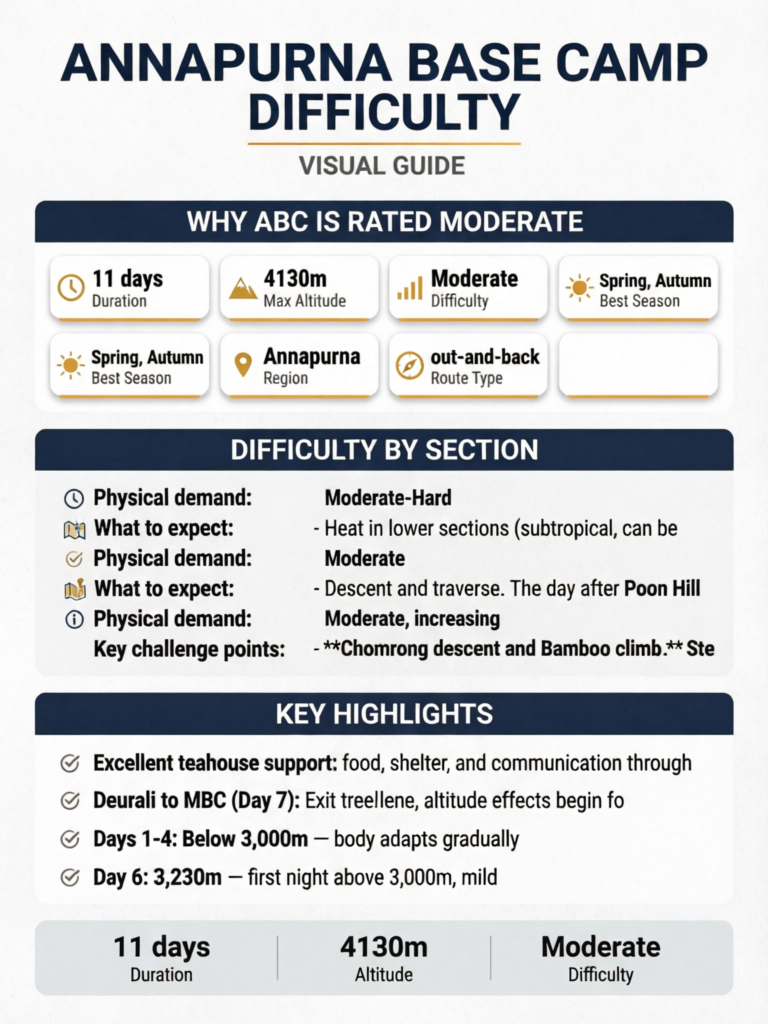
What keeps it at Moderate, not Hard:
- Maximum altitude of 4,130m vs EBC's 5,364m or Thorong La's 5,416m
- No technical terrain — no snow, ice, or scrambling in normal conditions
- No single extremely long or strenuous day (no "Thorong La equivalent")
- Well-maintained trail with clear markings throughout
- Excellent teahouse support: food, shelter, and communication throughout
- Guides not legally mandatory — experienced trekkers complete independently
What stops it being Easy:
- Significant cumulative elevation gain and loss (7,000+ meters total)
- 10-11 days duration requires sustained effort and fitness
- Cold temperatures above 3,500m require acclimatization and gear
- Some steep stone staircases with no bypass
Distance, Duration, and Daily Walking Hours
A big part of the ABC difficulty level is simply the time on your feet. The trek is a 10-11 day out-and-back route covering roughly 110-115km round trip, depending on your start and end points. Most days involve 5-7 hours of walking, with a couple of longer days on the steep staircase sections.
| Day | Typical Walking Time | Difficulty |
|---|---|---|
| Day 1-2 (to Ghorepani via Ulleri) | 6-7 hours | Moderate-Hard (stairs) |
| Day 3-4 (Poon Hill, descent to Chhomrong) | 6-8 hours | Moderate (knees) |
| Day 5-6 (Chhomrong to Deurali) | 5-7 hours | Moderate, climbing |
| Day 7-8 (Deurali to MBC to ABC) | 4-6 hours | Moderate, altitude |
| Day 9 (ABC to Bamboo descent) | 7-8 hours | High (descent) |
| Day 10 (Bamboo to Jhinu/road) | 5-6 hours | Moderate |
The pace is steady rather than punishing — there is no single day comparable to crossing Thorong La on the Annapurna Circuit. What wears trekkers down is the accumulation: 7,000+ meters of total ascent and descent spread across more than a week. A reasonable level of endurance matters more than raw speed or strength.
Difficulty by Section
Section 1: Pokhara to Ghorepani (Days 1-2)
Physical demand: Moderate-Hard Why it's the first real challenge: The climb to Ghorepani via Ulleri involves one of Nepal's most famous staircase sections — roughly 3,500 stone steps gaining approximately 700 vertical meters from Tikhedhunga to Ulleri. It is not technically difficult, but it is relentless.
What to expect:
- Heat in lower sections (subtropical, can be 25-30°C)
- Long stone staircase to Ulleri (1-1.5 hours of steep climbing)
- No technical difficulty, just sustained effort
Who struggles here: Out-of-shape trekkers, those unused to hiking with a pack, those unacclimatized to heat.
Section 2: Ghorepani to Chhomrong (Days 3-4)
Physical demand: Moderate What to expect: Descent and traverse. The day after Poon Hill involves long descent through forest, crossing to Ghandruk, then climbing back up to Chhomrong. Knee-intensive descent, not cardiovascular.
Section 3: Sanctuary Ascent — Chhomrong to ABC (Days 5-8)
Physical demand: Moderate, increasing Why it gets harder: Altitude increases from 2,170m (Chhomrong) to 4,130m (ABC) over 4 days. The trail narrows, accommodation becomes more basic, and temperature drops significantly.
Key challenge points:
- Chhomrong descent and Bamboo climb: Steep stone steps down to river then steep ascent — hard on knees
- Bamboo to Deurali (Day 6): 920m altitude gain, longest single climb in the sanctuary corridor
- Deurali to MBC (Day 7): Exit treeline, altitude effects begin for most trekkers
- MBC to ABC (Day 8): Final 430m at altitude — may feel harder than the numbers suggest due to thin air
Section 4: Return Descent (Days 9-10)
Physical demand: High (musculoskeletal, not cardiovascular) Why it's deceptively hard: The descent from ABC (4,130m) to Bamboo (2,310m) in a single day is 1,820m of altitude loss. Sustained downhill of this magnitude is brutal on knees, quads, and ankles — especially on day 9 of a long trek when legs are already fatigued.
This is where injuries happen. Most ankle twists and knee pain on ABC occur on the descent, not the ascent. Use trekking poles, take breaks, and don't rush.
Trail Conditions: What You Actually Walk On
The Annapurna Base Camp trail is well-built and well-trodden, but the surfaces change constantly — and understanding them is half of judging the difficulty.
- Stone staircases (lower trail): The defining feature of ABC. Thousands of stone steps — up to and beyond Ulleri's roughly 3,500-step climb — dominate the first and last days. They are uneven in height and hard on knees, especially descending.
- Forest paths (Chhomrong to Bamboo): Mixed dirt, roots, and stone through the Modi Khola gorge. Sections can be muddy and slippery after rain.
- Rocky and exposed sections (Deurali to MBC): The trail narrows through avalanche-prone terrain above the treeline. In spring and winter, snow can cover parts of this stretch.
- Snow near the sanctuary (seasonal): Between MBC (3,700m) and ABC (4,130m), late-winter and early-spring snow can make footing slick and slow your pace.
The Modi Khola gorge between Deurali and Machapuchare Base Camp passes through known avalanche zones. In heavy-snow winters and early spring, check current conditions with your guide or a verified local agency before crossing. Never push through fresh, unstable snow on these sections.
Annapurna Base Camp Altitude: How High and How It Affects You
The Annapurna Base Camp altitude is 4,130m (13,553 ft) at the sanctuary itself — the highest point of the trek. Machapuchare Base Camp (MBC), where most trekkers sleep the night before, sits at 3,700m. This is moderate by Himalayan standards: well below Everest Base Camp's 5,364m and the Annapurna Circuit's Thorong La at 5,416m.
| Location | Altitude | Notes |
|---|---|---|
| Pokhara (start) | 822m | Subtropical, warm |
| Chhomrong | 2,170m | Gateway to the sanctuary |
| Deurali | 3,230m | First night near 3,000m+ |
| Machapuchare Base Camp (MBC) | 3,700m | Treeline, cold nights |
| Annapurna Base Camp (ABC) | 4,130m | Highest point of the trek |
Because the maximum altitude stays at 4,130m, ABC sits below the threshold where serious altitude illness becomes common. Most healthy adults acclimatize to this height without major complications, provided they ascend gradually and sleep at progressively higher elevations. The altitude profile below shows how the elevation builds across the route.
Altitude Sickness Risk
ABC vs EBC vs Annapurna Circuit
| Trek | Max Altitude | AMS Risk | High-Altitude Days |
|---|---|---|---|
| ABC | 4,130m | Low-Moderate | 3-4 (MBC, ABC, descent) |
| EBC | 5,364m | Moderate-High | 7-9 |
| Annapurna Circuit | 5,416m | Moderate-High | 5-7 |
ABC's 4,130m maximum significantly reduces altitude sickness risk compared to higher treks. Most healthy adults can acclimatize to 4,130m without serious complications if they ascend gradually.
Compared with the Annapurna Circuit, ABC is shorter, lower, and gentler on acclimatization — the Circuit's 5,416m Thorong La Pass crossing is a far bigger altitude challenge. Against Everest Base Camp, ABC is markedly easier on every metric except the sheer number of stairs. For a direct head-to-head, see our ABC vs EBC comparison and the Langtang Valley vs ABC comparison if you are weighing a lower-key alternative.
Acclimatization Profile (11-Day Itinerary)
The 11-day itinerary naturally spaces out altitude gains:
- Days 1-4: Below 3,000m — body adapts gradually
- Day 6: 3,230m — first night above 3,000m, mild symptoms possible
- Day 7: 3,700m — mild AMS symptoms (headache, fatigue) common and manageable
- Day 8: 4,130m — most trekkers reach ABC without serious symptoms
The risk period: Days 7-8 (3,700-4,130m). Typical symptoms: mild headache, reduced appetite, mild nausea, disrupted sleep.
Warning Signs
Stop ascending and rest (or descend) if you experience:
- Severe headache not resolved by ibuprofen
- Vomiting (not just nausea)
- Extreme fatigue or weakness at rest
- Loss of coordination or confusion
- Persistent dry cough or breathlessness at rest
Fitness Requirements
Minimum Fitness Level
You can trek ABC comfortably if you can:
- Walk 3-5 hours with a light day pack without significant fatigue
- Climb several flights of stairs without stopping
- Complete a 5km walk with 300m elevation gain in under 2 hours
Recommended Preparation (8-12 Weeks Before Trek)
Cardiovascular: 3-4 sessions per week of sustained aerobic exercise (hiking, cycling, swimming). Build to 3 hours continuous by 4 weeks before departure.
Strength: Focus on quads (for descent), hip flexors, and calves. Stair climbing with a weighted pack is the most specific preparation.
Practice hike: At least one full-day hike (6+ hours, 600m+ elevation) with your actual trekking pack, wearing your trekking boots.
Common Difficulties and Solutions
| Problem | When | Solution |
|---|---|---|
| Knee pain on descent | Days 9-10 | Trekking poles; anti-inflammatories |
| Altitude headache | Days 7-8 | Rest, hydrate, ibuprofen; don't ascend further |
| Stomach illness | Any | Hand sanitizer before every meal; avoid raw vegetables |
| Blisters | Days 2-3 | Treat immediately; moleskin; liner socks |
| Heat exhaustion (lower) | Days 1-3 | Early starts; adequate hydration; rest midday |
How Seasons Change the Difficulty Level
The season you choose has a real effect on how hard ABC feels. The trail does not move, but weather changes the surfaces, the temperatures, and the risk.
- Spring (March-May): Stable weather and rhododendron forests in bloom. Lingering snow near MBC and ABC early in the season can slow the final approach. One of the two best windows — see the best time for the ABC trek.
- Autumn (late September-November): The most popular and arguably easiest season — clear skies, dry trails, and comfortable temperatures. Trails are busy, but conditions are at their kindest.
- Winter (December-February): Cold nights well below freezing above 3,500m and a genuine snow/avalanche risk in the sanctuary. The trek is doable for prepared trekkers but meaningfully harder. Some teahouses near ABC close.
- Monsoon (June-August): Slippery stone steps, leeches in the forest, cloud cover hiding the peaks, and a higher landslide risk on the access roads. The hardest season for footing — covered in our monsoon trekking guide.
Pro Tip
For your first Himalayan trek, target late October or April. Dry trails, settled snow, and clear mountain views remove the variables that turn a Moderate trek into a hard one.
Is the Annapurna Base Camp Trek Safe?
Yes — the Annapurna Base Camp trek is one of the safer multi-day treks in Nepal when you trek in season and follow a sensible itinerary. There is no technical climbing, the altitude tops out at a manageable 4,130m, and teahouses, food, and communication exist along the whole route. The completion rate is around 90% of those who start, and the most common reason for not finishing is stomach illness rather than altitude.
The genuine risks to be aware of, in rough order of likelihood:
- Stomach illness and food/water hygiene — the number-one trip-ender. Sanitize hands before every meal, purify your water, and avoid raw vegetables and questionable meat.
- Slips and falls on stairs — most ankle and knee injuries happen descending. Trekking poles and unhurried footing prevent the majority.
- Mild altitude sickness (AMS) — uncomfortable but rarely serious at 4,130m if you ascend gradually. Know the signs and turnaround rules.
- Avalanche in the Modi Khola gorge — a real but seasonal and manageable risk; cross the Deurali-MBC section in good conditions and avoid it after heavy snowfall.
Carry comprehensive travel insurance with helicopter evacuation cover for any Nepal trek above 4,000m. It is the single most important safety step you can take before you leave home.
Guided vs Independent: Which Is Easier?
ABC can be trekked independently — guides are not legally mandatory on this route, and experienced trekkers complete it on their own. But "easier" depends on what you want to manage.
A guide makes the trek easier if you:
- Are on your first Himalayan trek or first time at altitude
- Want someone monitoring you for AMS symptoms and making the descent call
- Prefer not to handle teahouse booking, route-finding in snow, or logistics
- Want local context on Gurung culture and the landscape
Independent trekking suits you if you:
- Have multi-day mountain experience and are confident with navigation
- Want maximum flexibility on pace and overnight stops
- Are comfortable self-managing altitude and hygiene
Hiring a porter (whether you take a guide or not) removes a large share of the physical difficulty by carrying the bulk of your load, leaving you a light daypack on the stairs. If you do book support, book with a verified local agency and read up on porter ethics and fair loads.
Mental Preparation: The Difficulty Nobody Warns You About
Physical fitness gets all the attention, but ABC is also a test of patience and motivation. By Day 6 or 7, the early excitement fades, your legs are tired, the teahouses are colder and more basic, and the relentless up-and-down of stone steps becomes monotonous. Trekkers who quit rarely do so because they physically can't continue — they lose the will to.
Prepare for this the way you prepare your legs:
- Break the day into segments. Focus on reaching the next teahouse or tea stop, not the summit.
- Expect a low point. Knowing the mid-trek slump is normal makes it far easier to push through.
- Pace deliberately on the stairs. A slow, steady rhythm beats stop-start bursts that exhaust you mentally and physically.
- Sleep, hydrate, and eat enough. A bad night or skipped meal turns a moderate day into a miserable one.
Common Mistakes That Make ABC Harder Than It Should Be
Most of the difficulty trekkers experience is self-inflicted and avoidable. The biggest mistakes:
- Under-training the legs for stairs. ABC is defined by stone steps; weighted stair training is the single most specific preparation you can do.
- Rushing the descent. Pounding down the 1,820m drop to Bamboo on Day 9 is how knees and ankles get hurt.
- Skipping water purification or hygiene. Stomach illness ends more ABC treks than altitude does.
- Choosing too short an itinerary. Compressing the ascent raises AMS risk and removes recovery time. The standard 11-day ABC itinerary paces altitude sensibly.
- Carrying too much. An overloaded pack turns every staircase into a grind — review a complete ABC packing checklist.
- Ignoring the weather window. Trekking in monsoon or deep winter adds difficulty that the route itself does not.
See our wider guide to common beginner trekking mistakes in Nepal to avoid the rest.
Is ABC Right for You?
ABC is probably right for you if:
- You are generally fit and active (not necessarily an athlete)
- You have 10-12 days available
- You want your first significant Himalayan experience
- You prefer moderate altitude to extreme altitude
- You are comfortable with basic teahouse accommodation
Consider EBC or Annapurna Circuit instead if:
- You want the highest possible altitude experience
- You are an experienced trekker seeking a greater challenge
- You have significant previous high-altitude experience
Consider Poon Hill instead if:
- You have less than 6 days available
- You are recovering from injury
- You want to test Nepal trekking before committing to a longer route
Do I Need to Be Fit for Annapurna Base Camp?
You need a reasonable level of fitness but not athletic-level conditioning. The minimum requirement is the ability to walk 4-6 hours per day for 10-11 consecutive days while carrying a daypack. If you can comfortably hike 10-15km on hilly terrain at home, you can complete ABC. A cardiovascular training plan starting 8-12 weeks before departure significantly improves your experience and reduces injury risk.
Frequently Asked Questions
Is the Annapurna Base Camp trek hard for beginners?
ABC is rated Moderate and is achievable by reasonably fit beginners who prepare adequately. It is one of the best beginner treks in Nepal for those willing to commit to 10-11 days. The trail has no technical sections -- it is walking only.
What is the hardest day on the ABC trek?
Day 2 (the Ulleri staircase climb of approximately 3,500 stone steps) and Day 9 (the 1,820m descent from ABC to Bamboo) are the most physically demanding. The altitude day reaching ABC (4,130m) is physiologically challenging but the distance is short.
Is ABC or EBC harder?
EBC is harder than ABC primarily because of higher altitude (5,364m vs 4,130m), longer duration (14 days vs 10-11 days), and more demanding acclimatization requirements. ABC is the better choice for first-time trekkers.
Can I get altitude sickness on the ABC trek?
Yes, though the risk is lower than on higher treks. AMS symptoms can begin above 3,500m. The Annapurna Circuit packing list and altitude sickness prevention strategies apply equally to ABC.
How do I train for the ABC trek?
Start training 8-12 weeks before departure with regular hiking, stair climbing, and cardio exercises. See our 8-week ABC training plan for a structured program, or the EBC training plan, which works equally well for ABC preparation.
What is the difficulty level of the Annapurna Base Camp trek?
The difficulty level of the Annapurna Base Camp trek is Moderate. There is no technical climbing, the maximum altitude is 4,130m, and the trail is well-maintained with teahouses throughout. The main physical demands are the thousands of stone stairs and the long 1,820m descent on Day 9 — both manageable with 8-12 weeks of training.
How high is Annapurna Base Camp?
The Annapurna Base Camp altitude is 4,130m (13,553 ft), the highest point of the trek. You sleep the night before at Machapuchare Base Camp (3,700m). At 4,130m the altitude is moderate — well below Everest Base Camp (5,364m) — so serious altitude sickness is uncommon if you ascend gradually.
Is the Annapurna Base Camp trek safe?
Yes. ABC is one of the safer multi-day treks in Nepal, with around a 90% completion rate, no technical sections, and full teahouse support. The main risks are stomach illness, slips on the stairs, and seasonal snow or avalanche in the Modi Khola gorge — all manageable with in-season trekking, good hygiene, trekking poles, and travel insurance with helicopter cover.
Can a beginner do the Annapurna Base Camp trek?
Yes. ABC is one of the best beginner treks in Nepal for those who can commit 10-11 days and train for the stairs. No prior high-altitude or technical experience is required — just steady fitness and sensible pacing.
Plan your Annapurna Base Camp trek with confidence
Compare verified local agencies and get a properly paced ABC itinerary matched to your fitness and season.