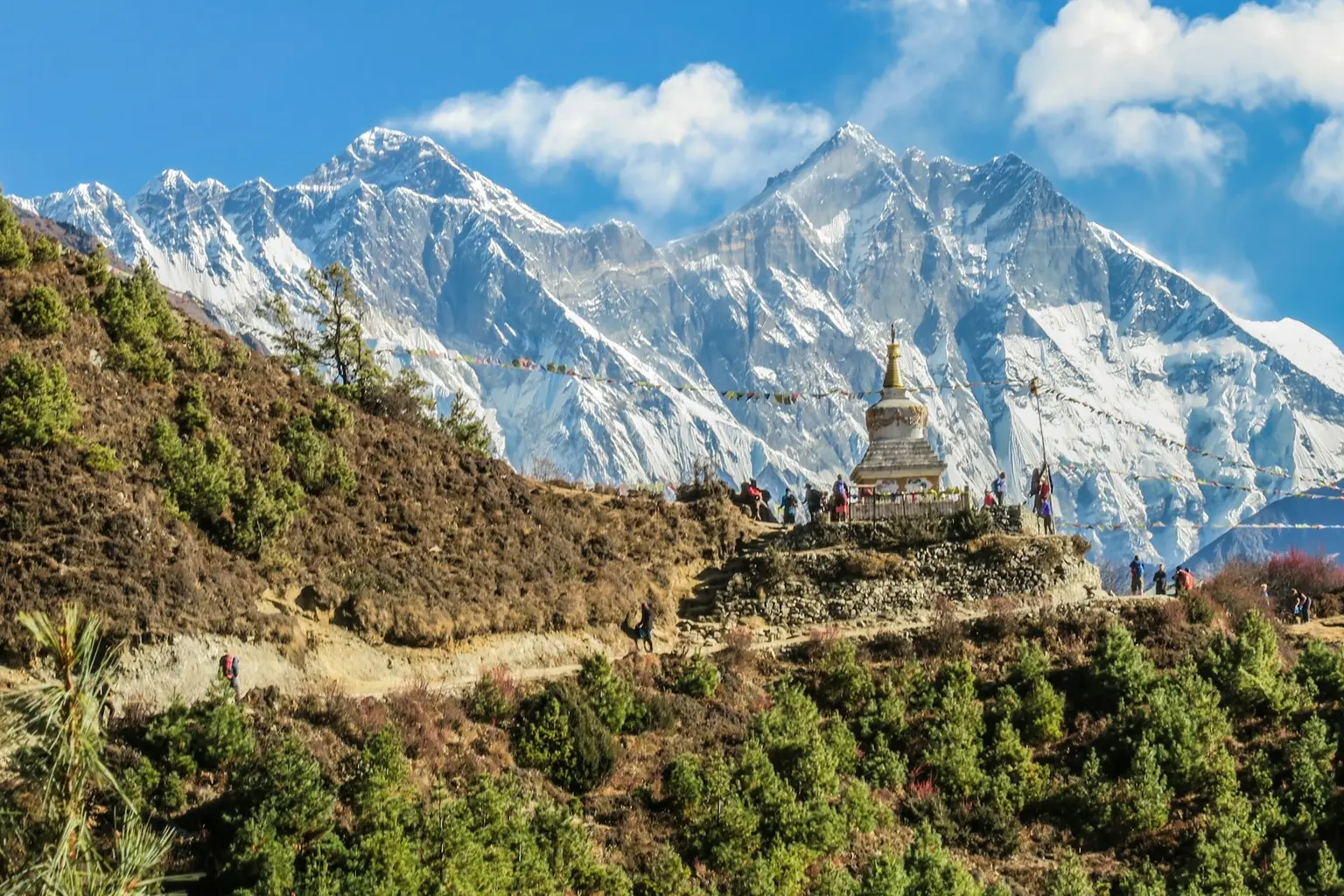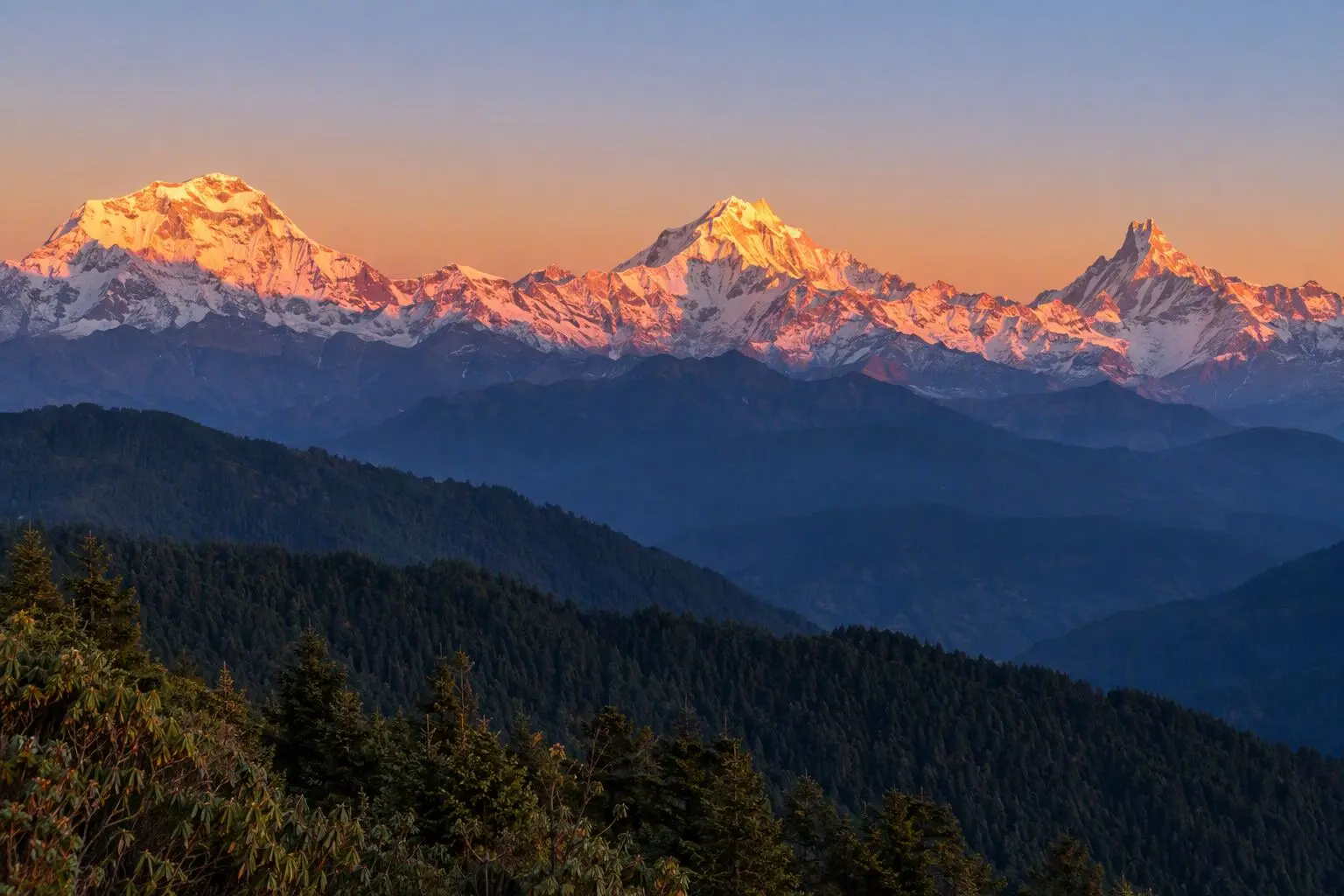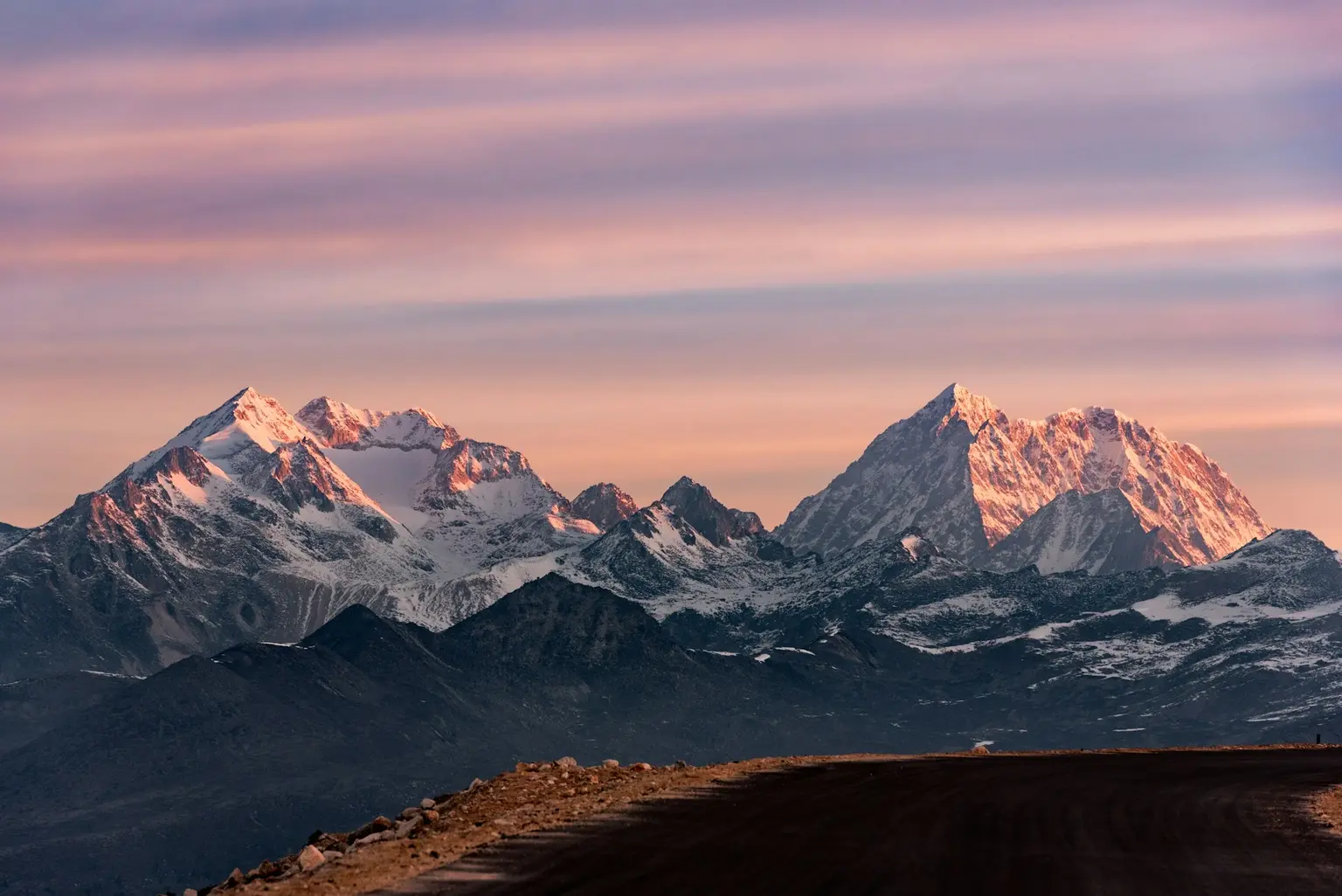

The Annapurna region offers two experiences so distinctive that choosing between them is genuinely difficult. Poon Hill delivers the most famous Himalayan sunrise panorama on Earth. Over 30 peaks appear in a single sweep, including Dhaulagiri and the full Annapurna range, lit by the morning sun above a sea of rhododendron forest. Annapurna Base Camp delivers complete immersion in a glacial sanctuary enclosed by some of the highest walls of mountain on the planet.
Most trekkers pick one. The Poon Hill to ABC extension does both.
In 12-16 days from Pokhara, you trek from the classic Poon Hill sunrise viewpoint (3,210m) through the rhododendron forests of Ghorepani and Tadapani. You then continue directly to the glacial amphitheater of Annapurna Base Camp (4,130m), without returning to Pokhara between the two. The connecting trail from Tadapani to Chhomrong (the logical link between the two routes) is one of the most beautiful sections of forest trekking in the entire Annapurna region.
This guide covers both the 12-day compressed version and the 15-16 day relaxed version, explains the route options (Poon Hill first versus ABC first), details the logistics of connecting the two trails, and helps you decide whether this combination is the right choice for your time, fitness, and goals.
- Total Duration
- 12-16 days (see itinerary options)
- Maximum Altitude
- 4,130m (Annapurna Base Camp)
- Poon Hill Altitude
- 3,210m (sunrise viewpoint)
- Total Distance
- 100-115km
- Difficulty
- Moderate to Challenging
- Best Seasons
- March-May (rhododendrons), October-November (views)
- Permits
- ACAP ($23) + TIMS ($15) -- covers entire route
- Daily Budget
- $25-45/day on trail
- Key Connecting Trail
- Tadapani to Chhomrong (Day 4 link)
- Recommended For
- First-time Nepal visitors wanting the full Annapurna experience
Why Extend Poon Hill to Include ABC?
The Case for Doing Both
Poon Hill and ABC are the two most popular treks in the Annapurna region, and for good reason. Each delivers something the other cannot:
Poon Hill gives you breadth: A 360-degree panorama from a single viewpoint that takes in over 30 Himalayan peaks, from Dhaulagiri (8,167m, seventh highest) to the full Annapurna massif. The sunrise from 3,210m, with the peaks rising from a valley of rhododendron forest and morning mist, is one of the most celebrated mountain sunrises in Nepal.
ABC gives you depth: You walk into the mountains rather than looking at them from a distance. The glacial sanctuary at 4,130m puts you inside a ring of 7,000-8,000m peaks. Annapurna I (8,091m) is not a distant pyramid on the horizon. It is a wall of ice directly above you.
The extension trek gives you both experiences in one continuous trek, joined by a logical trail link between the two routes.
What You Save Versus Two Separate Trips
| Factor | Poon Hill (separate) + ABC (separate) | Poon Hill + ABC Extension |
|---|---|---|
| Total days needed | 13-14 days (3-4 + 10) | 12-16 days |
| Trips from Pokhara | 2 | 1 |
| Permit costs | $76 ($38 x 2) | $38 |
| Transport costs | 2 x Pokhara-Nayapul | 1 round trip |
| Poon Hill sunrise | Yes | Yes |
| Annapurna Base Camp | Yes | Yes |
| Rhododendron forest | Yes (Poon Hill section) | Yes (extended section) |
| Connecting trail (Tadapani to Chhomrong) | Not walked | Included |
The combination saves one permit set ($38), one Pokhara departure trip, overlapping logistics, and the wasted days of returning to Pokhara between treks. For a first-time Nepal visitor who wants the complete Annapurna experience, the extension is the most efficient and rewarding approach.
Best Value Trek in the Annapurna Region
The Poon Hill to ABC extension offers the best "experience per day" ratio of any Annapurna trek. In 12-16 days, you walk through more ecosystems (subtropical farmland, rhododendron forest, alpine scrub, glacial moraine) than on any single-destination itinerary in the region. You also visit more cultural villages (Ghorepani, Tadapani, Ghandruk optional, Chhomrong) and reach two famous destinations. If you have the time, this is the most complete Annapurna trek.
Route Options: Which Direction Should You Go?
Option A: Poon Hill First (Recommended)
Nayapul → Tikhedhunga → Ghorepani → Poon Hill → Tadapani → Chhomrong → Sanctuary → ABC → (return) → Nayapul
This is the recommended direction for three reasons:
-
Better acclimatization: The Poon Hill section (reaching 3,210m by Day 3) pre-acclimatizes your body before you tackle the higher ABC (4,130m). By the time you arrive at ABC on Day 8-9, you have had 6-7 days of altitude exposure. This is demonstrably better than the standard ABC-only route, which reaches 4,130m with less preparatory altitude exposure.
-
Natural crescendo: Poon Hill is impressive, but ABC is the high point. Starting with the foreground and building to the glacial sanctuary gives the trek a natural progression.
-
Avoids the logistical complication of ending at Ghorepani (not a direct jeep road connection to Pokhara) after the ABC portion.
Option B: ABC First
Nayapul → Chhomrong → Sanctuary → ABC → (return) → Chhomrong → Tadapani → Ghorepani → Poon Hill → Nayapul
This direction works logistically but has disadvantages:
- You reach 4,130m before your body has had time to acclimatize at intermediate altitudes
- You end the trek at Poon Hill (3,210m) rather than building toward it, which feels anticlimactic for many trekkers
- The descent from Ghorepani to Nayapul at the end of a 12-16 day trek feels like a long exit on tired legs
Recommendation: Option A (Poon Hill first) unless you have a specific reason for the reverse direction.
Option C: Adding Ghandruk (16-Day Version)
The maximum Annapurna extension adds Ghandruk, the large Gurung village southwest of Chhomrong, as a full day and overnight. This is the most complete Annapurna experience:
Nayapul → Ghorepani → Poon Hill → Tadapani → Ghandruk → Chhomrong → Sanctuary → ABC → (return) → Jhinu → Nayapul
Ghandruk at 1,940m offers the Gurung Museum, the best cooking on the lower trail, panoramic mountain views, and a full-day cultural immersion that standard itineraries miss. This is the option for trekkers who want the complete cultural and natural picture of the Annapurna region.
Complete Day-by-Day Itinerary (13-Day Core Version)
This 13-day itinerary is the sweet spot: thorough without being rushed.
Pre-Trek Day: Pokhara (822m)
Obtain permits from the Tourism Board office in Damside (open 7 days):
- TIMS Card: NPR 2,000 ($15)
- ACAP Permit: NPR 3,000 ($23)
- Total: NPR 5,000 ($38), which covers the entire combined route
Book transport to Nayapul (shared jeep NPR 500-800 / private NPR 8,000-10,000).
Day 1: Pokhara to Nayapul (1,070m), Trek to Tikhedhunga (1,540m)
Drive: 1.5-2 hours Pokhara to Nayapul Trek Distance: 11km | Time: 4-5 hours | Elevation Gain: +470m
The trek begins at Nayapul, following the Modi Khola river through subtropical farmland. The ACAP checkpoint at Birethanti (1,025m) is your first permit stop, so have both permits ready. The trail continues through small farming villages to Tikhedhunga, a pleasant settlement with several tea houses overlooking the river.
Key waypoints:
- Nayapul to Birethanti (1,025m): 30 minutes, flat and easy
- Birethanti to Hille (1,475m): 2 hours, gentle ascent
- Hille to Tikhedhunga (1,540m): 1.5 hours
Accommodation: Tea houses at Tikhedhunga ($4-8/night)
Day 2: Tikhedhunga to Ghorepani (2,860m)
Trek Distance: 11km | Time: 6-7 hours | Elevation Gain: +1,320m | Difficulty: Challenging
The hardest day of the Poon Hill section. The stone staircase from Tikhedhunga to Ulleri (approximately 3,300 steps) gains 530m in less than 3km, and it is slow and relentless. Above Ulleri, the trail enters rhododendron forest that extends all the way to Ghorepani.
Key waypoints:
- Tikhedhunga to Ulleri (2,070m): 2-2.5 hours, steep stone staircase
- Ulleri to Banthanti (2,210m): 1.5 hours, entering rhododendron forest
- Banthanti to Nangethanti (2,430m): 1 hour, steady climb
- Nangethanti to Ghorepani (2,860m): 1.5-2 hours, final push
Ghorepani is a busy trekking village on the ridge with numerous lodges, shops, and restaurants. Secure a room before exploring, because the village fills quickly during peak season.
Accommodation: Tea houses in Ghorepani ($5-12/night)
Rhododendron Season: March and April
If trekking between mid-March and late April, the forest between Ulleri and Ghorepani becomes one of the finest botanical displays on Earth. Nepal's national flower (Rhododendron arboreum) blooms in red, pink, and white, and forms tunnels of color through the ancient forest. This is unique to the Poon Hill section, because the standard ABC route from Chhomrong misses these forests entirely. Spring trekkers on the extension get this as an added bonus that standalone ABC trekkers never see.
Day 3: Poon Hill Sunrise (3,210m) and Trek to Tadapani (2,630m)
High Point: 3,210m (Poon Hill) | Ending Elevation: 2,630m (Tadapani) | Total Distance: 13km | Time: 7-8 hours
Pre-dawn start (4:30-5:00 AM): The alarm before sunrise is non-negotiable. The 45-minute climb from Ghorepani to the Poon Hill summit platform (stone staircase through dark forest, headlamp required) brings you to a crowded but exceptional viewpoint.
The Poon Hill sunrise panorama (3,210m):
As light breaks from the east, the peaks emerge one by one:
- Dhaulagiri (8,167m) to the west: the seventh highest mountain, massive and close, turning gold before any other peak
- Annapurna I (8,091m) to the east: the tenth highest, its summit lit last as the sun angles around
- Annapurna South (7,219m): directly in front, brightly lit and seemingly close enough to touch
- Machhapuchhre/Fishtail (6,993m): the sacred unclimbed peak's distinctive twin summit
- Hiunchuli (6,441m), Nilgiri (7,061m), Annapurna III (7,555m), Annapurna IV (7,525m)
On clear mornings (common October-November, possible March-April), the full sweep is visible. On partially cloudy mornings, the peaks emerge and disappear through the cloud layers.
After sunrise: Descend to Ghorepani for breakfast, then continue east on the connecting trail to Tadapani. This trail climbs to Deurali Pass (3,100m) before descending through dense rhododendron forest to Tadapani.
Tadapani (2,630m) is a small ridge settlement where the Poon Hill route meets the standard ABC trail. From here, you are on the ABC approach.
Accommodation: Tea houses at Tadapani ($5-10/night)
Pro Tip
On Poon Hill, position yourself on the platform's eastern edge for Annapurna range views, or the western edge for the best Dhaulagiri perspective. During peak October-November season, 100-200 people crowd the summit. Arrive 30-40 minutes before sunrise to secure position. Bring a thermos of hot tea (ask your lodge the evening before), because the wait at 3,200m before dawn is cold.
Day 4: Tadapani to Chhomrong (2,170m) -- The Connecting Day
Trek Distance: 10km | Time: 5-6 hours | Net Elevation: -460m (with ups and downs)
Day 4 is the logical heart of the entire extension: the trail that physically connects Poon Hill to ABC. Without this connecting route through Tadapani and Chhomrong, the two treks would be entirely separate.
Route options from Tadapani:
- Via direct trail (Chuile, 2,040m): 5-6 hours, forest trail with river crossing
- Via Ghandruk (1,940m): 6-7 hours, adds the largest Gurung village on the route, strongly recommended for those with time
Arriving at Chhomrong: This large, terraced Gurung village spreads down a steep hillside with panoramic views of Annapurna South and Hiunchuli. Chhomrong has the best lodge selection and facilities of any village on the combined route. The stone-paved paths, traditional architecture, and mountain backdrop make it one of the most beautiful places to spend a night in all of Nepal.
Chhomrong is also the last village with reliable hot showers and private room availability before the sanctuary.
Accommodation: Himalayan Lodge or Laxmi Guest House, Chhomrong ($5-12/night)
The Chhomrong Staircases
No matter how you approach Chhomrong, you face a significant stair climb. The village sits on a steep hillside with stone steps connecting its terraced sections. From Tadapani direction, there is a steep descent to the valley and then a grueling 30-minute stair climb to the main village. From below (returning from ABC), the same staircase must be climbed. Trekking poles and a slow pace are strongly recommended. The views from Chhomrong justify every step.
Day 5: Chhomrong to Bamboo (2,310m) -- Entering the Sanctuary
Trek Distance: 10km | Time: 5-6 hours
From Chhomrong, the trail descends steeply to the Chhomrong Khola river and bridge, crosses to the eastern bank, and climbs to Sinuwa (2,340m), a small cluster of tea houses on a forested ridge. The descent to Bamboo follows through increasingly dense forest.
You are now inside the Annapurna Sanctuary proper: the protected glacial amphitheater enclosed by the Annapurna and Machhapuchhre massifs. The trail narrows and the canyon walls begin closing in.
Bamboo (2,310m): A peaceful cluster of tea houses in a bamboo grove by the Modi Khola. The sound of the river, the bamboo canopy, and the first hints of mountain views above the forest make this one of the most atmospheric overnight stops on the route.
Day 6: Bamboo to Himalaya Hotel (2,920m)
Trek Distance: 7km | Time: 4-5 hours | Elevation Gain: +610m
The trail passes through Dovan (2,505m) and climbs steadily through the valley. The forest transitions from bamboo to rhododendron to increasingly sparse alpine vegetation. Mountain views begin emerging as the valley walls open.
Himalaya Hotel (2,920m) is a cluster of lodges at a widening in the valley, and the first stop where significant mountain views appear above the treeline. Annapurna South's southern flanks become visible for the first time from directly inside the sanctuary.
Avalanche Risk: Dovan to Deurali Section
The trail between Dovan and Deurali (and continuing to MBC) passes beneath steep snow-laden slopes. This section carries genuine avalanche risk, particularly from December to April. Always move through the exposed sections early morning when snow is frozen and stable. Your guide should assess conditions and advise on timing. Do not linger in avalanche run-out zones. If your guide recommends delaying departure, listen.
Day 7: Himalaya Hotel to Machhapuchhre Base Camp (3,700m)
Trek Distance: 7km | Time: 4-5 hours | Elevation Gain: +780m
The most dramatic day of the upward journey. The trail climbs from Himalaya Hotel through Deurali (3,230m), where the tree cover finally ends, and emerges into the full open sanctuary. Suddenly, the walls of rock and ice that enclose the amphitheater rise on all sides.
Deurali (3,230m) marks the transition from forested trail to open moraine. From here, the peaks are visible in their full scale: Machhapuchhre directly ahead fills the valley, Annapurna South towers to the left, and Hiunchuli's rocky flanks drop into the valley floor.
Machhapuchhre Base Camp (3,700m): A group of lodges on a rocky plateau at the foot of Machhapuchhre's south face. The name is somewhat misleading: no climbing is ever conducted here, as Machhapuchhre is protected as a sacred mountain. But the views are exceptional. Spend the afternoon here acclimatizing and photographing the peaks as afternoon light shifts the colors across the faces.
Day 8: ABC Summit Day (4,130m) and Return to MBC
Trek Distance: 4km up, 4km return | Time: 2-2.5 hours up, 1.5-2 hours return | Elevation Gain: +430m
The culminating moment of the entire 13-day trek. Depart MBC by 6:00-6:30 AM for the walk to ABC. The trail is relatively straightforward (a gradual gradient across moraine), but the altitude makes every step feel deliberate.
Arriving at Annapurna Base Camp (4,130m):
Step into the glacial bowl and the scale is overwhelming. A complete ring of massive peaks surrounds the flat moraine camp:
- Annapurna I (8,091m): directly north, the primary mountain, the world's tenth highest
- Annapurna South (7,219m): south and close, an enormous wall of rock and ice
- Gangapurna (7,455m): east, with its dramatic hanging glacier
- Annapurna III (7,555m): northeast
- Machhapuchhre (6,993m): behind you, the sacred peak at the sanctuary entrance
- Hiunchuli (6,441m): guarding the corridor you walked through
The prayer flags, the glacial moraine, the cracking of ice above, and the thin air combine into an experience that rewards every hour of the 8 days it took to reach this point.
Spend 2-3 hours at ABC before returning to MBC for the night.
Pro Tip
Having already experienced the Poon Hill sunrise on Day 3, you can now compare Nepal's two greatest mountain sunrise experiences. Poon Hill gives a panoramic sweep across 30 peaks, while ABC is an enclosed amphitheater with Annapurna I filling the sky above you. Both are memorable, and they are utterly different. At ABC sunrise (set your alarm for 5:30 AM), you watch the first light catch Annapurna I's summit and descend peak by peak around the full ring.
Days 9-12: Descent to Pokhara
The descent reverses the approach trail, with the option to vary the return through Jhinu Danda for the hot springs reward.
| Day | Route | Sleep Altitude | Highlight |
|---|---|---|---|
| 9 | MBC → Bamboo | 2,310m | Long descent, 17km |
| 10 | Bamboo → Jhinu Danda | 1,780m | Hot springs at river |
| 11 | Jhinu → Chhomrong → Nayapul | 1,070m | Final trekking day |
| 12 | Drive Nayapul → Pokhara | 822m | Celebration dinner |
Jhinu Danda hot springs: Natural thermal pools on the Modi Khola, 20 minutes walk below the village. Entry NPR 100-200. After 10 days of trekking, the warm mineral soak is one of the trek's great rewards. Arrive by 4:00 PM.
The 12-Day Compressed Version
For trekkers with less time, the minimum feasible combined itinerary:
| Day | Route | Notes |
|---|---|---|
| 0 | Pokhara | Permits |
| 1 | Nayapul → Ulleri | Skip Tikhedhunga, push higher |
| 2 | Ulleri → Ghorepani | |
| 3 | Poon Hill sunrise → Tadapani | Full day |
| 4 | Tadapani → Chhomrong | No Ghandruk detour |
| 5 | Chhomrong → Sinuwa/Bamboo | |
| 6 | Bamboo → Himalaya Hotel | |
| 7 | Himalaya Hotel → ABC via MBC | Long day, +1,210m |
| 8 | ABC → Bamboo | Long descent |
| 9 | Bamboo → Jhinu Danda | |
| 10 | Jhinu → Nayapul → Pokhara |
This 10-day trail version (12 days including Pokhara preparation and return) requires longer individual days and skips the Ghandruk option. It is feasible for fit trekkers but removes the relaxed pace that makes the combination so rewarding.
The 15-16 Day Extended Version
For trekkers wanting the most complete experience:
Additional nights: one extra in Ghorepani (waiting for a second sunrise attempt if first is cloudy), one full day in Ghandruk, and an extra night at MBC for additional acclimatization. This version also allows for a full day at ABC before descending, which gives you the most immersive ABC experience available.
Recommended for: Photography enthusiasts, trekkers aged 55+, anyone who wants to truly savor the experience rather than cover ground.
Difficulty and Fitness Requirements
Overall Rating: Moderate to Challenging
The extension trek is harder than either standalone route because of cumulative fatigue over 10-13 days of walking.
| Section | Difficulty | Key Challenge |
|---|---|---|
| Nayapul to Ghorepani | Challenging | 1,790m gain, stone staircase to Ulleri |
| Poon Hill sunrise day | Moderate | Pre-dawn start, long day to Tadapani |
| Tadapani to Chhomrong | Moderate | Multiple descents and ascents |
| Chhomrong to Himalaya Hotel | Moderate | Sustained ascent, entering altitude |
| Himalaya Hotel to ABC | Challenging | Altitude at 3,700-4,130m |
| Descent (ABC to Nayapul) | Moderate | Cumulative fatigue, knee strain |
Fitness requirements:
- Comfortable walking 6-8 hours per day for 10 consecutive days
- Able to handle 1,000m+ elevation gain/loss in a single day
- Moderate cardiovascular fitness (altitude at 4,130m requires adequate base fitness)
- No prior mountaineering experience required
Costs
Permit Costs
| Permit | Foreign Trekkers | SAARC Countries |
|---|---|---|
| ACAP | NPR 3,000 ($23) | NPR 200 ($1.50) |
| TIMS Card | NPR 2,000 ($15) | NPR 1,000 ($8) |
| Poon Hill Entry | NPR 50 ($0.40) | NPR 50 ($0.40) |
| Total | $38.40 | $9.90 |
Key savings: One set of permits covers both Poon Hill and ABC. If you do the treks separately, each one requires its own ACAP permit and TIMS card, so combining them saves $38.
Total Budget Estimates (12-13 Trek Days)
Independent Budget Trek:
- Trail costs: $25-$40 /day x 11 trail days = $275-440
- Transport (both ways): $15-40
- Permits: $38
- Total: $328-518
Standard Guided Trek:
- Trail: $30-40/day x 11 days = $330-440
- Guide: $25-35/day x 13 = $325-455
- Porter: $15-20/day x 13 = $195-260
- Transport: $20-40
- Permits: $38
- Tips: $80-150
- Total: $988-1,383
Agency All-Inclusive Package: $900-1,800 depending on service level
Frequently Asked Questions
Can I do both Poon Hill and ABC in one trip?
Yes. The combined Poon Hill to ABC extension takes 12-16 days from Pokhara. The trails connect via Tadapani to Chhomrong, allowing you to experience both the famous Poon Hill sunrise and the ABC glacial sanctuary without returning to Pokhara between them.
Which order is better -- Poon Hill first or ABC first?
Poon Hill first is the standard and recommended order. Starting at lower altitude (Ghorepani, 2,860m) provides natural acclimatization before ascending to ABC at 4,130m. The sunrise at Poon Hill also provides motivating mountain views early in the trek.
Do I need separate permits for the combined trek?
No. A single ACAP permit ($23) and TIMS card ($15) cover the entire combined route, since both Poon Hill and ABC are within the Annapurna Conservation Area.
How fit do I need to be for the combined trek?
The combined 12-16 day trek is rated moderate to challenging. You should be able to walk 5-7 hours daily for 10+ consecutive days with altitude gains up to 1,000m per day. The steepest section is the stone staircase at Ulleri on the Poon Hill approach.
- ABC and Poon Hill Combination Trek Full Guide
- Poon Hill 3-Day Itinerary
- Poon Hill Trek Route Overview
- Annapurna Base Camp Route Overview
- ABC 10-Day Standard Itinerary
- Best Time for Annapurna Base Camp
- ABC Trek Cost Breakdown
- Annapurna Base Camp Difficulty Assessment
- Annapurna Region Overview
- Nepal Trekking Permits Explained