
Where to Donate Camping Gear in Nepal
The best place to donate camping gear, trekking clothing, and warm outdoor equipment in Nepal is a porter-welfare charity — the KEEP Porter Clothing Bank in Thamel, Kathmandu, the International Porter Protection Group (IPPG) through partner agencies, Porter Progress UK, and Alternative Nepal in Pokhara. Bring functional gloves, sleeping bags, boots, socks, and waterproofs in person, or donate cash so charities can buy correctly sized clothing in Nepal.
This is a local guide to donating your trekking gear in Nepal after your trek — at porter-welfare charities and drop-off points in Kathmandu and Pokhara — not a directory of camping-gear donation centres in the US or UK. If you are clearing out gear at home and searching for where to donate camping gear, where to donate sports equipment, where to donate fitness equipment, or where to donate luggage, jump to the donating at home section below; the value of carrying donations to Nepal versus giving locally depends entirely on what you have.
Every year, tens of thousands of trekkers arrive in Nepal with gear they don't fully use and leave with gear they'll never use again. The sleeping bag that sat unused in your pack because the teahouses were warm enough. The fleece midlayer you over-packed. The rain jacket whose replacement you bought in Thamel. The trekking poles you borrowed and decided you want left behind.
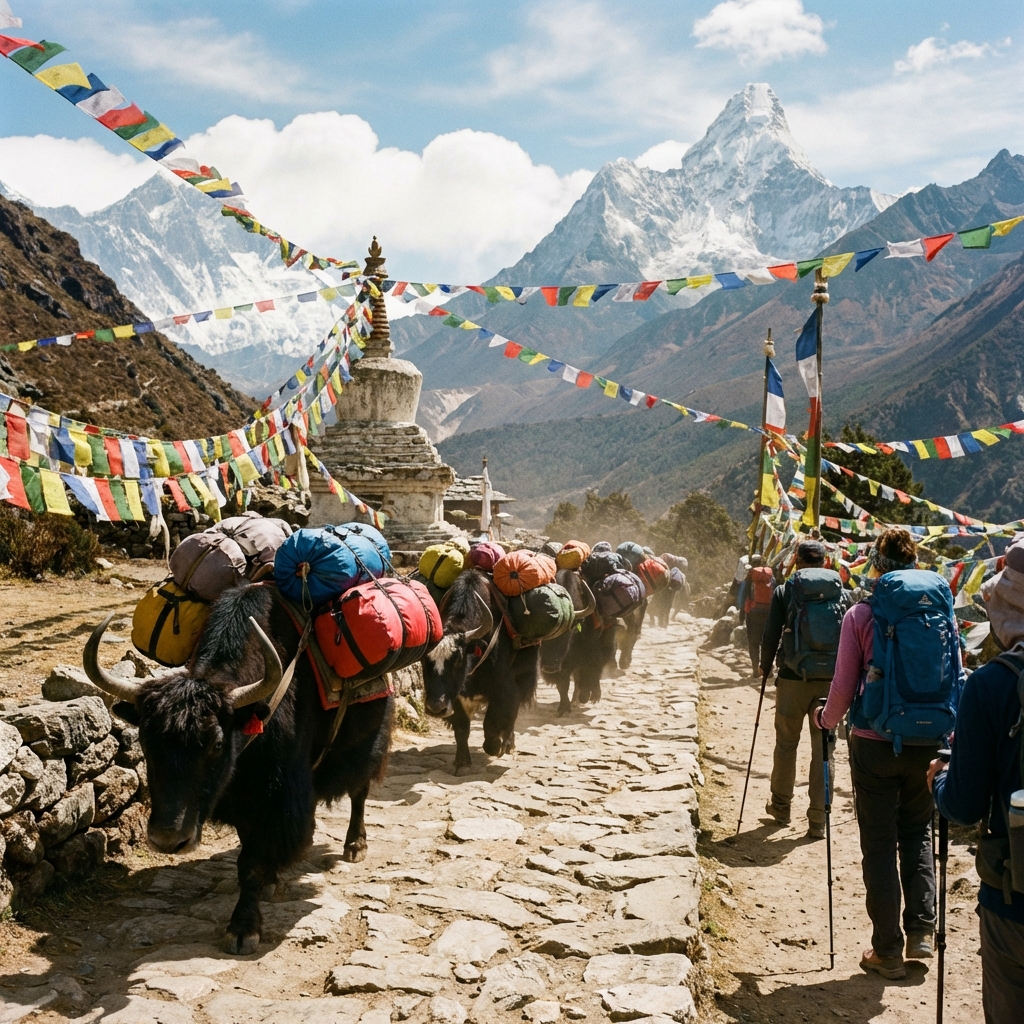
Meanwhile, Nepal's porters — the backbone of every expedition and guided trek — often work in conditions of genuine gear deprivation. A porter carrying 25kg of gear over a 5,000m pass in October may have no gloves, inadequate footwear, a cotton jacket rather than down, and no sleeping bag for nights spent in teahouses without blankets.
This is not an exaggeration. The International Porter Protection Group (IPPG) — a UK-registered charity that has worked on porter welfare since 2000 — documents these conditions through regular field surveys. The gap between what trekkers carry and what their porters have access to is striking.
Responsible gear donation, in the right places to the right organisations, meaningfully improves this situation. This guide tells you where, what, and how.
Where to Donate Camping Gear in Nepal: Quick Answer
If you only have a minute, here is the short version. Donate camping and trekking gear at one of these channels:
- KEEP Porter Clothing Bank — KEEP office, Thamel, Kathmandu. Accepts socks, boots, sunglasses, warm gloves, and sleeping bags. Prefers cash so it can buy correctly sized clothing in Nepal.
- International Porter Protection Group (IPPG) — no fixed drop-off; coordinates collection through partner trek agencies. Contact before arrival via ippg.net.
- Porter Progress UK — porter-specific clothing, boots, and equipment, collected through partnered Kathmandu agencies (porterprogress.org).
- Alternative Nepal (Pokhara) — warm clothing for Annapurna Circuit porters; reaches recipients reliably.
- Direct to your own porters — the most transparent option, best handled through your guide.
The single rule that matters most: only donate gear that still genuinely works, and where possible, donate before the trekking season, not at the very end of it.
Western-sized jackets and trousers often do not fit Nepali porters, who tend to be smaller. KEEP and most porter charities therefore prefer cash to buy correctly fitting clothing locally. Socks, boots, sunglasses, warm gloves, and sleeping bags are the physical items that are always welcome.
What Gear is Most Needed
Priority Items
Warm gloves or mittens: The single most urgent need. Porters regularly work on passes above 5,000m — where temperatures drop to -15°C — without gloves. Wool or insulated gloves, even older pairs, are genuinely valued.
Sleeping bags: Even lightweight bags (rated to 0°C) dramatically improve porter overnight conditions. In the off-season (December–February), many porters sleep with inadequate warmth.
Warm jackets (fleece or down): Old down jackets and fleece layers are among the most appreciated donations. Size is relevant — look for organisations that can match sizes to recipients.
Waterproof shell jackets: Rain gear that would otherwise be discarded is highly functional for porters working in monsoon conditions and during shoulder season rain.
Trekking boots: Porters often carry loads in flip-flops or worn trainers, including on snowy high passes. Good used boots (particularly in US sizes 7–10 or European sizes 39–44, which are most common) are valuable.
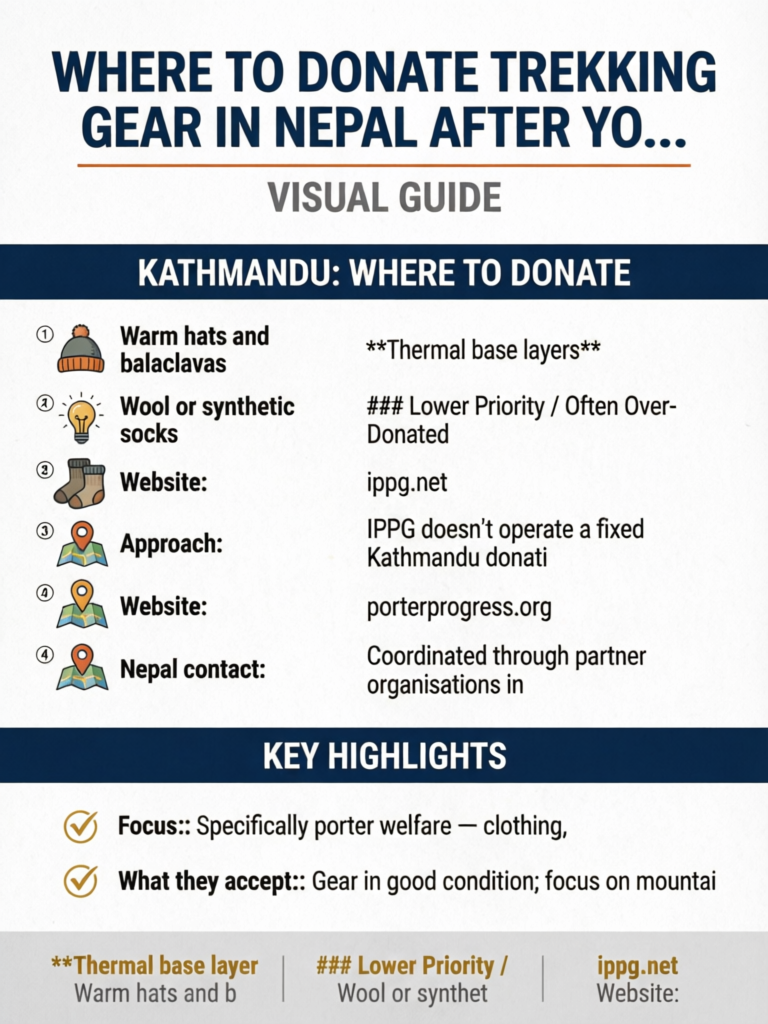
Warm hats and balaclavas
Thermal base layers
Wool or synthetic socks
Sunglasses: Snow blindness is a real and preventable porter injury. UV-rated sunglasses or glacier glasses are specifically named by KEEP as a welcome donation.
Lower Priority / Often Over-Donated
Western-sized jackets and trousers: Useful in principle, but a practical mismatch. As KEEP notes plainly, donations of used jackets and trousers from Western trekkers usually do not fit Nepali porters, who tend to be smaller in build. A large men's down jacket may simply be unwearable. This is the main reason charities prefer cash for clothing.
Technical gear (crampons, ice axes, GPS devices): These require training to use safely. Most donation organisations lack the infrastructure to match technical gear to appropriately skilled recipients. Better to sell these in Kathmandu and donate the cash.
High-end electronics: Satellite communicators, cameras, and similar electronics are occasionally donated with good intentions but often end up in informal markets rather than with intended recipients.
Damaged or worn-out gear: A pair of boots with a sole delaminating, a fleece with a broken zip, or a sleeping bag with compressed fill is not a donation — it's waste transfer. Only donate gear that genuinely still functions.
Kathmandu: Where to Donate
Kathmandu Environmental Education Project (KEEP) — Porter Clothing Bank
Location: KEEP office, Jyatha, Thamel, Kathmandu (check current address — the office has moved several times) What they accept: Socks, boots, sunglasses, warm gloves, and sleeping bags in good condition Best for: The single most established porter-clothing channel in Kathmandu
KEEP runs the Porter Clothing Bank (PCB), established in September 2009 to provide porters with complete, better-quality clothing sets suitable for Nepal's high hills and harsh mountains, reducing the avoidable illnesses and fatalities that occur each year. The scheme works as a lending bank: porters borrow proper kit for the season and return it afterwards. In 2015, according to the PCB's own records, the bank lent items to around 1,000 porters across the spring and autumn seasons. Demand runs to roughly 600 pairs every year, and limited stock means some porters still go without — which is exactly why donations matter.
KEEP makes one thing explicit: financial donations are preferred over used clothing. Cash lets KEEP buy new clothing in Nepal that actually fits Nepali porters, and cover the cost of repairing and replacing worn items. If you do bring physical gear, the items most welcome are socks, boots, sunglasses, warm gloves, and sleeping bags, which you can deliver in person to KEEP's Thamel office.
Why KEEP prefers cash: a wire transfer of even a modest amount buys multiple correctly sized garments locally, supports Nepali retailers, and avoids the customs and sizing problems that come with shipped or carried Western clothing. Mark your payment reference for the "PCB" (Porter Clothing Bank).
KEEP's porter work goes beyond clothing. It runs Porter and Guide Awareness Workshops covering safety, health, hygiene, basic first aid, and porters' rights under International Labour Organisation standards for decent work. The Clothing Bank exists because the risks are real: every season porters suffer altitude sickness, snow blindness, hypothermia, and frostbite, and some die. KEEP's own founding story is a stark reminder — in 1997 a 20-year-old porter who fell ill with altitude sickness was paid off and sent down the mountain alone; it took 30 hours for him to die, leaving a wife and two small children. The PCB and the awareness programmes are a direct response to deaths like his.
International Porter Protection Group (IPPG)
Website: ippg.net Approach: IPPG doesn't operate a fixed Kathmandu donation point (they coordinate with trek agencies), but their website lists current active collection initiatives and partner agencies. Contact them before arrival to identify the current best donation channel.
IPPG is the most reputable international organisation working specifically on porter welfare and works to improve standards through both gear provision and industry lobbying for safety and employment standards. It is also a long-standing project partner of KEEP's Porter Clothing Bank.
Porter Progress UK
Website: porterprogress.org Nepal contact: Coordinated through partner organisations in Kathmandu Focus: Specifically porter welfare — clothing, boots, equipment
Porter Progress operates gear collection through partnered trekking agencies. Contact them via their website to identify the current Kathmandu point.
Gear for Change Drop Points in Thamel
Several trekking gear shops in Thamel operate informal donation boxes or accept gear for redistribution. Ask specifically in gear shops on JP Road and Jyatha — shop owners with long-term community relationships often know the most current effective donation channels.
Shanta Bhawan (Patan Hospital) Charity Shop
Location: Patan (Lalitpur), 30 minutes from Thamel Accepts general used goods including clothing and outdoor gear for resale to fund the hospital's charity work. An option for gear not specifically needed for porter welfare.
Pokhara: Where to Donate
Pokhara is the gateway to the Annapurna region and the home base of many trekking agencies working those routes. The porter welfare challenge is as significant here as in the Khumbu.
Alternative Nepal (Pokhara)
Website: alternativenepal.com Focus: Responsible trekking, porter welfare, social enterprise What they accept: Gear in good condition, particularly warm clothing for the Annapurna Circuit porters
Alternative Nepal operates a socially responsible trekking enterprise and has established relationships with local communities. They are able to ensure donated gear reaches intended recipients.
Annapurna Base Camp Trekking Agency Offices (Lakeside area)
Several established agencies along Lakeside in Pokhara maintain informal gear collection for porters. Ask at the Trekking Agencies' Association of Nepal (TAAN) office in Pokhara for current recommendations.
How to Donate Cash to a Porter Charity
Because correctly sized clothing is so much more useful when bought locally, a cash donation is often the highest-impact way to give. The process is simple:
- Choose a registered charity — KEEP, IPPG, or Porter Progress UK are the established names.
- Use the official channel — donate via the charity's website, or by wire transfer to their Nepal or UK bank account. KEEP accepts payments to its accounts at Standard Chartered Bank Nepal and Sanima Bank.
- Mark the purpose — note "PCB" or "Porter Clothing Bank" in the payment reference so the funds reach the right programme.
- Ask for a receipt if you need one for your records.
Confirm bank details directly with the charity at the time you give. Account numbers and office addresses change. Never wire money based only on a third-party page — verify on the organisation's own site or by email first.
On the Trail: Giving Directly to Porters
Some trekkers prefer to give gear directly to the porters working with their group during the trek. This is the most transparent form of donation — you see exactly who receives what.
Guidelines for direct porter giving:
- Ask permission before offering gear (some porters have cultural preferences around gift-giving)
- Offer to your own group's porters first — they are most directly known to you
- Ask your guide to facilitate the conversation in Nepali
- Gear given in the Khumbu (NPR-denominated economy) is often sold rather than kept if the porter already has adequate gear — this is fine; they use the cash for their family
The downside of direct giving: It can create awkward dynamics if you only have one pair of gloves to give and three porters in your group. The organisational donation channels distribute more equitably across the porter community.
If you are still deciding how to treat the people carrying your load fairly — pay, tips, gear, and load limits — read our guides on porter ethics and responsible trekking and tipping guides and porters in Nepal.
Donating Camping Gear at Home Before You Fly
If you searched for where to donate camping gear, where to donate sports equipment, where to donate fitness equipment, or where to donate luggage, and you are not travelling to Nepal soon, the honest advice is to give locally rather than ship to Nepal. Here is how to decide:
- Bulky or heavy items (tents, camp stoves, sleeping pads, gym weights, large luggage): Donate at home. The cost and customs hassle of getting these to Nepal almost always outweighs their value here. Outdoor charities, scout groups, refugee resettlement programmes, and outdoor-gear "thrift" or consignment schemes in your own country are the right home for them.
- Lightweight, high-impact cold-weather items (gloves, warm hats, socks, a packable down jacket, sunglasses): These are worth carrying to Nepal in your checked bag, where porter need is acute. See the priority list above.
- Sports and fitness equipment specifically: Running shoes, base layers, and warm sports clothing can suit porters; bulky gym and fitness equipment does not travel and is better donated to a local sports club, school, or community centre at home.
- Luggage and duffels: A sturdy used duffel is genuinely useful to porters and agencies in Nepal and packs flat in your bag. Worn or wheeled suitcases are better donated locally.
In short: donate camping gear in Nepal when it is light, warm, and needed by porters; donate it at home when it is bulky, technical, or a poor climate match. If you are buying or replacing kit before your trip, our complete trekking gear list and the rent vs buy gear in Kathmandu guide will help you avoid over-packing in the first place.
International Shipping: Is it Worth It?
Some trekkers ask whether they can ship gear from home to Nepal for donation rather than carrying it in their luggage.
The honest answer: Usually not. Nepal's customs system imposes significant import duties on clothing and gear shipped from overseas. Organisations regularly lose donated gear to customs holds or must pay substantial fees to release it. The cost and hassle typically exceeds the value for individual packages.
What works better: Carry donation gear as part of your checked luggage allowance (most airlines allow 20–23kg). Many trekkers deliberately fill their outbound luggage with donation items knowing they'll return with a lighter bag. An extra fleece or pair of gloves adds minimal weight and zero customs complexity. The cleanest alternative of all is a cash donation, which sidesteps customs entirely.
Responsible Donation Principles
Donate before you trek, not after. The most useful place for warm gear is with the people who need it during the trekking season — not handed in at the end of October when the season is winding down.
Quality matters. Donate gear that still genuinely functions. Worn-out boots, compressed sleeping bags, and broken-zip fleeces are more burden than benefit.
Match gear to climate and to size. Lightweight running gear and thin summer clothes have limited value in the Khumbu, and large Western-cut jackets often won't fit Nepali porters. The organisations above will be honest if you contact them about what's needed — ask before bringing, and prefer cash for clothing.
Don't create dependency on donated gear for safety-critical equipment. Reputable porter welfare organisations argue that the best solution to porter gear deprivation is enforced minimum equipment standards (which IPPG campaigns for), not charity. Donation is a bridge, not a substitute for fair labour standards in the trekking industry.
What Should You Know Before Donating Gear in Nepal?
Before donating, assess your gear honestly. Only donate items that are genuinely functional -- a worn-out jacket or delaminating boots transfer waste, not help. Contact organisations before arrival to confirm current needs and drop-off points, as these change seasonally. For clothing, remember that cash usually buys a better-fitting result than a carried Western garment.