
Packing List for the Annapurna Circuit
The essential packing list for the Annapurna Circuit covers a four-season layering system, a -15°C sleeping bag, an expedition-grade down jacket and insulated gloves for Thorong La Pass (5,416m), waterproof boots, sun protection, and a personal first-aid kit — all kept to 10-14kg total across a 6-8kg daypack and a porter bag of up to 15kg. The challenge is packing for both subtropical heat at 800m and -20°C wind chill on the pass without overloading your knees over 15-16 days.
Packing for the Annapurna Circuit is uniquely challenging because the route traverses an extraordinary range of climate zones in a single journey. Day 2 is subtropical lowlands at 800m where you'll sweat in a t-shirt. Day 12 is Thorong La Pass at 5,416m where -20°C wind chill is normal before dawn. Getting the gear right for this range — without overpacking — is the core challenge of any Annapurna Circuit packing list.
This guide focuses on exactly what the circuit's conditions demand, with honest assessments of what you actually need versus what gets left in your bag. Every item below is grouped the way you'll pack it, and the page ends with a printable checklist and FAQ. If you are still in the planning stage, pair this with our Annapurna Circuit 15-day itinerary and cost breakdown so your gear, days, and budget line up before you book with a verified local agency.
15-16 days
800m (Besisahar) to 5,416m (Thorong La)
-15°C to -25°C at pre-dawn
20-30°C (subtropical)
10-14kg (daypack + porter bag)
6-8kg
Up to 15kg maximum
Available Kathmandu and Pokhara
The Circuit Packing Philosophy
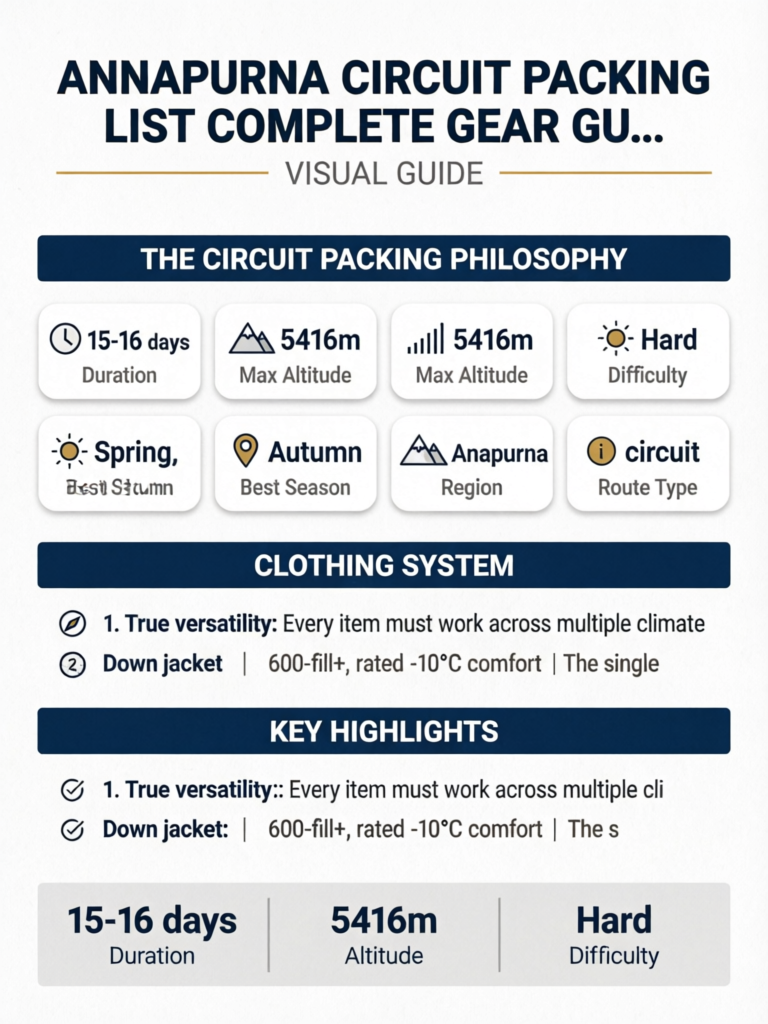
The Annapurna Circuit demands a layering system designed to handle a 4,600m altitude range in 15 days. This means:
1. True versatility: Every item must work across multiple climate zones 2. Weight discipline: 15 days is long; every unnecessary kilogram punishes your knees on the descent from Thorong La 3. Pass-day readiness: Your warmest gear must be accessible in your daypack for the pre-dawn Thorong La start, not buried in your porter's bag 4. Rain and wind protection: Both sides of the circuit get wet; waterproofs are non-negotiable
Pro Tip
The Annapurna Circuit is not the trek to "go ultralight" on by sacrificing warmth. Some experienced trekkers do finish with 30-35L packs under 9kg, but every one of them still carries a proper down jacket and a cold-rated sleeping bag — they cut clothing quantity, not safety gear. Pack light by carrying fewer duplicate layers and doing a laundry stop in Manang, never by skipping the warm kit Thorong La demands.
Backpacks and Bags: What Size Do You Need?
Your bag setup depends on one decision: are you hiring a porter or carrying everything yourself? On a guided Annapurna Circuit trek you typically share one porter between two trekkers, so you split your load into a porter bag and a daypack.
| Bag | Capacity | Who carries it | Notes |
|---|---|---|---|
| Duffel / porter bag | 60-70L | Porter | Soft duffel only — no suitcases or wheeled bags; double zippers you can lock |
| Daypack | 30-40L | You | Holds water, layers, snacks, camera, valuables; needs hip belt and chest strap |
| Single rucksack (if no porter) | 50-65L | You | Internal frame, padded hip belt, gear loops for poles |
| Rain cover | Fits your pack | — | Essential; weather turns fast on both sides of the circuit |
If you carry your own pack, a 50-65L backpack with an internal frame and a load-bearing hip belt is the sweet spot — large enough for a cold-rated sleeping bag and all layers, small enough to discourage overpacking. If you use a porter, give them a soft duffel of around 60-70L and carry a 30-40L daypack yourself.
Porter Bag Weight Limit
Keep your porter bag to 15kg maximum — this is both an ethical limit (one person carries it all day at altitude) and a practical one. If your circuit ends with the small aircraft flight from Jomsom to Pokhara, that flight enforces strict baggage limits of roughly 10kg hold and 5kg hand luggage. Wear your boots and heaviest jacket on the plane to stay under. See our guide to porter ethics and responsible trekking before you load up.
Waterproofing inside the bag matters as much as the rain cover. Line your main pack with a heavy-duty bin liner or a dry bag, and keep your sleeping bag and a set of dry sleep clothes in their own waterproof stuff sacks. A wet down jacket or sleeping bag at 4,000m is a genuine safety problem, not just an inconvenience.
Clothing System
Base Layers
| Item | Specification | Quantity | Notes |
|---|---|---|---|
| Merino wool long-sleeve shirts | 150-200 weight | 2 | Manage odor over 15 days; worth the cost |
| Synthetic quick-dry shirts | Lightweight | 2 | For lower valley heat |
| Long underwear | Lightweight merino or synthetic | 2 | |
| Trekking trousers | Zip-off/convertible | 2 | |
| Lightweight shorts | Optional | 1 | Chame to Manang lower sections |
| Underwear | Quick-dry synthetic | 4-5 | Merino if budget allows |
Insulating Layers
| Item | Specification | Notes |
|---|---|---|
| Fleece jacket | 200-weight at minimum | Core mid-layer; used most days above 2,500m |
| Down jacket | 600-fill+, rated -10°C comfort | The single most critical item for Thorong La |
| Warm trekking trousers | Fleece or softshell | For cold evenings in teahouses above 3,000m |
Down Jacket Quality Matters
Thorong La at 5,416m in pre-dawn darkness is one of the coldest experiences on any mainstream Nepal trek. A city-weight packable down jacket is insufficient. You need a mountaineering or expedition-grade down jacket with a minimum 600-fill power and a comfort rating of at least -10°C. Many trekkers who struggle on Thorong La are underdressed, not underfit.
Outer Layers
| Item | Specification | Notes |
|---|---|---|
| Hardshell jacket | Waterproof/breathable, all taped seams | Essential — both sides of circuit get rain |
| Hardshell trousers | Waterproof/breathable | |
| Gaiters | Low gaiters minimum | For snow on Thorong La pass day |
Head, Hands, Feet
| Item | Notes |
|---|---|
| Warm wool or fleece hat | For evenings and mornings above 3,000m |
| Balaclava | The single most underrated item — keeps face warm on Thorong La |
| Buff / neck gaiter | 1-2; versatile for face and neck protection |
| Lightweight gloves | For hiking in cool weather |
| Insulated waterproof gloves or mittens | Non-negotiable for Thorong La — frostbite risk is real |
| Merino wool socks | 4-5 pairs; vital for 15 days |
| Liner socks | 2 pairs; blister prevention |
| Trekking boots | Waterproof, ankle support, worn in before departure |
| Camp sandals or light shoes | For teahouse evenings and river crossings |
| Sunglasses | Category 3-4, UV400; critical — glacial reflection above 4,000m |
| Goggles | Optional; valuable if snowstorm catches you near the pass |
Sleeping System
| Item | Specification | Notes |
|---|---|---|
| Sleeping bag | -15°C rated (comfort, not limit) | Teahouses above Manang are cold; even -10°C bags feel insufficient |
| Sleeping bag liner | Silk or fleece | Adds warmth and hygiene over 15+ nights |
What the teahouses provide: Mattress, pillow, blanket (usually thin). Never rely on the teahouse blanket above Manang.
Navigation and Safety
| Item | Notes |
|---|---|
| Trekking poles | Both poles; essential for the 1,656m descent from Thorong La to Muktinath |
| Headlamp | 200 lumens minimum; USB rechargeable preferred |
| Extra batteries | For non-USB headlamp |
| Portable power bank | 20,000mAh; charging above Thorong Phedi unreliable |
| Whistle | Emergency signaling; weighs nothing |
| Emergency space blanket | Hypothermia insurance |
| Compass or GPS | Trail can be unclear in heavy snowfall near Thorong La |
| Downloaded offline maps | Maps.me works offline; download before departure |
| Pulse oximeter | $20-40; SpO2 monitoring above 3,500m — serious tool, not optional |
First Aid Kit
| Item | Why |
|---|---|
| Diamox (acetazolamide 250mg) | AMS prevention — consult doctor before trek |
| Dexamethasone 4mg | HACE emergency — guide administers |
| Nifedipine 10mg | HAPE emergency |
| Ibuprofen + Paracetamol | Headache, body pain |
| Oral rehydration salts (ORS) | Dehydration and stomach illness |
| Ciprofloxacin or Azithromycin | Stomach infections |
| Anti-diarrhea medication | Common on long treks |
| Antinausea (ondansetron) | High altitude nausea |
| Blister kit (moleskin, Compeed) | 15 days = foot wear |
| Athletic tape | Ankle support and general |
| Antiseptic and wound dressings | Minor cuts |
| Water purification tablets | Backup |
| Throat lozenges | Dry high-altitude air causes throat issues |
Hydration
| Item | Notes |
|---|---|
| Water filter | Sawyer Squeeze or similar — primary water treatment |
| Purification tablets | Backup; keep in daypack |
| 1L insulated water bottle (x2) | Insulated bottles prevent freezing above 4,000m |
| Thermos flask (optional) | Fill with hot water at Thorong Phedi for the pass |
| Hydration bladder | Optional; can freeze near Thorong La — carry water bottles as backup |
Hydration strategy: The circuit's altitude makes dehydration risk very high. Target 3-4 liters per day above 3,000m. Drink before you're thirsty. Urine should be pale yellow — above 4,000m, many trekkers become mildly dehydrated without noticing. For the full breakdown of methods and costs, see our water purification guide.
Snacks and Trail Food
Teahouses serve full meals along the entire circuit, so you do not need to carry days of food. But altitude blunts appetite and slows digestion, and high-energy snacks become valuable currency on the long Thorong La pass day. Pack snacks light, calorie-dense, and easy to eat with cold hands.
| Item | Why it earns its weight |
|---|---|
| Energy bars / protein bars | One per trail day; reliable calories when appetite drops |
| Trail mix and nuts | Slow-burn energy; salt helps with hydration balance |
| Chocolate | Morale and fast energy on pass day — bring favourites from home |
| Hard candies / ginger candy | Soothe a dry high-altitude throat; ginger helps nausea |
| Electrolyte / drink sachets | Replace salts lost to altitude and exertion |
| Instant coffee sachets | Teahouse coffee is inconsistent above Manang |
Local shops in Besisahar, Chame, and Manang restock the basics, but prices climb steeply with altitude, so buy the bulk of your snacks in Kathmandu or Pokhara where choice is wider and cheaper. Anything imported you genuinely care about — a specific bar or gel — should come from home, as it will not be available on the trail.
Comfort and Repair Extras
These items are not life-or-death, but circuit veterans consistently rank them as the small things that made 15-16 days more bearable.
| Item | Why |
|---|---|
| Earplugs | Dogs, roosters, and yaks make teahouse nights loud; one of the most recommended low-cost items |
| Lightweight book or e-reader | Acclimatisation rest days in Manang and Marpha are long |
| Duct tape (wrapped around a pole) | Field repairs for boots, packs, and blisters |
| Small multi-tool or pocket knife | General repairs (pack in checked luggage when flying) |
| Ziploc / dry bags | Organise small items and keep electronics dry |
| Notebook and pen | Journaling, and useful for permit checkpoints |
| Travel clothesline | Dry hand-washed socks and base layers on rest days |
| Spare passport photos (4) | Backup for permit processing in Kathmandu or Pokhara |
Electronics
| Item | Notes |
|---|---|
| Camera + extra batteries | Keep batteries in jacket pocket at altitude — cold drains them fast |
| Smartphone | Nepali SIM works in most villages; buy in Kathmandu |
| Portable power bank (20,000mAh) | Most important electronic item; charging above Thorong Phedi is unreliable and costs $2-4 per device |
| Solar charger (optional) | Useful above 4,000m on sunny days |
| Universal plug adapter | Nepali, European, and Australian sockets all appear on circuit |
| E-reader or downloaded books | 15 days; rest days in Manang and Marpha beg for reading |
Hygiene and Personal Care
| Item | Notes |
|---|---|
| Biodegradable soap | Conservation area requirement |
| Hand sanitizer | Before every meal; stomach infections derail treks |
| Baby wipes | Essential above Manang where showers are less reliable |
| Quick-dry microfiber towel | Compact, fast drying |
| Toothbrush + toothpaste | Minimal |
| Sunscreen SPF50+ | UV intensity increases dramatically at altitude |
| Lip balm with SPF | Lips crack badly on Thorong La without protection |
| Moisturizer | Cold alpine air is intensely drying |
| Toilet paper | Some sections have no facilities |
Documents and Money
| Item | Notes |
|---|---|
| Passport | Required at multiple ACAP checkpoints |
| Permits (copies) | Keep originals with guide or in waterproof bag |
| Travel insurance document | With emergency helicopter number |
| Emergency contact card | Laminated; carry in daypack |
| Cash (50,000-70,000 NPR) | No ATMs Chame to Jomsom; withdraw in Pokhara |
| Small bills | 100 and 500 rupee notes for teahouse payments |
Bag Organization
Main bag (to porter, 8-12kg):
- Sleeping bag and liner
- Extra clothing layers
- Full first aid kit
- Snacks bulk supply
- Electronics cables and chargers
- Camp sandals
Daypack (carry yourself, 6-8kg):
- Down jacket (accessible at all times)
- Waterproof jacket and trousers
- Warm hat and insulated gloves
- Headlamp
- Water bottles (2L minimum)
- First aid essentials (Diamox, ORS, ibuprofen)
- Camera
- Power bank
- Passport and documents
- Day's snacks
- Emergency space blanket
Pass day daypack (5-7kg): Same as above but add:
- Thermos of hot water
- Gaiters
- Goggles (if carrying)
- Extra warm layer
What to Leave Behind
| Item | Reason |
|---|---|
| Cotton clothing | Kills in wet/cold; no place on any Himalayan trek |
| Flip-flops | Pack light camp sandals instead |
| Jeans | Heavy, no insulation when wet |
| Multiple guidebooks | Download digitally |
| Laptop | Too heavy and fragile |
| Full makeup kit | Sunscreen and lip balm are the beauty essentials |
| Expensive jewelry | No secure storage; lost risk |
Gear Rental vs Purchase: Circuit-Specific Advice
Must purchase (fit and break-in critical):
- Trekking boots
- Backpack (if carrying your own)
- Trekking poles (if you haven't used before, buy not rent for proper fit)
Strong rental candidates:
- Sleeping bag (-15°C): $120-$280 for 15 days in Kathmandu
- Down jacket: $15-22 for 15 days
Buy if you'll trek more than once:
- Down jacket
- Waterproof jacket
- Base layers
Thamel in Kathmandu and Lakeside in Pokhara both have dozens of rental and gear shops. Pokhara is the closer launch point if you start the circuit anti-clockwise via Jomsom, while Kathmandu has the deepest stock. Inspect rented down jackets and sleeping bags for loft and broken zips before you pay, and compare full prices in our rent vs buy gear in Kathmandu guide and Pokhara gear shopping and rental walkthrough.
Planning your Annapurna Circuit?
Book the circuit with a verified local agency and get a porter, permits, and a gear-check sorted before you fly.
What Should I Pack for Thorong La Pass Day?
Thorong La pass day requires your warmest gear accessible in your daypack, not buried in your porter's bag. Pack your down jacket, hardshell jacket, insulated gloves, balaclava, and thermos of hot water in your daypack the night before. Pre-dawn temperatures at Thorong Phedi (4,450m) can drop to -20°C with wind chill. Layer aggressively and strip layers as you warm up during the ascent.
Frequently Asked Questions
Can I rent gear for the Annapurna Circuit in Kathmandu or Pokhara?
Yes. Down jackets, sleeping bags, trekking poles, and backpacks are available for rent in Thamel (Kathmandu) and Lakeside (Pokhara) for $1-5 per day per item. Quality varies -- inspect before committing. See our rent vs buy gear guide for detailed advice.
How heavy should my pack be for the Annapurna Circuit?
Target 6-8kg for your daypack and up to 15kg for your porter bag. Total weight should not exceed 20-22kg including everything. The 15-day duration makes weight discipline critical -- every unnecessary kilogram punishes your knees on the long descent from Thorong La.
Do I need crampons for the Annapurna Circuit?
No. The standard Annapurna Circuit including Thorong La does not require crampons in normal conditions. Good trekking boots with solid tread are sufficient. In rare heavy snow conditions, lightweight microspikes can provide extra grip.
What sleeping bag temperature rating do I need?
A sleeping bag rated to -10°C to -15°C comfort is recommended for the Annapurna Circuit. Thorong Phedi and High Camp can drop to -15°C or below at night. Tea houses provide blankets, but your own sleeping bag ensures warmth at the highest and coldest lodges.
Should I bring a water filter or purification tablets?
Yes, bring water purification tablets (Aquamira or chlorine dioxide) as your primary method. Boiled water and bottled water are available at tea houses but become expensive at altitude ($2-4 per liter). Purification tablets cost pennies per liter and reduce plastic waste.
What size backpack do I need for the Annapurna Circuit?
If you carry everything yourself, choose a 50-65L internal-frame backpack with a load-bearing hip belt. If you hire a porter, give them a soft 60-70L duffel and carry a 30-40L daypack yourself. Add a rain cover regardless, since both sides of the circuit get wet.
How much cash should I bring for the Annapurna Circuit?
Carry 50,000-70,000 NPR in cash. There are no reliable ATMs between Chame and Jomsom, so withdraw what you need in Pokhara or Kathmandu before the trek. Bring plenty of 100 and 500 rupee notes for teahouse meals, hot showers, and charging fees. See our ATMs and cash on trek guide for details.
How much does it cost to rent gear for the Annapurna Circuit?
Renting the warm kit for the full 15-day trek is affordable: a -15°C sleeping bag runs about $120-280 and a down jacket around $15-22 for the trip, with most individual items renting for $1-5 per day in Thamel or Lakeside. Buy your boots and trekking poles for fit; rent the bulky warm layers if you only trek once.
Do I need a down jacket for the Annapurna Circuit?
Yes. A down jacket rated to at least -10°C comfort with 600-fill power or higher is the single most critical item for Thorong La Pass. Pre-dawn temperatures at the pass and at Thorong Phedi (4,450m) drop to around -20°C with wind chill, so a thin city-weight down jacket is not enough for pass day.
Printable Annapurna Circuit packing checklist
Working through this list bag by bag — porter duffel, daypack, then pass-day daypack — is the fastest way to pack without forgetting the warm gear Thorong La demands. Cross-check it against our broader Nepal trekking packing list and the complete trekking gear list before you leave home.