Mustang and Dolpo occupy a category of trekking experience that has no equivalent elsewhere in the Himalaya. These are not remote versions of popular treks — they are fundamentally different destinations defined by restricted access, ancient Tibetan-origin cultures that have survived largely unchanged for centuries, and landscapes that bear more resemblance to the high plateaus of Tibet than to the forested valleys of mainstream Nepal trekking. Collectively, they receive fewer than 2,000 foreign trekkers per year, making them among the quietest major trekking destinations on Earth. The restricted area permit system, combined with high costs and demanding logistics, creates a natural filter that preserves both the cultural integrity of these communities and the wilderness character of their landscapes. For trekkers willing to invest the time, money, and preparation, Mustang and Dolpo deliver experiences that the global trekking industry has long since erased from its more accessible destinations.
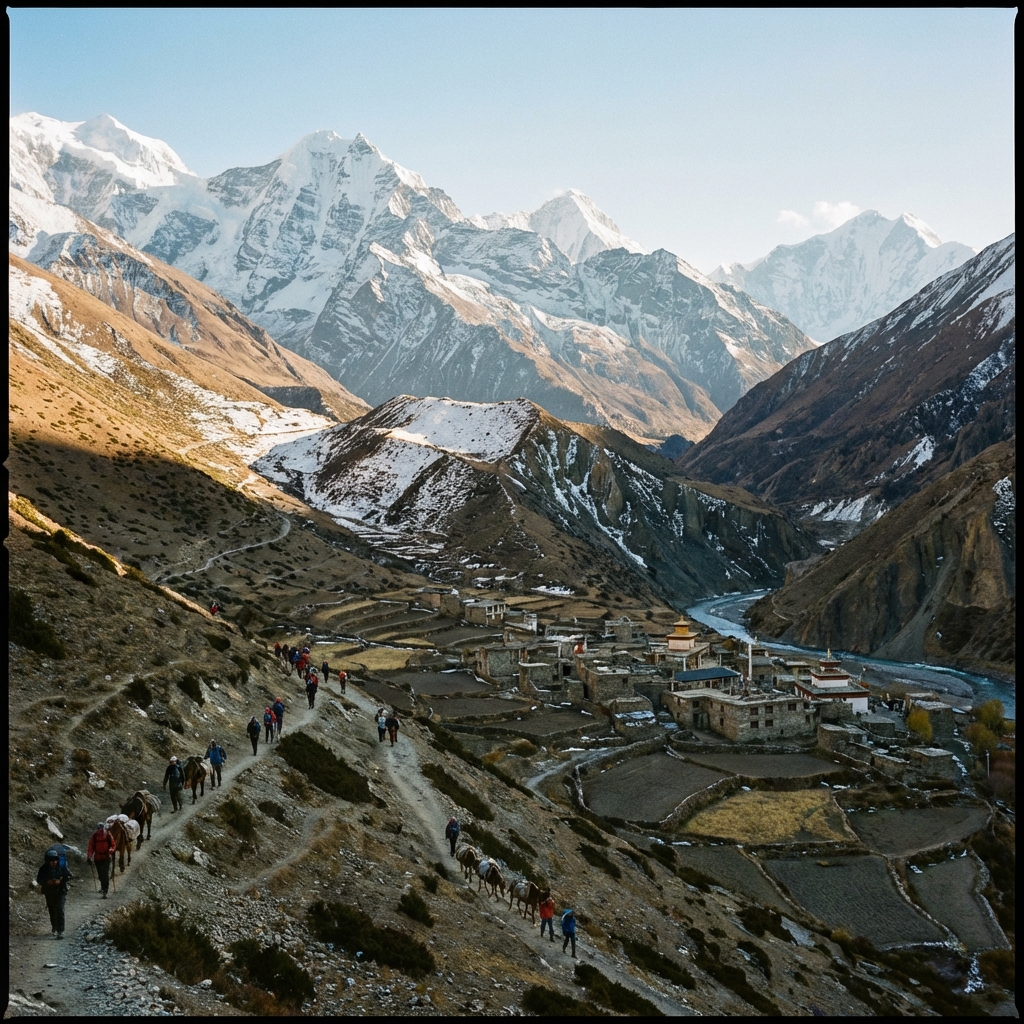
Upper Mustang — the "Last Forbidden Kingdom" — was closed to all foreign visitors until 1992, preserving a Tibetan Buddhist culture that has maintained its identity for over 600 years. The walled city of Lo Manthang, the capital of the ancient Kingdom of Lo, sits at 3,840 metres on an arid plateau that receives less than 250mm of annual rainfall, making it one of the driest inhabited places in the Himalaya. The city's medieval architecture — four-storey whitewashed buildings with flat rooftops, a royal palace, and four active monasteries — has survived intact because geographic isolation and political closure shielded it from the modernisation that transformed other Himalayan communities. The Tiji festival, held annually in May, is a three-day ceremony in which monks perform masked dances that re-enact the story of Dorje Jono defeating a demon to bring water back to the arid kingdom. Attending Tiji is one of the most powerful cultural experiences available to travellers in the Himalaya — a living ceremony performed for the community, not for tourists, in a setting that has not changed in centuries.
The Mustang landscape defies every preconception about Nepal trekking. Instead of lush forests and rushing rivers, the trail traverses a high-altitude desert of eroded sandstone canyons, rust-red cliffs, and wind-carved formations that resemble the American Southwest more than the Himalaya. The Kali Gandaki gorge, which separates the Annapurna and Dhaulagiri massifs, is the deepest gorge on Earth — and the trail follows its upper reaches through a landscape of geological drama. Fossil hunters find ammonite shells (called shaligram by Hindus, considered sacred manifestations of Vishnu) embedded in the riverbed, evidence that this desert landscape was once an ocean floor 100 million years ago. Cave complexes carved into cliff faces — some containing 2,000-year-old Buddhist paintings — dot the upper Mustang landscape, the subject of ongoing archaeological research that has revealed one of the world's least-explored medieval civilisations. The rain shadow effect that creates Mustang's desert climate also makes it one of the few Nepal regions suitable for monsoon-season trekking, when warm temperatures and minimal precipitation create conditions unavailable anywhere else in the country during June through September.
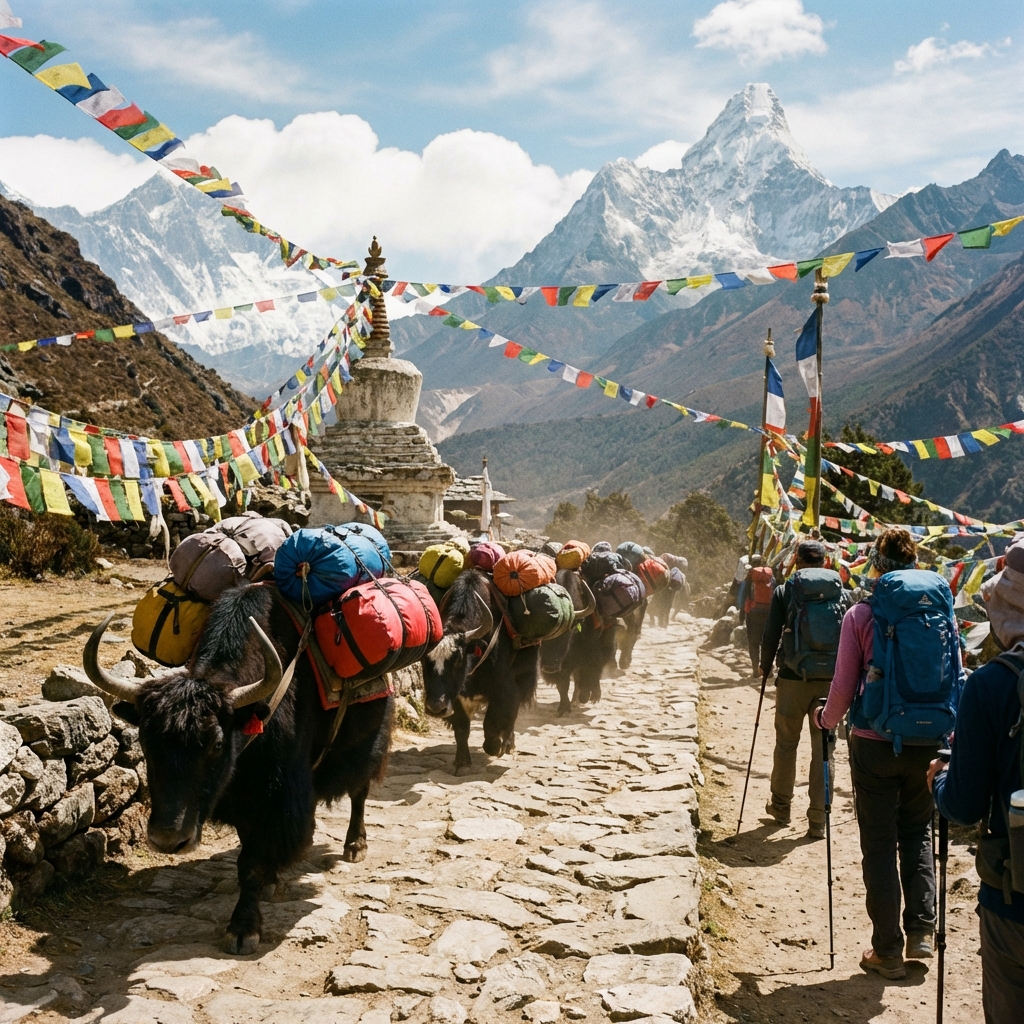
Dolpo is Nepal at its most extreme — the most remote, the most expensive, the most logistically demanding, and for many experienced trekkers, the most rewarding trekking destination in the entire Himalaya. Brought to international attention by Peter Matthiessen's 1978 book "The Snow Leopard" and Eric Valli's documentary "Caravan," Dolpo has changed remarkably little since those classic accounts. The region straddles the Nepal-Tibet border in the country's far northwest, accessible only by small aircraft from Nepalgunj to Juphal or by multi-day walks from the nearest road. Upper Dolpo remains one of the last places on Earth where traditional Tibetan Buddhist culture exists substantially unaltered — villages like Saldang and Shimen practice a form of Bön-influenced Buddhism that predates organised Tibetan religion, and the annual yak caravan carrying salt from Tibet continues as it has for a thousand years.
Phoksundo Lake, the centrepiece of Lower Dolpo, is Nepal's deepest lake and arguably its most beautiful natural feature. At 3,612 metres, this turquoise glacial lake sits in a steep-walled valley surrounded by conifers and rocky peaks, with a clarity that reveals the lakebed 40 metres below the surface. Hindu and Buddhist traditions hold it sacred — local communities prohibit swimming, fishing, and boating, which has preserved its pristine condition. The lake is the gateway to Upper Dolpo for trekkers attempting the full circuit, and even those trekking only Lower Dolpo (a more affordable and accessible 8-10 day trek from Juphal) count Phoksundo among the most memorable sights of their Nepal experience. Shey Phoksundo National Park, at 3,555 square kilometres Nepal's largest national park, protects the lake and surrounding wilderness including habitat for the snow leopard, blue sheep, musk deer, and Himalayan wolf — species that require vast undisturbed ranges to survive.
The Upper Dolpo Circuit is one of the great expedition treks of the Himalaya — a 18-25 day journey that crosses multiple passes above 5,000 metres, including the Kang La (5,360m) and Numa La (5,238m), traverses high valleys with no permanent settlements, and visits the ancient monastery of Shey Gompa, where the crystal mountain described by Matthiessen rises above the meditation caves. This trek requires full camping support: tents, kitchen crew, pack animals (yaks or horses), and supplies for up to three weeks of self-sufficiency. There are no teahouses, no shops, no communication infrastructure, and no rescue facilities along much of the route. A helicopter evacuation from Upper Dolpo can take 24-48 hours to coordinate due to the remoteness and limited landing zones. This is not a trek for casual adventure — it demands genuine expedition capability, including previous high-altitude experience, physical fitness for sustained multi-day passes, cold-weather camping skills, and mental resilience for extended periods without the comforts that even basic teahouse treks provide. The reward is proportional to the demand: Upper Dolpo delivers a wilderness experience that has virtually disappeared from the rest of the trekking world.
Planning logistics for remote regions require significantly more lead time and budget than popular or emerging regions. Permit processing takes 5-7 business days in Kathmandu and requires confirmed agency booking. Flights to access towns (Jomsom for Mustang, Juphal for Dolpo via Nepalgunj) are weather-dependent and frequently delayed or cancelled — building 2-3 buffer days into your itinerary at both ends is essential, not optional. Dolpo treks via Juphal require an overnight in Nepalgunj, Nepal's hottest city, before the morning flight. Equipment for camping treks (Upper Dolpo) must be arranged through your agency in Kathmandu. Budget expectations should reflect the premium nature of these destinations: an Upper Mustang trek typically costs $2,500-$4,000 per person all-inclusive; an Upper Dolpo circuit runs $4,000- $7,000 per person. These costs cover permits, agency fees, guide, porter/pack animals, camping equipment, food, and internal flights. For both regions, the investment buys access to experiences that commercial tourism cannot replicate at any price — and that the restricted permit system ensures will remain exclusive enough to retain their character for future generations of trekkers.