
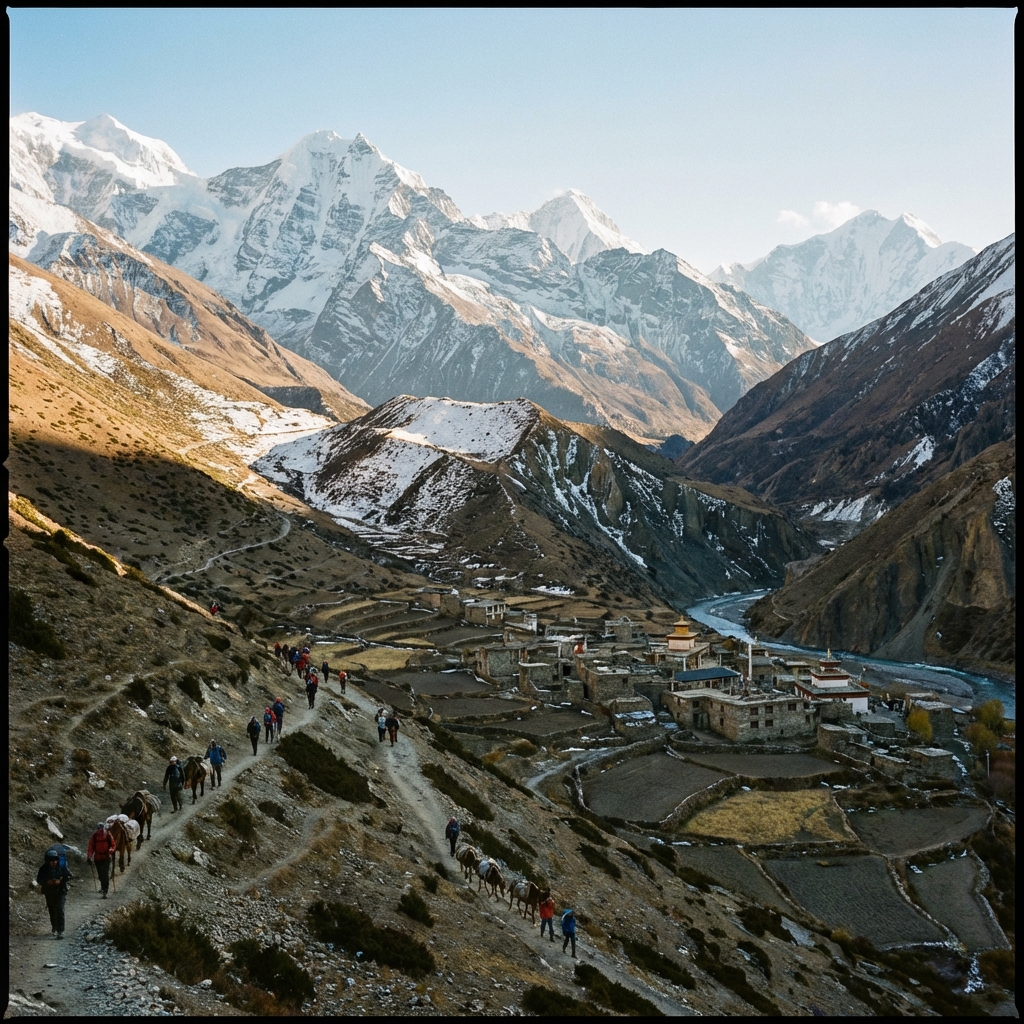
The Nar Phu Valley sits in a unique meteorological position: the high Tibetan plateau border region creates different weather patterns from the south-facing Annapurna slopes. The valley receives relatively little monsoon precipitation (protected by the same rain shadow effect that defines Upper Mustang) while being exposed to jet stream weather systems in winter. This creates a usable season that is both longer and more unpredictable than standard Annapurna routes.
The critical factor for timing is Kang La Pass (5,243m). The pass must be accessible and safe on your intended crossing day. Everything else in the seasonal calculation flows from this requirement.
October, May, April
Mid-October to mid-November; late April to May
April-May (slightly lower permit cost)
September-November (most reliable)
December-March (pass often closed), June-August (monsoon)
October (highest), April-May (second)
The Kang La Pass Factor
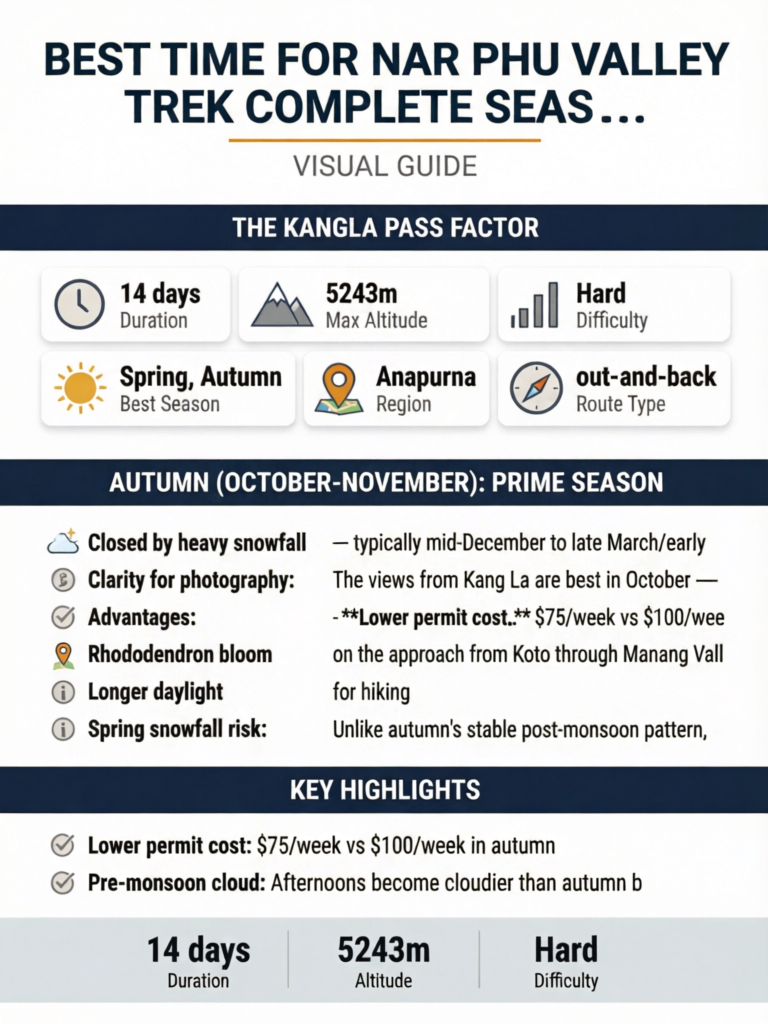
All seasonal planning for Nar Phu Valley must be centered on Kang La Pass (5,243m). The pass is:
- Closed by heavy snowfall — typically mid-December to late March/early April
- Best in stable weather windows — even in prime season, 1-2 day delays for weather are common
- Less trafficked than Thorong La — post-snowfall conditions may persist longer as fewer boots pack the trail
The decision rule: Any timing window that cannot reliably access Kang La Pass is the wrong time for Nar Phu.
Autumn (October-November): Prime Season
October: Best Month
Why October is optimal for Nar Phu:
-
Post-monsoon stability: The monsoon exits Nepal in mid-September, leaving behind dry, stable conditions. October high-pressure systems dominate — clear mornings, light afternoon cloud, low wind.
-
Kang La Pass reliability: October has the lowest probability of fresh snowfall blocking the pass. Most years offer multiple pass-crossing windows throughout the month.
-
Temperature range: Cold nights at Phu and Nar (4,080-4,110m) are manageable with appropriate sleeping bags — typically -10°C to -15°C. Days are comfortable for hiking.
-
Clarity for photography: The views from Kang La are best in October — Annapurna III, IV, Gangapurna, and Tilicho Peak under blue skies.
The tradeoff: Higher permit cost ($100/week vs spring's $75/week). Kathmandu and major transit routes are busy (peak Nepal tourism month).
November: Excellent Alternative
Strong conditions continue through November. Temperatures drop significantly by late November — Phu and Nar nights can reach -20°C by late month. Kang La Pass becomes more challenging as snowfall risk increases. Early November (1st-15th) is nearly as good as October. Late November requires robust cold-weather gear and local advice on current pass conditions.
Advantage: Significantly lower crowds in Kathmandu and main transit routes. Nar Phu itself is never crowded, but logistics are easier when the broader tourism system is quieter.
Spring (April-May): Good Alternative
April-May: Second Season
The spring window offers slightly different conditions:
Advantages:
- Lower permit cost: $75/week vs $100/week in autumn
- Rhododendron bloom on the approach from Koto through Manang Valley
- Longer daylight for hiking
Challenges:
- Pass conditions are less predictable: Late winter snowfall can delay the pass opening into mid-April or beyond. Verify conditions before committing.
- Spring snowfall risk: Unlike autumn's stable post-monsoon pattern, spring weather is more variable — significant fresh snowfall events can occur through May.
- Pre-monsoon cloud: Afternoons become cloudier than autumn by May.
Best spring window: Late April to mid-May, after winter snowpack has melted from Kang La but before monsoon cloud builds.
Pro Tip
If planning a spring trip, contact your agency for current Kang La pass conditions in the 2-3 weeks before departure. Spring conditions are more variable than autumn. A reputable agency maintains contact with Nar Phu guides year-round and can provide real-time updates.
Why to Avoid Other Seasons
December-March: Pass Mostly Closed
Heavy winter snowfall typically closes Kang La from mid-December through late March/early April. The pass at 5,243m accumulates significant snow depth. Even when temperatures are technically passable, the snow depth and post-storm consolidation period creates unacceptable risk for non-mountaineering trekkers.
December (early): Occasionally possible if conditions align, but high risk of being stranded if weather turns.
January-February: Do not attempt Kang La. The Nar Phu Valley in winter without the Kang La crossing option is technically doable (out-and-back from Koto) but reduces the trek to a fraction of its full experience.
June-August: Monsoon
The Nar Phu Valley receives less monsoon precipitation than the main Annapurna slopes (rain shadow effect), making it technically possible during monsoon. However:
- Kang La approaches become slippery and dangerous
- Access roads to Koto flood regularly
- Leeches and insects in lower approach sections
- Cloud obscures views
The small potential advantage (lower permit cost, empty trails) does not justify the risks.
Month-by-Month Summary
| Month | Kang La | Temperature | Permit Cost | Recommended |
|---|---|---|---|---|
| January | Usually closed | Very cold | $75/week | No |
| February | Usually closed | Very cold | $75/week | No |
| March | Opening (late) | Cold | $75/week | Possible late March |
| April | Open (variable) | Cool-warm | $75/week | Yes (late April) |
| May | Open | Warm | $75/week | Yes ★★★★ |
| June | Risky | Warm/wet | $75/week | No |
| July | Risky | Warm/wet | $75/week | No |
| August | Risky | Warm/wet | $75/week | No |
| September | Opening | Cool | $100/week | Late Sept (careful) |
| October | Best | Cold nights | $100/week | Yes ★★★★★ |
| November | Good-Risky late | Cold | $100/week | Early-mid Nov ★★★★ |
| December | Closing | Very cold | $100/week | Early Dec only |
Festival Timing
The villages of Nar and Phu have several important festivals tied to the Tibetan lunar calendar:
Tiji Festival (Phu): Usually May. Three-day ritual dance festival performed by monks. One of Nepal's most spectacular and least-visited cultural events. If your timing aligns, this adds extraordinary cultural depth to the trek.
Nar Gompa Annual Festival: Usually October-November. Timing varies — confirm with your agency.
For trekkers who prioritize cultural immersion alongside trekking, May (Tiji Festival period) can be the most rewarding season despite the less-certain pass conditions.
Pre-Departure Weather Check
Given Kang La's condition-dependence, always request a current pass condition report from your agency 7-10 days before departure. Reputable Nar Phu-specialized agencies maintain contacts with guides who winter in Manang and can relay current conditions.
Questions to ask:
- What is the current snow depth on Kang La?
- When was the last successful crossing reported?
- What is the 10-day weather forecast for the Manang Valley?
- Is there an alternative exit if Kang La is impassable on our crossing day?
Is Kang La Pass Open Year-Round?
No. Kang La Pass (5,243m) is only safely crossable during specific weather windows, primarily mid-October to mid-November and late April to May. Heavy snow in winter (December-February) makes the pass dangerous or impassable. Monsoon conditions (June-August) bring unstable weather and poor visibility. Always confirm current pass conditions with your trekking agency and local guides before attempting the crossing.
Frequently Asked Questions
When is the best time to trek the Nar Phu Valley?
October is the most reliable month, offering stable weather and the best chance of a clear Kang La Pass crossing. May is the best spring window, with slightly lower permit costs. April can work but late-season snow on Kang La adds risk.
Do I need a restricted area permit for Nar Phu?
Yes. The Nar Phu Valley requires a Restricted Area Permit, which must be obtained through a registered trekking agency. The permit costs $100 per person for the first week and $15 per day thereafter, plus the standard ACAP permit and TIMS card.
How does the Nar Phu weather compare to the Annapurna Circuit?
The Nar Phu Valley sits in a rain shadow similar to Upper Mustang, receiving significantly less monsoon precipitation than the south-facing Annapurna slopes. This creates a longer usable season but also means the valley is drier and colder, with less vegetation. Winter conditions at altitude are harsher than the main circuit.
Can I trek Nar Phu independently?
No. The restricted area status requires a registered trekking agency, licensed guide, and a minimum of two trekkers. Independent trekking is not permitted in the Nar Phu Valley.
Is the Nar Phu Valley trek worth the extra cost?
For experienced trekkers seeking remote Tibetan Buddhist culture and genuine solitude, absolutely. The valley receives fewer than 1,500 trekkers per year, and the landscapes are unlike anything on the main Annapurna Circuit. It is one of Nepal's most rewarding off-the-beaten-path treks.