
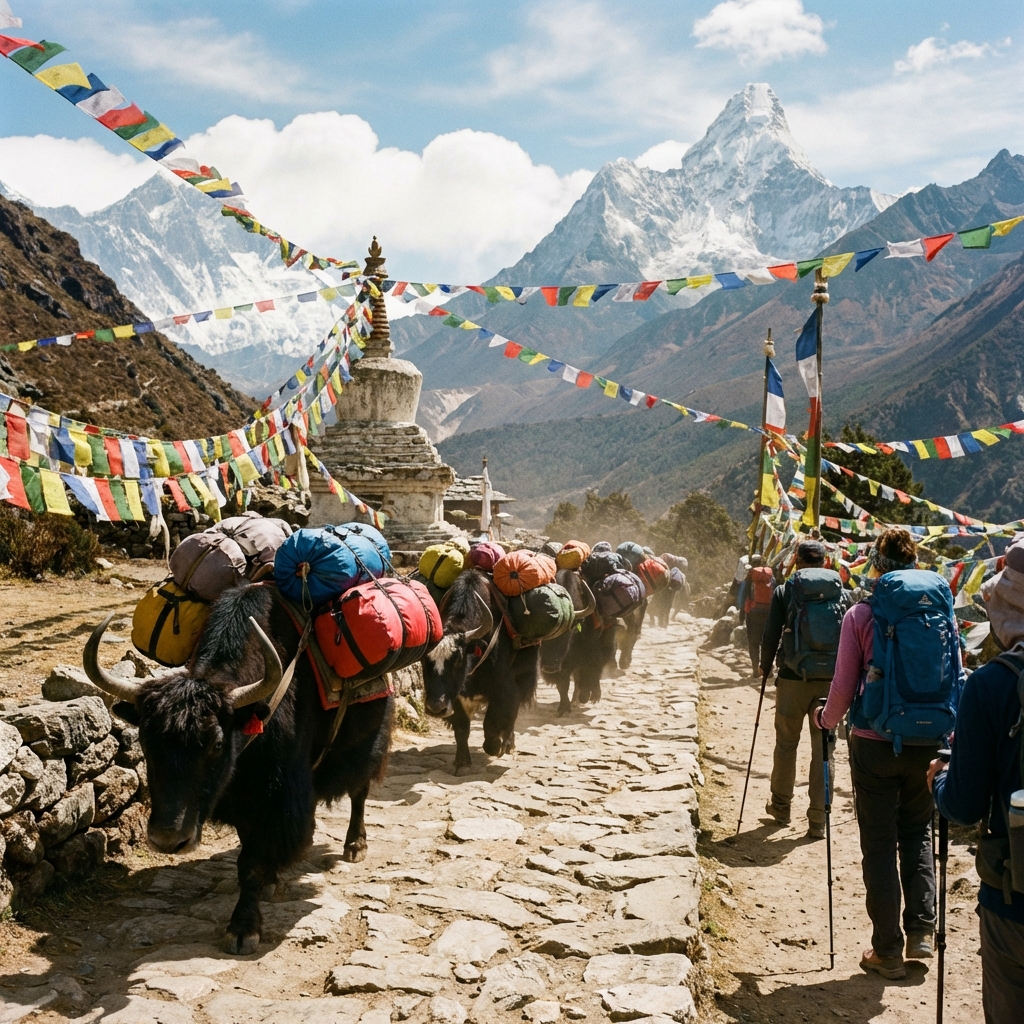
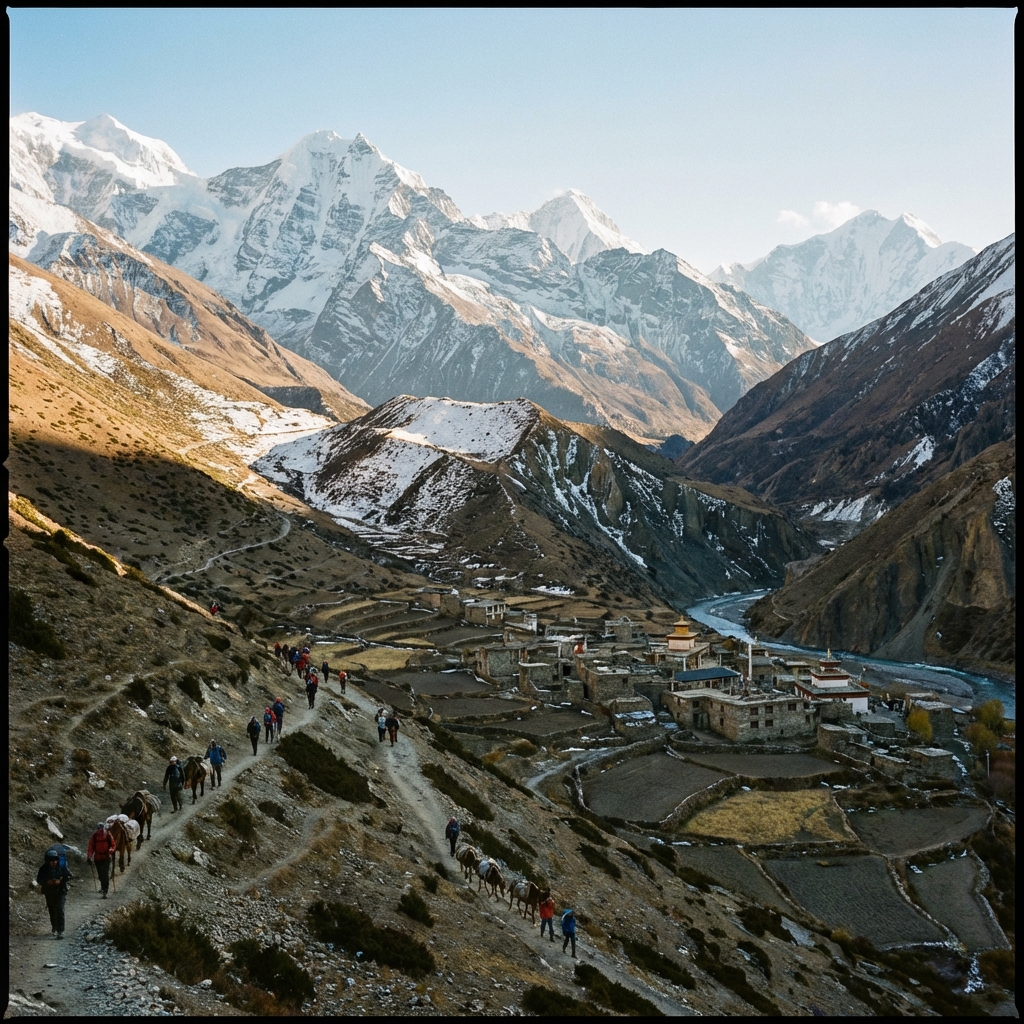
The Nar Phu Valley is Nepal trekking's last true frontier. This restricted area, accessed through a dramatic narrow gorge from Koto on the Annapurna Circuit, contains two of the most isolated inhabited valleys in the Himalayas: Phu (a 4,080m trading village ancient beyond memory) and Nar (a 4,110m monastery settlement with murals dating to the 15th century). A mandatory licensed guide and restricted area permit keep visitor numbers in the low hundreds per season.
The standard 14-day itinerary combines the full Nar Phu Valley with a dramatic exit over Kang La Pass (5,243m) into the Manang Valley — joining the Annapurna Circuit and completing a loop that traverses some of the most spectacular and culturally significant landscapes in Nepal.
14 days
5,243m (Kang La Pass)
~140km
Hard
Mandatory (restricted area law)
2 (or solo with surcharge)
Nar Phu RAP ($100/week) + ACAP + TIMS
~400-600 trekkers
October-November, April-May
$45-80
Why Nar Phu is Unlike Any Other Nepal Trek
Genuine isolation: Nar Phu is not marketed as "off the beaten path" while being a busy teahouse circuit. The Nar Phu Valley has approximately 400-600 annual visitors — compared to 100,000+ on EBC. Days without seeing another trekking group are common.
Living Tibetan civilization: Phu and Nar are not tourist villages. They are living communities that have maintained continuous Tibetan Buddhist culture for centuries, largely isolated from the changes affecting the rest of Nepal.
Kang La Pass: The crossing at 5,243m is a serious mountaineering-adjacent experience — not a recreational walk. The pass requires good acclimatization, appropriate gear, and respect for altitude.
Restricted area: The permit system that limits access also ensures that Nar Phu retains its character. This is by design, and it works.
Permit Requirements
Nar Phu Restricted Area Permit (RAP): $100 per person per week (USD). Valid for both Nar and Phu valleys. Must be obtained through a licensed agency — no independent arrangement possible.
ACAP (Annapurna Conservation Area Permit): $30
TIMS Card: $10-20
Mandatory licensed guide: One guide per two trekkers minimum. Your agency arranges this.
Altitude Profile
| Day | Destination | Altitude | Notes |
|---|---|---|---|
| 1 | Kathmandu | 1,400m | Preparation, permits |
| 2 | Drive to Koto | 2,600m | 8-9 hour drive |
| 3 | Trek to Meta | 3,560m | Enter restricted area |
| 4 | Trek to Phu Village | 4,080m | +520m |
| 5 | Rest/Explore Phu | 4,080m | Acclimatization |
| 6 | Trek to Nar Village | 4,110m | +30m (different valley) |
| 7 | Rest/Explore Nar | 4,110m | Acclimatization |
| 8 | Trek to Kang La Base | 4,800m | +690m |
| 9 | Cross Kang La (5,243m) to Ngawal | 3,657m | Pass day |
| 10 | Trek to Manang | 3,540m | Descend |
| 11 | Drive/Trek toward Chame | 2,670m | Leaving valley |
| 12 | Drive to Kathmandu | 1,400m | Long drive |
| 13 | Rest Day Kathmandu | 1,400m | Recovery |
| 14 | Departure | 1,400m | International flight |
Day-by-Day Itinerary
Day 1: Arrival in Kathmandu (1,400m)
Airport pickup, hotel transfer, trek briefing. Confirm permit arrangements with your agency. Permits for Nar Phu are issued from the Department of Immigration in Kathmandu — your agency handles this on your behalf, but the permit requires your passport details and arrival date.
Accommodation: Hotel in Kathmandu Meals: Dinner
Day 2: Drive to Koto (2,600m)
The drive to Koto follows the main Annapurna Circuit road: Kathmandu → Besisahar → up the Marsyangdi Valley to Koto. Koto is a small village where the Nar Phu gorge branches north from the main Annapurna Circuit road.
Drive time: 8-9 hours total What to expect: Long but increasingly dramatic drive. The Marsyangdi Valley road is rough in sections. The journey through Besisahar and up toward Chame passes through the lower Annapurna Circuit zone — familiar to circuit trekkers.
At Koto, your permits will be checked at the restricted area checkpoint. Ensure all permits are in order before this point.
Accommodation: Teahouse in Koto Meals: Breakfast, Lunch, Dinner
Day 3: Koto to Meta (3,560m)
Trek distance: 14km | Trek time: 6-7 hours
The Nar Phu Valley begins dramatically. From Koto, the trail enters a narrow gorge carved by the Phu Khola river. The gorge is one of the most dramatic geological features in Nepal — sheer walls rising hundreds of meters on both sides, the trail carved into the cliff face in some sections, with the river raging far below.
After the gorge opens, the landscape transitions to Tibetan high-altitude terrain: sparse vegetation, large mani stones, prayer flags on every ridge, and distant snow peaks framing every view. Meta is the first substantial settlement in the valley — a small cluster of stone houses with basic teahouses.
Key experience: The gorge entry. For the first 3-4km from Koto, the trail is essentially carved into the wall of a canyon. The scale is extraordinary.
Accommodation: Teahouse in Meta Meals: Breakfast, Lunch, Dinner
Day 4: Meta to Phu Village (4,080m)
Trek distance: 12km | Trek time: 5-6 hours
The valley widens above Meta, opening into the high pasture zone typical of Tibetan borderland topography. The trail passes through summer herding settlements (occupied only in warmer months) and crosses several tributary streams before the final approach to Phu.
Phu village is one of Nepal's most astonishing human settlements — a collection of ancient stone buildings stacked at the base of a dramatic cliff, with the ruins of a larger upper village above. The entire settlement at 4,080m has survived at the edge of inhabitable altitude for centuries, sustained by trade with Tibet (now closed) and increasingly by tourism (very limited).
Key sight: Tashi Lhakhang Gompa — the main monastery of Phu. The monks here maintain centuries-old religious practices in near-complete isolation from the modern world.
Accommodation: Teahouse in Phu Village Meals: Breakfast, Lunch, Dinner
Phu Village Etiquette
Phu is a living religious community, not a museum. Ask your guide before entering any monastery or private building. Do not photograph villagers or monks without permission. Dress modestly — shoulders and knees covered when in the village. The gompa may require removing shoes. Respect for local culture ensures the community's continued openness to the small number of visitors who reach this place.
Day 5: Exploration and Acclimatization Day in Phu (4,080m)
This is your most important acclimatization day. Spending two nights at Phu (4,080m) before pushing higher significantly reduces altitude risk for the Kang La crossing (5,243m).
Morning: Visit Tashi Lhakhang Gompa with your guide. The gompa houses ancient thangkas (Buddhist scroll paintings), bronze statues, and ritual items dating back hundreds of years. If monks are present, they may invite you to witness morning prayers — an extraordinary privilege rarely available to visitors.
Afternoon: Hike above the village for acclimatization (aim for 4,400-4,500m, then return). Explore the ruins of the upper village and the cliff-carved water channels that supply Phu. Visit the mani walls on the valley edge.
Optional: Walk toward the Himlung Himal base camp approach (3-4 hours round trip) for views of Himlung (7,126m), Ratna Chuli, and the surrounding peaks.
Evening: Rest and hydrate aggressively. Tomorrow's walk to Nar requires a detour over a ridge.
Accommodation: Teahouse in Phu Village Meals: Breakfast, Lunch, Dinner
Day 6: Phu to Nar Village (4,110m)
Trek distance: 12km | Trek time: 6-7 hours
The walk from Phu to Nar requires crossing a ridge (approximately 4,350m) that separates the two valleys — they are closer as the crow flies than the walking distance suggests. The trail climbs from Phu through Nar Phedi (the "foot of Nar") before the final ascent to the village.
Nar village is Phu's sister settlement — similar in character but with a slightly larger monastery complex and a different architectural style that reflects its position on a slightly lower, more sheltered slope.
Key sight: Nar monastery (Nar Gompa). Larger than Phu's gompa, with better-preserved murals that your guide can interpret. The monastery's annual festival (timing varies by lunar calendar) draws villagers from both Nar and Phu.
Accommodation: Teahouse in Nar Village Meals: Breakfast, Lunch, Dinner
Day 7: Exploration Day in Nar (4,110m)
Second acclimatization day before the Kang La crossing. Critical.
Morning: Hike to Nar Phedi (4,400m) for acclimatization — this is also your preview of the approach route to Kang La. Assess conditions: snow depth, trail condition, weather forecast.
Afternoon: Explore Nar village fully. Visit the monastery, the community crafts, the traditional irrigation systems. If a village elder is willing to share tea with your group, this is among the most remarkable cultural experiences available to any Nepal traveler.
Evening: Prepare for tomorrow's long climb to Kang La Base Camp (4,800m). Pack carefully — this is the highest sleeping altitude of the trek.
Accommodation: Teahouse in Nar Village Meals: Breakfast, Lunch, Dinner
Day 8: Nar to Kang La Base Camp (4,800m)
Trek distance: 9km | Trek time: 4-5 hours
A steady climb from Nar through increasingly sparse, barren terrain toward the base of Kang La. The route passes through Nar Phedi and continues up the valley to the highest teahouse on the route.
Kang La Base Camp (4,800m): Basic accommodation — usually one lodge with limited capacity. Confirm availability with your agency before departure. Some groups camp here if the lodge is full.
Evening: Same Thorong La protocol — eat well, pack carefully, sleep early. The Kang La crossing is the toughest day of the trek.
Accommodation: Basic teahouse at Kang La Base Camp Meals: Breakfast, Lunch, Dinner
Day 9: Cross Kang La Pass (5,243m), Descend to Ngawal (3,657m)
Start time: 4:00-5:00 AM | Pass time: 8:00-10:00 AM | Ngawal arrival: 2:00-4:00 PM Trek time: 9-11 hours total
The defining day of the Nar Phu Valley trek.
Pre-dawn departure: The climb from Base Camp to Kang La involves approximately 443m of ascent over 3-4km. The trail is steep and rocky in the lower section, then traverses snow and glacial terrain near the pass. Crampons and ice axes are not standard requirements but should be considered in early-season conditions — your guide will advise based on current conditions.
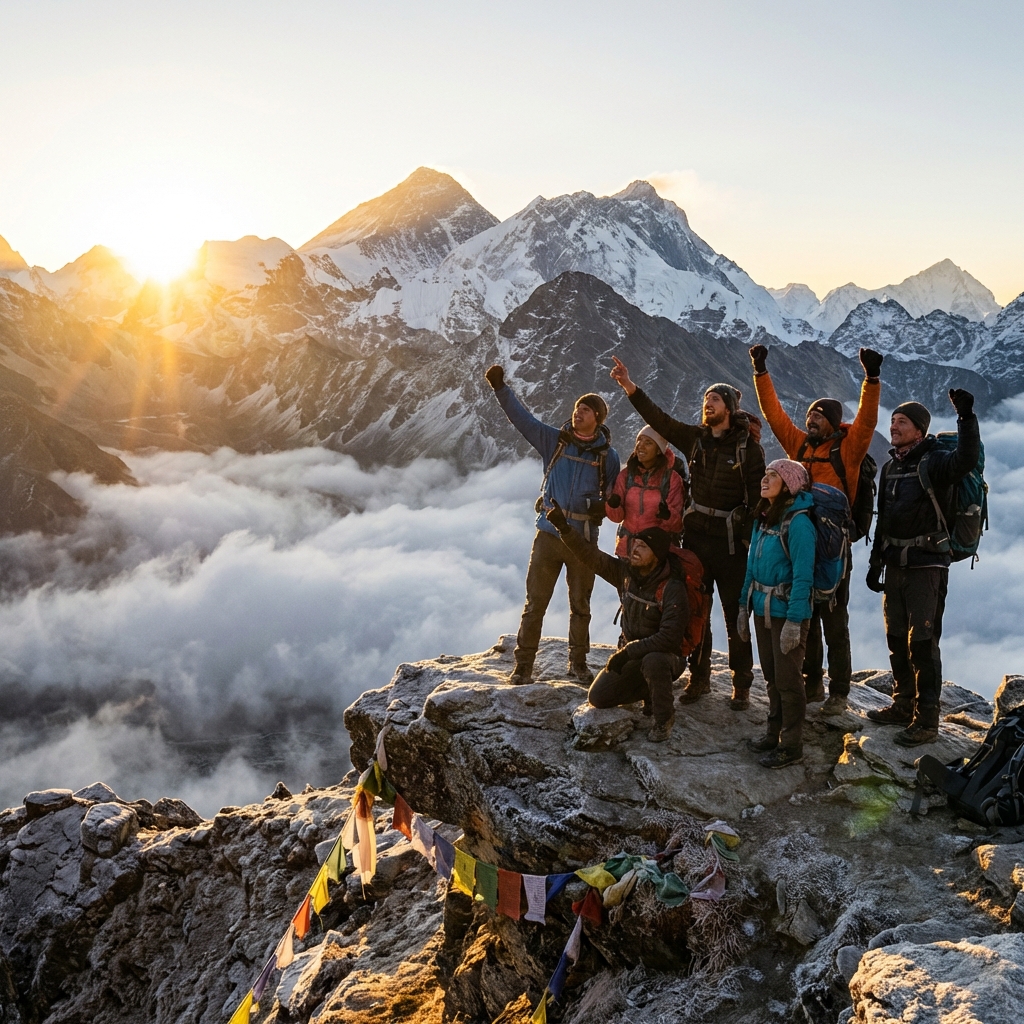
Kang La Pass (5,243m): The view from the pass is one of the most spectacular in the Annapurna region: Annapurna III and IV to the south, Gangapurna, Tilicho Peak, and the full Manang Valley spread below. On clear days, the panorama extends to Manaslu.
Descent to Ngawal (3,657m): The western descent is steep and long — dropping 1,586m to Ngawal village in the Manang Valley. The trail joins the Annapurna Circuit, and Ngawal feels civilized by comparison with the isolation you have experienced.
Accommodation: Teahouse in Ngawal (Annapurna Circuit standard) Meals: Breakfast, Lunch, Dinner
Kang La Pass Conditions
Kang La (5,243m) is more technically demanding than Thorong La (5,416m, Annapurna Circuit) in some conditions because it sees far fewer maintenance passes and less foot traffic. Snow can remain on the approach and descent long after Thorong La is clear. Your guide's judgment on conditions is essential — be prepared to delay the pass crossing by a day if conditions are unfavorable.
Day 10: Ngawal to Manang (3,540m)
Trek distance: 8km | Trek time: 3-4 hours
A gentle walk from Ngawal down the Manang Valley to Manang — the large hub village of the Annapurna Circuit. The contrast with Nar and Phu is immediate: Manang has bakeries, gear shops, a cinema, and the Himalayan Rescue Association medical post. It feels like a city after 8 days in the restricted valleys.
Rest, eat well, and celebrate. The hardest part of the trek is complete.
Accommodation: Teahouse in Manang (excellent quality by any standard) Meals: Breakfast, Lunch, Dinner
Day 11: Trek to Chame, Drive toward Besisahar
Descend the Marsyangdi Valley from Manang through Pisang, Hongde, and down to Chame (2,670m). From Chame, vehicles run down the valley road toward Besisahar.
Options:
- Trek to Chame (3-4 hours), then take a jeep to Besisahar (2-3 hours)
- Trek part of the valley and take a jeep from wherever vehicles are available
Accommodation: Teahouse in Chame or Besisahar Meals: Breakfast, Lunch, Dinner
Day 12: Drive to Kathmandu (1,400m)
The drive from Besisahar to Kathmandu follows the Prithvi Highway — 6-7 hours total. Arrive in Kathmandu by afternoon.
Accommodation: Hotel in Kathmandu Meals: Breakfast, Dinner
Day 13: Rest Day in Kathmandu
Recovery, shopping, sightseeing. Boudhanath stupa and Pashupatinath temple are the recommended post-trek cultural visits.
Accommodation: Hotel in Kathmandu Meals: Breakfast
Day 14: Departure
Transfer to Tribhuvan International Airport.
Meals: Breakfast
Alternative Itinerary: 16-Day with Tilicho Lake Extension
Trekkers who want the maximum Annapurna Circuit experience can extend the itinerary by 2 days in Manang (Days 10-12) to add the Tilicho Lake extension (4,919m) before descending to Chame.
This creates a 16-day combined Nar Phu Valley + Tilicho Lake + Manang Valley trek — arguably the most complete Nepal trekking experience available on a single route.
Teahouse Conditions in Nar Phu
| Location | Altitude | Quality | Notes |
|---|---|---|---|
| Koto | 2,600m | Basic-Good | Last reliable facilities |
| Meta | 3,560m | Basic | Simple but adequate |
| Phu Village | 4,080m | Basic | Main lodge has generator evenings |
| Nar Village | 4,110m | Basic | Similar to Phu |
| Kang La Base Camp | 4,800m | Very Basic | Limited capacity — confirm ahead |
| Ngawal (post-pass) | 3,657m | Good | Annapurna Circuit standard |
Frequently Asked Questions
Can I combine the Nar Phu Valley with the full Annapurna Circuit?
Yes. The standard approach enters Nar Phu from Koto/Meta on the Annapurna Circuit and exits over Kang La Pass back into the Manang Valley. This adds 7-10 days to the standard circuit for a total of 18-24 days.
Is the Kang La Pass crossing dangerous?
Kang La (5,243m) is challenging but not technical in normal conditions. The main risks are weather deterioration, snow on the pass in early season, and altitude. An experienced guide and proper acclimatization make the crossing manageable for fit trekkers.
How remote is the Nar Phu Valley?
Very remote. There are no roads, no mobile signal in most areas, and helicopter evacuation is the only rapid exit option. Teahouses in Phu and Nar villages are basic. This is genuinely off-the-beaten-path trekking.