Kala Patthar Summit Guide: The Best Everest Viewpoint at 5,545m
The Kala Patthar summit at 5,545m (18,192ft) is the best Everest viewpoint accessible to trekkers — a dark rocky promontory above Gorak Shep that gives an unobstructed, straight-on view of the world's highest mountain from summit to glacier. Unlike Everest Base Camp, where Everest itself is hidden, Kala Patthar shows the full south face. The pre-dawn ascent takes 2–3 hours, gains 381m, and is the visual highlight of the entire Everest Base Camp trek.
Every trekker who reaches Everest Base Camp arrives with one image burned into their mind — the world's highest mountain filling the horizon above them. They are often surprised, even disappointed, to discover that Everest itself is largely hidden from the base camp. The Khumbu Icefall and the walls of the valley obscure the summit. You walk for two weeks to stand at 5,364 metres among a jumble of glacial moraine and you cannot properly see the mountain you came to witness.
Kala Patthar changes everything.
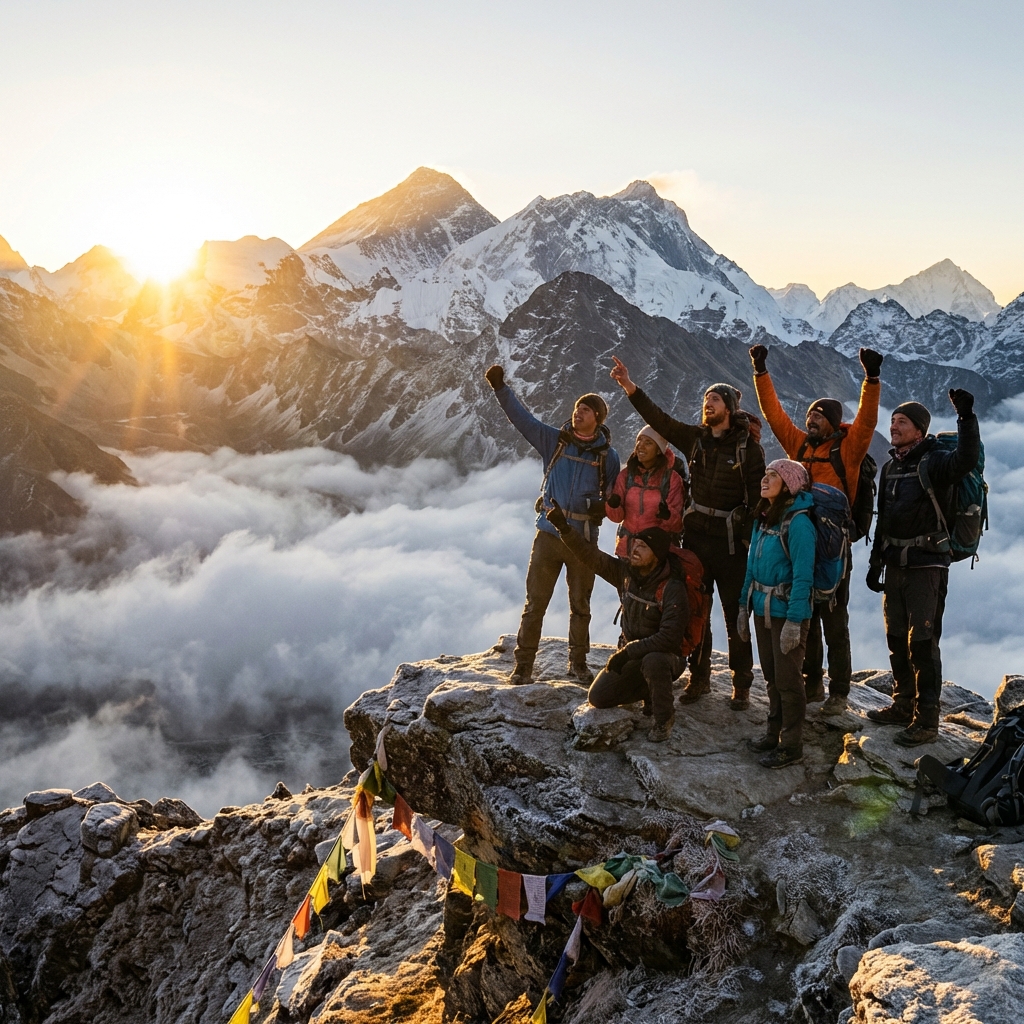
This dark rocky promontory, rising above the village of Gorak Shep at 5,545 metres, offers what Everest Base Camp cannot: an unobstructed, straight-on view of the world's highest mountain from summit to base. On a clear morning, the south face of Everest — from the Hillary Step to the Khumbu Icefall, the South Col, the Southeast Ridge, and the utter black pyramid of the summit itself — is laid out before you in perfect clarity.
This guide tells you everything you need to know about the Kala Patthar summit: why it matters more than EBC for most trekkers, the route from Gorak Shep, how to choose between sunrise and sunset ascents, the safety-critical 2 PM rule, photography strategy, costs, and the altitude challenges of a 5,545m peak. If you are still planning the wider trip, pair this with our complete Everest Base Camp route guide.
Quick Facts: Kala Patthar Summit
5,545m (18,192ft)
Gorak Shep (5,164m)
381m
~1.5 km from Gorak Shep
2–3 hours from Gorak Shep
1.5–2 hours
4–5 hours return
Moderate-Strenuous (altitude makes it hard)
Sunrise (5:30–7:30 AM)
Oct–Nov, then Mar–May
Sagarmatha National Park (included in EBC trek)
Best mid-morning — clear of cloud by 8 AM most days
Why Kala Patthar is the Real Everest Viewpoint
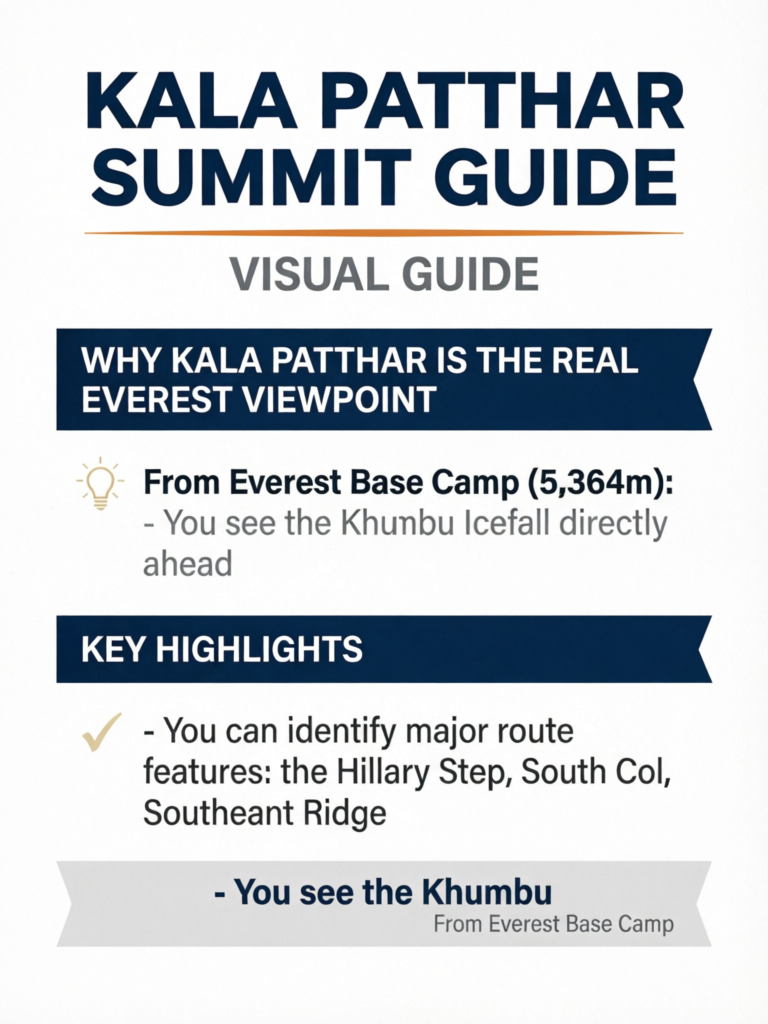
The confusion between Kala Patthar and Everest Base Camp as "the Everest viewpoint" is one of the most persistent misunderstandings in Nepal trekking. Many trekkers do not realise until they arrive that you cannot see Mount Everest from Everest Base Camp — the surrounding peaks and the Khumbu Icefall block it entirely. Here is the honest comparison:
From Everest Base Camp (5,364m):
- You see the Khumbu Icefall directly ahead
- Everest summit is hidden behind the West Ridge and other peaks
- The view is of glacial chaos — impressive but not the iconic summit shot
- The experience is more "standing in the presence of" than "looking at"
- Best understood as a historic and atmospheric experience, not a panoramic viewpoint
From the Kala Patthar summit (5,545m):
- Everest's south face is directly visible — the full mountain from Khumbu Glacier to summit
- You can identify major route features: the Hillary Step, South Col, Southeast Ridge, Yellow Band
- Nuptse (7,861m), Changtse, Lhotse, Ama Dablam, and Pumori surround the view in all directions
- You look down on the entire Everest Base Camp site and the Khumbu Glacier below
- Sunlit mornings produce textbook Everest photographs
- The wind, cold, and 381m extra elevation create a genuine summit feeling
The Classic Everest Photo
Virtually every famous photograph of Everest taken from the Nepal side — the triangular black summit, the plume of cloud from the top, the glaciated south face — was taken from the Kala Patthar ridge or nearby Pumori's lower slopes. If you've seen an Everest photo, it was taken from somewhere very close to where you'll be standing.
The Route: Gorak Shep to Kala Patthar
Trailhead: Gorak Shep (5,164m)
Gorak Shep is the highest permanently inhabited settlement in the Khumbu, sitting on a frozen lake bed just 4 km below Everest Base Camp. The handful of lodges here are the final teahouses before the trail ends at base camp. See our Gorak Shep village guide for accommodation and what to expect at this altitude.
Almost every EBC trekker stays at least one night in Gorak Shep, making the Kala Patthar summit an extension of the EBC itinerary rather than a separate undertaking. The full distance from Gorak Shep to the summit is roughly 1.5 km one way — short on the map, but brutal in thin air.
Starting the ascent: The trail to Kala Patthar begins immediately behind the lodges, heading northwest up a rocky ridge. It is well-worn and generally unmistakeable, though in pre-dawn darkness a headlamp is essential as loose rocks make the lower sections tricky. The path starts at the northern end of Gorak Shep — find it before you set off, and trudge steadily uphill rather than chasing a fast pace.
Stage 1: Gorak Shep to Kala Patthar Lower Viewpoint (1.5–2 hours)
The trail climbs steeply through loose rocky terrain, gaining approximately 300m over the first stretch. There is no single defined path — multiple lines weave between boulders and patches of consolidated gravel. In good conditions, any reasonable-looking upward line works.
Key landmarks:
- The initial rise behind Gorak Shep is the steepest section — gain this early
- A false summit at approximately 5,450m is commonly mistaken for the top
- The lower viewpoint (approximately 5,550m) offers the first clear Everest views
Conditions at dawn: At pre-dawn temperatures of -15 to -20°C, the rocky trail can be icy. Move carefully on the steeper lower sections. Crampons are not generally required but microspikes are useful in November onward and in early spring. The dry lakebed between the lodges and the base of the climb is loose and sandy underfoot — expect your shoes to fill with grit on the flat approach.
Stage 2: Lower to Upper Viewpoint (30–45 minutes)
Above the lower viewpoint, the trail continues up the ridge to the true summit cairn and prayer flags at approximately 5,545m. This section is less steep but altitude makes each step harder than it should rationally feel.
The prayer flag cairn at the top marks the standard summit — the point from which 90% of Kala Patthar photographs are taken. The view directly south reveals Pumori; looking east across the Khumbu Glacier you see the full south face of Everest. Do not waste energy scrambling off-trail through the scree near the top, as it is slower and riskier than staying on the worn path.
Stage 3: Descent (1.5–2 hours)
Descend the same way you came up. The descent is straightforward — follow the ridge back south to Gorak Shep. Allow more time than your ascent in cold conditions as muscles are less responsive. Watch particularly for loose rocks on the steeper lower sections.
Pace Yourself — The Most Common Mistake
The single most frequent error on the Kala Patthar summit is walking too fast. At 5,545m you have roughly 50% of the oxygen available at sea level. Set a slow, sustainable rhythm from the lodge door — a well-acclimatised, fit trekker may summit in around 90 minutes, while someone less adjusted may need 3 hours or more. Both are fine. The only goal that matters is reaching the viewpoint safely and returning under your own power.
How Long Does It Take to Climb Kala Patthar?
The Kala Patthar climb takes 2–3 hours to ascend from Gorak Shep and 1.5–2 hours to descend, for a total of 4–5 hours return including time at the summit for the sunrise and photographs. The ascent gains 381m over roughly 1.5 km of rocky trail.
Your exact time depends on three things: your fitness, how well you have acclimatised, and the trail and weather conditions on the day. A strong, fully acclimatised trekker can reach the summit in about 90 minutes. A trekker who is not yet adjusted to the altitude — or who arrived at Gorak Shep tired after the long climb from Lobuche — may need three hours or more with frequent rest stops. Plan for the full five hours so you are never rushing in the cold or the dark.
Best Time for the Kala Patthar Summit
Kala Patthar follows the same seasonal pattern as the wider Everest region. For full month-by-month detail, see our best time to trek the Everest region guide.
Best season — October to November (post-monsoon / autumn): This is the peak trekking season in Nepal. The monsoon has cleared, skies are reliably blue, temperatures are comfortable, and visibility of Everest from Kala Patthar is at its finest. Lodges in Gorak Shep are fully staffed and the trail is in solid condition.
Second best — March to May (pre-monsoon / spring): Spring brings stable weather and excellent long-range visibility. Lower sections of the EBC trail are lined with blooming rhododendrons. Warmer daytime temperatures make the cold summit slightly more bearable.
Avoid if you can — December to February (winter): Extreme cold and powerful winds make the exposed summit genuinely dangerous, and heavy snow can close the Lukla flights and high lodges. Only experienced, well-equipped trekkers should attempt the winter EBC route.
Avoid — June to September (monsoon): Heavy rain, dense cloud, and leeches on the lower trails. Visibility at the summit is often zero, which defeats the entire purpose of climbing Kala Patthar.
The 2 PM Rule: A Safety Essential
The 2 PM rule is a widely respected high-altitude safety guideline in the Everest region: aim to reach your high point and be heading back down before 2:00 PM. In the Khumbu, afternoon weather windows close quickly — clouds build, visibility collapses, and wind and snow can move in with little warning.
For the Kala Patthar summit this rule shapes your whole morning. It is one of the main reasons experienced guides recommend a pre-dawn departure for a sunrise ascent rather than an afternoon attempt:
- Depart Gorak Shep around 4:00–5:00 AM
- Summit before or at first light (clouds are rare before 9 AM)
- Descend with a wide weather margin, long before the afternoon deteriorates
A sunset attempt deliberately works against this window, which is part of why morning is the safer, more reliable choice for most trekkers.
Turn Around if the Weather Closes In
If cloud rolls in and obscures the summit while you climb, or if wind chill becomes unmanageable, turn around. The view will not improve once a Khumbu afternoon storm sets in, and trekkers who start too late routinely face whiteout conditions and lose the crisscrossing trail markings. No photograph is worth a forced descent in poor visibility.
Sunrise vs Sunset: Which is Better?
Most trekkers are divided on this question. Here is the honest assessment:
Sunrise Ascent (Recommended)
Departure from Gorak Shep: 4:00–5:00 AM (adjust seasonally for sunrise time) Summit arrival: Before first light; watch dawn break on Everest Temperature: Coldest of the day, typically -15 to -20°C in October–November Wind: Calmer at dawn than afternoon on most days Crowds: Similar numbers to sunset ascents
Advantages of sunrise:
- The famous "Everest alpenglow" — summit lit pink and gold while the valley below remains in shadow
- Stable atmospheric conditions before wind picks up
- Clouds rarely build before 9 AM, giving a wide weather window after your ascent
- Keeps you well inside the 2 PM rule for a safe descent
- The walk back to Gorak Shep in full morning light is beautiful
Disadvantages:
- Extreme cold in the dark — requires full layering including down jacket
- Pre-dawn navigation on rocky trail requires good headlamp
Sunset Ascent
Departure from Gorak Shep: 2:00–3:00 PM Summit for light: 4:30–5:30 PM Temperature: Warmer than dawn, typically -5 to -10°C Wind: Often stronger than mornings
Advantages of sunset:
- More comfortable temperatures during ascent
- Evening light on Everest creates different, warmer tones
- Some photographers prefer the depth of late afternoon light
Disadvantages:
- Afternoon clouds more common — summit may be obscured
- Descent in fading light or darkness (headlamp essential)
- Wind tends to be stronger
- Works against the 2 PM rule, raising weather and visibility risk
The verdict: For most trekkers, sunrise is the better choice — primarily because of atmospheric stability. The chance of Everest being cloud-free is higher in morning than afternoon. The cold is brutal but the experience of watching the sun rise behind the world's highest mountain is unmatched.
What You Can See from the Kala Patthar Summit
The panorama from Kala Patthar is among the most spectacular accessible mountain views on Earth. On a clear morning you can pick out:
- Mount Everest (8,848m) — the full south face, summit pyramid, Southeast Ridge and South Col, straight on
- Nuptse (7,861m) — the immense wall directly in front of and to the right of Everest
- Lhotse — the world's fourth-highest peak, just south of Everest
- Pumori — rising sharply directly behind and above you to the north
- Changtse — Everest's northern neighbour, across the border ridge
- Ama Dablam — the elegant fang-shaped peak down the valley to the south
- Khumbu Glacier and the Everest Base Camp site — laid out below the ridge
This combination — the highest mountain on Earth seen head-on, ringed by 7,000m and 8,000m giants — is the reason most trekkers rate Kala Patthar above EBC itself.
Photography: Getting the Best Kala Patthar Shot
The Kala Patthar summit is one of the world's great photography viewpoints. Here's how to make the most of it. For wider planning, see our Everest region photography spots guide.
Technical Settings
For sunrise shots:
- Use a wide-angle lens (16–24mm) to capture Everest in context
- Set ISO to 400–800 for pre-dawn shots; reduce as light builds
- Use a tripod — even well-lit photos benefit from stability at altitude
- Bracket exposures — the dynamic range between dark foreground and bright summit is extreme
For clear-sky midday shots:
- Polarising filter eliminates haze and deepens the blue sky
- A longer focal length (70–200mm) isolates the summit
- Shoot at f/8 for maximum sharpness across the depth of field
The Classic Shot
The classic Kala Patthar composition places the snow-covered summit of Everest in the upper right third of the frame, with the rocky foreground of the Khumbu Glacier in the lower left. Prayer flags at the summit cairn can be included in the foreground for colour and context.
Protecting Your Camera
At -20°C, camera batteries fail rapidly. Keep a spare battery inside your inner jacket, close to your body. Mirrorless cameras are more power-hungry than DSLRs and need more attention to battery management. Keep the camera inside your jacket between shots and only extend it for actual shooting.
Altitude Challenges at 5,545m
Kala Patthar is the highest point most standard EBC trekkers reach. At this altitude, the body is under significant physiological stress.
What to expect:
- Breathing is laboured even at slow walking pace
- Headache is common, particularly if you ascended from Lobuche in one day
- Mental clarity may be reduced — decisions feel harder
- Rate of perceived exertion is extremely high relative to actual effort
Key precautions:
- Never attempt Kala Patthar if you have any AMS symptoms the evening before
- Acclimatise fully in Dingboche (two nights minimum) before ascending to Gorak Shep — see our Dingboche village guide
- Carry Diamox if prescribed — it does not prevent AMS but can ease symptoms
- Descend immediately if you develop symptoms during ascent
- Tell your guide or lodge staff your planned departure and expected return time
Other Common Problems on the Climb
Beyond classic altitude sickness, several practical issues catch trekkers out on the Kala Patthar summit:
- Dehydration: Cold, dry mountain air dulls your sense of thirst, so dehydration creeps in unnoticed and saps your strength. Drink steadily before and during the climb. Our water and hydration guide covers how much and how.
- Extreme cold and wind chill: Wind chill at the summit can drop well below -20°C before sunrise. Frostbite of exposed fingers and faces is a real risk — full layering, a windproof shell, a warm hat, and good gloves are non-negotiable.
- Accumulated fatigue: By the time you reach Gorak Shep you have typically been trekking for 10–12 days. The Kala Patthar hike asks for one more big effort from legs that are already well-worked. Factor this into your pace.
- Poor trail visibility: Clouds can roll in fast and erase the faint, branching trail. Start early and turn back if you lose the route.
For the full medical picture, read our altitude sickness prevention and treatment guide and the dedicated HAPE and HACE emergency guide.
The Gorak Shep Altitude Trap
Many trekkers feel unwell in Gorak Shep itself — not because of the ascent to Kala Patthar but simply due to sleeping at 5,164m. Poor sleep, reduced appetite, and morning headaches are very common. This does not necessarily mean you have AMS, but it does mean you should assess carefully before adding 381m of ascent to your morning.
The Himalayan Rescue Association clinic in Pheriche (3,840m) is the nearest professional medical facility. If symptoms are concerning, descend rather than ascend.
Combining Kala Patthar with Everest Base Camp
Most trekkers do both the Kala Patthar summit and Everest Base Camp in the same Gorak Shep stay. The typical approach is:
Day 1 (arrival in Gorak Shep): Afternoon walk to Everest Base Camp (5,364m), return to Gorak Shep for night Day 2 (Kala Patthar day): Pre-dawn ascent of Kala Patthar, return to Gorak Shep for breakfast, then begin descent toward Pheriche
This schedule is physically demanding — particularly the EBC afternoon walk on your first day at Gorak Shep altitude — but is how the majority of independent trekkers organise the section.
An alternative is: Day 1: Kala Patthar sunrise, then EBC in the afternoon Day 2: Descent
This works well for trekkers who prioritise the Kala Patthar experience over EBC.
See the complete Everest Base Camp route guide for full itinerary options, or our breakdown of how long the EBC trek takes. If you have more time in the Khumbu, the Three Passes trek and the Gokyo Lakes trek both pair beautifully with a Kala Patthar summit.
Cost: Is Kala Patthar a Separate Trip?
For nearly all trekkers, Kala Patthar is not a separate cost — it is an extension of the Everest Base Camp trek and is reached during the standard Gorak Shep overnight. No additional permit is required beyond the Sagarmatha National Park entry permit and the Khumbu Pasang Lhamu Rural Municipality permit already needed for EBC. See our Sagarmatha National Park permit guide for current fees.
If you book a dedicated guided "Kala Patthar trek" — essentially a shorter Everest Base Camp itinerary built around the viewpoint — operators typically price a roughly 12-day package in the region of USD 1,200–1,300 per person, with the per-person cost falling for larger groups. This usually covers guide, porter, permits, domestic flights to and from Lukla, lodge accommodation and meals on the trail. For a full breakdown of what you actually pay, see our EBC trek cost breakdown.
Whichever way you arrange it, we recommend you plan your Everest trek and book with a verified local agency or guide rather than going fully independent at this altitude — the margin for error at 5,545m is small.
Plan Your Everest Base Camp & Kala Patthar Trek
Reach the best Everest viewpoint with a verified local guide who knows the 2 PM rule, the weather windows, and the safe pace at 5,545m.
Is the Kala Patthar Sunrise Hike Worth It?
Absolutely. The Kala Patthar summit provides the best view of Everest available to trekkers — the complete south face from summit to glacier, illuminated by sunrise. The view from Everest Base Camp itself is largely obscured by surrounding peaks. Most trekkers consider Kala Patthar the emotional and visual highlight of the entire EBC trek. The pre-dawn cold and altitude are challenging but the reward is proportional.