Knee Protection for Trekking in Nepal
Knee protection for trekking in Nepal comes down to four things: build eccentric quad strength 8–12 weeks before departure, use trekking poles on every descent (they cut knee load 20–30%), descend with a slight forward lean and a never-locked knee, and rest at the first sign of pain. Nepal's stone-step trails load each knee at 3–5 times body weight per step, so preparation matters more here than on any other trail.
Ask any guide in Namche Bazaar what injury causes the most problems on the Everest trail, and most will say the same thing: knees. Not altitude sickness. Not blisters. Knees.
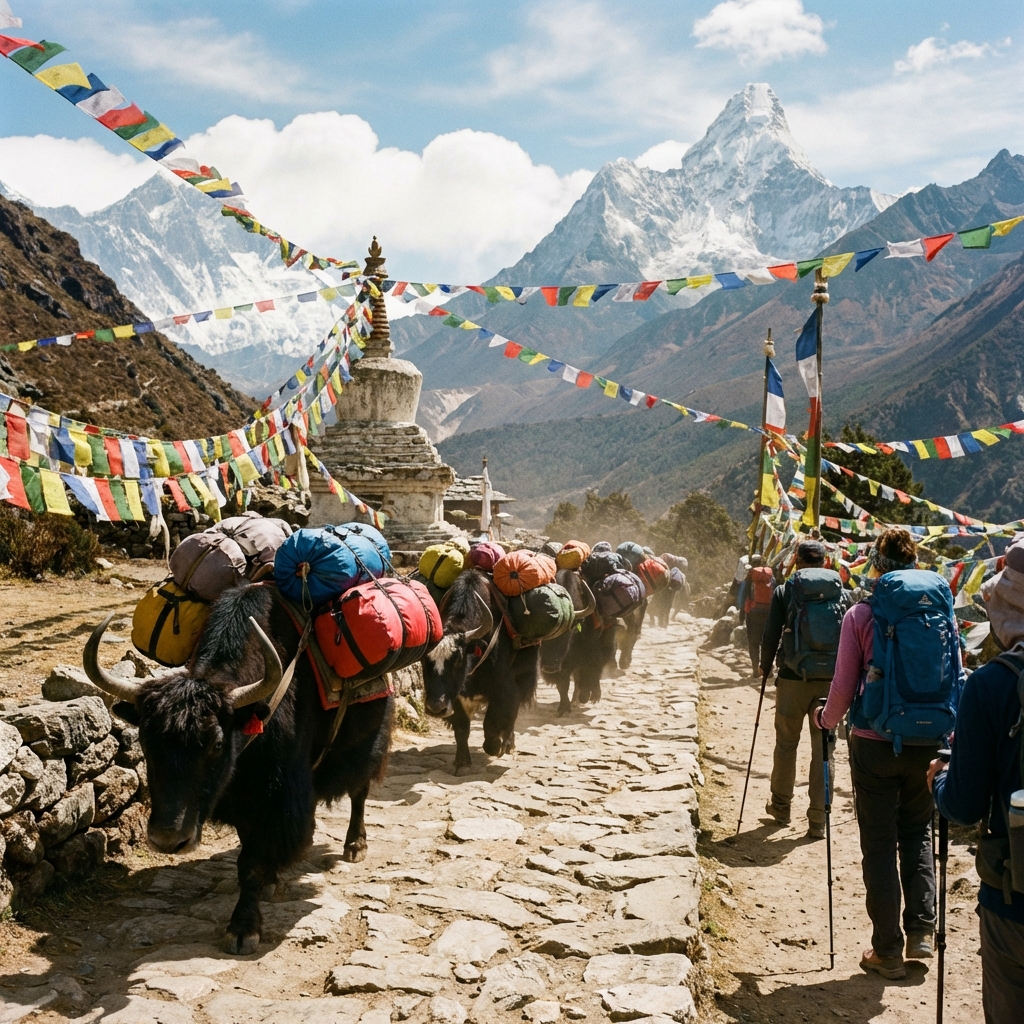
This is not surprising when you understand Nepal's trail architecture. The most famous trekking routes in the country — the Everest, Annapurna, and Langtang corridors — are built primarily from stone steps. Not gentle gravel paths or forested dirt tracks, but thousands of hand-laid stone slabs, often steep, irregular, slick when wet, and relentless in their demand on the knee joint.
The descent from Namche Bazaar to the Dudh Kosi bridge is the classic example: 800 metres of elevation loss over stone steps in 3–4 hours. Your quadriceps must eccentrically contract on every single step to absorb your weight. Multiply that by tens of thousands of steps over 14 days and you understand why knee pain is endemic on Nepal treks.
This guide gives you what you need to protect your knees before your trek, on the trail, and in the event that something goes wrong. It pairs naturally with our fitness requirements for Nepal trekking and our trekking poles guide — read all three before you plan your trek.
Quick navigation: Jump to why descents hurt, pre-trek strengthening, poles and braces, descent technique, treating pain on trail, or trekking with bad knees.
Understanding Why Nepal Descents Destroy Knees
The Biomechanics of Stone Steps
On flat terrain, your knee bends and extends under minimal load. On a downhill step, physics changes dramatically. As you lower your body weight onto the forward foot, your quadriceps must produce a braking force equal to multiples of your body weight.
Studies of stair descent biomechanics show knee joint loads of 3–5 times body weight during each step. On a 75-kg trekker, that is 225–375 kg of force through the knee joint with every step down. Over 8 hours of descending, the cumulative load is extraordinary.
The main structures under stress:
Patellofemoral joint: The kneecap (patella) tracks in a groove on the femur. Repetitive loading under fatigue causes the patella to track improperly, producing the anterior (front) knee pain called patellofemoral syndrome — colloquially "trekker's knee" or "runner's knee." This is the most common knee complaint on Nepal's trails.
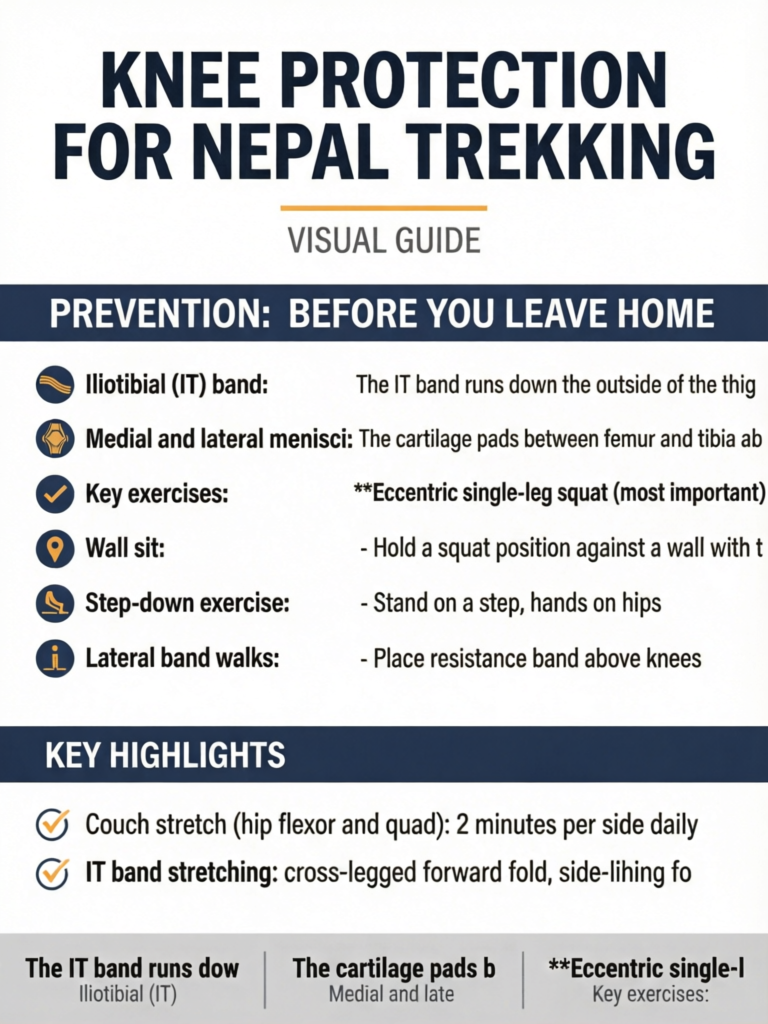
Iliotibial (IT) band: The IT band runs down the outside of the thigh and attaches near the knee. Repetitive bending causes friction on the lateral femoral condyle, producing sharp pain on the outside of the knee. IT band syndrome is common and debilitating if untreated.
Medial and lateral menisci: The cartilage pads between femur and tibia absorb shock and enable smooth joint movement. Fatigue and awkward foot placements on uneven stone steps can compress and twist these structures beyond their tolerance.
Patellar tendon: The tendon connecting the kneecap to the shinbone. Sustained eccentric loading produces patellar tendinopathy — pain below the kneecap, typically worst at the start of movement and after prolonged rest.
The Nepal-Specific Factor
Nepal's trails concentrate descent load in ways that differ from mountain trails in other countries:
Stone is unforgiving. Dirt and packed gravel absorb some impact. Stone absorbs none. Each step transfers full impact directly through your foot into your knee.
Step height is irregular. Stone steps carved by hand vary enormously — from ankle-height to thigh-height within a few metres. Your knee absorbs sudden unexpected loads as you misestimate step height, particularly when tired.
Wet stone is treacherous. Monsoon-season trekking and rainy days produce slick stone surfaces. Slipping on a step forces the knee into abrupt and uncontrolled positions that can strain ligaments.
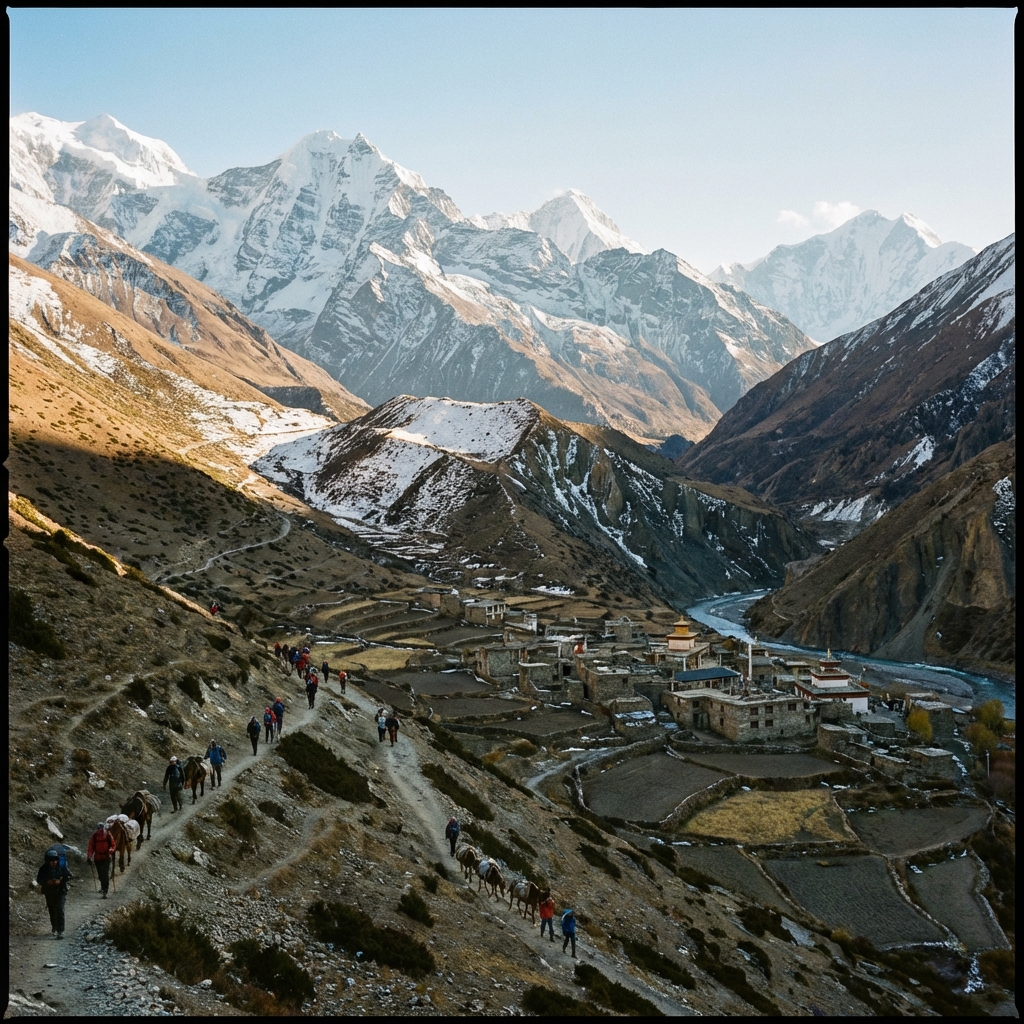
Elevation change is concentrated. Nepal treks don't gently undulate — they climb steeply and descend steeply. The 1,400-metre descent from Thorong La to Muktinath on the Annapurna Circuit happens in 3 hours. The 1,700-metre descent from Ghorepani to Birethanti is 5–6 hours of continuous downhill.
Which Nepal Treks Are Hardest on Your Knees
Not every trek loads the knees equally. The worst offenders are the routes that combine long single-day descents with relentless stone staircases. If you have a history of knee trouble, factor this into your route choice as carefully as you factor in altitude.
| Trek / descent | Knee-load severity | Why |
|---|---|---|
| Everest Base Camp (Namche → Phakding) | High | Continuous stone steps, 800 m loss in 3–4 hours, plus the return leg from Gorak Shep |
| Annapurna Circuit (Thorong La → Muktinath) | Very high | 1,400 m descent in ~3 hours immediately after a high pass, on loose scree and steps |
| Poon Hill / Ghorepani (Ghorepani → Birethanti) | Very high | 1,700 m of near-continuous stone-step descent over 5–6 hours — the classic "knee killer" |
| Annapurna Base Camp (Chhomrong stairs) | High | Thousands of stone steps in and out of Chhomrong, repeated on the return |
| Langtang Valley | Moderate | Steep but shorter descents; more forgiving than the Annapurna staircases |
| Everest View Trek | Moderate | Shorter days reduce cumulative descent load — a good choice for sensitive knees |
If your knees are a known weakness, lower-staircase, shorter-day routes such as the Everest View Trek or a gentler Langtang Valley itinerary are far kinder than the Poon Hill or Thorong La descents. You can also book a porter to carry your pack — removing 10–15 kg of load directly reduces the eccentric force through your knees on every step down. See our guide to hiring guides and porters in Nepal.
Prevention: Before You Leave Home
Strengthening Programme (Start 8–12 Weeks Before)
Building quadriceps and posterior chain strength before your trek is the single most effective knee protection strategy. The muscles must be conditioned to sustain eccentric loads before you ask them to do it for hours per day.
Key exercises:
Eccentric single-leg squat (most important):
- Stand on one foot at the edge of a step
- Slowly lower your body weight until your knee bends to 90°
- Use the other foot to return to start position
- Repeat 3 sets of 12 each leg, 3x per week
- Progress to deeper knee bend as strength develops
Wall sit:
- Hold a squat position against a wall with thighs parallel to floor
- Start with 30 seconds, progress to 90 seconds
- Builds isometric quad strength directly relevant to stair descent
Step-down exercise:
- Stand on a step, hands on hips
- Slowly lower one foot toward the ground (do not touch)
- Return to standing
- 3 sets of 15 per leg, focusing on control not speed
Lateral band walks:
- Place resistance band above knees
- Step sideways maintaining tension
- 3 sets of 20 steps each direction
- Strengthens glutes — essential for knee tracking
Hip bridge:
- Lie on back, knees bent
- Drive hips toward ceiling, hold 3 seconds
- 3 sets of 15
- Builds glutes and hamstrings that support knee in descent
Flexibility Work
Tight hip flexors and quadriceps increase patellofemoral compression. Add:
- Couch stretch (hip flexor and quad): 2 minutes per side daily
- Calf stretching: critical for Achilles health, which affects knee biomechanics
- IT band stretching: cross-legged forward fold, side-lying foam roller
On the Trail: Equipment
Trekking Poles: Non-Negotiable on Nepal Descents
If you use trekking poles on the ascent and then stow them for the descent because "the poles aren't needed going down" — you are making the most common and most damaging mistake in Nepal trekking.
Trekking poles on descents:
Reduce knee load by 20–30%: Studies consistently show that properly used trekking poles reduce the eccentric knee load during stair descent by this margin. Over an 8-hour descent day, this is thousands of kilonewton-seconds of reduced knee stress.
Improve balance: The four-point stance created by two trekking poles dramatically reduces the risk of awkward step placements. The poles give you a warning system — you feel the surface through the pole before committing full weight.
Reduce fatigue accumulation: By sharing the descent load across your upper body and core, poles extend the period before quads fatigue — and fatigue is when most injuries occur.
Proper pole technique for descents:
- Lengthen poles 5–10 cm compared to your ascent length
- Plant both poles ahead of you before stepping down
- Brace through both poles as you lower your body weight
- Do not use poles after the step — plant them on the next step down first
- Keep elbows slightly bent — pole length should create a slight forward lean
Knee Braces
For trekkers with existing knee conditions or previous injuries, a knee brace can extend functional trekking capacity significantly.
Patellofemoral/runner's knee sleeve: A simple neoprene sleeve with a patellar cutout. Provides proprioceptive feedback, keeps the knee warm, and may improve patellar tracking. Lightweight and inexpensive. Recommended for anyone with a history of anterior knee pain.
IT band strap: A strap worn just below the kneecap or around the IT band insertion. Can dramatically reduce IT band pain by altering the tension angle of the band.
Hinged brace: For ligament instability or previous ACL/MCL injuries. Heavier and more restrictive but provides genuine mechanical support. Essential if your orthopaedist has recommended bracing for your joint.
What to avoid: Bulky, rigid braces that restrict range of motion are counterproductive on technical terrain. You need full knee flexion to navigate high steps safely.
Footwear Considerations
Boots with good ankle support and a stiff midsole transmit less torsional force to the knee on uneven surfaces. Worn-out boots with compressed midsoles increase impact transmission. Replace boots if the midsole shows visible compression patterns.
Avoid foam-only trail runners for Nepal's stone trails — their flexibility may be comfortable on soft surfaces but increases knee loading on hard stone stairs. For a full breakdown, see our trekking boots and footwear guide.
Pack Weight and Load Management
Every kilogram on your back is added force through your knee on every descent step. Because Nepal's stone staircases load each knee at multiples of body weight, reducing pack weight is one of the most direct levers you have for knee protection — and one of the easiest to act on.
Hire a porter or use a porter-guide. A porter typically carries 10–15 kg, leaving you with only a daypack of 4–6 kg (water, layers, camera, snacks). Removing that load directly lowers the eccentric braking force your quads must produce on every step down. See our guide to hiring guides and porters in Nepal and the ethics of responsible porter hiring.
Keep your daypack light and high. If you carry your own gear, pack heavy items high and close to your spine so the load sits over your hips rather than dragging behind you. A pack that pulls you backward forces you to lean back on descents — the exact posture that dumps load onto the knee. Our trekking backpacks guide covers fit and load distribution.
Cut non-essentials before you fly. Trekkers routinely carry 3–4 kg of gear they never use. Review the Nepal trekking packing list and the common packing mistakes guide, and weigh your loaded pack before departure.
Hydration, Nutrition, and Muscle Fatigue
Knee injuries on Nepal's trails cluster in the final hours of long descent days, and the underlying cause is almost always muscle fatigue eroding technique. Well-fuelled, well-hydrated quadriceps hold good descent form for far longer than depleted ones.
- Eat carbohydrate before and during descents. Quad muscles burn glycogen to control each step. A carbohydrate snack mid-descent — biscuits, energy bars, the ubiquitous dal bhat at lunch — keeps the muscle working rather than failing. See the altitude nutrition and eating strategy guide.
- Stay hydrated. Dehydration accelerates muscle fatigue and cramping, both of which wreck step-down control. Drink steadily through the day rather than gulping at rest stops; our water purification and hydration guide explains how to keep clean water flowing.
- Pace to the muscle, not the clock. When your quads start to burn or shake, slow down or rest. Pushing a fatigued muscle to finish faster is the single most common precursor to a descent injury.
Warming Up and Cooling Down on Trail
A cold, stiff knee tracks worse than a warm one. Five minutes of easy walking and a few gentle leg swings before a big descent prime the joint and the surrounding muscles. After a long descent day, a short, slow walk and light stretching of the quads, hip flexors, and IT band help the muscles recover overnight so they are ready for the next day's steps.
Where to Buy Knee Braces and Trekking Poles in Nepal
If you arrive without knee support, you have options. Thamel in Kathmandu and Lakeside in Pokhara are dense with outdoor shops selling neoprene knee sleeves, IT-band straps, and trekking poles — both genuine brands and inexpensive copies. A basic neoprene sleeve is widely available; a quality hinged brace is harder to find, so bring that from home if your orthopaedist has prescribed one.
For poles specifically, you can rent or buy in Kathmandu before you start. A reliable pair is the single best knee-protection purchase you can make on the ground. See our gear rental in Kathmandu and rent vs buy gear in Kathmandu guides to decide what is worth bringing versus sourcing locally, and the trekking poles guide for choosing the right pair.
Pro Tip
Buy a neoprene knee sleeve before you fly out and break it in on training walks. Sleeves sold in Thamel vary in sizing and quality, and you do not want to discover a poor fit on Day 1 of a trek when you most need the support.
On the Trail: Technique
The Step-Down Technique
Most knee pain is caused not by the magnitude of descent but by technique failures. The correct technique:
-
Lead with your heel on descents. Placing the heel first rather than the midfoot or toe allows the ankle to absorb impact before the knee is loaded.
-
Keep a slight forward lean. The classic mistake is leaning back in fear of slipping — this places the load entirely on the knee rather than distributing it through hip and core.
-
Never straighten the knee fully on landing. The "locked knee" landing is the primary mechanism of stair descent injury. Keep a slight bend throughout.
-
Look ahead, not at your feet. Plan 2–3 steps ahead to identify step heights and adjust your pace before committing to the step.
-
Use a shorter step on very steep sections. If the steps are very high, take them one at a time — both feet on each step before proceeding.
Adjusting Technique to the Terrain
Nepal's descents are not uniform, and the right knee-saving technique changes with the surface under your boots.
High, irregular stone steps (Chhomrong, Ulleri, the Namche descent): Take steps one at a time on the steepest sections, planting both feet on a step before moving to the next. Lower yourself with the quad and pole rather than dropping onto a locked knee. Where a step is too high to control, turn slightly sideways and step down at an angle to reduce the drop.
Loose scree and gravel (Thorong La to Muktinath): Keep your weight slightly back-of-centre but not leaning away from the slope, take shorter steps, and let the foot slide a little to absorb energy. Poles are essential here for the four-point stability they provide on shifting ground.
Wet or icy stone (monsoon days, shaded sections, early winter mornings): Slow right down, shorten your stride, and test grip with the pole before committing weight. A slip on wet stone is one of the most common ways trekkers wrench a knee or ankle. Our monsoon trekking guide and winter trekking guide cover seasonal footing in more detail.
Long graded switchbacks: These are the kindest descents in Nepal because they spread elevation loss over distance. Even so, the cumulative load adds up — keep using poles and take your scheduled breaks rather than letting your guard down.
Managing Fatigue
Knee injuries cluster in the final 2 hours of long descent days — when fatigue erodes technique. Strategies:
- Eat a carbohydrate snack mid-descent to maintain muscle glycogen
- Take regular 5-minute breaks, especially on long descents of more than 3 hours
- Slow your pace as fatigue accumulates rather than pushing to finish faster
- If you notice technique degrading (locking knees, heavy impacts), stop immediately for 10 minutes
Treatment: When Pain Appears
Immediate Response to Knee Pain
If knee pain develops on the trail:
Stop and assess before pushing on. A 10-minute rest that allows you to identify the nature of the pain is more valuable than pushing through to the next teahouse.
RICE protocol: Rest the knee (no further walking), Ice if available (cold streams work), Compression with a knee wrap if you have one, Elevate if resting.
Anti-inflammatory medications: Ibuprofen (400–600mg with food) reduces inflammation and pain. Do not use as a masking agent to continue trekking at the same pace — use it as a tool to reduce inflammation while genuinely resting.
Common Conditions and Trail Management
Patellofemoral syndrome (front knee pain): Rest, taping the knee, compression sleeve, avoid bent-knee positions for extended periods. Often manageable with poles and modified pace.
IT band syndrome (outside knee pain): Rest is the primary treatment. Foam rolling the lateral quad and glute if available. The condition typically resolves with 24–48 hours of rest. Return to trekking on flat terrain first.
Significant acute pain (possible ligament injury): Do not continue. Splint the knee, arrange evacuation, contact your travel insurance's emergency line. A suspected ligament tear requires medical assessment.
Medical Resources on Nepal's Trails
The Himalayan Rescue Association operates posts in Pheriche (Khumbu region) and Manang (Annapurna Circuit). Both have physicians who see significant numbers of knee injuries.
For evacuation from remote sections, helicopter services operate throughout the Khumbu and Annapurna regions. Confirm your travel insurance has helicopter evacuation coverage before your trek — read our travel insurance for Nepal trekking guide and the helicopter rescue in Nepal overview before you go.
Trekking in Nepal With Bad Knees
Can you trek in Nepal with bad knees? In most cases, yes — provided you choose the right route, prepare your legs properly, and adjust your expectations. Thousands of trekkers with prior knee surgery, arthritis, or chronic patellofemoral pain complete Nepal treks every season. The key is matching the trek to your knees rather than the other way around.
A realistic plan for sensitive knees:
- Pick a shorter, lower-staircase route. Favour the Everest View Trek, a gentle Langtang Valley itinerary, or a Poon Hill trek done at a relaxed pace over the brutal Thorong La or Ghorepani–Birethanti descents.
- Train harder than other trekkers. The 8–12 week eccentric strengthening programme above is non-negotiable if your knees are a known weakness.
- Use two poles from Day 1, plus a brace. Do not wait for pain. The 20–30% load reduction from poles is most valuable to the trekkers who need it most.
- Hire a porter. Carrying nothing but a daypack removes 10–15 kg of descent load from every step. Combined with a private guide, you can also set your own pace.
- Build in extra days. A slower itinerary with shorter descent days keeps you below the fatigue threshold where most knee injuries happen.
If you have a recent injury, an unstable joint, or have been advised against impact loading, get a pre-trek medical checkup and clear the trip with your doctor first. See also our guide to trekking in Nepal with health conditions and trekking Nepal for seniors and older adults.
Booking with a verified local agency lets you customise the itinerary around your knees — shorter descent days, an extra rest day, a private guide who sets your pace, and a porter to carry the load. This is far easier to arrange in advance than on the trail.
Post-Trek Knee Recovery
Your knees do not stop needing care the moment you reach Kathmandu. After a long descent-heavy trek, mild swelling, stiffness, and lingering anterior knee soreness are common and usually settle within one to two weeks.
To recover well:
- Keep moving gently. Light walking and cycling maintain circulation without the eccentric load of stairs.
- Resume strengthening. Return to the step-downs and glute work that protected you on trail, starting light.
- Watch for warning signs. Persistent swelling, locking, instability, or pain that worsens rather than improves over two weeks warrants a doctor's assessment back home.
- Treat a flare sensibly. Relative rest, ice, and a short course of ibuprofen (with food) for genuine inflammation.
For the bigger picture on recovering from a Nepal trek, see our post-trek recovery in Nepal guide and the broader common trekking injuries and treatment reference.
Knee Protection Checklist for Nepal Trekking
Use this as a quick pre-trek and on-trail reference. Each item maps to a section above.
Before you leave home:
- Start the 8–12 week eccentric strengthening programme (single-leg squats, step-downs, wall sits, lateral band walks, hip bridges)
- Buy and break in a neoprene knee sleeve on training walks
- Confirm travel insurance includes helicopter evacuation
- Choose a route that matches your knees (favour shorter, lower-staircase trails if knees are a weakness)
- Get a pre-trek medical checkup if you have a history of knee injury
On the trail every day:
- Use two trekking poles on every descent, extended 5–10 cm longer than your ascent length
- Keep your daypack light; let a porter carry the heavy load
- Lead with the heel, keep a slight forward lean, never lock the knee on landing
- Eat carbohydrate and drink water before and during long descents
- Slow down or stop the moment technique degrades or pain appears
If pain appears:
- Stop, assess, and apply RICE (rest, ice from cold streams, compression, elevation)
- Use ibuprofen (400–600 mg with food) to reduce inflammation while resting — not to mask pain and push on
- Descend to a Himalayan Rescue Association post or arrange evacuation if pain does not improve, or if you have swelling, locking, or instability
Related Resources
- Common Trekking Injuries and Treatment
- Medical Facilities on Nepal's Trekking Routes
- Trekking Gear Maintenance
- Acclimatization Day Activities
- Everest Base Camp Trek Guide
- Annapurna Circuit Trek Guide
- Trekking Poles Guide
- Fitness Requirements for Nepal Trekking
- Hiring Guides and Porters in Nepal
- Heat Management While Trekking
Do Trekking Poles Really Help Protect Knees on Nepal Descents?
Yes. Research shows trekking poles reduce knee joint load by 20-25% on descents by transferring weight to the arms and shoulders. On Nepal's stone staircase trails, where knee loads reach 3-5 times body weight per step, this reduction is significant. Proper technique is essential -- extend poles longer for downhill, plant them ahead of your body, and lean weight into them with each step.
Frequently Asked Questions
What is the most common knee injury on Nepal treks?
Patellofemoral syndrome ("trekker's knee") -- anterior knee pain caused by the patella tracking improperly under repetitive descent loading. The descent from Namche Bazaar to the Dudh Koshi bridge is the classic trigger on the EBC trek.
Should I wear a knee brace while trekking in Nepal?
A neoprene knee sleeve or patellofemoral brace provides compression and warmth that can reduce symptoms. Use braces proactively from Day 1, not reactively after pain begins. Hinged braces offer more support but are bulkier.
How can I strengthen my knees before a Nepal trek?
Focus on eccentric quad strengthening (controlled slow squats, step-downs), hip abductor exercises (side-lying leg raises), and glute bridges. Begin training 8-12 weeks before departure. See our fitness requirements guide for complete training plans.
What pain medication should I carry for knee pain?
Ibuprofen (400mg) is the standard anti-inflammatory for knee pain on trek. Carry 30-40 tablets. Ice packs are unavailable on trail, but cold river water can substitute for icing. See our first aid kit guide for complete medication recommendations.
When should I stop trekking due to knee pain?
If knee pain does not improve with rest, anti-inflammatories, and adjusted technique within 24 hours, or if you develop swelling, locking, or instability, descend to the nearest medical facility. Continuing through significant knee pain risks long-term joint damage.
Can I trek in Nepal with bad knees?
Yes, in most cases. Choose a shorter, lower-staircase route such as the Everest View Trek or a relaxed Poon Hill trek rather than the punishing Thorong La or Ghorepani descents, train your quads and glutes for 8–12 weeks beforehand, use two trekking poles plus a brace from Day 1, and hire a porter so you carry only a daypack. Clear any recent injury with your doctor and get a pre-trek medical checkup first.
Do trekking poles really reduce knee pain on descents?
Yes. Properly used poles transfer 20–30% of the eccentric descent load to your arms and shoulders, which is exactly where Nepal's stone staircases punish the knee most. Extend the poles 5–10 cm for downhill, plant them ahead of your body, and brace through them before committing your weight to each step. See our trekking poles guide for choosing a pair.
Which Nepal trek is hardest on the knees?
The Ghorepani–Birethanti descent on the Poon Hill / Annapurna routes (1,700 m of near-continuous stone steps) and the Thorong La–Muktinath descent on the Annapurna Circuit (1,400 m in about 3 hours) are the two most knee-punishing descents in Nepal. The Everest Base Camp trail and the Chhomrong stairs on Annapurna Base Camp are close behind.
How do I recover my knees after a Nepal trek?
Expect mild swelling and stiffness for one to two weeks. Keep moving gently (walking, cycling), resume light step-down and glute strengthening, ice and rest any flare, and use ibuprofen with food for genuine inflammation. Persistent swelling, locking, or worsening pain after two weeks needs a doctor's review. See our post-trek recovery guide.
Does hiring a porter really help my knees?
Yes, significantly. A porter carries 10–15 kg, leaving you with a 4–6 kg daypack. Because every kilogram on your back adds force through the knee on each descent step, shedding the main load directly lowers the eccentric braking force your quads must absorb on Nepal's stone staircases. It is one of the simplest and most effective knee-protection measures. See hiring guides and porters in Nepal.
Is ascending or descending worse for your knees in Nepal?
Descending is far harder on the knees. Climbing works the muscles concentrically without the high braking loads, while descending forces the quads to contract eccentrically to absorb 3–5 times body weight per step on stone stairs. Almost all trekking knee pain in Nepal comes from descents, which is why poles, technique, and pacing matter most on the way down.
How much does pack weight affect knee pain on descents?
A heavier pack increases the downward force through the knee on every step, so each extra kilogram raises the eccentric load your quads must brake. Keeping your daypack light, packing heavy items high and close to your spine, and using a porter for the bulk of your gear all reduce that load directly. See our trekking backpacks guide.
What footwear protects knees best on Nepal's stone trails?
Boots with a stiff midsole and good ankle support transmit less torsional and impact force to the knee on uneven stone steps. Avoid foam-only trail runners on Nepal's staircases, and replace boots whose midsoles show visible compression. See the trekking boots and footwear guide.
Plan a knee-friendly Nepal trek
Book with a verified local agency to customise your itinerary around your knees — shorter descent days, a porter to carry your pack, and a private guide who sets your pace.