Mustang Helicopter Tour: Aerial Access to the Forbidden Kingdom
A Mustang helicopter tour flies you from Pokhara (or Kathmandu) north up the Kali Gandaki gorge into Upper Mustang, lands at the walled city of Lo Manthang at 3,840m for 45–90 minutes of guided ground time, and returns the same day. From Pokhara the round trip runs 3–5 hours and costs roughly $450–600 per person on a shared seat in 2026, with the Upper Mustang restricted-area permit usually included.
Upper Mustang — the Forbidden Kingdom — spent decades closed to foreign visitors after Nepal opened most of its territory to trekking in the 1950s. It only opened in 1992, and only under a strict permit system that remains in place today. The combination of this history, the dramatic canyon landscapes of the Kali Gandaki rain shadow, and the walled medieval city of Lo Manthang has made Mustang one of the most evocative destinations in the Himalayan world.
Trekking Upper Mustang takes 10–14 days of walking from Kagbeni and requires a $500 USD restricted area permit (USD 50 per day for the first 10 days). For travellers whose schedules, fitness, or preferences don't suit multi-week trekking in Nepal, helicopter tours offer an alternative that provides genuine access to this remarkable landscape — the aerial perspective, in some ways, reveals the canyon geology and settlement patterns more dramatically than ground-level travel.
This guide covers everything about Mustang helicopter tours: what they include, what you'll see, how to book, what it costs, when to go, and how to combine a flight with a shorter ground trek.
Mustang Helicopter Tour at a Glance
Pokhara (most common) or Kathmandu
~45 min each way
~90 min each way
3–5 hrs (Pokhara), 5–7 hrs (Kathmandu)
Lo Manthang, 3,840m
45–90 minutes
$450–600 per person from Pokhara
$2,500–3,500 (Pokhara), up to 5 pax
Upper Mustang restricted-area permit (usually included)
October–November, then March–May
What a Mustang Helicopter Tour Covers
The Core Itinerary
Most Mustang helicopter tours follow a similar pattern:
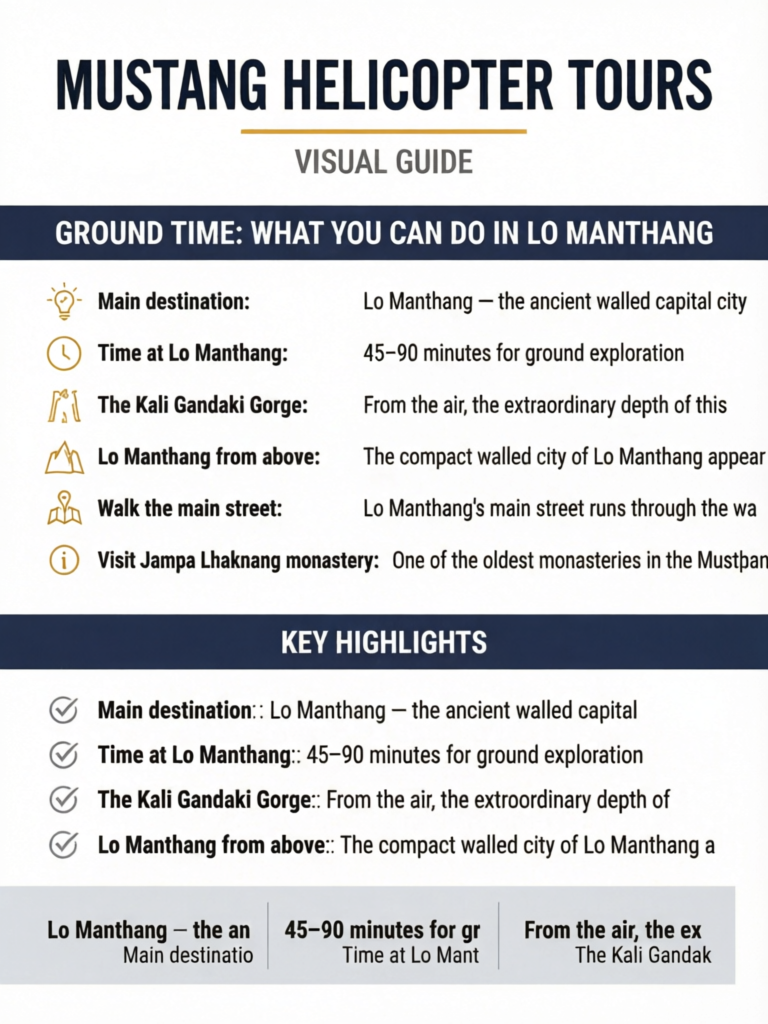
Departure: Pokhara (most common) or Kathmandu (longer flight, more expensive) Route: Fly north up the Kali Gandaki valley, over the Grand Canyon-like terrain of the Kali Gandaki gorge (the deepest gorge on Earth by some measures), past Kagbeni and Ghyakar into Upper Mustang Main destination: Lo Manthang — the ancient walled capital city at 3,840m Time at Lo Manthang: 45–90 minutes for ground exploration Return: Fly south via the same valley or alternative routing over Muktinath and Annapurna viewpoints
The helicopter typically carries up to 5 passengers plus the pilot. On shared-seat tours, operators pool individual bookings to reach the minimum of 4 passengers; on a private charter, you book the whole aircraft regardless of how many of you fly. Most flights use the AS350 B3e (Airbus H125) — the workhorse turbine of the Nepali Himalaya, proven at high altitude.
Passenger Weight and Seating Logistics
At Lo Manthang's altitude the AS350 B3e flies near the limits of what thin air allows, so weight matters more than on a low-altitude joyride. Operators ask for the body weight of every passenger when you book, and they use those figures to balance the load and decide how many people the aircraft can carry on a given day. In practice a full load of five passengers is comfortable from Pokhara; heavier groups occasionally fly with four to keep the helicopter within safe high-altitude limits. This is normal Himalayan aviation practice, not a quality concern.
Luggage is strictly limited. A small daypack with a camera, water, and warm layers is fine; full trekking duffels stay behind in Pokhara or Kathmandu. If you are flying the helicopter as one leg of a longer trip, ask your agency where your main bag will be stored and when you will be reunited with it.
The two most photogenic seats are next to the windows on either side of the cabin. On a shared tour the crew assigns seats by weight distribution rather than preference, so if a window is essential to you, a private charter is the only way to guarantee it.
What You See on the Flight
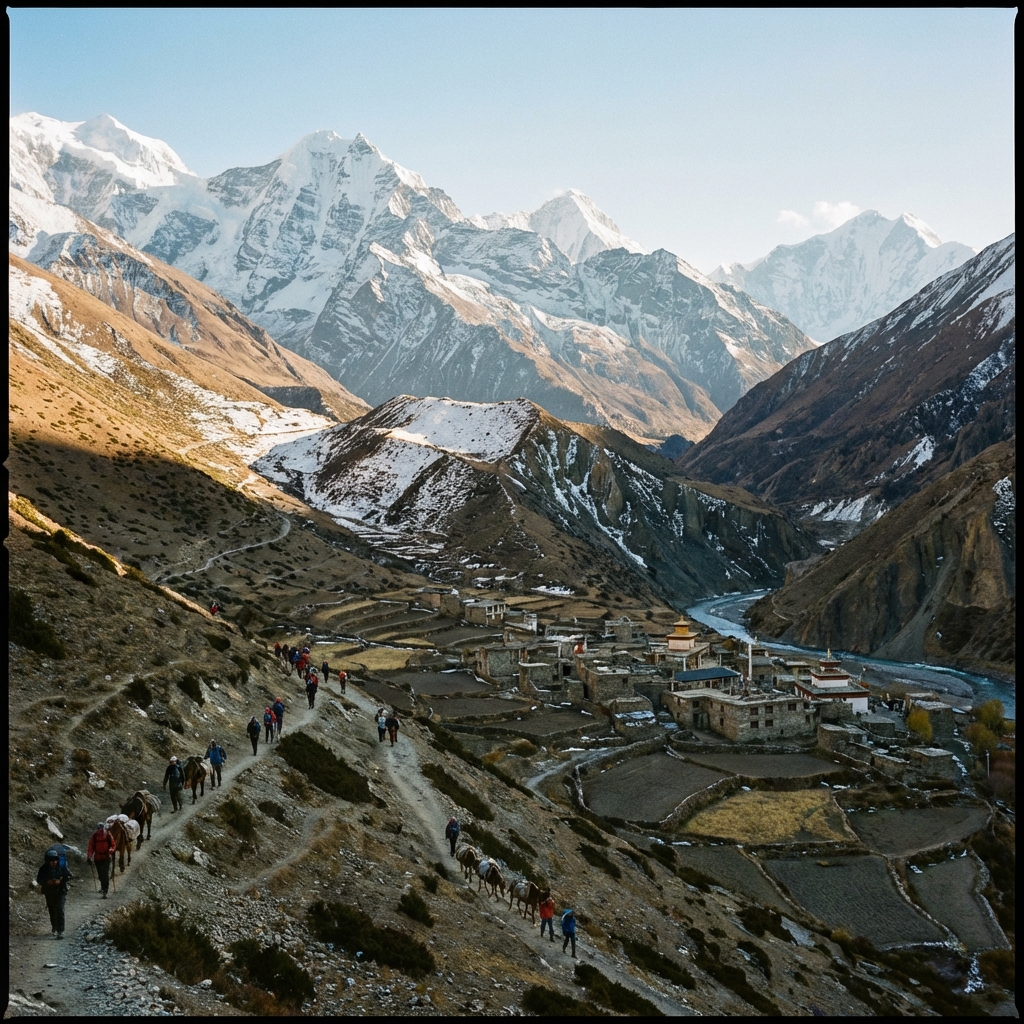
The Kali Gandaki Gorge: From the air, the extraordinary depth of this gorge — which cuts between the Annapurna massif and Dhaulagiri, both exceeding 8,000m — is fully comprehensible for the first time. The river is visible as a thin silver thread far below canyon walls that rise thousands of metres. Even passengers who have trekked the Annapurna Circuit have reported that the aerial view was the first time they truly understood the gorge's scale.
The Mustang Plateau: As you cross north of Kagbeni, the landscape changes abruptly from the green Kali Gandaki valley to the Tibetan-style semi-arid plateau of Upper Mustang. Eroded canyon formations in red, orange, and ochre create a landscape more evocative of the American Southwest than anything typical of Nepal.
Cave dwellings: Hundreds of ancient cave dwellings are carved into cliff faces throughout the Upper Mustang plateau. From the helicopter at close range, their architecture — windows, partitions, connecting passages — is clearly visible. Some have been dated to 2,000–3,000 years old. Ground access is limited; the aerial view is often the best view available.
Lo Manthang from above: The compact walled city of Lo Manthang appears from the air as a dramatically bounded settlement — high white walls enclosing a cluster of flat-roofed buildings on the plateau. The scale of the walls relative to the surrounding emptiness is striking. The larger palace and monastery buildings are identifiable from the air.
Annapurna and Dhaulagiri: On the return flight (particularly from Pokhara departures), the air-level views of the Annapurna massif — Annapurna I (8,091m), II, III, and IV, along with Gangapurna and Machhapuchhre (Fishtail) — are extraordinary. No trekking route provides a comparable aerial view of these giants.
Pro Tip
Sit on the left side of the cabin on the outbound Pokhara leg for the best gorge and plateau views, and the right side on the return for the Annapurna massif. On a shared tour you may not get to choose, so bring a wide-angle lens and shoot through the cleanest part of the window. Polarising filters can create rainbow banding on helicopter glass — skip them.
Ground Time: What You Can Do in Lo Manthang
Most tour itineraries allow 60–90 minutes on the ground in Lo Manthang. In this time, guided visitors typically:
Walk the main street: Lo Manthang's main street runs through the walled city from the main gate. The whitewashed buildings, prayer wheel installations, and age of the architecture create an atmosphere unlike anywhere else in Nepal.
Visit Jampa Lhakhang monastery: One of the oldest monasteries in the Mustang area. Contains important thangka paintings and religious artefacts. Access requires a donation (typically NPR 500–1,000). Respectful photography may be permitted — ask the guide.
Visit Thuchen Gompa: The large assembly hall with remarkable red walls and decorated exterior. Contains some of Mustang's most significant Buddhist art.
The palace: The Royal Palace of Lo Manthang remains the residence of the former Mustang Royal family (though Nepal's monarchy was abolished, the Mustang Raja retains his residence). Exterior viewing is typical on short tours; interior access sometimes arranged for small guided groups.
Local market and tea: The small market street near the main gate has handicraft shops selling local items — Tibetan-style jewellery, thangka copies, tsampa flour, local dried apple products. A cup of butter tea in a local home or the small teahouse near the gate rounds out the cultural experience.
For a deeper look at what's inside the walls and how to spend more time there, see the dedicated Lo Manthang exploration guide.
Time Limitation Reality
Sixty to ninety minutes in Lo Manthang is genuinely limited. You can walk the main street, visit one monastery, and drink tea. You cannot explore the surrounding countryside, visit the cave monasteries north of the city, or engage deeply with the community. If Lo Manthang is your primary interest, a 10-day trek provides incomparably deeper engagement. The helicopter tour is excellent for understanding the landscape and getting a first impression, not for deep cultural immersion.
Altitude on a Helicopter Tour
A Mustang helicopter tour takes you from Pokhara (822m) to Lo Manthang (3,840m) in well under an hour — a rapid ascent of roughly 3,000m with no acclimatisation. Most people tolerate 60–90 minutes at this altitude without trouble, but the speed of the gain matters. Move slowly on the ground, avoid running up stairs to a rooftop viewpoint, and drink water before and during the flight.
People with significant heart or lung conditions, recent surgery, or pregnancy should consult a doctor before booking, since the abrupt gain is harder on the body than a graded trek. Symptoms such as headache, dizziness, or breathlessness usually resolve within minutes of descending back toward Pokhara. For the fuller picture on how altitude affects you, read our guides on acclimatisation and altitude sickness prevention and treatment.
Mustang Helicopter Tour vs Trekking: Which Suits You?
The honest answer comes down to three things: how much time you have, how much you want to walk, and what kind of experience you are after. A helicopter delivers the landscape and the walled city in a single morning; a trek delivers the people, the rhythm, and the slow reveal of the plateau over ten to fourteen days. Neither is "better" — they answer different questions.
Choose the helicopter if you have a tight itinerary, limited stamina, or you simply want the unforgettable aerial view of the Kali Gandaki gorge and the Annapurna massif. Choose the Upper Mustang trek if your real interest is the culture, the villages, and the meditative pace of walking the Forbidden Kingdom. And if you cannot decide, the fly-in/trek-out hybrid described further down combines the best of both.
Tour Duration and Routes
Standard Day Tour from Pokhara
Flight time: Approximately 45 minutes each way Total tour duration: 3–5 hours including ground time Typical schedule: Depart Pokhara 7–8 AM, arrive Lo Manthang 8–9 AM, ground time 60–90 minutes, return to Pokhara by midday
The Pokhara departure is standard because:
- Pokhara airport handles helicopter traffic efficiently
- The routing via Kagbeni provides the dramatic Kali Gandaki gorge views
- Weather windows at Pokhara are generally good in the morning
- The cost is lower than Kathmandu routing (shorter flight)
If you are not already in Pokhara, the city is a 25-minute flight or roughly 6–7 hour drive from Kathmandu; see our Kathmandu to Pokhara transport guide and the overview of domestic flights for trekkers to plan the connection.
Extended Tour from Pokhara (Full Day)
Some operators offer extended tours with stops at both Lo Manthang and Muktinath temple (the ancient Vishnu shrine at 3,800m on the Annapurna Circuit). This provides greater cultural diversity — Hindu and Buddhist sacred sites in a single day — but at higher cost due to additional flight time and landing fees. The same shrine sits on the popular Jomsom Muktinath trek, so an extended flight effectively samples two iconic Mustang destinations at once.
Tour from Kathmandu
Flight time: Approximately 90 minutes each way Total tour duration: 5–7 hours Typical schedule: Early morning Kathmandu departure; more expensive due to flight duration
Kathmandu departures are less common but available for visitors who cannot or prefer not to add a Pokhara leg. The Kathmandu–Mustang flight route passes above the Langtang massif and provides different mountain views than the Pokhara routing. Most Kathmandu tours include a refuelling stop in Pokhara each way.
Route Comparison
Costs (2026)
Per-Person Pricing
| Tour Type | Per Person Cost |
|---|---|
| Standard day tour from Pokhara (min. 4 pax) | $450–600 USD |
| Extended Pokhara tour with Muktinath stop | $600–800 USD |
| Private charter Pokhara (helicopter for up to 5 pax) | $2,500–3,500 USD total |
| Standard tour from Kathmandu | $650–900 USD per person |
| Private charter Kathmandu | $3,500–5,000 USD total |
What the cost includes: Helicopter flight, Upper Mustang restricted area permit, guide on the ground, landing fees, and snacks.
What it does not include: Personal travel insurance, additional photography fees at monasteries, tips for crew, drinks and meals beyond provided snacks.
Why Prices Vary
Three factors move the price within these ranges:
- Shared vs. private. On a shared tour you pay per seat and the operator needs a minimum of 4 passengers to fly; if numbers fall short, the flight is rescheduled or you pay more to fill the gap. A private charter costs the same whether 1 or 5 of you fly, so it becomes cheaper per head as your group grows.
- Departure point. Kathmandu routing roughly doubles flight time versus Pokhara, which is the single biggest cost driver.
- Season and demand. Peak autumn (October–November) sells out and prices firm up; monsoon prices are lower but flights are unreliable.
For a sense of how the helicopter compares with doing it on foot, see the Upper Mustang cost breakdown.
Permit Requirement for Helicopter Tours
Helicopter tours to Upper Mustang still require the standard Upper Mustang restricted area permit (USD 50 per day per person, USD 500 for the standard 10-day allowance). This cost is typically included in the tour package — verify before booking. The permit requirement applies regardless of transport method, and Upper Mustang permits are only issued to travellers using a registered agency with a licensed guide. Tour operators handle the permit application as part of the booking process. See the full Upper Mustang permit guide and the broader restricted-area permits overview.
Operators
Reputable Operators (Verify Current Status)
Himalaya Airlines, Simrik Airlines, Purnima Airlines: The established helicopter operators in Nepal serving the tourism market. Book through their agents or directly through their offices.
Kathmandu-based agencies: Several established trekking agencies (Ultimate Descents Nepal, Himalayan Rescue Association-affiliated agencies, and specialist Nepal tour operators) offer helicopter tour packages as part of broader Nepal trip planning.
How to verify an operator:
- Confirm Civil Aviation Authority of Nepal (CAAN) registration
- Ask for references from previous tour clients
- Confirm what is included in the price (permits, insurance, guide quality)
- Check that their helicopter has been maintained within CAAN-required service intervals
When you book with a verified local agency, the operator also handles your restricted-area permit, ground guide, and weather contingencies — the same standards you'd apply to choosing any trekking agency apply here.
Booking Through Pokhara
Pokhara's Lakeside area has multiple agents offering Mustang helicopter tours. Walk-in booking is possible during trekking season. Competitive pricing is available by comparing 3–4 agents. Off-season (monsoon) prices are lower but weather makes flights unreliable. If you have a spare day in town, the Pokhara Lakeside area guide covers where the agencies cluster.
What to Check Before You Pay
Booking checklist
Before you commit a deposit, confirm in writing: the minimum passengers required to fly, the exact ground time at Lo Manthang, whether the Upper Mustang permit is included, the refund policy for weather cancellations, and whether a backup date is offered if your flight is grounded. Reputable operators answer all five without hesitation.
Best Time for Mustang Helicopter Tours
October–November (Best)
Post-monsoon clarity makes October and November the finest months for aerial views. Visibility is maximum — you'll see every detail of the canyon landscape from the air, and the Annapurna and Dhaulagiri profiles on the return flight are dramatic.
Weather windows at both Pokhara and Lo Manthang are reliable in October. Morning departures benefit from the most stable air before midday thermals develop. Some afternoon turbulence over the canyon terrain is normal. This is also the season of the Yartung festival in Mustang, a horse-racing celebration that occasionally overlaps with early-autumn flights.
March–May (Good)
Spring provides good visibility though with more variable weather than autumn. The approach from Pokhara passes over rhododendron-covered hills in full bloom (March–April), adding colour to the flight. Pre-monsoon afternoon clouds build earlier than in autumn — morning departures are more important.
December–February (Possible)
Winter tours operate in good weather windows but cold temperatures (-10 to -20°C at Lo Manthang) require appropriate clothing. Some months see reduced operator activity. Fewer tourists mean quieter ground conditions at Lo Manthang.
June–September (Not Recommended)
Monsoon clouds make flights unreliable. Days of clear weather alternating with complete cloud cover means tour cancellations are frequent. Operators typically offer refunds for weather cancellations but the logistical disruption is significant.
Because Mustang sits in the Annapurna rain shadow, the ground stays relatively dry even in monsoon — but the cloud that builds over Pokhara and the gorge is what grounds the helicopter. For the wider regional picture, see the best time to trek the Annapurna region.
Build in a buffer day
Weather is the single biggest variable in any Himalayan helicopter tour. Even in peak autumn, a clear forecast can close in over the gorge within an hour. Keep at least one buffer day in Pokhara so a weather hold doesn't cost you the whole experience, and confirm the operator's rebooking policy before you pay.
What to Bring on the Flight
A Mustang helicopter day tour needs far less than a trek, but the rapid altitude gain and cold at Lo Manthang catch people out:
- Warm layers. Even in autumn, Lo Manthang is cold and windy. A fleece or light down jacket plus a windproof shell is right for 60–90 minutes on the ground.
- Sun protection. High-altitude UV is intense; bring sunglasses, sunscreen, and a hat.
- Camera and spare battery. Cold drains batteries fast — keep a spare in an inside pocket.
- Cash in Nepali rupees. For monastery donations (NPR 500–1,000), tea, and handicrafts. There is no ATM in Lo Manthang.
- Passport and permit copies. Your agency holds the original permit, but carry copies.
- Light snacks and water, beyond what the operator provides.
Photography on a Mustang Helicopter Tour
For many passengers the photographs are the point, and a helicopter gives you angles no trekker on the ground can reach. A few habits make a large difference to what you bring home.
Shoot through the cleanest glass. Helicopter windows are rarely spotless. Find the clearest patch of the window before the dramatic terrain appears and frame your shots through it. Hold the lens close to the glass to cut reflections, but never let it touch — vibration transfers straight into the image.
Skip the polariser. Polarising filters interact with the layered helicopter canopy and can produce rainbow banding across the frame. Leave it off and rely on a fast shutter instead.
Use a fast shutter speed. The cabin vibrates and the ground moves quickly beneath you. Aim for 1/1000s or faster to freeze the gorge and the cave-pocked cliffs cleanly. Wider apertures and higher ISO are a fair trade for sharpness.
Bring a wide lens. The Kali Gandaki gorge, the Mustang plateau, and Lo Manthang's walls are about scale and context. A wide-angle lens captures the relationship between the tiny river thread and the canyon walls far better than a long lens, which is hard to hold steady in a moving aircraft anyway.
Keep a spare battery warm. Cold at 3,840m drains batteries fast. Keep your spare in an inside pocket against your body and swap it in once the first one fades.
On the ground, photography inside monasteries such as Jampa Lhakhang may be restricted or require a donation — always ask your guide before raising the camera. For broader etiquette around photographing people, monasteries, and sacred sites in Nepal, see our guide to photography etiquette while trekking, and for technique on a longer trip the trekking photography guide for Nepal.
Drone rules in restricted areas
Tempting as it is, you cannot simply launch a drone over Lo Manthang. Upper Mustang is a restricted area and drone use requires separate permits that are difficult to obtain and often refused near settlements and monasteries. Do not pack a drone expecting to fly it on a day tour. Our drone regulations guide for Nepal explains where flying is and is not allowed.
What Goes Wrong (and How to Avoid It)
Most disappointing Mustang helicopter days trace back to a handful of avoidable problems. Knowing them in advance lets you book defensively.
Weather cancellation with no buffer. This is the single most common letdown. A clear dawn can close in over the gorge within the hour, and once cloud fills the canyon the flight cannot go. Trekkers who built no spare day into their Pokhara stay lose the experience entirely. Keep at least one buffer day, and confirm the rebooking policy in writing before you pay.
The minimum-passenger trap. Shared-seat tours need four passengers to fly. If only two of you have booked and no one else fills the seats, the operator either reschedules you or asks you to top up the fare to cover the empty seats. Ask at booking how many passengers are already confirmed for your date.
Hidden permit costs. Reputable operators include the Upper Mustang permit in the price, but some budget agents list it separately and quote a low headline figure. Confirm the permit is included so you are not surprised at the counter.
Underestimating the cold and altitude. People arrive in light clothing expecting a "flight", then step out into wind at 3,840m. Bring the warm layers listed above, and treat the rapid altitude gain seriously if you have any heart or lung condition.
Expecting deep cultural immersion. Sixty to ninety minutes is enough for a first impression, not for the cave monasteries or the countryside. If culture is your priority, plan a trek instead. When you do book, the principles in our guide on how to choose a trekking agency and the warning signs in trekking agency red flags and scams apply just as much to helicopter operators.
Combining with Trekking
Many visitors combine a helicopter overview of Mustang with a shorter ground trek in the adjacent Mustang area:
Helicopter in, trek out: Fly to Lo Manthang, spend 2–3 days exploring the northern areas on foot, then trek south to Jomsom (2 days) and fly Jomsom–Pokhara. This gives both the aerial perspective and ground-level engagement without the full 10-day trek commitment.
Trek in, helicopter out: Complete the standard 10–12 day Upper Mustang trek on foot, then return to Pokhara by helicopter from Jomsom (30-minute flight) rather than trekking the full return. This saves 4–5 days without compromising the outbound experience.
For the full Upper Mustang trekking experience, see the Upper Mustang trek guide and the day-by-day Upper Mustang trek itinerary. If you'd rather stay on the ground entirely, the gateway villages of Kagbeni and Jomsom are where most Mustang journeys begin.
Helicopter return is common on other treks too
The helicopter-out idea isn't unique to Mustang. Trekkers on the Everest side increasingly fly back rather than retrace their steps — see our guide to the Everest Base Camp helicopter return for how that logistics-saving option works.
Is a Mustang Helicopter Tour Worth It?
It depends on what you're after. If you have the time and fitness, the 10–14 day trek delivers far deeper cultural immersion, the chance to meet Loba communities, and the slow reveal of the landscape on foot. If you have only a day or two, limited stamina, or want an unforgettable overview, the helicopter is the only way to stand inside Lo Manthang's walls and see the gorge from the air in a single morning. Many travellers split the difference with a fly-in/trek-out combination. The aerial view of the Kali Gandaki gorge and the Annapurna massif on the return leg is, for most passengers, worth the price on its own.
To understand where the flight sits within the wider area — and what else the region offers on the ground — see our overview of the Mustang region and the broader Annapurna region, both of which the helicopter routing crosses.
Plan Your Mustang Trip with a Verified Local Agency
Whether you want the half-day helicopter overview or the full Upper Mustang trek, book with a CAAN-registered operator who handles your restricted-area permit, ground guide, and weather contingencies.
Frequently Asked Questions
Related Resources
- Upper Mustang Trek Guide
- Upper Mustang Trek Itinerary
- Lo Manthang Exploration Guide
- Upper Mustang Cost Breakdown
- Upper Mustang Permit Guide
- Restricted Area Permits Overview
- Jomsom Muktinath Trek Guide
- Best Time to Trek the Annapurna Region
- Everest Base Camp Helicopter Return
- Best Trekking Agencies for Upper Mustang
- Mustang Region Overview
- Kagbeni Village Guide
- Jomsom Village Guide