Gokyo Lakes Cost Breakdown 2026
This Gokyo Lakes cost breakdown shows the trek costs $900–$2,500 per person in 2026, depending on whether you go independent or book a guided package, your season, and your comfort level. Most trekkers land mid-range at $1,300–$1,800 for a 12–14 day trip.
The Gokyo Lakes trek costs between $900 and $2,500 per person depending on whether you book a guided package or arrange independently, which season you travel, and what level of comfort you expect. For most trekkers, the realistic mid-range total lands at $1,300-1,800 — slightly less than the Everest Base Camp trek despite comparable logistics, because the Gokyo route reaches a lower maximum altitude and involves fewer days above 4,500m.
Understanding Gokyo costs requires separating the fixed expenses from the variable ones. The Lukla flight ($215-400 return) is non-negotiable — there is no road to the Khumbu. Sagarmatha National Park permits ($30) are mandatory. A licensed guide is legally required for all Khumbu region treks as of 2026. These three categories alone account for $700-800 of your total budget before you eat a single meal or sleep a single night. Everything else — accommodation quality, food choices, porter hire, gear status — is where your decisions shape the final cost.
What distinguishes Gokyo from EBC financially is the optional Gokyo Ri summit (5,357m), which requires no additional permits but needs a strong guide and properly acclimatized legs. Trekkers who choose to add the Three Passes extension — connecting Gokyo to EBC via Cho La and Kongma La — should budget an additional $300-600 for extra days, which is covered at the end of this guide.
Quick Cost Summary
$900-1,200 (12-14 days)
$1,300-1,800 (13-14 days)
$2,000-2,500 (14 days)
$30-45 (budget) to $70-100 (premium)
$215-400 round trip
$50-60
$25-$35 /day
$3-10/night
$15-25 (budget) to $30-45 (premium)
12-14 days on trail
Understanding the Three Budget Tiers
Budget Tier: $900-1,200
Who it's for: Experienced trekkers, budget travelers, backpackers comfortable with basic facilities and managing logistics independently.
What you get:
- Freelance guide hired directly in Kathmandu or Lukla
- Basic teahouse rooms (shared bathrooms, no heating)
- Dal bhat for two meals daily, simple breakfast
- Minimal hot showers (2-3 total over 13 days)
- Carry your own daypack
- Tourist bus transport in Kathmandu
- Economy Lukla flights booked directly
What you give up:
- Private guide attention and planning
- Room comfort and heated rooms
- Flexible food choices and western meals
- Regular showers above Namche
- Porter service for pack
- Agency backup and emergency support
Budget Package Red Flags
Any all-inclusive Gokyo package priced under $850 per person should be examined carefully. Legitimate budget packages that include the Lukla flight (~$350 alone), permits, 11+ nights accommodation, a licensed guide, and meals cannot be profitably delivered below this threshold. Prices this low typically indicate unlicensed guides, skipped insurance coverage, or hidden costs collected on trail.
Mid-Range Tier: $1,300-1,800
Who it's for: First-time Khumbu trekkers, travelers wanting balance between cost and support, those who want a proper guide without premium extras.
What you get:
- Experienced guide (2-3 trekkers per guide, or private for a modest premium)
- Reputable teahouse selection — cleaner, better food
- Mix of local and western food options
- Hot shower every 3-4 days
- Porter for main bag
- Reputable mid-range agency with agency phone support
- Private vehicle transport options in Kathmandu
What you give up compared to premium:
- Private guide exclusively
- Best available lodge rooms
- Daily showers at any altitude
- Comprehensive trip cancellation insurance
- Luxury Kathmandu hotel stays
Premium Tier: $2,000-2,500
Who it's for: First-timers prioritizing safety and comfort, travelers 50+, those with limited vacation days who want everything handled.
What you get:
- Private guide (or group of max 2-3 trekkers)
- Best available Khumbu lodges with heated common rooms
- Private porter for all gear
- Full menu choice including dietary accommodations
- Hot showers whenever available (limited above Dole)
- International-standard agency
- Emergency evacuation insurance included
- 4-star Kathmandu hotel
- Pre-departure planning consultation
| Trek | Duration | Max Altitude | Difficulty | Best For | Cost |
|---|---|---|---|---|---|
| Budget Independent | 12-14 days | 5,357m (Gokyo Ri) | Strenuous | Experienced budget trekkers | $900-1,200 |
| Mid-Range Guided | 13-14 days | 5,357m (Gokyo Ri) | Strenuous | First-timers, moderate budget | $1,300-1,800 |
| Premium Package | 14-15 days | 5,357m (Gokyo Ri) | Strenuous | Comfort-focused, fully managed | $2,000-2,500 |
Guided Package Costs
Budget Agency Package: $900-1,200
Included:
- Lukla flights (round trip)
- Sagarmatha National Park permit and TIMS
- Khumbu Pasang Lhamu Municipality fee
- Shared guide (3-4 trekkers per guide)
- 11-12 nights teahouse accommodation
- 3 meals daily (limited menu)
- Airport transfers in Kathmandu
Not included:
- Travel insurance
- International flights
- Nepal visa ($30-50)
- Kathmandu hotel (pre/post trek)
- Personal gear and equipment
- Hot showers ($3-5 each)
- Battery charging ($2-4 per device)
- WiFi ($3-6/day above Namche)
- Bottled water and soft drinks
- Tips for guide and porter ($150-220 recommended)
Mid-Range Package: $1,300-1,800
Included (all of budget tier plus):
- Experienced guide with smaller group ratio (2:1 or private)
- Individual porter for each trekker's pack
- Better teahouse selection
- Some meals with menu flexibility
- Welcome dinner in Kathmandu
- 2-3 nights Kathmandu hotel (3-star)
- City sightseeing
- Emergency contact and agency phone support
Premium Package: $2,000-2,500
Included (all of mid-range plus):
- Private guide (senior, 10+ years Khumbu experience)
- Personal porter for all gear
- Best available lodges
- Full menu and dietary accommodations
- Private vehicle in Kathmandu
- 4-star Kathmandu hotel (3-4 nights)
- Helicopter evacuation insurance
- Satellite phone or GPS tracker
- Trip cancellation coverage
- Pre-departure consultation calls
- Gear rental package option
Pro Tip
Mid-range packages ($1,300-1,800) represent the best value for most Gokyo trekkers. The Gokyo route is logistically simpler than EBC, with fewer teahouses and less competition for rooms in peak season — which means the premium-tier lodge upgrades deliver marginal comfort improvement above Namche Bazaar regardless of what you pay. Invest the savings in good gear and adequate travel insurance.
Independent Trekking Costs
As of 2026, Nepal mandates licensed guides for all treks in national park areas, which includes the Gokyo Lakes route through Sagarmatha National Park. You can arrange a guide independently — without booking a full agency package — and potentially save $300-500 compared to agency pricing. See hiring guides and porters in Nepal for how to vet a freelance guide.
Total Independent Cost: $750-1,400 (12-14 Days)
| Category | Budget Approach | Cost Range |
|---|---|---|
| Sagarmatha NP Permit | Self-obtained, Kathmandu | $30 |
| TIMS Card | NPR 2,000 via Tourism Board | $0-20 |
| Khumbu Municipality Fee | Paid at Lukla | $20 |
| Lukla Flights (RT) | Booked directly | $215-400 |
| Guide (required) | Freelance, shared if possible | $300-420 (12 days @ $25-35/day) |
| Accommodation (12 nights) | Budget teahouses | $36-120 ($3-10/night) |
| Food (13 days) | Dal bhat focus | $195-325 ($15-25/day) |
| Hot Showers | 3-4 total | $9-20 |
| Charging | 4-6 charges | $10-20 |
| WiFi | Selective use | $15-30 |
| Snacks | Bought partly in Kathmandu | $30-50 |
| Kathmandu (3-4 days) | Budget guesthouse, local food | $80-160 |
| Tips | Guide + porter (if hired) | $120-180 |
| Buffer | Weather delays | $60-100 |
| TOTAL | $1,255-1,895 |
How to reduce this further: Share a freelance guide with 2-3 other trekkers heading to Gokyo on the same dates. Your guide cost drops from $300-420 to $75-140 per person — a saving of $200-280 compared to a solo arrangement. Join Gokyo trekking Facebook groups or ask at Kathmandu guesthouses in the week before departure.
Independent vs Package: The Realistic Comparison
When you factor in sharing a guide and managing permits yourself, independent Gokyo trekking costs $900-1,200 — roughly $300-500 less than an equivalent mid-range agency package. The tradeoff is that you handle all logistics personally: booking flights, obtaining permits, finding your guide, and having no agency safety net if problems arise. For experienced Nepal trekkers, the savings are worthwhile. For first-timers to the Khumbu, an agency's support structure is worth the premium.
Flight Costs: The Non-Negotiable Expense ($350-400)
The Kathmandu to Lukla flight is the same for Gokyo as for EBC — both routes begin from Lukla and diverge at Namche Bazaar. There is no road alternative; the flight is mandatory. For full booking details, fare patterns, and delay contingencies, see our Kathmandu to Lukla flights guide.
What the Lukla Flight Costs
| Season | One-Way Price | Round-Trip Total |
|---|---|---|
| Peak (Oct-Nov, Mar-Apr) | $190-210 | $380-420 |
| Shoulder (Sep, Dec, Feb, May) | $175-195 | $350-390 |
| Low (Jun-Aug) | $165-185 | $330-370 |
What is included: 30-minute flight in a 14-18 seat turboprop, 15kg baggage allowance, weather rebooking (usually).
What is not included: Excess baggage ($1-3/kg), onward ground transport, priority boarding.
Airlines operating Lukla flights: Tara Air, Summit Air, Sita Air, Goma Air.
October-November Ramechhap Departures
From roughly October 1 to November 15, Kathmandu airport congestion forces Lukla flights to depart from Ramechhap (Manthali Airport), a 4-5 hour drive east of Kathmandu. The flight cost is the same, but add $15-25 for transport to Ramechhap and account for a 2:30-3:00 AM departure from Kathmandu. Agency packages typically handle this logistics; independent trekkers must arrange it themselves.
Booking Strategies
-
Book 2-3 months ahead during peak season. October and early November sell out earliest. Early bookings also lock in lower published fares.
-
Morning departures only. All Lukla flights depart between 6:00 and 9:30 AM before afternoon mountain winds build. Book the earliest available slot.
-
Build in a buffer day. Weather delays affect 40-60% of Lukla flight days in October. Build one extra Kathmandu day before international connection.
-
Check both agency and direct airline pricing. Sometimes bulk airline partnerships give agencies lower rates; sometimes direct bookings with Tara Air or Summit Air websites are cheaper. Compare before paying.
Pro Tip
If you are flying back from Lukla late in your trip window and have an international connection, consider booking a helicopter from Lukla to Kathmandu as a contingency option — not as your primary plan, but as something you know the cost of. Helicopters cost $500-700 per person (Lukla to Kathmandu), and sharing with 5 others in a group brings the cost down considerably. Knowing this option exists reduces weather-delay anxiety significantly.
Permits and Entry Fees: $50-60 Total
Sagarmatha National Park Entry Permit: $30
Every trekker entering the Gokyo Lakes area must pay the Sagarmatha National Park entry fee. The permit is checked at the Monjo checkpoint, approximately 3 hours above Lukla.
- Where to obtain: Nepal Tourism Board office in Kathmandu, or the Monjo checkpoint (slower, shorter queue)
- Documents needed: Passport, 2 passport photos
- Processing time: Immediate in Kathmandu, 30-60 minutes at Monjo
- Validity: Single entry for the entire trek duration
- Tip: Get it in Kathmandu to avoid queuing at Monjo checkpoint with returning EBC trekkers
TIMS Card (Trekkers' Information Management System): $0-20
- Status 2026/2027: Free for treks arranged through registered agencies; $10-20 for independent trekkers
- Where to obtain: Nepal Tourism Board office, Kathmandu (Pradarshani Marg office)
- Documents needed: Passport, agency or guide details, emergency contact
- Processing time: 15-30 minutes
Khumbu Pasang Lhamu Rural Municipality Fee: $20
- Where to pay: Lukla Airport upon arrival or at the Monjo checkpoint
- Purpose: Local village infrastructure, trail maintenance, community development
- Note: Introduced in 2022. Not always highlighted in agency packages — confirm whether your package includes this.
Total permits budget: $50 (with agency TIMS) to $70 (self-arranged TIMS + admin fees).
Pro Tip
Bring at least four passport-sized photos to Kathmandu. You will need them for the Sagarmatha permit and TIMS card. Photobooth shops on Thamel's main road offer "same-day passport photos" for NPR 300-500 (6-8 photos). Getting them on day one prevents scrambling on permit day.
Accommodation Costs: $3-10 Per Night
Gokyo Lakes teahouses are simpler and fewer in number than the EBC corridor — especially above Dole (4,038m). This is both a cost advantage and a comfort consideration.
What Teahouses Cost Along the Route
| Section | Budget Room | Standard Room | Notes |
|---|---|---|---|
| Lukla | $5-10/night | $8-15/night | Most options, competitive |
| Phakding | $3-6/night | $5-10/night | Basic but functional |
| Namche Bazaar | $8-20/night | $15-30/night | Widest selection, hot water available |
| Dole (4,038m) | $4-8/night | $6-12/night | Fewer teahouses, simpler facilities |
| Machhermo (4,470m) | $3-8/night | $5-10/night | Limited options |
| Gokyo (4,790m) | $5-10/night | $8-15/night | Several teahouses, all basic |
The Teahouse Business Model
Understanding how Khumbu teahouses work helps budget accurately. Room prices are kept deliberately low (or even subsidized) because owners make their real money from meals and drinks. This is why:
- You are generally expected to eat all meals at your accommodation teahouse
- Skipping meals at your lodge to eat elsewhere is frowned upon and may result in higher room rates
- "Free" or very cheap rooms sometimes come with an unspoken obligation to eat there
Budget accordingly: If you sleep somewhere for $3-5 per night, plan to spend $20-30 on meals at the same establishment. The economics balance out — you are effectively paying $25-35 total for bed and board, which is fair for the altitude and remoteness involved.
Peak Season Booking at Gokyo
Unlike the EBC corridor where dozens of teahouses compete at every village, Gokyo village (4,790m) has a limited number of lodges. During October and early November, these fill quickly. Agency guides handle bookings; independent trekkers should either call ahead (satellite phones) or arrive early in the afternoon. Unlike Namche, you cannot easily wait for a room to become available if the lodges are full.
Food and Drink Costs: $15-25 Per Day
Food costs on the Gokyo route follow a predictable pattern: cheap at lower altitudes, progressively more expensive as you gain elevation, with a premium at Gokyo itself where everything arrives by porter or yak.
Food Price by Altitude Zone
| Altitude Zone | Dal Bhat | Breakfast | Soup | Tea |
|---|---|---|---|---|
| Lukla-Phakding (2,600-2,610m) | $3-5 | $2-4 | $2-3 | $0.50-1 |
| Namche Bazaar (3,440m) | $4-7 | $3-5 | $3-5 | $1-1.50 |
| Dole-Machhermo (4,038-4,470m) | $5-8 | $4-6 | $3-5 | $1-2 |
| Gokyo (4,790m) | $6-9 | $5-7 | $4-6 | $1.50-2.50 |
Daily Food Budget Projections
| Trekker Type | Strategy | Daily Cost |
|---|---|---|
| Budget | Dal bhat x2, simple breakfast, water | $15-20 |
| Standard | Mix of local and western, 3 meals, tea | $22-30 |
| Relaxed | Full menu, coffee, occasional treats | $30-45 |
13-day food total: $195-325 (budget) to $390-585 (premium).
The Dal Bhat Advantage
Dal bhat — lentil soup, rice, vegetable curry, papad — comes with unlimited rice refills at most Khumbu teahouses. At $6-9 per serving above Namche, it is the calorie-per-dollar champion of trekking menus. Eating dal bhat for dinner and a western-style breakfast daily costs roughly $12-16/day in the upper sections — $8-15 less than eating western food for both meals. On a 10-day upper section, that is $80-150 in savings.
Water Costs
Bottled water costs NPR 100-200 ($0.75-1.50) at lower altitudes and NPR 200-400 ($1.50-3) at Gokyo. Boiled water from teahouses costs NPR 50-100 ($0.40-0.75) per cup. The most cost-effective option:
- Carry a 1-litre reusable bottle and refill with boiled teahouse water at $0.40-0.75 per litre
- Water purification tablets (iodine or chlorine) bought in Kathmandu for $2-5 treat 30-50 litres
- SteriPen UV purifiers work well and allow stream water use: $30-50 purchase
Avoiding bottled water entirely saves $30-60 over a 13-day trek.
Guide and Porter Costs
Why a Guide Is Non-Negotiable
Nepal's 2026 regulation requiring licensed guides for national park treks applies fully to the Gokyo route. Beyond legal compliance, a Gokyo guide provides route knowledge through the Ngozumpa Glacier moraines, weather pattern awareness, teahouse knowledge, and altitude illness recognition — all more critical than on lower, more frequented routes.
Guide Daily Rates
| Guide Type | Daily Rate | 13-Day Total | Typical Tip |
|---|---|---|---|
| Budget freelance guide | $22-28/day | $286-364 | $80-120 |
| Experienced licensed guide | $28-35/day | $364-455 | $100-150 |
| Senior Khumbu specialist | $35-45/day | $455-585 | $120-180 |
Porter Costs (Optional but Recommended)
At altitudes above 4,000m, carrying a heavy pack significantly increases exertion and altitude illness risk. Most trekkers who hire a guide also hire a porter to carry their main bag (15-18kg limit per porter).
| Porter Type | Daily Rate | 13-Day Total | Tip |
|---|---|---|---|
| Standard porter | $18-22/day | $234-286 | $60-100 |
| Porter-guide (combined) | $25-30/day | $325-390 | $80-120 |
Two trekkers sharing one porter: Each pays $9-11/day instead of $18-22/day — a saving of $117-143 per person over 13 days.
Porter Welfare on the Gokyo Route
The Gokyo route is longer and colder than EBC for porters, who often carry loads in inadequate footwear and clothing. Use the KEEP (Kathmandu Environmental Education Project) guidelines: porters should carry maximum 20-25kg, receive appropriate clothing and equipment for the altitude, have emergency medical access, and be paid fair wages. Never negotiate below market rates. The trekking industry functions because porters absorb significant physical risk on your behalf.
Pro Tip
Hire your guide in Kathmandu rather than in Lukla. Kathmandu has a much larger pool of certified Khumbu guides, allowing you to interview 2-3 candidates, check credentials (Nepal Tourism Board guide license), verify Gokyo-specific experience, and agree on terms before you are at a remote trailhead with limited options. Lukla hiring happens under time pressure and offers fewer vetted candidates.
Equipment and Gear Costs
Rent vs Buy
For a Gokyo trek, you need the same gear as EBC: warm layers, waterproof outer shell, sleeping bag rated to -15°C, trekking boots, trekking poles, and sun protection. For a full breakdown of what to bring, see the Nepal trekking packing list, and weigh the rent vs buy gear in Kathmandu decision before you fly.
Buy in Kathmandu (Thamel): High-quality gear shops line Thamel Main Road and Jyatha Street. Prices for key items:
| Item | Nepal Purchase Price | Notes |
|---|---|---|
| Down jacket (600-fill) | $50-120 | Good value; brands vary in quality |
| Sleeping bag (-15°C rated) | $60-130 | Essential at Gokyo (4,790m) |
| Trekking boots (mid-weight) | $60-150 | Check waterproofing carefully |
| Trekking poles (pair) | $25-60 | Useful for moraine navigation |
| Base layer set | $30-70 | Merino wool preferred |
| Waterproof jacket | $50-130 | Goretex or equivalent |
Rent in Kathmandu:
| Item | Rental/Day | 14-Day Rental | Notes |
|---|---|---|---|
| Sleeping bag (-15°C) | $1.50-3/day | $21-42 | Inspect loft and zipper carefully |
| Down jacket | $2-4/day | $28-56 | Check fill quality |
| Trekking poles | $1-2/day | $14-28 | Most teahouses also have spares |
| Crampons/microspikes | $1.50-2.50/day | $21-35 | Needed if snow on Gokyo Ri in Dec-Feb |
Total gear budget:
- Already own gear: $0-50 (consumables, replacements)
- Renting key items: $80-160 for 14 days
- Buying key items: $200-600 (but you keep everything)
Gokyo Ri Summit Day Gear Requirement
Gokyo Ri (5,357m) is the highest point of the standard trek and requires appropriate footwear, warm gloves, balaclava or buff, and sun protection at altitude. It does not require technical climbing equipment or ropes. However, in December through February, microspikes or crampons are strongly advisable for the icy final approach. Rent these in Kathmandu if you are trekking in winter months — they are rarely available above Namche.
Travel Insurance: The Required Safety Net
Travel insurance is not optional for the Gokyo Lakes trek. A helicopter evacuation from Gokyo (4,790m) or Machhermo to Kathmandu costs $4,000-7,000. Altitude illness can develop quickly and require emergency descent — situations that are medical emergencies, not inconveniences. Insurance is what separates a financial setback from a catastrophe.
What Your Policy Must Cover
- Trekking altitude: Minimum 5,500m coverage (Gokyo Ri is 5,357m; some policies need headroom above maximum planned altitude)
- Helicopter evacuation: Non-negotiable — this is the primary rescue mechanism in the Khumbu
- Medical treatment: In-country treatment at Himalayan Rescue Association clinics and Kathmandu hospitals
- Trip delay/cancellation: Useful for Lukla flight weather delays and international connection problems
Insurance Cost by Policy Type
| Policy Type | Approximate Cost (14-21 days) | Coverage Level |
|---|---|---|
| Budget backpacker (World Nomads Standard) | $70-100 | Trekking to 4,500m — insufficient for Gokyo Ri |
| Standard adventure (World Nomads Explorer) | $110-160 | Trekking to 6,000m, full evacuation — appropriate |
| Comprehensive travel + adventure (AIG, Allianz) | $140-220 | Full medical, evacuation, cancellation |
| Annual multi-trip adventure policy | $300-500/year | Best value for repeat Nepal visitors |
Recommended minimum: World Nomads Explorer or equivalent covering 6,000m altitude and helicopter evacuation. Budget $110-160 for a 14-21 day policy.
Check the Altitude Limit on Your Policy
Many standard "adventure travel" policies cover activities to 4,000m or 4,500m. Gokyo Ri sits at 5,357m. A policy that excludes evacuation above 5,000m is functionally useless for your summit day — the highest-risk moment of the trek. Read the policy document, not just the marketing summary. Call the insurer and confirm: "Does this policy cover helicopter evacuation from 5,357m during a trekking activity?" Get the answer in writing.
Recommended Providers (2026)
- World Nomads Explorer Plan — widely used by Khumbu trekkers, clear altitude coverage, straightforward claims
- True Traveller (UK-based) — excellent altitude terms, competitive for European trekkers
- Global Rescue — membership-based evacuation and rescue service; excellent complement to a standard policy
- SafetyWing — check policy documents carefully; altitude limits vary by plan
Hidden Costs Most Trekkers Miss
| Hidden Cost | Amount | Notes |
|---|---|---|
| Hot showers (4-5 total) | $12-25 | Only available reliably up to Namche |
| Battery charging (5-6 charges) | $12-24 | $2-4 per charge device; solar above Dole |
| WiFi (Namche + select lodges) | $15-40 | Unreliable above Machhermo |
| Bottled water (if not purifying) | $30-70 | 2 bottles/day × 13 days |
| Sagarmatha Conservation Area snacks | $20-40 | Bought on trail; buy most in Kathmandu |
| Nepal visa (first-time) | $50 | 15-day single entry |
| Kathmandu hotel (3-4 nights) | $40-160 | Pre and post trek |
| Airport transfers in Kathmandu | $10-20 | Taxi or pre-arranged pickup |
| Ramechhap transport (Oct-Nov) | $20-30 | If departing during peak migration period |
| Emergency dental or medical in Kathmandu | $50-200 | HRA clinic fees in Namche ($30-60) |
| Tips (guide + porter) | $150-250 | Plan and carry cash in advance |
Total hidden costs estimate: $360-900 depending on season and travel style.
Tipping: What to Budget and How
Tipping is standard practice and represents meaningful additional income for guides and porters beyond their negotiated daily rate.
Recommended Tip Amounts
| Staff | Trek Length | Budget Tip | Standard Tip | Excellent Service |
|---|---|---|---|---|
| Guide | 13 days | $100-130 | $130-180 | $180-250 |
| Porter | 10-12 days | $70-90 | $90-120 | $120-160 |
Tipping Logistics
- Carry tipping money in Nepali rupees (NPR), not USD
- Prepare separate envelopes before the final day — don't scramble at the trailhead
- Tip at the trek endpoint (Lukla) or back at your Kathmandu hotel, not at individual camps
- If booked through an agency, confirm whether guides share tips with the agency office
Pro Tip
Carry an extra NPR 10,000-15,000 in small denominations specifically for tips and on-trail extras. Changing money above Namche Bazaar is difficult or impossible. ATMs in Namche exist but charge high fees and occasionally run out of cash during peak season. Withdraw in Kathmandu and carry enough cash for the full trek — see our guide to ATMs, cash, and money on the trek.
Cost Variation by Season
Gokyo teahouse prices shift meaningfully across seasons, but the big cost variable for most trekkers is guide availability and Lukla flight pricing.
| Season | Months | Accommodation | Food | Guide Availability | Notes |
|---|---|---|---|---|---|
| Peak Autumn | Oct - early Nov | Full price | Full menu | Highest (book ahead) | Best weather, highest demand |
| Shoulder Autumn | Late Nov | -10 to -15% | Standard | Good | Quieter, still good conditions |
| Winter | Dec - Feb | -20 to -30% | Reduced menu | Limited | Cold, possible snow above Dole |
| Peak Spring | Mar - May | Full price | Full menu | High | Second best season |
| Shoulder Spring | Late Feb, early Jun | -10 to -15% | Standard | Good | Some post-monsoon residue |
| Monsoon | Jun - Aug | -25 to -40% | Minimal | Very scarce | Trail conditions dangerous |
Key insight: The shoulder seasons (late November, early March) offer genuine savings of 10-15% on teahouse accommodation with no meaningful reduction in trail quality or guide availability. These windows represent the most cost-efficient Gokyo trekking periods for budget-conscious travelers.
The Gokyo Ri Summit: Does It Cost Extra?
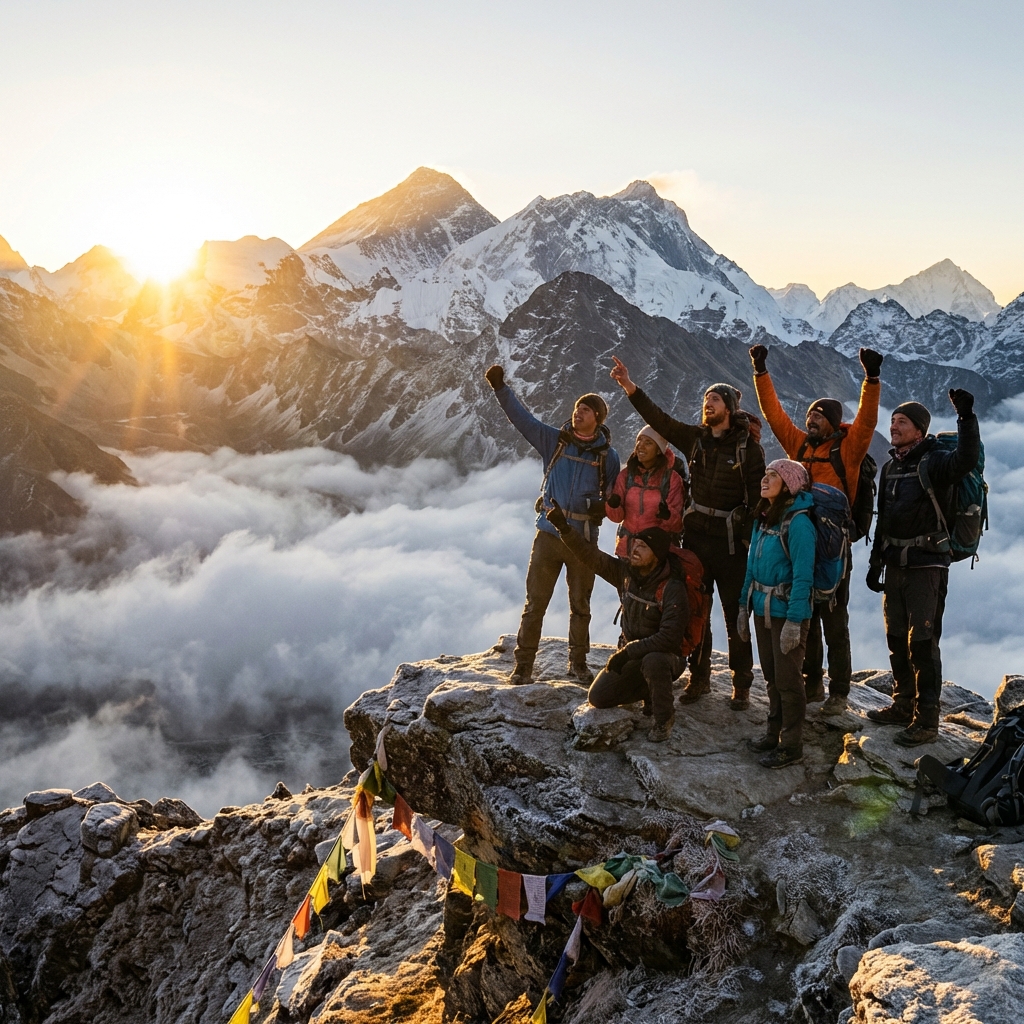
Gokyo Ri (5,357m) — the mountain that rises directly behind Gokyo village and offers panoramic views of Cho Oyu, Makalu, Lhotse, Everest, and the Ngozumpa Glacier — requires no additional permits. It is included in the standard Sagarmatha National Park permit.
What the summit day does cost:
- Extra day at Gokyo: $15-30 accommodation + $20-35 food = $35-65
- Guide's extra day rate: $25-35
- Energy snacks for summit push (bought in Kathmandu): $5-15
- Total Gokyo Ri cost premium: $65-115
Most itineraries already include Gokyo Ri as standard — it is the primary objective of the trek, not an add-on. If your itinerary does not include it, ask why.
Does Itinerary Length Change the Cost?
Yes — the number of trail days is the single biggest lever on total cost after the fixed flight and permits. Each extra day adds roughly $25-45 (food and accommodation) plus a $25-35 guide day. Express operators advertise 8-day Gokyo Ri itineraries that skip rest days, while standard trips run 12-14 days with proper acclimatization.
| Itinerary | Trail Days | Acclimatization | Typical Guided Cost | Trade-off |
|---|---|---|---|---|
| Express Gokyo Ri | 7-8 days | None or minimal | $900-1,150 | Higher altitude-sickness risk; for fit, acclimatized trekkers only |
| Standard Gokyo Lakes | 12-14 days | 1-2 rest days | $1,300-1,800 | The safe, comfortable default |
| Gokyo + Three Passes | 17-21 days | 2-3 rest days | $1,800-3,000 | Most scenic; highest cost and difficulty |
Don't Buy an Itinerary That Skips Acclimatization to Save Money
The cheapest 8-day packages cut cost by removing the acclimatization days that prevent acute mountain sickness above 4,000m. Saving $200-300 on a compressed itinerary is a false economy if it ends in a $4,000-7,000 helicopter evacuation. Choose the 12-14 day standard itinerary unless you have recent high-altitude experience. See our Gokyo Lakes 12-day itinerary for the recommended day-by-day plan.
Adding the Three Passes: Cost Implications
The Everest Three Passes trek connects Gokyo to the EBC route via Cho La Pass (5,420m) and on through Kongma La (5,535m), adding 5-7 days to the standard Gokyo trek and significantly increasing total cost.
| Additional Cost Item | Amount |
|---|---|
| Extra trek days (5-7) | $25-45/day = $125-315 |
| Extra guide days | $25-35/day = $125-245 |
| Extra accommodation (5-7 nights) | $15-70 |
| Extra food (5-7 days) | $75-245 |
| No additional permits required | $0 |
| Total cost to add Three Passes | $340-875 |
For full Three Passes trek cost analysis, see the dedicated Three Passes Trek Cost Breakdown.
Gokyo vs EBC: The Cost Comparison
The Gokyo Lakes trek costs $100-300 less than a comparable EBC itinerary for most budget categories. The savings come from slightly fewer trail days, fewer teahouses above Namche competing on premium upgrades, and the absence of the Kalapathar summit scramble (no premium altitude acclimatization days). Flight costs, permits, and guide rates are identical for both routes since they share the same logistics chain from Lukla to Namche.
Money-Saving Tips
1. Trek in shoulder season — late November or early March. Teahouse prices drop 10-15%, guides are available, and trails are significantly less crowded. Temperature conditions are still entirely manageable with proper gear.
2. Share a guide with 1-2 other trekkers. Two trekkers sharing one guide reduces per-person guide cost from $300-420 to $150-210 for the full trek. The Gokyo route is well-marked above Namche, making a shared guide perfectly adequate for most sections.
3. Eat dal bhat for at least one full meal daily. Unlimited rice refills make dal bhat ($6-9 at Gokyo altitude) the most calorie-efficient meal on the menu. Substituting one western dinner with dal bhat saves $4-8 per day — $50-100 over a 13-day trek.
4. Buy snacks entirely in Kathmandu before departure. Chocolate bars cost NPR 60-80 ($0.45-0.60) in Kathmandu supermarkets and NPR 250-400 ($1.90-3) at Gokyo. Carry a full supply of trail snacks — nuts, energy bars, dried fruit — from Kathmandu.
5. Use a reusable water bottle with purification tablets. Avoid buying bottled water on trail. Iodine tablets bought in Kathmandu for $3-5 treat 50+ litres. Combined with boiled teahouse water at $0.40-0.75 per litre, you save $40-70 compared to buying bottled water throughout.
6. Obtain permits yourself in Kathmandu. The Sagarmatha National Park permit and TIMS card can be obtained at the Nepal Tourism Board office on Pradarshani Marg in about 1-2 hours. Agency processing fees add NPR 500-1,500 ($4-12) per permit. The self-obtained process is straightforward.
7. Hire your guide directly, not through an agency markup. Reputable freelance certified guides hired in Kathmandu charge $25-$35 /day versus the $35-50/day embedded in mid-range agency packages. Verify the Nepal Tourism Board guide license, check 3+ references from previous clients, and confirm Gokyo-specific experience.
8. Stay in Namche Bazaar's Damside or outer guesthouses. Namche has a wide price range — central lodges near the main square charge $15-25/night while outer-area guesthouses charge $8-12 for comparable quality. The extra 5-minute walk is not a meaningful inconvenience.
9. Charge devices at solar-powered charging stations, not in rooms. Above Machhermo, centralized solar charging stations charge NPR 200-300 ($1.50-2.25) per device versus NPR 300-500 ($2.25-3.75) for in-room charging points. Small saving per charge, but meaningful over 5-6 charges.
10. Walk from Jiri to Lukla to eliminate flights (for time-rich trekkers). Adding the 5-7 day Jiri approach eliminates the $350-400 Lukla flight cost. Total extra costs (food, accommodation, guide days for Jiri section) run $180-300, creating net savings of $50-200 for trekkers with 20+ days available.
Sample 13-Day Daily Expense Log
This represents a realistic mid-range independent trekker budget: guide hired directly in Kathmandu, eating a mix of local and western food, staying comfortable, carrying own daypack.
| Day | Location | Accommodation | Food | Extras | Daily Total |
|---|---|---|---|---|---|
| Day 1 | Lukla → Phakding | $5 | $18 | $3 charging | $26 |
| Day 2 | Phakding → Namche Bazaar | $12 | $24 | $4 hot shower, $5 WiFi | $45 |
| Day 3 | Namche Bazaar (acclimatization) | $12 | $28 | $6 WiFi, $3 bakery | $49 |
| Day 4 | Namche → Dole | $6 | $22 | $3 charging | $31 |
| Day 5 | Dole → Machhermo | $5 | $24 | $4 hot shower, $2 charging | $35 |
| Day 6 | Machhermo → Gokyo | $8 | $26 | $3 charging | $37 |
| Day 7 | Gokyo Ri Summit Day | $8 | $28 | $5 snacks, $3 charging | $44 |
| Day 8 | Gokyo (rest/acclimatization) | $8 | $25 | $4 WiFi attempt | $37 |
| Day 9 | Gokyo → Machhermo | $5 | $22 | $3 charging | $30 |
| Day 10 | Machhermo → Namche | $12 | $26 | $5 hot shower, $4 WiFi | $47 |
| Day 11 | Namche → Phakding | $5 | $20 | $3 charging, $5 snacks | $33 |
| Day 12 | Phakding → Lukla | $8 | $22 | $4 hot shower | $34 |
| Day 13 | Lukla departure day | $0 | $10 (breakfast before flight) | $5 airport snacks | $15 |
13-day trail subtotals: Accommodation $94, Food $295, Extras $67 = $456 Guide (13 days × $28/day): $364 Guide tip: $130 Permits: $50 Lukla flights: $215 Kathmandu (3 nights, meals, airport): $215 Insurance: $130 Nepal visa: $50 Total: ~$1,685
This lands squarely within the mid-range independent range of $1,300-1,800. Food costs are the main lever — switching entirely to dal bhat would reduce the food subtotal by $60-80.
Complete Budget Summary by Tier
Budget Tier (~$950)
- Freelance guide (shared with 2 others): $120
- Lukla flights: $215
- Permits: $50
- Accommodation (12 nights): $65
- Food (13 days, dal bhat focus): $200
- Extras (showers, WiFi, charging): $50
- Kathmandu (2 nights, local food): $55
- Tips: $100
- Insurance: $110
- Nepal visa: $50
- TOTAL: ~$1,160 (includes visa and insurance; see note below)
Note: A truly stripped-down budget with a shared guide and minimal extras can reach $900-1,000 if skipping Kathmandu hotel nights (staying at airport area guesthouses) and holding food costs to the minimum.
Mid-Range Tier (~$1,550)
- Private guide: $364
- Lukla flights: $215
- Permits: $50
- Accommodation (13 nights, better selection): $100
- Food (mix of local/western): $320
- Extras: $80
- Kathmandu (3 nights, 3-star): $120
- Tips: $150
- Insurance: $140
- Nepal visa: $50
- TOTAL: ~$1,749
Premium Tier (~$2,200)
- Agency package (includes guide, porter, accommodation, meals): $1,800
- Insurance upgrade: $180
- Extras (shopping, restaurants): $120
- Tips: $200
- TOTAL: ~$2,300
FAQ
- Gokyo Lakes Route Overview
- EBC Trek Cost Breakdown
- Three Passes Trek Cost Breakdown
- Budget Trekking Nepal
- Nepal Trekking Permits Explained
- Best Time to Trek Everest Region
- Altitude Sickness Signs and Turnaround Rules
- Solo Trekking Everest Base Camp
- EBC vs Gokyo: Which Trek is Better?
- Nepal Trekking Packing List