



Himalayan Tahr and Wildlife in Nepal: A Trekker's Field Guide
The Himalayan tahr is the wildlife species you are most likely to see while trekking in Nepal — a stocky, shaggy-coated wild goat that lives on steep cliffs between 2,500 and 5,000m across Sagarmatha, Annapurna, and Langtang. Beyond the tahr, Nepal's trails also hold musk deer, red panda, the elusive snow leopard, and spectacular birds like the Himalayan monal.
Nepal's trekking trails pass through some of Asia's most significant wildlife habitats. The country's remarkable vertical range — from subtropical lowlands to Himalayan high-alpine zones — creates a concentration of endemic and endangered species that few countries can match at comparable scale.
Wildlife encounters on Nepal treks are not guaranteed. The mountains are large and the animals are wild — they follow their own schedules and have no obligation to appear for trekkers. But with knowledge of what to look for, where, and when, you increase your chances significantly. And when an encounter does happen — a Himalayan tahr herd crossing the ridgeline above you, a bearded vulture spiralling on a thermal, the improbable flash of a Himalayan monal's iridescent plumage — it is among the finest experiences the mountains offer.
Understanding Nepal's Wildlife Zones
The Vertical Gradient
Nepal's wildlife, like its vegetation, is distributed vertically. As you ascend from subtropical valley floors to alpine meadows, you pass through distinct ecological communities with different characteristic species.
Subtropical and Temperate Zone (1,000–2,500m):
- Highest biodiversity in terms of species number
- Tropical birds, forest mammals, reptiles
- Rhododendron and oak forests support rich understory wildlife
- Most accessible to trekkers on approach sections
Subalpine Zone (2,500–3,500m):
- The transition zone — species from both temperate below and alpine above
- Snow leopard, musk deer, and tahr overlap here
- Dense birch and rhododendron forest creates excellent cover for mammals
- Most accessible zone for serious wildlife observation
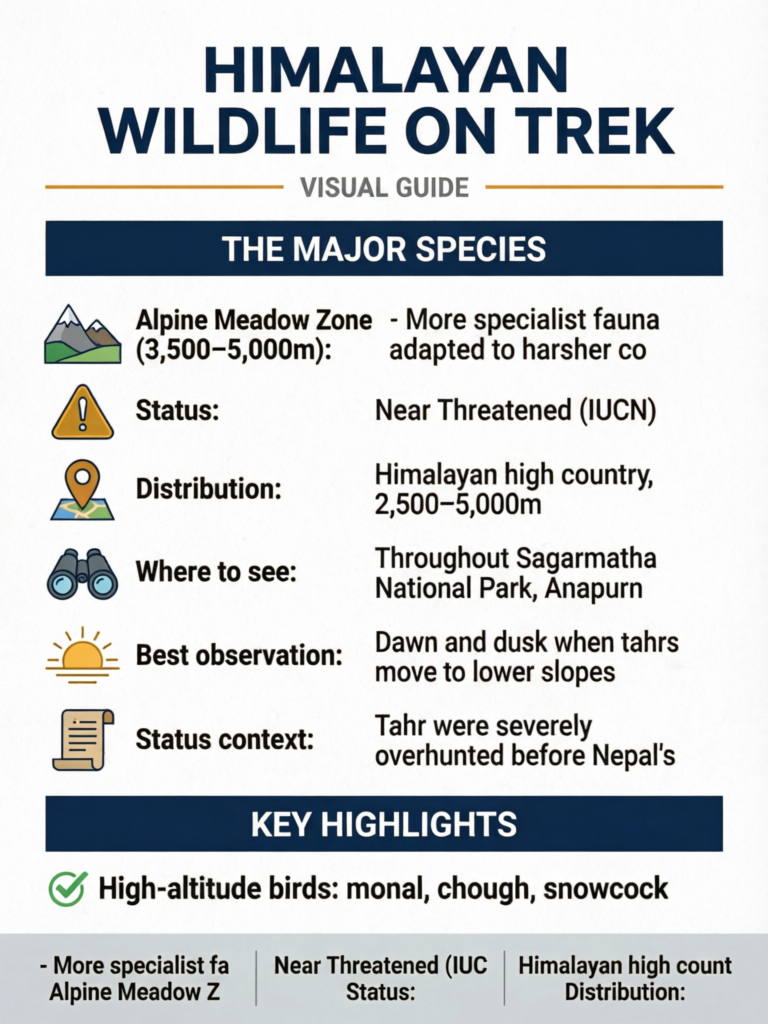
Alpine Meadow Zone (3,500–5,000m):
- More specialist fauna adapted to harsher conditions
- Prime Himalayan tahr and snow leopard territory
- High-altitude birds: monal, chough, snowcock
- Snow leopard most active here in winter and spring
Nival Zone (above 5,000m):
- Minimal wildlife — extreme conditions limit viable habitat
- Some bird species transit (bar-headed goose)
- Microbial communities on glaciers
The Major Species
Himalayan Tahr (Hemitragus jemlahicus)
Status: Near Threatened (IUCN) Distribution: Himalayan high country, 2,500–5,000m Where to see: Throughout Sagarmatha National Park, Annapurna Conservation Area, Langtang National Park — best near Namche Bazaar, Tengboche, and the hillsides between Chhomrong and Machapuchare Base Camp
The Himalayan tahr is the most commonly sighted large mammal on Nepal's major trekking routes and one of the most impressive — a stocky, shaggy-coated wild goat with impressive backward-curving horns and a reddish-brown to dark brown coat. Males carry dense manes of longer hair around the neck and shoulders.
Tahrs live in steep, rocky terrain — cliffs, rocky ridgelines, and talus slopes — where their climbing ability provides refuge from predators. You'll typically see them in small groups of 5–20, with larger male groups during the non-breeding season and mixed family groups in summer.
Best observation: Dawn and dusk when tahrs move to lower slopes to feed. Look for movement on rocky hillsides rather than the horizon. The click of hooves on stone often alerts you before you see the animal.
Behaviour to observe: The dominance hierarchy in male groups is fascinating — older males with the largest horns maintain social precedence without fighting. If you watch long enough, you'll see clear deference behaviour in younger males.
Status context: Tahr were severely overhunted before Nepal's national parks provided protection. Within park boundaries, populations have recovered well. Outside parks, poaching pressure continues in some areas.
Where to See Himalayan Tahr in Nepal
The single best place to see Himalayan tahr is Sagarmatha National Park in the Everest region — herds graze the slopes above Namche Bazaar, around Tengboche, and on the hillsides framing the Everest Base Camp trek. In the Annapurna region, the steep faces between Chhomrong village and Machhapuchhare Base Camp on the Annapurna Base Camp route are reliable. Langtang National Park, on the Langtang Valley trek, holds tahr on the cliffs above Kyanjin Gompa.
Hemitragus jemlahicus
Bovidae / Caprinae
Near Threatened (population declining)
2,500–5,000m
~73 kg (161 lb)
~36 kg (79 lb)
46 cm (18 in)
Everest, Annapurna, Langtang
What a Himalayan Tahr Looks Like
The Himalayan tahr has a small head, small pointed ears, and large eyes, set on a stocky body built for cliffs rather than open ground. The species is strongly sexually dimorphic: males are noticeably larger and carry a dense mane of long hair around the neck and shoulders, while females are smaller with shorter coats. An average male weighs roughly 73 kg (161 lb); females average around 36 kg (79 lb).
Both sexes grow backward-curving horns with a triangular cross-section, reaching a maximum length of about 46 cm (18 in) in large males. The horn curves back deliberately — this shape reduces the risk of serious injury during the headbutting contests males use in the rut. The coat is a thick, reddish-brown wool over a dense undercoat, an adaptation to the harsh Himalayan winter; the coat thins and lightens in colour as winter ends.
The tahr's most useful adaptation is invisible at a distance: its hooves combine a flexible, rubber-like central pad that grips smooth rock with a hard keratin rim that bites into rough surfaces. This dual grip is what lets a 70 kg animal stand calmly on terrain that would defeat almost any predator — which is exactly why tahr feel safe enough to be watched from the trail below.
Taxonomy: Is the Tahr a Goat?
Tahr belong to the subfamily Caprinae within the order Artiodactyla (even-toed ungulates), making their closest relatives the true sheep and goats. The genus Hemitragus — from the Greek hēmi ("half") and trágos ("goat"), literally "half-goat" — was once thought to contain several species, but recent phylogenetic analysis treats it as monospecific, with the Himalayan tahr essentially a wild goat. An "Eastern Himalayan tahr" subspecies described in 1944 is no longer considered valid; no subspecies are currently recognised.
A note on spelling for trekkers: the word "tahr" entered English around 1835 from a Western Himalayan name. It is frequently confused with thār, a Nepali word for the Himalayan serow — a different animal entirely — which is why you will sometimes see the tahr written as "thar." On the trail, if a guide says "thar," check whether they mean the cliff-dwelling wild goat (tahr) or the forest serow.
Behaviour, Diet, and Predators
Tahr are diurnal grazers, most active in the cool hours of dawn and dusk when they move down to lower, grassier slopes to feed, retreating to steep cliffs to rest and ruminate through midday. Their diet is almost entirely vegetarian — grasses, herbs, and the leaves of shrubs — and as bulk grazers they play a genuine role in shaping high-altitude meadows.
Their primary natural predator is the snow leopard, with leopards and Himalayan wolves taking animals at lower elevations. Tahr defend themselves chiefly through terrain and senses: they have excellent eyesight, hearing, and smell, and a herd posted on a cliff face can detect an approaching predator — or trekker — long before it arrives. This is why patient, quiet observation from below works far better than trying to climb toward a herd.
Within male groups, older bulls with the largest horns hold social precedence largely through displays rather than constant fighting; watch a group for a few minutes and you can usually read the hierarchy from the deference of younger males. The rut peaks in autumn and into early winter, which is also when males are most visible.
Pro Tip
The click of hooves on stone usually gives a tahr away before you see it. On the Everest and Annapurna trails, scan rocky hillsides at eye level rather than the skyline — tahr graze on the slope, not the ridge top — and look for movement in the early morning before the day's trekkers fill the trail.
Tahr Abroad: An Introduced Species
Although the Himalayan tahr is Near Threatened across its native range — which spans Nepal, northern India, southern Tibet, and western Bhutan — it has been introduced and now thrives in several other countries, including New Zealand, Argentina, South Africa, and the United States. In New Zealand's Southern Alps in particular, introduced tahr have become so numerous they are managed as an invasive species. The contrast is a useful reminder for trekkers: the animal you may struggle to glimpse on a protected Nepali cliff is, elsewhere, an over-abundant pest — habitat protection and anti-poaching effort, not the animal's hardiness, are what keep Nepal's populations at risk.
Musk Deer (Moschus chrysogaster)
Status: Endangered (IUCN) Distribution: Himalayan forests, 2,500–4,500m Where to see: Forest sections of Langtang, lower Khumbu, Annapurna rhododendron forest below 3,500m; primarily dawn and dusk
The musk deer is one of Nepal's most ecologically important and most threatened mammals. Neither true deer nor antelope (it occupies its own family Moschidae), it is characterised by large ears, strong hind legs (giving it an upward-tilted posture), and — in males — the remarkable saber-like upper canine tusks and the musk gland that has made it a poaching target for centuries.
Musk — the waxy secretion from the male's abdominal gland — was historically one of the world's most valuable natural products, used in perfumery and traditional medicine. At peak demand, musk sold for more per gram than gold. The resulting poaching pressure drove musk deer populations to a fraction of historical numbers. Despite protection, illegal musk trade continues in parts of Nepal.
Observation: Musk deer are solitary and extremely shy. Sightings are usually brief — an animal startled from cover that bounds away in the distinctive humped-back gallop unique to the species. Pre-dawn walks in the forest zones of Langtang and Khumbu offer the best chance. Look for browsing activity (nibbled shrubs at deer height) to identify active areas.
Snow Leopard (Panthera uncia)
Status: Vulnerable (IUCN) Distribution: High mountains, 3,000–5,500m, occasionally lower in winter Nepal population estimate: 300–500 individuals Where to see: Essentially never — this is honest. Camera trap surveys confirm presence throughout Nepal's mountain parks
The snow leopard is one of the world's most elusive large cats. The combination of cryptic spotted coat that blends into rocky terrain, crepuscular and nocturnal activity patterns, and low population density means that even dedicated wildlife professionals working specifically in snow leopard habitat rarely get a sighting.
Your guide may show you snow leopard signs: pugmarks in snow or soft soil (round, large paw prints with no claw marks — cats retract claws, dogs don't), scrape marks (territorial scent marking on prominent rocks), kill remains (typically blue sheep or tahr, with characteristic feeding patterns).
The exception: A handful of operators in Nepal offer dedicated snow leopard expeditions in winter (November–February) in areas like the Dolpo region where prey density is high and experienced naturalists can track individuals. These are multi-week specialist expeditions, not standard treks. If seeing a snow leopard is a primary goal, they are the appropriate approach.
Why it matters even unseen: The presence of snow leopard in an ecosystem indicates healthy prey populations (tahr, blue sheep, musk deer), which in turn indicates healthy vegetation and an intact mountain ecosystem. The snow leopard is an indicator species for Himalayan ecological health.
Red Panda (Ailurus fulgens)
Status: Endangered (IUCN) Distribution: Temperate forest 2,000–4,000m, particularly bamboo-rhododendron forest Nepal population: Estimated 1,000+ individuals Where to see: Lower Khumbu forest near Namche, Modi Khola valley below ABC, Langtang forest zones
The red panda — no close relative of the giant panda despite the common name — is one of Nepal's most beloved and charismatic mammals. Roughly the size of a domestic cat with a distinctive rusty-red coat, a fox-like face, and a long striped tail, the red panda is unmistakeable when seen.
Red pandas are specialists in bamboo and rhododendron forest, where they feed primarily on bamboo shoots supplemented by berries, insects, and eggs. They are most active at dawn and dusk, spending the middle of the day resting in tree branches.
Observation tips: The Modi Khola gorge below Annapurna Base Camp is one of Nepal's best red panda habitats. Alert guides sometimes spot them resting in rhododendron branches above the trail. Look specifically in bamboo thickets along stream banks at forest edge. The distinctive rusty colouring and striped tail are visible from 20–30 metres with binoculars.
Himalayan Monal (Lophophorus impejanus) — Nepal's National Bird
Status: Least Concern Distribution: Himalayan forest and scrub, 2,000–4,500m Where to see: Throughout Nepal's trekking regions in rhododendron and alpine scrub
The Himalayan monal is Nepal's national bird and among the most spectacular birds you'll encounter on any trek. The male is quite extraordinary: a large pheasant with iridescent plumage covering every visible surface in a mosaic of metallic green, copper, purple, and blue. The colours shift dramatically with viewing angle — watch one bird move in sunlight and see a dozen apparent colour changes.
Females are streaked brown — effectively invisible in forest — and the contrast with the male's extravagance is remarkable.
Where to find: Males are most visible in April–May when breeding behaviour makes them more active in open areas. Look in rhododendron forest clearings and alpine meadow edges between 2,500–4,000m. They feed on bulbs and roots dug with their strong curved bill — look for disturbed soil in alpine meadows.
Call: A loud, whistling "keeooo-ooo" descending in pitch — once learned, it's immediately recognisable and often the first indication of presence before the bird is visible.
Yellow-Billed Chough (Pyrrhocorax graculus)
Status: Least Concern Distribution: Mountain areas above treeline, 3,000–5,000m+
You will almost certainly see choughs on any trek that goes above 4,000m. These glossy black birds with yellow beaks and red feet are the most conspicuous wildlife at high altitude — acrobatic, noisy, and apparently indifferent to altitude. They are the birds soaring around Gorak Shep, investigating lodge terraces at Gokyo, and riding thermals above Thorong La.
Choughs live in flocks of 20–200 individuals, using their intelligence to exploit food sources — both natural and trekker-related. They are opportunistic scavengers and will investigate unguarded food. They are also genuinely skilled fliers, performing aerial acrobatics in mountain thermals that are a pleasure to watch.
Bearded Vulture / Lammergeier (Gypaetus barbatus)
Status: Near Threatened Distribution: Mountains throughout Nepal Where to see: Large valleys with cliffs — Khumbu, Annapurna, Langtang, upper Marsyangdi
The lammergeier — also called the bearded vulture — is the largest vulture in Nepal and one of the most impressive birds in the world. With a wingspan reaching 2.8 metres and a distinctive rust-orange colouring (applied by bathing in iron-rich soil), it is unmistakeable in flight.
The lammergeier's ecological niche is unique among birds: it feeds primarily on bone. After other scavengers have stripped a carcass, the lammergeier carries bones high and drops them onto rocks to shatter them, then consumes the marrow. The stomach acid of the species is strong enough to dissolve bone completely.
Best observation: Thermals over large valleys in the Khumbu and Annapurna regions in late morning as thermals develop. The long, narrow wings and long diamond-shaped tail separate it from all other raptors at a glance.
Best Season and Regions for Wildlife on Nepal Treks
Timing matters as much as location. Spring (March–May) is the best window for birds — the Himalayan monal and many forest species are at their most active and visible during the breeding season — and for clear views of tahr on still-green slopes. Winter (December–February) pushes large mammals like tahr and musk deer down to lower, more visible elevations, and is the only realistic season for a dedicated snow leopard search. The monsoon (June–August) is lush but visibility is poor and leeches abound in the forest zones.
For region-by-region detail, see our wildlife across Nepal's trekking regions overview and the dedicated bird watching on Nepal treks guide. If you want to plan a trip specifically around forest wildlife, the rhododendron forests and flora guide explains the habitats that hold red panda and monal.
Ethical Wildlife Watching
Minimum approach distances: Never approach closer than the distance at which the animal shows signs of alert behaviour (raised head, cessation of feeding, movement toward cover). For most Himalayan species, this is 50–100 metres. Some species (musk deer, monal) tolerate a closer approach; snow leopard and red panda do not.
Do not feed wildlife. Habituating wildlife to human food is ecologically harmful and creates dangerous animals. In the Khumbu, choughs have become aggressive at some teahouses as a result of feeding — a small example of a much larger problem.
Photography ethics: Use telephoto rather than close approach. Never follow an animal to get a better shot. Photographing birds at the nest is particularly disruptive during breeding season.
Report significant sightings. The National Trust for Nature Conservation Nepal (www.ntnc.org.np) and Bird Conservation Nepal (www.birdlifenepal.org) maintain observation databases. A confirmed snow leopard sighting or an unusual bird species record has genuine conservation value. Your guide can help identify the appropriate reporting channel.
Related Resources
- Khumbu Conservation Area Guide
- Modi Khola Cloud Forest Guide
- Sagarmatha National Park Permit
- Annapurna Conservation Area Permit
- Dolpo Trekking Guide
- Langtang Valley Trek Guide
- Wildlife Across Nepal's Trekking Regions
- Bird Watching on Nepal Treks
- Rhododendron Forests & Flora of Nepal
- Chitwan National Park Safari Guide
Where Can You See Snow Leopards on Nepal Treks?
Snow leopard sightings on standard trekking routes are extremely rare. Your best chance is in the Manaslu Conservation Area, Upper Dolpo, and the northern reaches of Sagarmatha National Park during winter (December-February) when prey descends to lower elevations. Dedicated snow leopard tracking expeditions in the Tsum Valley or Dolpo offer 10-30% sighting probability over 10-14 days with experienced trackers.
Frequently Asked Questions
What is a Himalayan tahr?
The Himalayan tahr (Hemitragus jemlahicus) is a large, shaggy wild goat native to the Himalayas of Nepal, northern India, southern Tibet, and western Bhutan. It lives on steep cliffs between 2,500 and 5,000m, weighs up to about 73 kg as a male, and is listed as Near Threatened by the IUCN. It is the wildlife species trekkers see most often in Nepal.
Is the Himalayan tahr a goat or a deer?
It is a wild goat, not a deer. The tahr belongs to the subfamily Caprinae, the same group as true sheep and goats, and recent genetic analysis places it firmly among wild goats. The musk deer, by contrast, is an entirely separate animal in its own family (Moschidae).
What is the difference between a tahr and a thar (serow)?
"Tahr" and "thar" are often confused because the Nepali word thār refers to the Himalayan serow. The tahr is a cliff-dwelling wild goat seen on open rocky slopes; the serow is a stockier, darker, goat-antelope that hides in forest. If you spot an animal on an exposed cliff face, it is almost certainly a tahr.
How big do Himalayan tahr get?
Males average around 73 kg (161 lb) and females around 36 kg (79 lb). Both sexes have backward-curving horns reaching up to roughly 46 cm (18 in) in large males. Males also carry a thick mane around the neck and shoulders, making them easy to tell apart from females at a distance.
What is the most commonly seen large mammal on Nepal treks?
The Himalayan tahr is the most frequently sighted large mammal on Nepal's major trekking routes. Look for them on rocky hillsides between 2,500-5,000m, particularly near Namche Bazaar and between Chhomrong and Machhapuchare Base Camp on the ABC route.
Can I see red pandas while trekking in Nepal?
Red pandas inhabit the rhododendron and bamboo forests between 2,500-4,000m in the Langtang region, Kanchenjunga Conservation Area, and parts of the Annapurna region. Sightings are uncommon due to their shy, nocturnal habits, but dawn walks in suitable forest habitat offer the best chance.
What birds should I look for on Nepal treks?
The Himalayan monal (Nepal's national bird) with its iridescent plumage is the highlight species. Also watch for lammergeier (bearded vulture), alpine chough, Tibetan snowcock, and blood pheasant at higher altitudes.
Is it safe to encounter wildlife on Nepal treks?
Most Himalayan wildlife avoids humans. Maintain distance, never feed animals, and store food securely. The only genuine danger is the very rare encounter with a Himalayan black bear in forest zones -- make noise on the trail to avoid surprising them.
What is the best season for wildlife viewing on Nepal treks?
Spring (March-May) is best for bird watching when species are active and visible. Winter (December-February) is optimal for large mammals like tahr and musk deer, which descend to lower, more visible elevations.
Plan a wildlife-rich trek in Nepal
Want a guide who can spot tahr on the cliffs and a monal in the rhododendron before you do? Plan your trek with a verified local agency and a naturalist-minded guide.