



Modi Khola Cloud Forest Guide: Biodiversity Along the ABC Trail
The Modi Khola cloud forest is the mist-shrouded river gorge on the Annapurna Base Camp trail, holding one of Nepal's richest ecosystems: red pandas, Himalayan monal, dozens of rhododendron species and over 100 ferns, all protected by ACAP between roughly 1,800m and 3,000m. This guide explains what lives there, where to look, and when to visit.
The Annapurna Base Camp trek is famous for its destination — the extraordinary amphitheatre of 8,000m peaks surrounding the base camp at 4,130m. But many trekkers, focused on the destination, walk through one of Nepal's finest ecological systems without realising what surrounds them.
The Modi Khola gorge — the deep river valley that provides the only practical approach to the Annapurna Sanctuary — contains a cloud forest ecosystem of exceptional biodiversity. The combination of heavy moisture from the approaching monsoon (the gorge funnels moisture from the Bay of Bengal deep into the southern Annapurna massif), the dramatic altitude gradient, and the protection provided by ACAP (Annapurna Conservation Area Project) creates conditions that support an extraordinary concentration of plants, birds, and mammals.
This guide gives the Modi Khola's ecology the attention it deserves — what it contains, why it matters, the best spots for observation, and how to be a responsible visitor as you trek the Annapurna Base Camp route.
What is the Modi Khola cloud forest?
The Modi Khola cloud forest is a temperate, mist-bathed forest band along the Modi Khola river gorge on the way to the Annapurna Sanctuary, occurring mainly between 1,800m and 3,000m where persistent cloud keeps humidity high year-round. It is defined by moss-draped trees, dense bamboo understory, and a vertical sequence of habitats that pack subtropical-to-alpine diversity into a single trekking corridor.
In plain terms: as you walk from Jhinu Danda up through Chhomrong, Bamboo and Dovan, you are passing through a living cross-section of Himalayan ecology, layer by layer, in just a few days of trekking in Nepal. No other trekking corridor in the country compresses subtropical broadleaf forest, temperate cloud forest, birch-rhododendron woodland and subalpine shrub into such a short, walkable transect — which is exactly why naturalists rate the Modi Khola so highly even though most trekkers come for the mountain amphitheatre at the top.
Modi Khola gorge, Annapurna Sanctuary, Nepal
1,800–3,000m elevation
Annapurna Conservation Area Project (ACAP), since 1986
Red panda (Ailurus fulgens)
32 (many along this trail)
Over 100 recorded
Mid-March to late April (rhododendron peak)
March–May and October–November
Understanding the Modi Khola Gorge
Geology and Geography
The Modi Khola (Khola = river in Nepali) originates from the Annapurna Sanctuary, fed by glacier meltwater from the surrounding 7,000–8,000m peaks. As it descends southward through the gorge, it cuts one of the deepest river gorges in the Himalaya — with vertical relief of over 4,000m from the river bed to the surrounding summits.
This dramatic topography creates:
- Orographic precipitation: Moisture-laden air from the south is forced upward and cools, producing rainfall and cloud at 1,500–3,000m elevation
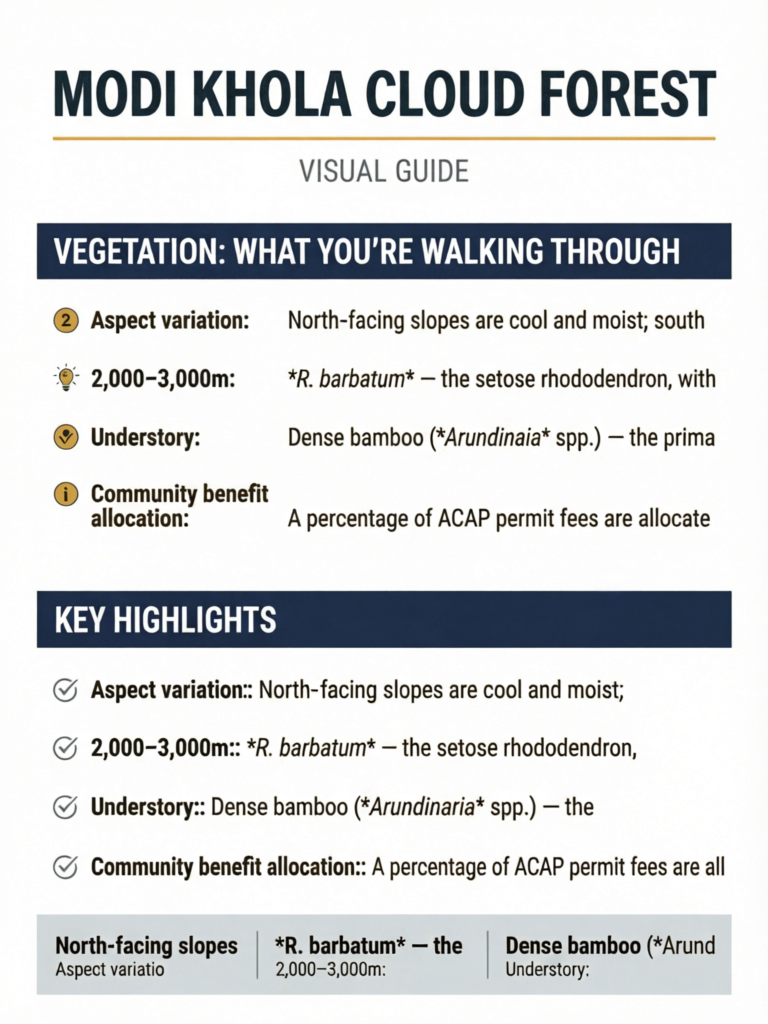
- Aspect variation: North-facing slopes are cool and moist; south-facing slopes are warmer and drier — creating microhabitat diversity within metres
- Humidity concentration: The gorge walls concentrate moisture, supporting cloud forest conditions that would otherwise only occur at lower altitudes in Nepal
The "Cloud Forest" Designation
Cloud forest is a specific ecological community defined by persistent or frequent immersion in cloud or mist. The moisture from cloud — called horizontal precipitation or fog drip — supplements rainfall and maintains high humidity even in dry seasons.
In the Modi Khola gorge, cloud forest occurs primarily between 1,800–3,000m, corresponding to the section of the ABC trail from Jhinu Danda to Chhomrong and above. The persistent cloud environment supports moss growth on every surface — tree branches, boulders, cliff faces, and the trail itself are draped in green.
The biodiversity consequence of cloud forest conditions is significant: moisture-dependent species that cannot survive in Nepal's drier regions thrive here. Fern diversity is extraordinary (over 100 species recorded in the ACAP area). Orchid species occur in surprising numbers for a temperate zone.
Altitude Zones at a Glance
The forest changes character every few hundred metres of ascent. Understanding these bands helps you predict what you will see and where:
How to Reach the Modi Khola Cloud Forest
The Modi Khola cloud forest is not a standalone destination — it is the corridor you walk through on the way to the Annapurna Sanctuary, so reaching it means starting the standard Annapurna Base Camp trek. Most trekkers base themselves in Pokhara, the gateway city for the whole Annapurna region.
- From Kathmandu to Pokhara: A 25-minute domestic flight or a 6–8 hour drive (200km) on the Prithvi Highway. See the Kathmandu to Pokhara transport guide for current options and fares.
- From Pokhara to the trailhead: A 1.5–2 hour drive to Nayapul or, increasingly, a longer jeep ride to higher roadheads near Kyumi or Siwai that shorten the lower walking sections. The jeep transport and trail access guide covers how the roads have changed access.
- Into the forest itself: From the trailhead you climb toward Ghandruk or Jhinu Danda, then up the gorge through Chhomrong. The true cloud-forest band begins above Chhomrong and intensifies between Bamboo and Dovan.
Because the forest is reached on a teahouse trek, you do not need to camp — lodges line the entire route. For how the accommodation works, see the wider tea house trekking explained guide.
Day-by-Day Through the Cloud Forest
On a typical Annapurna Base Camp itinerary, the cloud-forest zone occupies roughly two to three walking days each way. Here is where the ecology lines up with the standard stages:
For full day-by-day logistics and distances, the Annapurna Base Camp 11-day itinerary builds in the slower, forest-friendly pace this corridor rewards, while the ABC 10-day itinerary is the more standard option.
Vegetation: What You're Walking Through
Rhododendron Diversity — One of Nepal's Finest
The Modi Khola gorge is one of the best places in Nepal to observe rhododendron diversity. Nepal has 32 rhododendron species, and a significant proportion grow in the Annapurna Conservation Area. The ABC trail passes through their altitude range in sequence.
Key species by altitude:
1,500–2,000m: Rhododendron arboreum — the tree rhododendron, Nepal's national flower. Grows to 15m. The crimson and pink flowers create the famous spring display seen from Nayapul.
2,000–3,000m: R. barbatum — the setose rhododendron, with bristly stems and deep red flowers. Also R. campanulatum, with large pale lilac bells.
3,000–3,500m: R. hodgsonii — a large-leaved species with trusses of pink flowers. One of Nepal's most striking alpine shrubs.
3,500–4,000m: R. anthopogon — dwarf species with white or pale pink flowers, heavily fragrant. Traditional use in incense and ceremonial offerings.
Peak bloom timing: The rhododendron display peaks in mid-March to late April in the Modi Khola gorge, slightly later than lower-altitude displays in the Ghorepani area. The combination of rhododendron bloom and early spring weather makes April the finest month for the ABC approach from a botanical perspective. For the wider picture of these forests across the country, see the rhododendron forests and flora guide.
Forest Composition
The broad-leaved forest between Chhomrong (2,170m) and Sinuwa (2,360m) is among the finest temperate forest on the ABC trail:
Dominant trees: Himalayan birch (Betula utilis) with its distinctive white and copper-streaked bark, Himalayan maple (Acer campbellii), several oak species (Quercus semecarpifolia, Q. lamellosa)
Understory: Dense bamboo (Arundinaria spp.) — the primary food source of the red panda, and therefore an indicator of potential red panda habitat. Where bamboo is dense beneath rhododendron canopy, red pandas are possible.
Epiphytes: Hanging mosses, ferns, and occasional orchids coat older tree branches in the moistest sections between Bamboo (2,310m) and Dovan (2,600m).
Ferns, Mosses and Orchids
The defining texture of the Modi Khola cloud forest is green-on-green: every trunk, branch and boulder carries a coat of moss, liverwort and fern. The ACAP area holds over 100 recorded fern species, from tree ferns in the warmer lower gorge to delicate filmy ferns clinging to spray-soaked rock near waterfalls. Epiphytic orchids — plants that grow on tree branches rather than in soil — appear in surprising numbers for a temperate latitude, peaking with the warmth and humidity of late spring and the monsoon.
These plants are easy to overlook because they are not dramatic from a distance, but they are the clearest signal of how special this forest is. A drier valley elsewhere in Nepal simply cannot hold this volume of moisture-dependent life. Pause on the moss-draped staircase between Bamboo and Dovan, look closely at a single trunk, and you will often find several fern species, two or three mosses, and a small orchid sharing one square metre.
Pro Tip
Carry a small hand lens or use your phone camera's macro mode. The moss, fern and orchid detail in the Modi Khola gorge rewards close looking far more than wide landscape shots, especially on grey, misty days when distant views are closed in.
Wildlife: What Lives in the Modi Khola Forest
Red Panda (Ailurus fulgens)
The Modi Khola gorge is one of Nepal's most reliable red panda sites. The combination of rhododendron-bamboo forest at optimal altitude (2,200–3,400m) and the relative protection provided by ACAP's enforcement against poaching creates good habitat conditions.
Where to look: The sections between Jhinu Danda and Sinuwa, and particularly the dense forest between Bamboo and Dovan, represent the best red panda habitat on the trail. Look in bamboo thickets at the base of trees and on lower branches of rhododendron trees — red pandas rest off the ground to avoid ground predators.
When to look: Dawn and late afternoon (dusk before lodges close for the night) are the prime activity periods. The midday hours are typically rest time. Alert guides with knowledge of current individual ranges can significantly improve sighting odds.
Ecological significance: The Modi Khola population is scientifically significant — camera trap surveys by Tribhuvan University have documented multiple individuals in a relatively small area, suggesting the gorge supports a genuine population rather than occasional transient individuals.
Red panda sightings are never guaranteed — they are shy, mostly crepuscular, and well camouflaged. Treat any encounter as a rare privilege. Keep your distance, stay quiet, never feed or chase an animal for a photo, and let it move away on its own terms.
Himalayan Monal
The national bird is conspicuous and common in the rhododendron and oak forest zones of the ABC approach. Males display from exposed branches in April–May breeding season, making this one of the best times of year for observation.
The contrast between the male's iridescent plumage and the forest background is visually dramatic — once you've seen a male monal in sunlight, it's impossible to forget.
Satyr Tragopan (Tragopan satyra)
An extraordinary high-forest pheasant found in Nepal's Himalayan zone. The male is spectacular — a large bird with crimson upper parts covered in white spots, a brilliant blue facial wattle, and a complex breeding display that is among the most elaborate in the bird world. Less commonly seen than the monal, but the Modi Khola's dense forest provides the understory habitat it prefers.
Blood Pheasant (Ithaginis cruentus)
Common in the upper forest and shrub zones from Sinuwa to Chhomrong and above. Groups of 10–30 individuals forage in the undergrowth, their red-streaked plumage visible through gaps in vegetation. They are less shy than most pheasants and can often be observed at close range.
Other Birds of the Gorge
Beyond the famous pheasants, the Modi Khola is a productive corridor for general birdwatching. Mixed-species feeding flocks move through the canopy in the cooler months, often combining laughingthrushes, warblers, tits, nuthatches and treecreepers. Sunbirds and minivets add flashes of colour in the flowering rhododendron canopy. Along the river itself, look for plumbeous water redstart and white-capped redstart working the boulders, and dippers feeding in the rapids. For a wider species list and field tactics, see the dedicated bird watching in Nepal guide.
Himalayan Tahr
The rocky cliffs of the upper gorge above Chhomrong support a resident tahr population. Groups are most visible on south-facing cliffs in morning and evening. The trail from Chhomrong to Himalaya Hotel (2,990m) passes through typical tahr habitat — watch the cliff faces above the trail. For more on this animal, see the Himalayan tahr wildlife guide.
Where to Look: A Section-by-Section Wildlife Map
Knowing the trail geography turns a generic hope of "seeing wildlife" into a concrete plan. Walk these sections slowly, with eyes and ears open, and your odds rise sharply.
- Jhinu Danda to Chhomrong: Hot springs, river photography, and lower-elevation birds. Rhododendron arboreum in bloom in spring. Chhomrong village is the gateway and a good base to slow down.
- Chhomrong to Sinuwa to Bamboo: The steep moss-laden staircase enters prime red panda and blood pheasant habitat. The forest is densest and dampest here.
- Bamboo to Dovan: The single best stretch for red panda, orchids, ferns and epiphytes. Walk it at dawn if your itinerary allows an early start.
- Dovan to Himalaya Hotel: Birch–oak forest with monal and satyr tragopan; scan cliff faces for tahr.
- Deurali to Machhapuchhre Base Camp to ABC: Treeline gives way to subalpine shrub; dwarf rhododendron, alpine accentors and snowfinches, and the open sanctuary at last.
Pro Tip
Build a "wildlife day" into your itinerary. The standard ABC pace pushes hard from Chhomrong to Deurali in one day, leaving no time to stand still. An extra night at Bamboo or Sinuwa transforms your chances of seeing the forest's shyer residents — and eases acclimatisation too.
Practical Trail Notes for the Cloud Forest
The same moisture that makes the Modi Khola so biologically rich also makes it one of the wetter, more slippery sections of any Annapurna trek. A few practical points help you stay comfortable and safe while you watch wildlife.
Leeches and the Wet Forest
From roughly Nayapul to Chhomrong, leeches are active whenever the forest is damp — most aggressively during the monsoon (June to September) but also after rain in spring and autumn. They are harmless but unpleasant. To manage them:
- Wear gaiters and tuck trousers into socks; treat boots and lower legs with anti-leech salt or a repellent.
- Carry a small tin of salt or a lighter to detach any that attach; do not pull them off by force, which can leave the mouthparts behind.
- Check ankles and calves at each tea break, especially after walking through the mossy understory.
For a fuller treatment of bites and prevention, see the leeches, bites and insects guide.
Footing, Steps and the Damp Staircase
The Chhomrong-to-Bamboo and Bamboo-to-Dovan sections are built on long stone staircases that stay slick under near-permanent moss and mist. Trekking poles, lugged boots and an unhurried pace matter more here than on drier trails. The trekking poles guide explains how poles reduce knee load on these endless steps.
Acclimatisation and Altitude
The cloud forest itself sits below 3,000m, so altitude sickness is not a concern within the forest band. The risk begins higher, above Deurali (3,200m) on the climb to Machhapuchhre Base Camp (3,700m) and Annapurna Base Camp (4,130m). Building an extra forest night at Sinuwa, Bamboo or Dovan both improves wildlife odds and eases the later ascent. For the rules that keep you safe higher up, read the altitude sickness prevention and treatment guide.
How the Modi Khola Compares to Other Nepal Forests
Nepal has several outstanding forest treks, but few combine accessibility, altitude range and cloud-forest moisture the way the Modi Khola does. A quick comparison helps you decide where to go for forest and wildlife:
If rhododendron colour is your single priority, the lower Ghorepani village hillsides and the Poon Hill route are unrivalled in spring, and many trekkers combine the two on a Poon Hill and ABC extension. For broader context on Nepal's wildlife by region, see the wildlife of Nepal trekking regions guide.
ACAP Conservation in the Modi Khola
The Annapurna Conservation Area Project is one of Nepal's most successful conservation initiatives. Established in 1986 as a community-based conservation programme rather than a conventional national park, ACAP has generated a model for reconciling tourism revenue with ecological protection.
Key ACAP conservation programmes in the Modi Khola area:
Kerosene distribution: ACAP subsidises kerosene distribution to lodges throughout the ABC route, reducing firewood use. This is directly credited with the recovery of forest cover observed since the programme began.
Anti-poaching patrols: Regular ranger patrols reduce musk deer poaching and prevent illegal plant collection (particularly medicinal herbs and orchids).
Community benefit allocation: A percentage of ACAP permit fees are allocated to community development in trail villages — school buildings, health posts, water systems. This creates economic incentives for communities to protect the wildlife and forest that attract trekkers.
Conservation education: ACAP runs nature interpretation programmes in trail schools. Children in Chhomrong and Jhinu Danda receive environmental education that shapes long-term community attitudes toward conservation.
See the Annapurna Conservation Area Permit guide for permit details and ACAP fee structure.
How to Be a Responsible Visitor
The Modi Khola cloud forest is robust but not invulnerable. Your choices on the trail directly affect whether red pandas and rare plants persist here. A few principles matter most:
- Never pick or collect flowers, orchids, ferns or moss — many are protected, and removal damages slow-growing communities.
- Keep wildlife wild: observe quietly, never feed animals, and do not chase or crowd a red panda or pheasant for a photograph.
- Stay on the trail to avoid trampling the fragile understory and compacting soil around root systems.
- Pack out all waste, including organic scraps and fruit peel, which alter wildlife behaviour and attract scavengers.
- Choose firewood-free lodges where possible and minimise hot-shower demand on wood-burning systems.
For a fuller framework on minimising your footprint, read the Leave No Trace in Nepal guide.
Photography in the Modi Khola Forest
Challenges
The cloud forest environment creates challenging photographic conditions. The combination of:
- Low light under dense canopy
- Moving subjects (birds, animals in forest)
- High contrast between sky and shadow
- Moisture on lens elements from fog and mist
Requires specific approaches to produce good images.
Practical Techniques
For forest birds and wildlife:
- Use a telephoto lens with wide aperture (f/4 or wider at 300–400mm)
- ISO 800–1600 is often necessary under forest canopy — modern cameras handle this well
- Continuous autofocus for moving birds
- A monopod or trekking pole braced against your body provides stability without a full tripod
For landscape and forest atmosphere:
- Fog and mist in the Modi Khola gorge creates atmospheric conditions most beautiful in early morning
- Long exposures on flowing water with tripod — the Modi Khola river sections near Jhinu Danda offer excellent waterfalls and rapids
- Polarising filter reduces glare on wet foliage and saturates the green
For rhododendron bloom:
- Overcast light (common in the gorge) is actually ideal for rhododendron photography — it eliminates harsh shadows while revealing the saturation of the flowers
- A 50–85mm focal length captures individual flower clusters well
- Include forest context — the rhododendron in situ is more interesting than isolated close-ups
For wider planning, see the photography gear guide for Nepal trekking and the roundup of the best photography treks in Nepal.
Best Time to Visit for Natural History
March–April: Prime rhododendron bloom, bird breeding activity (most species more vocal and visible), red panda may be more active as temperatures warm. Forest at its most colourful. For the 2026 spring season, mid-March to late April remains the window most naturalists target.
October–November: Post-monsoon clarity, exceptional visibility, forest turning to autumn colours. Red pandas active as temperatures drop. Less botanically spectacular than spring but excellent for wildlife in alpine zones.
July–August (monsoon): The gorge is at peak moisture — waterfalls at maximum volume, forest incredibly lush. Leeches are present from Nayapul to Chhomrong. Visibility is poor for photography. Birds are breeding and relatively quiet. Not recommended for most visitors but the forest atmosphere is extraordinary. If you are tempted by the lushness, read the monsoon trekking in Nepal guide first.
For the full seasonal breakdown across the region, see the best time to trek the Annapurna region and the best time for Annapurna Base Camp.
If your priority is the forest rather than the summit views, an ABC trek in mid-April balances peak rhododendron bloom, active breeding birds, and warm enough conditions for red pandas — while still giving a strong chance of clear mornings at the base camp.
Planning Your Modi Khola Nature Trek
You do not need a specialist tour to experience this ecosystem — every standard Annapurna Base Camp itinerary passes straight through it. What changes the experience is pace and expertise. Budget at least one extra night in the cloud-forest zone (Sinuwa, Bamboo or Dovan), start sections at first light, and consider a guide with genuine natural-history knowledge rather than only logistics. A naturalist-minded guide who knows current red panda ranges and bird hotspots is the single biggest factor in what you actually see.
When you are ready to organise the trek, book with a verified local agency or guide who can build in the slower, wildlife-focused pace this forest deserves. The Modi Khola rewards trekkers who slow down — the destination is the sanctuary, but the journey is the forest.
Plan your Annapurna Base Camp nature trek
Trek the Modi Khola cloud forest at a wildlife-focused pace with a verified local guide who knows the gorge's red panda and bird hotspots.
Frequently Asked Questions
Related Resources
- Annapurna Base Camp Trek Guide
- Rhododendron Forests & Flora of Nepal
- Bird Watching on Nepal Treks
- Himalayan Wildlife Guide
- Annapurna Conservation Area Permit
- Best Time to Trek the Annapurna Region
- Chhomrong Village Guide
- Annapurna Base Camp 11-Day Itinerary
- Wildlife of Nepal's Trekking Regions
- Khumbu Conservation Area Guide