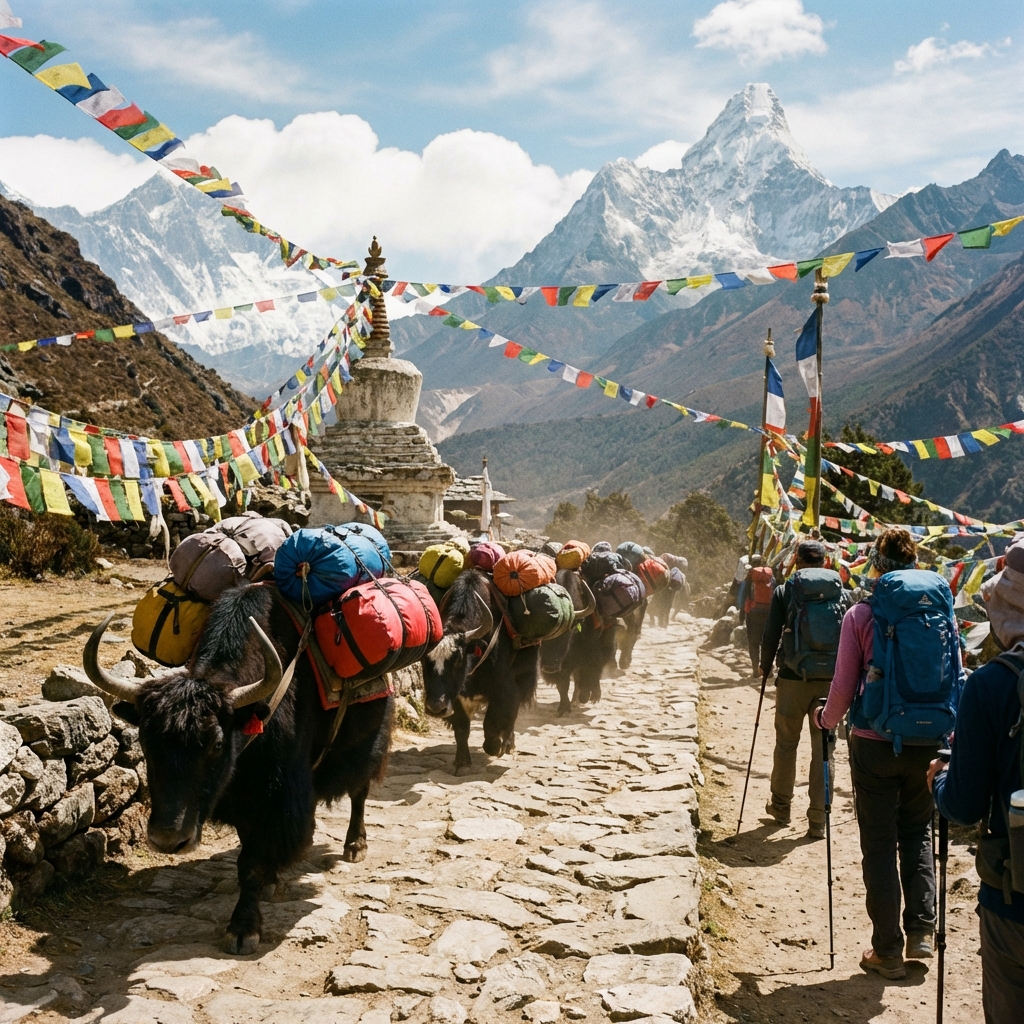
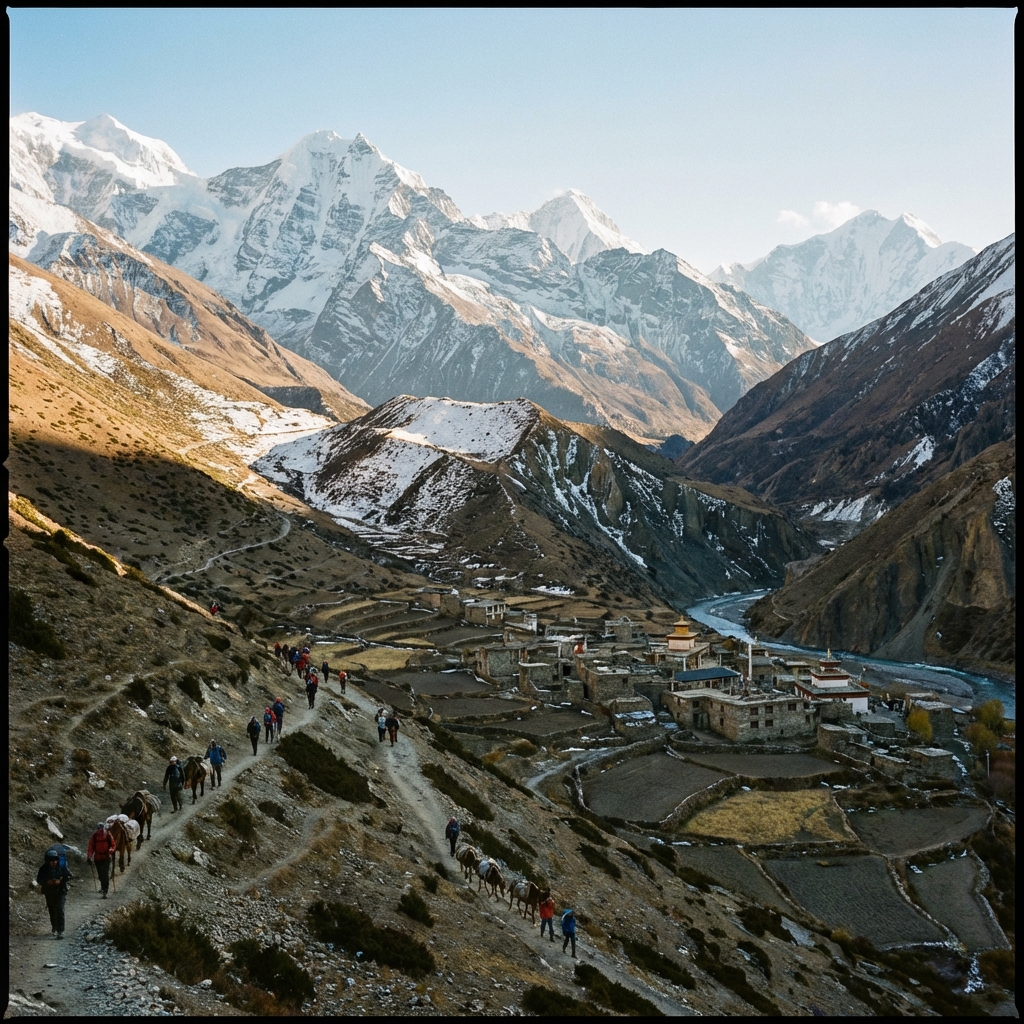
In February 1980, Prince Charles of Wales walked a quiet ridgeline east of Pokhara accompanied by a small retinue and no trekking infrastructure whatsoever. The route he chose offered something that no palace garden or Highland estate could replicate: an unbroken front-row view of the Annapurna range — Machapuchare's perfect fishtail summit, the vast white bulk of Annapurna II, and the sweeping arc of the Himalaya stretching east to west across the entire horizon.
Forty-five years later, the Royal Trek remains the most accessible multi-day Himalayan trekking experience in Nepal — and arguably the most underrated. While trekkers rush to Poon Hill or Annapurna Base Camp, the Royal Trek drifts quietly through traditional Gurung and Chhetri villages at an altitude so modest that even first-timers with no trekking experience feel completely comfortable. No altitude sickness risk. No technical terrain. No permits to navigate. Just walking, mountains, warm village hospitality, and one of the finest continuous Himalayan panoramas anywhere in the world.
Why the Royal Trek Deserves More Respect
Nepal's trekking media tends to measure routes by altitude and difficulty. By those metrics, the Royal Trek — maxing out at a gentle 1,740m at Chisapani — barely registers. That framing misses the point entirely.
The mountain views are world-class. From the ridgeline, you look north and see a 80-kilometre sweep of the Annapurna Himal: Machhapuchhre (6,993m), Annapurna II (7,937m), Annapurna IV (7,525m), Lamjung Himal (6,983m), and on clear days, the distant white smear of Manaslu. These are not distant background peaks visible through binoculars — they are close, immediate, and overwhelming. The views are comparable to what trekkers see from Poon Hill or Mardi Himal, but spread over three consecutive days of walking rather than a single pre-dawn pilgrimage.
The trail is genuinely gentle. Daily trekking runs 3-5 hours on established village paths with modest elevation changes. There are no multi-hour stone staircase climbs, no river crossings, no passes. A healthy 60-year-old and a determined 10-year-old will find this trek within their reach on the same day.
No permits means no planning friction. The Royal Trek passes through non-restricted zones east of Pokhara — you need no ACAP permit, no TIMS card, no restricted area permit. Book a teahouse or homestay, lace your boots, and go. It is the only multi-day Himalayan trek you can genuinely decide to start tomorrow morning.
The cultural experience is authentic. The Gurung and Chhetri villages along the route — Kalikasthan, Syaklung, Chisapani — see only a fraction of the trekkers who crowd the Annapurna Sanctuary trails. Village life here is unhurried and genuinely warm.
3-4 days (2-day express possible)
1,740m (5,709 ft) at Chisapani
Approx. 35-45 km point-to-point
Easy — Nepal's most accessible multi-day trek
Oct-Dec, Feb-May (year-round feasible)
Bijaypur Khola / Kalikapur (east of Pokhara)
Begnas Tal (Begnas Lake)
None
Teahouse and homestay throughout
$25-50/day all-in
$100-$200 excluding Pokhara transport
20-30 min by taxi or local bus
Prince Charles (trekked February 1980)
Day-by-Day Itinerary
The classic Royal Trek runs point-to-point from the Sedi Khola area east of Pokhara to Begnas Tal, with Pokhara as the natural base for both ends. The starting point (Bijaypur Khola or Kalikapur) is reached by taxi in 20-30 minutes from Pokhara lakeside (NPR 500-800). The end point, Begnas Lake, is served by local buses back to Pokhara (NPR 60-80, 45 minutes).
| Day | Route | Distance | Walking Time | Altitude |
|---|---|---|---|---|
| 1 | Bijaypur Khola → Kalikasthan | 10-12 km | 4-5 hours | 800m → 1,400m |
| 2 | Kalikasthan → Syaklung | 8-10 km | 3-4 hours | 1,400m → 1,580m |
| 3 | Syaklung → Chisapani | 6-8 km | 3-4 hours | 1,580m → 1,740m |
| 4 | Chisapani → Begnas Tal | 10-12 km | 4-5 hours | 1,740m → 820m |
Day 1: Bijaypur Khola to Kalikasthan (4-5 hours)
Your taxi drops you at the road end near the Sedi Khola valley. The first section passes through rice paddies and small settlements before the trail climbs steadily onto the Kalikasthan ridge. This is the most sustained ascent of the trek — about 600m of elevation gain — but spread across 4-5 hours, it never feels punishing.
Kalikasthan sits on a ridge with the first serious Himalayan views. On a clear day (mornings are almost always clearer than afternoons), Machapuchare's double summit appears to float above the valley haze. Local teahouses serve simple food; the dal bhat here is freshly cooked and generous. Stay overnight in Kalikasthan — the sunset over Pokhara valley from the teahouse roof is worth lingering for.
Day 2: Kalikasthan to Syaklung (3-4 hours)
This is the easiest and most pleasant walking day — a gentle ridgeline ramble with the Himalayan panorama continuously on your left (north) shoulder. The trail passes through Chhetri farmsteads and small hamlets where villagers will likely stop to chat, particularly if you have even a few words of Nepali. Syaklung is a compact Gurung settlement with two or three teahouses.
Day 2 Timing
Day 2 is short enough that you can take a long lunch break, explore Syaklung village properly, and still arrive at your teahouse by early afternoon. Use the extra time to talk with your teahouse host about Gurung history and the ex-Gurkha families who have shaped these villages. Many hosts have fathers or grandfathers who served in the British or Indian Gurkha regiments — the stories are fascinating.
Day 3: Syaklung to Chisapani (3-4 hours)
The day begins with a descent into a forested valley before climbing back onto the main ridge at Chisapani — the highest point of the trek at 1,740m. "Chisapani" literally means "cold water" in Nepali, a name you'll find at several locations across Nepal — this one is distinguished by a particularly fine view of the Pokhara valley far below.
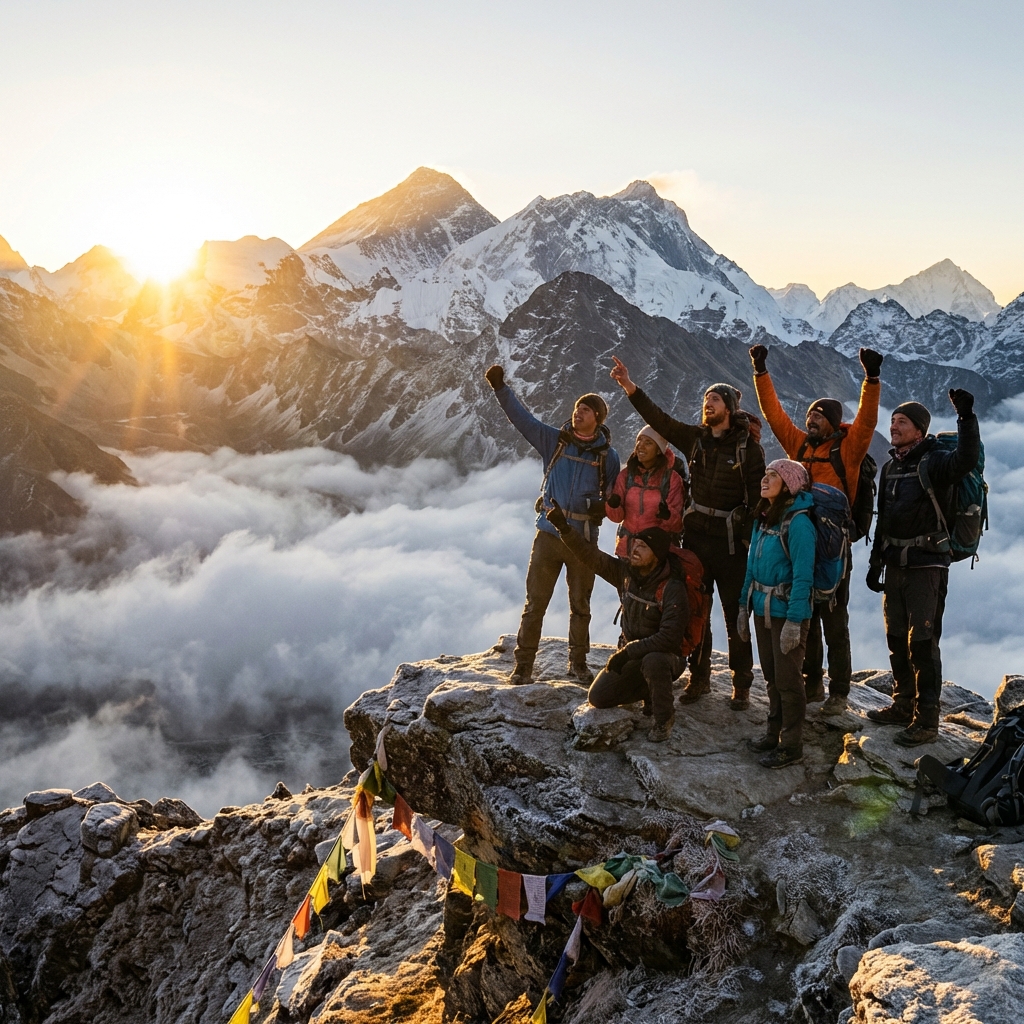
The afternoon at Chisapani rewards those who arrive early: the light on the Annapurna range in the hours before sunset is extraordinary, shifting from white to gold to deep orange as the day fades. Several teahouses here have rooftop decks designed for precisely this viewing.
Day 4: Chisapani to Begnas Tal (4-5 hours)
The final day descends from the ridge through oak and rhododendron forest before entering the Begnas Lake basin. Begnas Tal is the second-largest lake in the Pokhara valley (after Phewa Tal) and far less visited by tourists. The last hour of walking passes through agricultural land bordering the lake where fishing communities live much as they have for centuries.
Lunch at Begnas Lake before catching a local bus or jeep back to Pokhara (45 minutes, NPR 60-80). Many trekkers treat themselves to a lakeside meal at one of the simple restaurants near the Begnas Tal bus park — fresh fish from the lake is a specialty.
Difficulty Assessment
The Royal Trek is unambiguously the easiest multi-day trek in Nepal that offers genuine Himalayan views. Understanding what "easy" means in practice helps set appropriate expectations:
What makes it easy:
- Maximum altitude of 1,740m — well below any altitude acclimatization concern
- Daily walking of 3-5 hours on village paths, not mountain trails
- Elevation changes are gradual — no single day has more than 600m of climbing
- No technical terrain, river crossings, or exposed ridges
- Teahouses at every night stop — no camping required
- Good mobile phone coverage for most of the route
What still requires basic fitness:
- Day 1 involves 600m of cumulative ascent over 4-5 hours — you should be comfortable with a 2-3 hour hill walk at home
- Trail surfaces are uneven (stone paths, root-crossed forest trails) — ankle awareness matters
- Day 4 descent to Begnas is sustained and can be knee-fatiguing on the steeper sections
Who is this trek perfect for:
- Absolute first-timers who want a genuine multi-day Himalayan experience
- Families with children aged 7 and above
- Trekkers aged 60-75 with reasonable walking fitness
- Those with only 3-4 days in Pokhara who want more than a boat ride on Phewa Lake
- Trekkers acclimatizing or recovering before/after a longer trek
- People who had planned a longer trek and need a lower-effort alternative
The Royal Trek as Acclimatization
Several trekking agencies in Pokhara use the Royal Trek as a gentle acclimatization warm-up before clients begin the Annapurna Circuit or Mardi Himal trek. At 1,740m maximum altitude, it gets your legs working and your lungs adapting without any altitude risk, and the cultural experience is valuable in its own right.
How to Get There
The Royal Trek starts and ends within easy reach of Pokhara, making logistics refreshingly simple.
Getting to the starting point:
| Option | Duration | Cost | Notes |
|---|---|---|---|
| Taxi from Pokhara lakeside to Bijaypur Khola | 20-30 min | NPR 500-800 | Most convenient option |
| Local bus from Pokhara bus park | 30-45 min | NPR 40-60 | Buses run to Sedi area |
| Arrange with trekking agency | Included | — | Agency handles transport |
Getting back from Begnas Tal:
| Option | Duration | Cost | Notes |
|---|---|---|---|
| Local bus Begnas Tal → Pokhara | 45 min | NPR 60-80 | Frequent departures until 5 PM |
| Shared jeep | 30-40 min | NPR 100-150 | Faster, available near the lake |
| Private taxi | 30-40 min | NPR 600-800 | Most comfortable |
Getting to Pokhara from Kathmandu: Pokhara is 200km west of Kathmandu. Tourist buses take 6-7 hours (NPR 600-1,000). Private cars take 5-6 hours (NPR 5,000-8,000 sharing). Domestic flights take 25 minutes ($90-130). Most international travelers fly into Kathmandu and either bus or fly to Pokhara.
Accommodation and Food
The Royal Trek follows a well-established teahouse route with comfortable accommodation at Kalikasthan, Syaklung, and Chisapani. "Teahouse" in this context means a family-run guesthouse with simple but clean rooms, attached or shared bathroom, and home-cooked meals.
Room quality: Expect wooden or concrete rooms with single or twin beds, wool blankets or duvets, and in most cases a squat toilet (Western toilets available at a few guesthouses). Hot showers available for NPR 150-250 extra.
Food options:
| Dish | Cost Range | Notes |
|---|---|---|
| Dal bhat (set meal) | NPR 300-450 | Includes unlimited rice and dhal refills |
| Egg fried rice | NPR 250-350 | Popular breakfast and lunch option |
| Tibetan bread with honey/jam | NPR 150-200 | Good breakfast choice |
| Noodle soup | NPR 200-300 | Light lunch on the trail |
| Milk tea (chai) | NPR 50-80 | Served throughout the day |
| Bottled water (1L) | NPR 100-150 | Bring a filter to reduce plastic waste |
Our recommendation: Dal bhat for dinner every night. The unlimited refills policy (help yourself to more rice, dhal, and vegetable curry) means you recover properly for the next day's walking. Skip the "Western menu" items — pasta and pizza at altitude are made from ingredients that have traveled a long way and the results rarely justify the price premium.
Teahouse Booking on the Royal Trek
The Royal Trek sees modest enough traffic that walk-in accommodation is generally available outside peak season (October-November). However, in October and November, Syaklung and Chisapani can fill up by late afternoon. Phone ahead from your current stop if possible — teahouse owners almost all have mobile phones and are happy to reserve a room. Your guide or trekking agency can handle this easily.
Cost Breakdown
The Royal Trek's no-permit requirement and modest infrastructure keep costs genuinely low.
| Item | Cost (NPR) | Cost (USD approx.) |
|---|---|---|
| Permits | 0 | $0 |
| Teahouse accommodation (3 nights) | 1,500-2,400 (NPR 500-800/night) | $12-18 |
| Meals (3 days, approx. NPR 1,000/day) | 3,000 | $23 |
| Transport Pokhara → start point | 500-800 | $4-6 |
| Transport end point → Pokhara | 60-150 | $0.50-1.50 |
| Snacks and drinks | 500-1,000 | $4-8 |
| Guide (optional, per day) | 2,500-3,000 | $19-23 |
| Porter (optional, per day) | 1,500-2,000 | $12-15 |
Estimated totals for a 4-day trek:
| Budget Style | Estimated Total |
|---|---|
| Solo, no guide, local buses | $50-80 |
| With guide, private transport | $150-250 |
| With guide and porter | $200-350 |
The Royal Trek is the least expensive genuine multi-day Himalayan trek in Nepal. The absence of permits alone saves $38 compared to ACAP routes, and teahouse costs are modest given the route's lower altitude and limited infrastructure investment.
Best Time to Trek
At 1,740m maximum altitude, the Royal Trek is genuinely feasible in every month of the year except during the most intense monsoon weeks (typically late July to mid-August when heavy rain and leeches make the lower trail sections unpleasant).
| Season | Conditions | Mountain Views | Verdict |
|---|---|---|---|
| October | Warm days (20-25°C), cool nights | Excellent — crystal clear after monsoon | Peak season — best overall |
| November | Cool and dry (15-20°C) | Excellent | Excellent — fewer crowds than October |
| December | Cold nights, mild days (12-18°C) | Very good | Good — jacket needed in evenings |
| January | Cold nights, clear days | Good — occasional winter haze | Quiet — all teahouses open |
| February | Warming trend, first blooms | Good | Comfortable — rhododendrons begin |
| March | Warm (18-24°C), wildflowers | Good | Spring wildflowers on lower slopes |
| April | Warm, occasional cloud | Good | Best spring month |
| May | Hot in valleys, warm on ridge | Hazy but acceptable | Doable — go early mornings |
| June-Aug | Monsoon — rain and humidity | Poor | Leeches below 1,200m; not recommended |
| September | Clearing monsoon, warm | Improving | Late September is very pleasant |
The Royal Trek's sweet spot: October and early November for clarity; March and April for warmth and wildflowers. December and January are underrated — the low altitude prevents any cold-weather suffering and the trail is nearly empty.
Winter on the Royal Trek
January is one of the quietest months on Nepal's trekking trails, but on the Royal Trek it is genuinely comfortable: daytime temperatures of 12-18°C on the ridge, cold nights (5-8°C) requiring a sleeping bag liner and fleece, and the clearest mountain views of the year. If you visit Nepal in winter and want a multi-day walk, this route offers exceptional value.
Packing Essentials
The Royal Trek's low altitude and warm temperatures mean you can pack lighter than almost any other multi-day trek in Nepal. There are no glaciers, no high passes, and no need for serious cold-weather gear.
Clothing:
- Light trekking trousers or hiking pants (1-2 pairs)
- Moisture-wicking T-shirts (2-3)
- Fleece jacket or light down jacket (for evenings)
- Light waterproof jacket (afternoon showers occur even in dry season)
- Comfortable walking shoes or light trail runners — full mountaineering boots are overkill
- Sandals for teahouse evenings
Gear:
- Daypack 20-30L (if using a porter, a small bag for essentials)
- Trekking poles (helpful for Day 1 ascent and Day 4 descent)
- Headlamp
- Reusable water bottle and purification tablets or UV pen
- Sunscreen SPF 30+ and sunglasses
- Basic first aid kit (blister plasters, ibuprofen, antihistamine)
What you don't need:
- Sleeping bag (teahouses provide blankets — bring a liner for extra warmth in winter)
- Crampons or microspikes
- Oxygen supplement
- Satellite communicator (mobile coverage exists throughout)
Practical Tips and Recommendations
Go with a mandatory licensed guide if you're experienced. The Royal Trek is straightforward enough that experienced trekkers with a good map and basic Nepali phrases can navigate independently. The trail is well-marked between the main villages, and locals will point you in the right direction willingly. A guide adds value primarily through language, cultural insight, and local connections — not route-finding.
Start early every morning. Himalayan weather follows a reliable pattern: mornings are clear, afternoons develop cloud. Every day on this trek, mountain views are dramatically better before 10 AM than after noon. Set your alarm for 6 AM and be walking by 7-7:30. You'll arrive at lunch with stunning views behind you rather than cloud.
Spend time in the villages. The Royal Trek's gentle schedule means you arrive at each stop before 2 PM on most days. Use the afternoon to walk through the village rather than collapsing on your teahouse bed. Conversation with Gurung and Chhetri villagers — about their ex-Gurkha relatives, about life at altitude, about the mountains they've grown up looking at — is the kind of encounter that doesn't happen if you're always hurrying to the next destination.
Take the Begnas Lake extension seriously. Most trekkers reach Begnas Tal and immediately board a bus back to Pokhara. Consider instead spending an hour or two at the lake — rent a boat (NPR 300-500/hour), eat lunch on the waterfront, and watch the fishing communities at work. It's an unexpectedly peaceful coda to the trek.
Combine with Panchase. For trekkers with 6-7 days around Pokhara, the Royal Trek pairs beautifully with Panchase — combining two easy ridgeline walks on opposite sides of the city for a varied week. Both require no permits, both offer exceptional Annapurna views, and together they cover the best easy terrain in the Pokhara region without repeating a single trail.
Don't Underestimate Day 1
The Royal Trek is easy, but Day 1 is the most demanding section — a sustained 600m climb in the heat of midday if you start late. Arrange your taxi to the trailhead for 7:00-7:30 AM, carry 1.5 litres of water, and set a slow pace. There is no shame in resting frequently on Day 1 — the ridge at Kalikasthan rewards you handsomely.
Frequently Asked Questions
How difficult is the Royal Trek?
The Royal Trek is rated Easy and is Nepal's most accessible multi-day Himalayan trek. Daily walking is 3-5 hours on established village paths with modest elevation changes. The maximum altitude of 1,740m means zero altitude sickness risk. Suitable for beginners, families with children, and older trekkers.
Do I need permits for the Royal Trek?
No. The Royal Trek passes through non-restricted zones east of Pokhara and requires no ACAP permit, no TIMS card, and no restricted area permit. It is one of the only multi-day Himalayan treks you can start without any paperwork.
What is the best time for the Royal Trek?
October through December and February through May all offer excellent conditions. The trek is feasible nearly year-round, though heavy monsoon rains (July-August) make trails muddy. Winter (December-February) is cold at night but offers the clearest mountain views.
How do I get to the Royal Trek trailhead?
Take a taxi from Pokhara to the trailhead near Bijaypur Khola (approximately 30-45 minutes). The return ends at Begnas Lake, where local buses or taxis connect back to Pokhara. Your hotel or trekking agency can arrange transport.
Can I combine the Royal Trek with other treks?
Yes. The Royal Trek pairs beautifully with Panchase for a 6-7 day circuit covering both east and west ridgelines around Pokhara. You can also link it with Ghale Gaun or Sikles for a longer cultural trekking experience. See our beginner treks guide for more options.
The Route
Interactive Route Map
Explore the trek on a topographic map. Tap a waypoint for elevation, accommodation, and day-by-day detail. Scroll to zoom.
Loading interactive map…


