
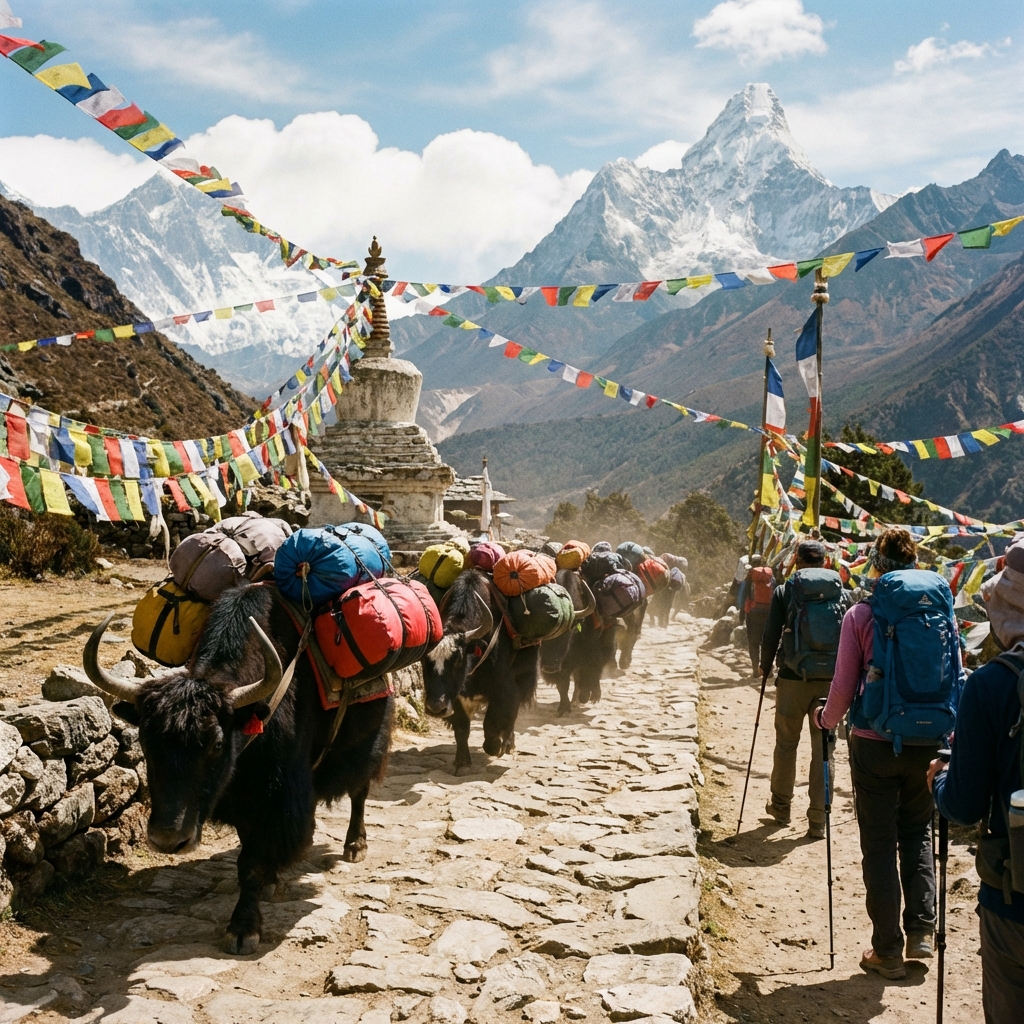
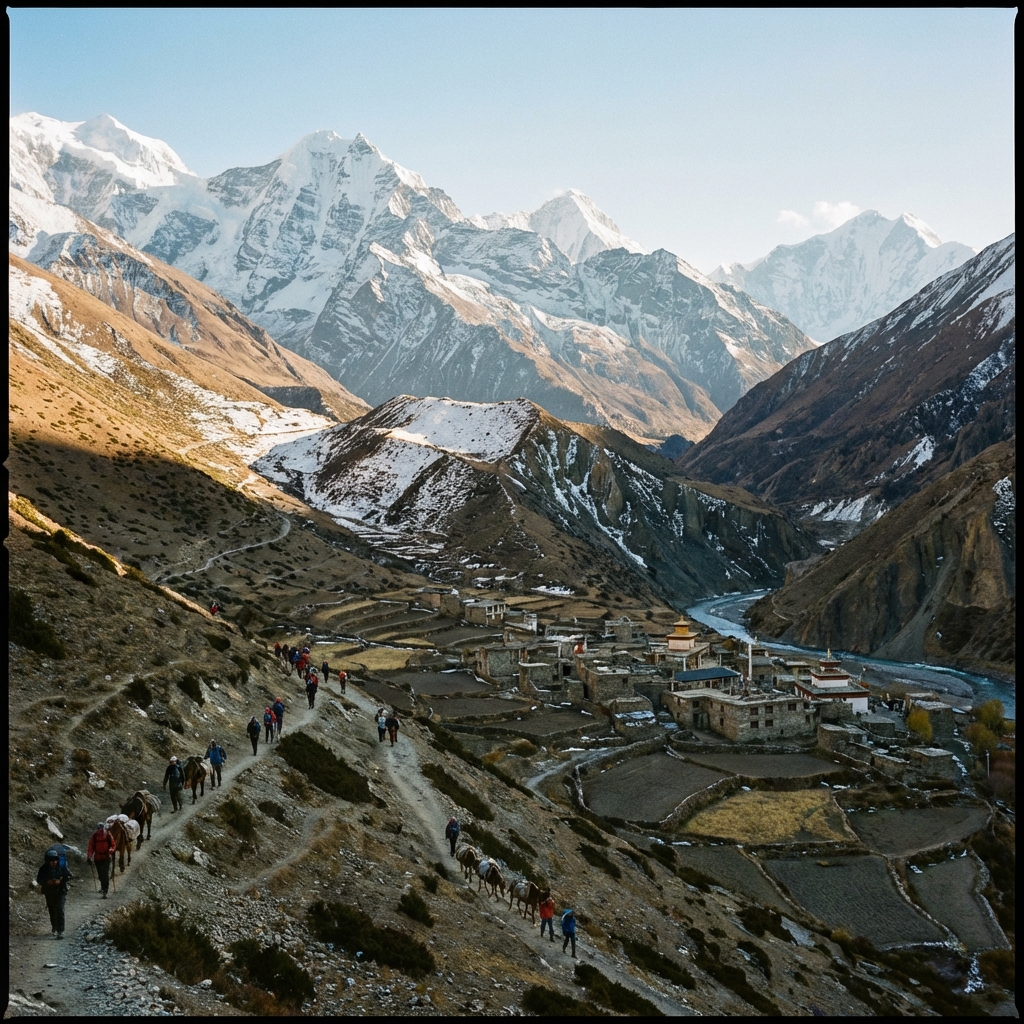
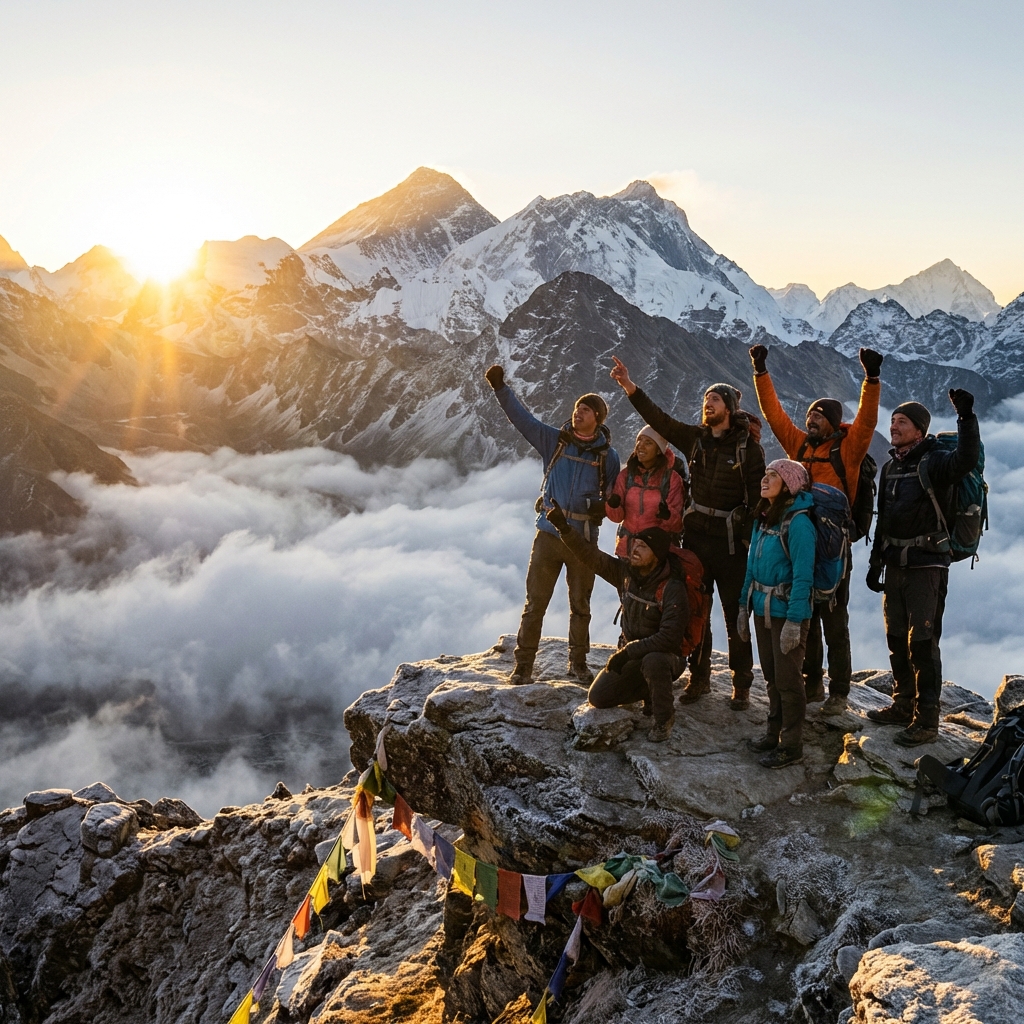
Stand on Panchase Hill at sunrise on a clear October morning and the view hits you like a wall: directly north, the full Annapurna massif from Dhaulagiri to Manaslu — eight-thousanders lined up like a geological atlas — and far below to the south, Phewa Lake catches the dawn light like a mirror dropped into the Pokhara valley. Between those two extremes, 2,517 metres of hard-won altitude feels entirely worthwhile.
Panchase is the Pokhara region's least-promoted viewpoint trek, and that underpromotion is its defining virtue. While Poon Hill draws several hundred trekkers per day at peak season, Panchase offers a quieter encounter with essentially identical mountain sight lines — supplemented by some of the finest rhododendron forest in western Nepal, Phewa Lake views that Poon Hill simply cannot offer, and the satisfaction of reaching a summit that fewer people have photographed.
No permits. A 3-4 day loop that starts and ends near Pokhara. Complete beginners welcome. And a sunrise from a 360-degree hilltop viewpoint that you will spend the next six months trying to adequately describe to people back home.
What is the Panchase trek? The Panchase trek is an easy 3-4 day loop near Pokhara that climbs to Panchase Hill (2,517m / 8,258 ft) for 360-degree sunrise views of the Annapurna massif and Phewa Lake. It needs no permits, suits complete beginners, and runs through one of western Nepal's finest rhododendron forests — a quieter, cheaper alternative to Poon Hill.
Why Panchase Over Poon Hill
This is a question worth answering directly, because Poon Hill has such outsized name recognition that many trekkers never seriously consider Panchase as an alternative.
The views are comparable. Panchase (2,517m) and Poon Hill (3,210m) both offer panoramic Annapurna views. Poon Hill sits closer to the mountains and therefore sees them at a slightly more imposing scale. Panchase, positioned south-west of Pokhara, adds something Poon Hill cannot match: a direct view over Phewa Lake with Pokhara city visible as a small smudge beyond the lake's southern shore. This lake-mountain layering is uniquely photogenic.
The rhododendron forest is superior. The trail to Panchase passes through a community-managed forest that is considered one of the finest rhododendron stands in the entire Annapurna region. During the March-April bloom, the hillsides turn crimson, pink, and white in a display that overwhelms even experienced trekkers. Poon Hill has rhododendrons too, but the Panchase forest trail, particularly between Naudanda and Bhadaure Tamagi, is extraordinary.
Significantly fewer trekkers. In peak season, Poon Hill summit at sunrise looks like a small city. Panchase at sunrise in peak season has tens of trekkers, not hundreds. This is not a minor quality-of-life improvement — it fundamentally changes the experience of standing on a viewpoint at dawn.
No permits. The Panchase route does not pass through the Annapurna Conservation Area and requires no permits whatsoever. You save NPR 5,000 ($38) compared to the Poon Hill route (ACAP + TIMS), and you can genuinely decide to start tomorrow.
Lower maximum altitude. At 2,517m, Panchase is 693m lower than Poon Hill. This is meaningless to experienced trekkers but matters to altitude-sensitive individuals, families with young children, and older trekkers for whom altitude sickness is a genuine concern.
3-4 days (2-day express possible)
2,517m (8,258 ft) at Panchase Hill
Approx. 30-40 km loop
Easy — no prior trekking experience required
Oct-Nov (Autumn), Mar-May (Spring rhododendrons)
Kande or Naudanda (30 min from Pokhara)
None
Teahouse and basic guesthouse throughout
$25-40/day for accommodation and meals
$80-$180 excluding Pokhara transport
360-degree panorama — Dhaulagiri to Manaslu + Phewa Lake
March-April (peak bloom)
Good — 150+ species in community forest
Day-by-Day Itinerary
The Panchase trek is a loop beginning and ending near the Pokhara-Baglung highway west of the city. The two main trailheads are Kande (on the highway, accessible by taxi or bus from Pokhara in 30 minutes) and Naudanda (further west, 45-60 minutes from Pokhara). Most trekkers start at Kande and descend to Phewa Lake and Pokhara via Bhadaure Tamagi, completing the loop.
| Day | Route | Distance | Walking Time | Altitude |
|---|---|---|---|---|
| 1 | Kande → Panchase Bhanjyang | 10-12 km | 4-5 hours | 1,770m → 2,400m |
| 2 | Panchase Bhanjyang → Panchase Hill → Bhadaure Tamagi | 12-14 km | 5-6 hours | 2,400m → 2,517m → 1,450m |
| 3 | Bhadaure Tamagi → Phewa Lake → Pokhara | 8-10 km | 3-4 hours + boat | 1,450m → 820m |
Alternatively (4-day itinerary for a more relaxed pace):
| Day | Route | Walking Time | Altitude |
|---|---|---|---|
| 1 | Kande → Australian Camp area | 3-4 hours | 1,770m → 2,060m |
| 2 | Australian Camp → Panchase Bhanjyang | 3-4 hours | 2,060m → 2,400m |
| 3 | Sunrise on Panchase Hill → descent to Bhadaure Tamagi | 5-6 hours | 2,400m → 2,517m → 1,450m |
| 4 | Bhadaure Tamagi → Phewa Lake → Pokhara | 3-4 hours | 1,450m → 820m |
Day 1: Kande to Panchase Bhanjyang (4-5 hours)
The trek begins at Kande on the Pokhara-Baglung highway — a busy junction accessible by bus from Pokhara's Baglung bus park (NPR 50-70, 30-40 minutes) or by taxi (NPR 400-600). The trailhead is clearly marked, and the first section passes through Australian Camp — a popular Pokhara-area day-trekking destination at 2,060m, named for Australian aid workers who once camped here.
Above Australian Camp, the trail enters the community forest in earnest. The forest canopy closes overhead, the highway noise fades, and the temperature drops noticeably. The trail ascends steadily through rhododendron, oak, and magnolia forest to Panchase Bhanjyang (the pass, at approximately 2,400m). A small teahouse cluster at the pass offers accommodation and simple food.
On clear days, the first full Annapurna views open from the pass — Machapuchare's distinctive double summit typically appears first, followed by the broader Annapurna chain as you continue ascending.
Australian Camp as Day 1 Overnight
For trekkers who prefer shorter walking days, Australian Camp (2,060m) makes an excellent Day 1 overnight stop — it's 2-3 hours from Kande, has several good teahouses, and offers a terrace view of Machapuchare and the Annapurna range that is genuinely spectacular at sunset. The 4-day itinerary above uses Australian Camp as the first night's stop and adds a more relaxed pace to the entire circuit.
Day 2: Panchase Bhanjyang to Panchase Hill summit → Bhadaure Tamagi (5-6 hours)
This is the centrepiece day. The alarm goes at 5:00 AM for the 45-60 minute walk to the Panchase Hill summit (2,517m) in pre-dawn darkness. The summit is marked by a small wooden structure and prayer flags. As the eastern horizon lightens, the Himalayan chain emerges from darkness peak by peak — first Machapuchare, then Annapurna South, then the massif broadens north and west to Annapurna I, Annapurna II, Lamjung Himal, Manaslu, and finally the massive bulk of Dhaulagiri to the northwest.
Turn south on the summit and the view is equally remarkable: Phewa Lake below, Pokhara city beyond, and on exceptionally clear mornings, the Terai plains extending towards India in the far south.
After spending 45-60 minutes on the summit (longer if you're a photographer), descend back to Panchase Bhanjyang for breakfast before continuing down the far side through the rhododendron forest to Bhadaure Tamagi. This descent takes 3-4 hours and is the most forested section of the entire trek — in March-April, the rhododendron bloom here is extraordinary.
Day 3: Bhadaure Tamagi to Pokhara via Phewa Lake (3-4 hours + boat)
The final day descends through agricultural terraces and Magar village settlements to the northern shore of Phewa Lake. At the lakeside village of Pame Danda, you board a boat across Phewa Lake to Pokhara's lakeside (NPR 100-200 per person, or hire a private boat for NPR 400-600). This boat journey across the lake — with the Annapurna range reflected in the water and the Tal Barahi temple island in the middle distance — is an unexpectedly lovely conclusion to the trek.
Alternatively, if the water is rough or you prefer to walk, a trail follows the northern lakeshore back to Pokhara. Either way, you're back in Pokhara for a late lunch.
Difficulty Assessment
Panchase is rated Easy and the rating is accurate. The key facts that make this assessment reliable:
Why it's genuinely easy:
- Maximum altitude of 2,517m — below the threshold where altitude sickness becomes a routine concern
- Daily walking of 4-6 hours on well-maintained trails
- No technical terrain, river crossings, or exposed ridges
- The steepest section (summit push on Day 2) takes 45-60 minutes — manageable even for relative beginners
- Teahouses at all major stops
- Mobile phone coverage throughout most of the route
Physical demands to prepare for:
- Day 1 involves 630m of elevation gain — roughly equivalent to climbing a significant urban hill in continuous ascent
- Day 2 starts with a pre-dawn 45-minute climb to the summit — in cold temperatures with a headlamp, this is more demanding than it sounds
- Day 2 descent to Bhadaure Tamagi covers significant elevation loss and can be knee-fatiguing on steeper sections
Who is this trek ideal for:
- Complete first-timers wanting a genuine mountain experience
- Families with children aged 6 and above
- Trekkers aged 60+ with walking fitness
- Anyone with only 3-4 days in Pokhara who wants more than a lakeside day trip
- Birdwatchers and botanists (especially spring)
- Photographers seeking the Phewa Lake–Annapurna composition
Who might consider alternatives:
- Trekkers seeking higher altitude or technical challenge — see Mardi Himal or Annapurna Base Camp
- Those wanting more cultural immersion — Ghale Gaun or Sikles offer more village engagement
Pre-Dawn Summit Preparation
The summit walk on Day 2 happens in complete darkness at temperatures that can drop to 2-5°C in autumn and below zero in winter. Wear all your layers before leaving Panchase Bhanjyang, pack your headlamp in an accessible pocket, and carry a thermos of hot tea. The 45-minute climb is not technically difficult, but underestimating the cold is the most common beginner mistake on Panchase.
How to Get There
Getting to the Panchase trailhead:
Kande is the standard trailhead — on the Pokhara-Baglung highway, 17km from Pokhara lakeside.
| Option | Duration | Cost | Notes |
|---|---|---|---|
| Local bus (Baglung bus park → Kande) | 30-40 min | NPR 50-70 | Departs from Pokhara Baglung bus park every 30-60 min |
| Taxi Pokhara lakeside → Kande | 25-35 min | NPR 400-600 | Most convenient for early departures |
| Private jeep (arranged by agency) | 30 min | NPR 1,500-2,000 | Included in agency packages |
Returning from Phewa Lake:
The trek ends on the northern lakeshore of Phewa Lake, from where a 20-minute boat ride (NPR 100-200) crosses to Pokhara lakeside (Baidam area). Alternatively, a 45-60 minute walk along the lakeshore trail returns to Pokhara. Most trekkers take the boat — the crossing is scenic and a fitting end to the circuit.
Getting to Pokhara from Kathmandu: Tourist buses run Kathmandu-Pokhara in 6-7 hours (NPR 600-1,000, book at Thamel bus agents). Private cars take 5-6 hours (NPR 5,000-8,000). Domestic flights take 25 minutes ($90-130 one way). Pokhara has its own international airport (Pokhara International Airport opened in 2023) with limited direct connections from select Asian cities.
Route Options and Navigation
Panchase is not a single fixed trail — several start and finish points work, and the choice affects distance, ascent, and how much road walking you do. Most agencies and independent trekkers use one of these:
| Route Option | Distance | Profile | Notes |
|---|---|---|---|
| Kande → Panchase → Bhadaure Tamagi → Phewa Lake (our loop) | ~30-40 km | More descent than ascent | Scenic boat finish; recommended |
| Pokhara Lakeside → World Peace Pagoda → Panchase → Kande | ~44 km | Most ascent (approx. 2,760m gain) | Walk out of your hotel; longest version |
| Kande → Panchase → Kande (out-and-back) | ~30 km | Equal up and down | Simplest, but repeats ~10 km of dirt road |
| Kande → Panchase → Ghatichhina (bus out) | ~26 km | Shortest one-way | Useful escape route in bad weather |
The Trail Is Poorly Marked — Carry Offline Maps
Unlike Poon Hill, the Panchase route has limited signage and several unmarked forks, especially the forested section between Panchase Bhanjyang and Bhadaure Tamagi. Download an offline map (Maps.me or a recommended offline navigation app) before you start, and keep your phone charged — teahouses have power outlets, but coverage and trail markers are unreliable in the dense forest. First-time trekkers who are not confident navigating off marked trails should consider hiring a local guide, who also adds value by reading the forest, wildlife, and weather.
The Panchase Sunrise: What to Expect
The sunrise from Panchase Hill is the trek's main event — plan everything else around maximising your chances of witnessing it clearly.
The panorama in detail:
| Direction | View | Key Features |
|---|---|---|
| North-Northwest | Dhaulagiri I (8,167m) | World's 7th highest; massive, isolated white pyramid |
| North | Annapurna I (8,091m) | World's 10th highest; the centrepiece of the massif |
| Northeast | Annapurna II (7,937m), Annapurna IV (7,525m) | Dramatic angular summits |
| East | Machapuchare (6,993m) | Nepal's sacred "Fishtail" — the most distinctive shape on the horizon |
| East | Lamjung Himal (6,983m), Manaslu (8,163m) | Eastern extent of the panorama |
| South | Phewa Lake, Pokhara valley | Lake reflection views, city in background |
| Southwest | Pokhara city and airport | Distinctive contrast — civilization beneath the giants |
Timing the sunrise:
| Month | Sunrise Time | Leave Panchase Bhanjyang by |
|---|---|---|
| October | 6:00-6:10 AM | 5:00-5:15 AM |
| November | 6:10-6:25 AM | 5:10-5:25 AM |
| December | 6:25-6:45 AM | 5:25-5:45 AM |
| January | 6:45-7:00 AM | 5:45-6:00 AM |
| February | 6:20-6:45 AM | 5:20-5:45 AM |
| March | 5:55-6:15 AM | 4:55-5:15 AM |
| April | 5:30-5:50 AM | 4:30-4:50 AM |
| May | 5:15-5:30 AM | 4:15-4:30 AM |
Cloud and Clear Sky
Mountain weather follows a seasonal and daily rhythm in Nepal. Generally: the clearest skies are October-November (post-monsoon) and December-January (winter). Spring (March-May) brings some haze from dust and pre-monsoon instability, but mornings are usually clear before 10 AM. Afternoons at any season can cloud over. The summit walk from Panchase Bhanjyang reaches the top before the cloud rises — so an early start is critical regardless of the season.
Accommodation and Food
Panchase has a compact but functional teahouse infrastructure at three main stop points: Australian Camp (if doing the 4-day route), Panchase Bhanjyang, and Bhadaure Tamagi.
Australian Camp (2,060m): Three to four teahouses, the best-developed stop on the route. Popular with Pokhara day-trekkers, so rooms at weekends fill quickly. Rooms with single or twin beds; shared bathrooms; hot shower available (NPR 150-250). Good food menu including reliable dal bhat, pasta, and breakfast items.
Panchase Bhanjyang (2,400m): Two to three simple teahouses at the pass. More basic than Australian Camp — squat toilets, cold water bucket wash, single-skin accommodation that gets cold on winter nights. Bring a sleeping bag liner in December-February. Food is simple: dal bhat, noodles, eggs, and tea. Limited but sufficient.
Bhadaure Tamagi (1,450m): Small Magar community with a few homestay options. Warm evenings after the ridge; food is home-cooked and good. The family-run feel here is more intimate than the Australian Camp teahouses.
Food across the route:
| Meal | Recommended Choices | Cost Range (NPR) |
|---|---|---|
| Breakfast | Porridge, eggs, Tibetan bread, sel roti | 200-350 |
| Lunch | Dal bhat, fried rice, noodle soup | 300-450 |
| Dinner | Dal bhat (always the best option) | 300-450 |
| Beverages | Milk tea, ginger lemon honey, hot chocolate | 80-200 |
Cost Breakdown
Panchase's no-permit requirement makes it the most cost-effective of the Pokhara-area viewpoint treks.
| Item | Cost (NPR) | Cost (USD approx.) |
|---|---|---|
| Permits | 0 | $0 |
| Accommodation (3 nights at NPR 400-800/night) | 1,200-2,400 | $9-18 |
| Meals (3 days at NPR 900-1,200/day) | 2,700-3,600 | $21-28 |
| Transport to Kande (taxi) | 400-600 | $3-5 |
| Boat across Phewa Lake (return) | 100-200 | $1-2 |
| Guide (optional, 3 days at NPR 2,500-3,000/day) | 7,500-9,000 | $58-69 |
| Porter (optional, 3 days at NPR 1,500-2,000/day) | 4,500-6,000 | $35-46 |
| Snacks and hot drinks | 500-1,000 | $4-8 |
Estimated totals for a 3-4 day trek:
| Budget Style | Estimated Total |
|---|---|
| Solo, no guide, local bus to trailhead | $40-65 |
| With guide, taxi transport | $130-200 |
| With guide and porter | $180-270 |
Permit comparison with Poon Hill:
| Item | Panchase | Poon Hill |
|---|---|---|
| ACAP Permit | $0 | $23 |
| TIMS Card | $0 | $15 |
| Total permit saving | — | $38 saved by choosing Panchase |
Best Time to Trek
| Month | Temperature | Rhododendrons | Mountain Views | Trail Conditions | Verdict |
|---|---|---|---|---|---|
| October | 15-25°C | No | Excellent | Perfect | Outstanding — best overall |
| November | 10-20°C | No | Excellent | Perfect | Excellent |
| December | 5-15°C | No | Very good | Dry | Good — cold nights |
| January | 2-12°C | No | Good | Dry | Quiet and cold but feasible |
| February | 8-18°C | Early buds | Good | Dry | Good — spring approaching |
| March | 12-22°C | Beginning | Good | Good | Excellent for wildflowers |
| April | 15-25°C | Peak bloom | Good (hazy) | Good | Best for rhododendrons |
| May | 18-28°C | Fading | Hazy | Good | Warm, go early |
| June | Monsoon | — | Poor | Wet and slippery | Not recommended |
| July-August | Monsoon | — | Obscured | Wet | Not recommended |
| September | 18-26°C | — | Improving | Damp | Late September good |
For rhododendrons: March-April, with peak bloom typically in late March to mid-April at altitude. The community forest section between Australian Camp and Panchase Bhanjyang is the finest section for this.
For mountain views: October and early November for the absolute clearest conditions following the monsoon's departure.
For complete solitude: January or early February — you will have the summit and teahouses largely to yourself.
Avoid Monsoon: Leeches and Overgrown Trail
The single biggest reason to avoid June through September on Panchase is leeches. The dense, humid forest that makes this trek special becomes leech territory in the monsoon — trekkers regularly report turning back in late September because of them. The trail also overgrows, views vanish behind cloud, and the unmarked forks become harder to follow. If you can only travel in summer, see our monsoon trekking in Nepal guide for rain-shadow alternatives. Late September can clear up, but early October onward is far safer.
The Rhododendron Forest: Panchase's Secret Weapon
The community-managed rhododendron forest between Australian Camp and Panchase Bhanjyang is one of the finest stands of flowering rhododendron in the Annapurna region — and it receives a fraction of the attention of rhododendron destinations like the Ghorepani forests on the Poon Hill route.
Nepal has 30 documented rhododendron species and forests; the Panchase forest contains at least 15-18 of them, ranging from the classic Rhododendron arboreum (the national flower, red) to the pale pink R. barbatum, white R. griffithianum, and the smaller R. lepidotum and R. anthopogon at the highest elevations.
Bloom timing by altitude:
- 1,500-2,000m: Early March
- 2,000-2,400m: Mid to late March
- 2,400-2,517m (summit zone): Late March to mid-April
During peak bloom, the trail through the forest is genuinely breathtaking — not a cliché but a factual description of what happens when you walk through a tunnel of scarlet and pink against a backdrop of snow peaks. The combination of rhododendron foreground and Himalayan background makes this one of the finest photography opportunities in the Pokhara region.
Spring Photography on Panchase
For the iconic Annapurna-rhododendron composition, you need the flowers in bloom and the mountains clear — which means early morning in late March or early April. The light at this time is warm, the flowers are fresh (not faded by May sun), and mountain clarity is still good before the pre-monsoon haze builds. Set up at dawn on the forest trail rather than the summit for the best shots — the summit itself is open ground; the forest trail below Panchase Bhanjyang offers the foreground.
Packing Essentials
Panchase's low altitude and short duration make it the most lightly-packable multi-day trek in the Pokhara region.
Essential clothing:
- Trekking trousers (1-2 pairs)
- Moisture-wicking T-shirts (2-3)
- Mid-layer fleece or down jacket (for summit morning — essential)
- Waterproof jacket (afternoon rain is possible year-round)
- Light gloves and hat (for pre-dawn summit walk, even in October)
- Comfortable walking shoes or light hiking boots
Essential gear:
- Daypack 20-25L
- Headlamp with fresh batteries (pre-dawn summit walk)
- Trekking poles (helpful for Day 2 descent)
- Reusable water bottle and purification method
- Sunscreen and sunglasses
- Basic first aid (blister plasters, ibuprofen, bandage)
- Sleeping bag liner (useful October-March; essential December-February)
What to skip:
- Heavy mountaineering boots (unnecessary at this altitude)
- Sleeping bag (teahouses provide blankets — liner is sufficient)
- Altitude sickness medication (2,517m maximum is well below risk threshold for most people)
For a full gear list applicable to Pokhara-region short treks, see our beginner trekking packing guide.
Practical Tips and Recommendations
Start as early as possible on Day 2. The Panchase summit walk is the trek's core experience, and it requires a 5:00-5:30 AM departure from Panchase Bhanjyang. Prepare your clothes and headlamp before going to bed on Day 1 so you're not searching for gear in the dark at 4:45 AM.
Combine with Pokhara's other easy treks. Panchase pairs naturally with the Royal Trek for a 6-7 day Pokhara circuit covering two different ridge systems — west (Panchase) and east (Royal Trek). Neither requires permits, both offer Annapurna panoramas from different angles, and together they represent the best accessible trekking the Pokhara region offers.
Take the boat finale. The Phewa Lake boat crossing at the end of Day 3 is one of the most satisfying trekking conclusions in Nepal — arriving at the lakeside by boat with the Annapurna range behind you. Don't skip it by walking the road. See our Phewa Lake boating guide and the Pokhara lakeside area guide for what to do once you're back.
Visit the Community Forest Management Office. Panchase's forest is managed by a community user group that has done exceptional work protecting the rhododendron stands from logging and overgrazing. The office near Australian Camp can provide information about the forest's ecology and ongoing conservation work. A small voluntary donation to the fund supports the maintenance of the trail you're walking on.
Go in spring if you have a choice. October is Nepal's trekking peak season for good reason — exceptional clarity. But March-April on Panchase offers something October cannot: the rhododendron forest at full bloom, combined with morning mountain views that are still excellent before the pre-monsoon haze builds. If your schedule allows, spring is the most complete Panchase experience.
Combining Panchase with Paragliding
Pokhara is one of the world's premier paragliding destinations, and several operators launch from sites near the Panchase trailhead. If you are returning via the Pokhara-Baglung highway after the trek, some trekkers arrange a paragliding flight from the Sarangkot/Naudanda ridge before descending to Pokhara — a genuinely spectacular way to see the mountains you just trekked through from a different angle. Book in advance through Pokhara-based operators — see our paragliding in Pokhara guide (NPR 7,000-8,000, approximately 30 minutes in the air).
Frequently Asked Questions
How difficult is the Panchase trek?
The Panchase trek is rated Easy and suitable for complete beginners, families with children, and older trekkers. Daily walking is 3-5 hours on forest trails with moderate elevation gain. The maximum altitude of 2,517m means altitude sickness is not a concern.
Do I need permits for the Panchase trek?
No. The Panchase route does not pass through any conservation area and requires no permits whatsoever. This makes it one of the few multi-day treks in Nepal you can start with zero paperwork.
What is the best time for the Panchase trek?
March and April offer the spectacular rhododendron bloom combined with good mountain views. October and November provide the clearest skies. The trek is feasible year-round except during heavy monsoon rains (July-August).
How do I get to the Panchase trailhead?
The standard trailhead is Kande on the Pokhara-Baglung highway (30-40 min by local bus for NPR 50-70, or 25-35 min by taxi for NPR 400-600). Naudanda and Bhadaure Tamagi also work as start points. The return typically ends near Phewa Lake with an optional 20-minute boat crossing back to Pokhara lakeside.
How much does the Panchase trek cost?
Because no permits are needed, Panchase is the cheapest multi-day trek near Pokhara. Independent trekkers can do it for $40-65 total over 3-4 days (local transport, teahouse food and lodging). With a guide and taxi transport, budget $130-200; with a guide and porter, $180-270. Organised agency packages start around $300 per person.
Do I need a guide for the Panchase trek?
A guide is not legally required — there is no permit and no restricted-area rule. However, the trail is poorly marked with several unmarked forest forks, so a guide is genuinely useful if you are not comfortable navigating with an offline map. Many trekkers do it independently using Maps.me; first-timers and solo travellers often prefer the security of a local guide. If you want to book with a verified local guide, choose one who knows the Panchase forest route specifically.
Is Panchase better than Poon Hill?
Both offer outstanding Annapurna panoramas. Panchase adds Phewa Lake views that Poon Hill cannot match, has dramatically fewer trekkers, requires no permits, and reaches a lower altitude (2,517m vs 3,210m). Poon Hill sits closer to the mountains for slightly more imposing scale. For a quieter, more affordable experience, Panchase wins.
The Route
Interactive Route Map
Explore the trek on a topographic map. Tap a waypoint for elevation, accommodation, and day-by-day detail. Scroll to zoom.
Loading interactive map…


