



Most guides to the Mardi Himal trek focus on the full 7-day route to the Upper Viewpoint at 4,500m. But there is a shorter, more accessible version that delivers exceptional mountain views in just 3-5 days -- and it is one of Nepal's most underrated short treks.
The Mardi Himal Viewpoint trek stops at High Camp (3,580m), the elevated ridgeline hub of the Mardi Himal route, rather than continuing to the Upper Viewpoint (4,500m). At 3,580m, High Camp offers 180-degree panoramic views of Machhapuchhre, Annapurna South, the full Annapurna range, and the Modi Khola valley below -- views that genuinely rival Poon Hill (3,210m) and come with a fraction of the crowds.
This short version is ideal for trekkers with limited time, beginners building confidence at altitude, or anyone who wants a challenging but achievable mountain experience without committing to a 7-day trek. The route passes through some of the most beautiful forest in the Annapurna region -- rhododendron trees that become a tunnel of bloom in spring, ancient oak with moss-draped branches in autumn -- and arrives at a ridgeline viewpoint that most Nepal visitors have never seen.
This guide covers the 3-day minimum and the more comfortable 4-5 day version, with detailed information on each camp along the route.
3-5 days (depending on starting point and pace)
3,580m (High Camp viewpoint)
35-45km round trip
Easy to Moderate
October-November, March-May
ACAP ($23) + TIMS ($15)
Very low (fraction of Poon Hill/ABC numbers)
Kande (1,770m) -- 1 hour from Pokhara
Beginners, short-trip trekkers, those acclimatizing for higher treks
Recommended (mandatory since April 2023 subject to current regulations)
Why the Short Mardi Himal Trek?
The Case for Stopping at High Camp
The conventional Mardi Himal narrative focuses on reaching the Upper Viewpoint at 4,500m. But High Camp at 3,580m is, in its own right, one of the finest mountain viewpoints in the Annapurna region -- and accessible in just 2 days of trekking from Kande.
What you see from High Camp (3,580m):
- Machhapuchhre (6,993m) -- the sacred Fishtail peak, 15-20km away across the ridge, its distinctive twin summit unmistakable
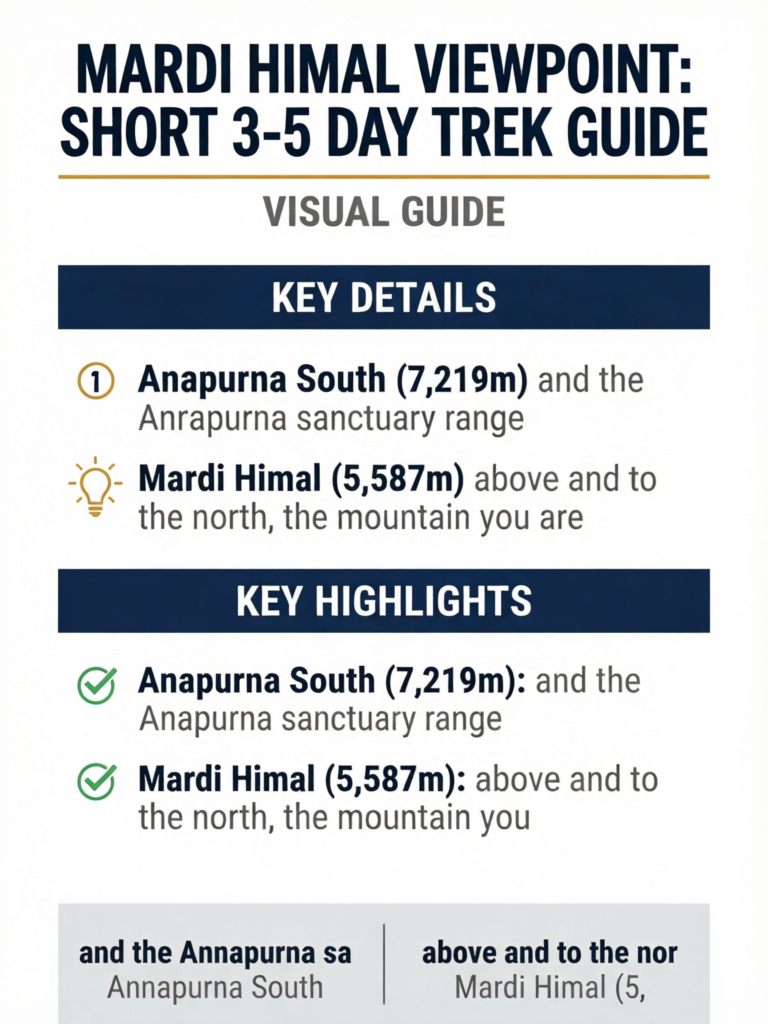
- Annapurna South (7,219m) and the Annapurna sanctuary range
- Annapurna I (8,091m), the world's tenth highest peak
- Mardi Himal (5,587m) above and to the north, the mountain you are trekking on
- The Modi Khola valley dropping 2,700m below -- one of the deepest valley-to-ridgeline drops viewable from any Annapurna trekking route
These are not consolation prizes for not reaching the top. They are genuinely extraordinary mountain views, and many experienced trekkers who have done both report that the panoramic quality of High Camp views rivals what the Upper Viewpoint offers.
How the Short Version Differs from the Full Trek
| Factor | Short (High Camp, 3-5 days) | Full (Upper Viewpoint, 7-9 days) |
|---|---|---|
| Maximum altitude | 3,580m | 4,500m |
| Duration | 3-5 days | 7-9 days |
| Difficulty | Easy to Moderate | Moderate |
| Machhapuchhre proximity | 15-20km | ~5km |
| Altitude sickness risk | Low-Moderate | Moderate |
| Best for | Beginners, limited time | Fit trekkers, full experience |
| Summit day required | No | Yes (Upper Viewpoint push) |
Perfect for First-Time Nepal Trekkers
The short Mardi Himal Viewpoint trek is one of the best introductory treks in Nepal. It reaches meaningful altitude (3,580m), passes through stunning forest, delivers excellent mountain views, and takes only 3-5 days. The difficulty is genuinely moderate -- unlike Poon Hill, which is rated easy but underestimates the Ulleri staircase, or EBC, which is long and demanding. If you are trekking in Nepal for the first time and have 3-5 days, Mardi Himal Viewpoint deserves serious consideration.
Getting to the Starting Point
Kande (1,770m): The Mardi Himal trail begins at Kande, a small village on the ridge road above Pokhara. All public and private transport from Pokhara reaches Kande in approximately 1 hour.
From Pokhara Lakeside:
- Taxi to Kande: NPR 1,000-1,500 ($8-12)
- Local bus (Kande Line): NPR 60-80 ($0.50-0.60), departs from Prithvi Chowk, irregular schedule
- Tourist van (arranged by agency): NPR 2,000-3,000 ($15-23)
The road to Kande is paved and the village is directly on the main ridge road. The trailhead is visible at the road's end -- a signboard indicates the Mardi Himal trail.
Permits: Obtain your ACAP and TIMS permits before departing Pokhara. The Tourism Board office in Damside or Lakeside is open daily (7:00 AM - 5:00 PM). You must have permits before reaching the first checkpoint, which is shortly after the trailhead at Kande.
The Route: Day by Day
3-Day Minimum Itinerary
| Day | Route | Altitude | Time | Notes |
|---|---|---|---|---|
| 1 | Kande → Low Camp → High Camp | 3,580m | 7-8 hours | Very long day, only for fit trekkers |
| 2 | High Camp viewpoint sunrise | 3,580m | Half day | Rest and views |
| 3 | High Camp → Forest Camp/Kande → Pokhara | 820m | 5-6 hours trek + drive |
This 3-day version compresses Kande to High Camp into a single very long day -- not recommended for beginners. The elevation gain (1,810m in a single day) is demanding, and the forest section provides no views to compensate for the effort. The 3-day trek is feasible only for fit, experienced trekkers who can manage sustained uphill walking.
4-Day Recommended Itinerary
| Day | Route | Sleep Altitude | Time | Highlights |
|---|---|---|---|---|
| 1 | Kande → Low Camp | 2,985m | 4-5 hours | Forest walk, first Machhapuchhre glimpse |
| 2 | Low Camp → High Camp | 3,580m | 4-5 hours | Ridge views open up, full panorama |
| 3 | High Camp sunrise and views, descent to Forest Camp | 2,600m | 4-5 hours | Best views, rhododendron descent |
| 4 | Forest Camp → Siding → Pokhara | 820m | 5-6 hours + drive | Alternate descent via Siding village |
The 4-day version is the minimum comfortable itinerary for most trekkers. It separates the Kande-to-High-Camp ascent into two manageable days and allows a full morning at High Camp for sunrise viewing before descending.
5-Day Relaxed Itinerary (Recommended for Beginners)
| Day | Route | Sleep Altitude | Time | Highlights |
|---|---|---|---|---|
| 1 | Kande → Low Camp | 2,985m | 4-5 hours | Gentle introduction, forest |
| 2 | Low Camp → High Camp | 3,580m | 4-5 hours | Ridge emerges, panoramic views |
| 3 | Rest day at High Camp / Sunrise viewpoint | 3,580m | Rest | Full day of mountain views, photography |
| 4 | High Camp → Forest Camp → Siding | 1,750m | 6-7 hours | Long descent via alternate route |
| 5 | Siding/Lwang → Pokhara | 820m | Drive | Jeep return to Pokhara |
The 5-day version is optimal for beginners, older trekkers, and anyone who wants to maximize their time at High Camp. The full rest day at 3,580m allows acclimatization, extends mountain view time, and removes the pressure of a rushed ascent-and-descent.
Camp-by-Camp Guide
Kande (1,770m) -- Starting Point
Kande is a small roadside village with basic facilities -- a few tea stalls, a small shop, and the trailhead sign. There is no reason to spend the night here unless your transport is delayed; the goal is to begin trekking immediately on arrival.
Trailhead logistics:
- Small parking area adjacent to the road
- Tea house at the trailhead for a pre-trek breakfast or tea
- Permit checkpoint immediately after the trailhead (have both ACAP and TIMS ready)
- Clear signage indicating the Mardi Himal trail direction
Low Camp (2,985m) -- Day 1 Destination
Distance from Kande: 8km | Time: 4-5 hours | Elevation Gain: +1,215m
The trail from Kande to Low Camp is entirely within forest -- oak transitioning to rhododendron as altitude increases. The path is clear and well-maintained but steep in sections. There are very few flat sections between Kande and Low Camp; the trail gains altitude consistently throughout.
The forest character: The lower section (Kande to approximately 2,200m) passes through Himalayan oak forest (Quercus leucotrichophora). The trees are large and ancient, their trunks wrapped in moss and lichen, the light filtering green through the canopy. In October-November, the oak leaves turn gold and red. In spring (March-April), the rhododendron trees above 2,200m bloom in spectacular red and pink clusters.
First views of Machhapuchhre: At approximately 2,700-2,800m, gaps in the rhododendron canopy begin revealing the first glimpses of Machhapuchhre's twin summits to the north. These glimpses are tantalizing -- a preview of the full view awaiting at High Camp.
Low Camp (2,985m): A clearing in the forest with 4-5 tea houses. This is the first overnight on the trail, and the facilities reflect the remote forest location: wooden dormitory-style bunk beds, squat toilets, and a limited menu (dal bhat, noodles, egg dishes, instant coffee). Solar panels charge phones during daylight hours.
What you see from Low Camp: Partial mountain views through the forest canopy. A short walk above the tea houses leads to a clearing with better Machhapuchhre views -- worth the 15-minute detour before dinner.
Tea house cost: NPR 300-500/night (bed only); NPR 1,500-2,000/day (meals included)
Spring at Low Camp
If trekking between mid-March and late April, Low Camp sits in the heart of the rhododendron bloom zone. The trees surrounding the camp are Nepal's national flower in full form -- not the small ornamental shrubs familiar from gardens, but full trees with trunks 30-40cm in diameter, covered in red and pink flowers. Waking at Low Camp surrounded by this bloom is one of the specific joys of the spring Mardi Himal trek.
Forest Camp (2,600m) -- The Alternate Intermediate Stop
Forest Camp is below Low Camp on the return route -- part of the circular descent via Siding rather than the ascent route via Kande. On the standard 4-5 day itinerary, you sleep here only on the descent (Day 3 or Day 4).
Character: Smaller than Low Camp (3-4 tea houses), sheltered in a forested valley, and quieter. The camp sits at the junction where the descent trail to Siding branches from the Kande ascent trail.
Note on naming confusion: The name "Forest Camp" is sometimes confusingly applied to both this lower camp (2,600m) and the area around Low Camp (2,985m), since both are in forest. The 2,600m Forest Camp is specifically the intermediate stop on the descent route to Siding village.
Tea house cost: NPR 300-400/night; NPR 1,200-1,800/day (meals)
High Camp (3,580m) -- The Viewpoint
Distance from Low Camp: 6km | Time: 4-5 hours | Elevation Gain: +595m
Day 2 begins with the trail leaving Low Camp and climbing through increasingly sparse rhododendron vegetation. The forest gradually opens, and by 3,000m the rhododendron is shoulder-height scrub rather than full trees. At approximately 3,200m, the ridgeline appears and the views open.
The moment the views appear: There is a specific point on the trail where you step out of the rhododendron scrub onto an exposed section of ridge, and the full Annapurna panorama opens up for the first time. This is one of Nepal trekking's great small revelations -- a view that arrives suddenly after two days of forest walking and rewards the climb immediately.
Ascending to High Camp: The trail from the first open ridge sections to High Camp climbs along the ridge crest, alternately exposed and sheltered, with views expanding on both sides. The western drops into the Modi Khola valley become visible, while the eastern face opens toward the Seti River watershed.
High Camp (3,580m):
Six to eight tea houses sit on the exposed Mardi Himal ridgeline at 3,580m. This is the highest sleep altitude on the viewpoint trek and the place that delivers the definitive Mardi Himal experience.
The panorama from High Camp:
Standing on the ridge at High Camp, the view encompasses:
- Machhapuchhre (6,993m) -- the sacred Fishtail Peak directly to the north, approximately 15-20km away. Both summits of the distinctive twin peak are clearly visible, as is the dramatic south face dropping from the summit toward the lower ridges. The sacred mountain has never been climbed (all attempts were stopped when it was declared a holy mountain in 1957) and the absence of any human infrastructure on its face preserves its pristine character.
- Annapurna South (7,219m) -- to the west-northwest, its massive southern wall of rock and ice rising from the Modi Khola valley
- Annapurna I (8,091m) -- the main Annapurna summit, visible to the northwest, its characteristic summit profile recognizable from many points in the region
- Annapurna III (7,555m) and Gangapurna (7,455m) extending the range
- Mardi Himal (5,587m) -- directly above and north-northeast; you are standing on the southern ridge of this mountain
- The Modi Khola valley -- a deep trench 2,700m below, with the tiny ribbon of the Modi Khola river visible on clear days
Tea house facilities at High Camp:
- 6-8 tea houses with wooden bunk beds (basic mattress, 2-3 blankets provided)
- Solar charging available at most tea houses (charging NPR 200-300/session)
- Cold water available; boiled water for drinking at NPR 100-200/bottle
- Basic hot shower (solar-heated) at some tea houses -- lukewarm to cold
- Squat toilets (clean, basic)
- Dining room with wood-burning stove (shared social space in evenings)
- Mobile phone signal (Ncell): intermittent; best near the ridge crest
Cost: NPR 400-600/night (bed only); NPR 2,000-2,500/day (meals included)
Pro Tip
On arrival at High Camp, immediately find the best viewpoint position before settling into your tea house. The specific viewpoint varies with cloud conditions -- sometimes the best Machhapuchhre angle is from the ridge crest above the tea houses; sometimes it is from the northern edge of the camp. Explore before the afternoon clouds close in. The first 30 minutes at High Camp often offer the clearest views of the day.
Sunrise at High Camp
Sunrise at High Camp is the viewpoint trek's defining experience. Set your alarm for 5:30 AM (earlier in winter when sunrise is later). Step outside with warm clothes before dawn and watch the sequence:
- Pre-dawn (5:00-5:30 AM): The sky over the Annapurna range begins lightening behind the peaks. Machhapuchhre is a dark silhouette against a deep blue sky.
- First light (5:30-6:00 AM): The highest summit of Machhapuchhre catches the first pink light -- the peak appears to glow from within before the valley below is lit.
- Sunrise sweep (6:00-6:30 AM): Light descends the mountain faces in sequence. Annapurna South lights up. Then Annapurna I. The valley below remains dark while the peaks are fully lit -- the classic Himalayan sunrise inversion.
- Full morning (6:30-7:30 AM): Golden light on all faces, the sharpest visibility of the day.
Winter Sunrise Timing
In December-January, sunrise at 3,580m can be as late as 7:00 AM, and the temperature before dawn is -15°C to -20°C on exposed ridge. Pre-dawn photography is significantly harder in winter than in October or April. Dress in all available warm layers for the sunrise wait and keep camera batteries in an inner pocket to preserve charge.
Short Trek vs Full Trek: What Do You Miss?
Trekkers who stop at High Camp rather than continuing to Upper Viewpoint (4,500m) miss the following:
Upper Viewpoint exclusives:
- Machhapuchhre at approximately 5km proximity versus 15-20km from High Camp
- The ability to see individual seracs and ice formations on Machhapuchhre's south face
- Being at the base of Mardi Himal peak itself
- The experience of 4,500m altitude (for those seeking high-altitude experience)
- Camping option at the highest point
What High Camp provides that matches or exceeds Upper Viewpoint:
- The sunrise panorama (equally spectacular from 3,580m vs 4,500m, with arguably better composition due to the valley below being visible)
- The ridge experience and forest-to-alpine ecosystem transition
- The Annapurna range panorama (similar quality from both viewpoints)
- The solitude (High Camp is less visited even than Upper Viewpoint on busy days)
For most trekkers doing a 3-5 day short trip, High Camp is the right destination. The Upper Viewpoint's primary advantage -- Machhapuchhre proximity -- requires the extra 920m of elevation gain and a full additional day. Worth it on a 7-day trek; not necessary on a 3-5 day introduction.
Comparing Mardi Himal Viewpoint with Poon Hill
Both are short Annapurna region viewpoint treks with excellent mountain panoramas. The comparison is instructive:
| Factor | Mardi Himal Viewpoint (3-5 days) | Poon Hill (3-4 days) |
|---|---|---|
| Maximum altitude | 3,580m (High Camp) | 3,210m (Poon Hill summit) |
| Duration | 3-5 days | 3-4 days |
| Crowds | Very low | High (Ghorepani is a major hub) |
| Forest character | Dense rhododendron ridge | Rhododendron valley |
| Sunrise experience | From your camp on the ridge | 45-min climb pre-dawn from Ghorepani |
| Mountain views | Machhapuchhre-dominated, panoramic | Classic full-range panorama including Dhaulagiri |
| Culture | Minimal (forest trail) | Gurung villages (Ghorepani, Ulleri) |
| Difficulty | Moderate | Easy-Moderate (staircase is hard) |
| Best for | Solitude, ridge experience | Classic sunrise, cultural villages |
Recommendation: If you want the most famous Nepal sunrise experience with cultural village context, choose Poon Hill. If you want a more adventurous, uncrowded ridge trek with excellent mountain views and you are comfortable with slightly more demanding terrain, choose Mardi Himal Viewpoint.
Pro Tip
Mardi Himal Viewpoint is an excellent "training" trek for trekkers planning a longer Himalayan journey in subsequent years. It provides meaningful altitude experience (3,580m), multi-day mountain trekking stamina, and high-quality mountain views -- all in 3-5 days. Several trekkers use it as a first Nepal trek, then return for EBC or ABC in later years with far better physical and psychological preparation.
Descent Routes from High Camp
Route 1: Return via Kande (Same Route -- Simplest)
Time: 4-5 hours | Distance: 14km down | End: Kande, then drive to Pokhara
The simplest descent reverses the ascent route through Low Camp back to Kande. This is the fastest way to return to Pokhara and the best option if you need to minimize time.
Advantage: Familiar trail, straightforward navigation, shortest time to transport. Disadvantage: You see the same forest twice without new scenery.
Route 2: Descent via Forest Camp and Siding (Recommended)
Time: 6-7 hours | Distance: 16-18km | End: Siding/Lwang, then drive to Pokhara
The more scenic descent takes a different trail from High Camp to Forest Camp (2,600m) and then continues through sub-tropical forest to Siding village (1,750m) and Lwang (1,650m), where jeeps and taxis return to Pokhara.
Advantage: A circular route that avoids repeating trail, passes through completely different (lower elevation, subtropical) forest ecosystem, and ends in a traditional Gurung farming village. Disadvantage: Longer day, more knee strain on the final descent, requires arranging transport from Lwang (your agency or guide can arrange this).
Siding to Pokhara transport: Local jeeps (NPR 1,000-1,500 per vehicle, shared) or private vehicles (NPR 4,000-6,000). The drive takes 1.5-2 hours on rough road.
Costs and Budget
Permit Costs
| Permit | Foreign Trekkers | SAARC Countries |
|---|---|---|
| ACAP | NPR 3,000 ($23) | NPR 200 ($1.50) |
| TIMS Card | NPR 2,000 ($15) | NPR 1,000 ($8) |
| Total | $38 | $9.50 |
Daily On-Trail Costs (4-Day Itinerary)
| Day | Accommodation | Meals | Miscellaneous | Approximate Total |
|---|---|---|---|---|
| 1 | Low Camp ($4-6) | $8-12 | Water, snacks $2-4 | $14-22 |
| 2 | High Camp ($5-8) | $10-15 | Charging $2, snacks $3 | $20-26 |
| 3 | Forest Camp ($4-6) | $8-12 | Water, snacks $2-3 | $14-21 |
| 4 | Transport ($8-15) | Meals in Pokhara $15-25 | -- | $23-40 |
Budget independent total (4 days): $70-109 on trail + $38 permits + $16-30 transport = $124-177
Guided trek total (4 days): Guide $25-35/day x 5 = $125-175; Porter optional $15-20/day x 5 = $75-100; Total including trail costs: $350-520
Agency package: NPR 35,000-55,000 ($265-420) per person for a 4-5 day guided package including transport, guide, porter, and lodging. Prices vary by group size.
Packing List for the Short Mardi Himal Trek
The viewpoint trek reaches 3,580m and the ridge is exposed to wind. Do not underpack for altitude.
Essential clothing:
- Thermal base layers (top and bottom)
- Fleece mid-layer
- Down jacket (for High Camp evenings -- temperature drops to -5°C or below)
- Windproof outer shell (critical at High Camp ridge)
- Warm hat and gloves
- 2-3 changes of trekking clothes
Footwear:
- Waterproof trekking boots with ankle support (mandatory -- the trail has rocky sections above Low Camp)
- Camp sandals or lightweight shoes for evenings
Gear:
- Trekking poles (strongly recommended for descent)
- Headlamp with spare batteries (for pre-dawn sunrise viewing)
- Sleeping bag liner (High Camp provides blankets, but a liner adds warmth)
- Sunscreen SPF 50+ and UV-blocking sunglasses (ridge exposure at altitude)
- Water bottle (2 liters minimum)
What you can leave behind:
- Technical climbing equipment (none needed)
- Heavy sleeping bag (a -5°C bag is sufficient with the liner, even in October)
- Multiple sets of clothing (porter carries bag; pack light)
For a comprehensive gear list, see our Nepal trekking packing list.
Do Not Underestimate Cold at High Camp
High Camp at 3,580m has overnight temperatures of -5°C to -15°C in October-November and December-February. Trekkers who arrive without adequate warm layers suffer genuinely cold nights that undermine the experience. At minimum: a down jacket, thermal base layers, a warm hat, gloves, and thick socks. The tea house blankets alone are insufficient for cold nights on the exposed ridge. A sleeping bag liner adds meaningful warmth and weighs very little.
Frequently Asked Questions
Is the short Mardi Himal Viewpoint trek good for beginners?
Yes. The short version stopping at High Camp (3,580m) is one of the best introductory treks in Nepal. The altitude is manageable, the trail is well-defined through forest, and the mountain views from High Camp are genuinely exceptional.
How does High Camp compare to the Upper Viewpoint?
High Camp (3,580m) offers 180-degree panoramic views of the Annapurna range from about 15-20km distance. The Upper Viewpoint (4,500m) brings you within 5km of Machhapuchhre. High Camp views are broader; Upper Viewpoint views are more intimate.
Can I do the short Mardi Himal trek in 3 days?
Yes, a fit trekker can reach High Camp from Kande in 2 days and descend on day 3. However, the 4-5 day version is more comfortable and allows time for acclimatization and better photography opportunities.
Do I need special gear for the short version?
Standard trekking gear is sufficient for the High Camp version. A warm fleece, rain jacket, and proper trekking boots are essential. You do not need the extreme cold-weather gear required for the full trek to 4,500m.
- Mardi Himal Full 7-Day Itinerary
- Best Beginner Treks in Nepal
- Mardi Himal Route Overview
- Annapurna Region Overview
- Best Time for Mardi Himal Trek
- Mardi Himal Cost Breakdown
- Best Trekking Agencies for Mardi Himal
- Nepal Trekking Packing List
- Nepal Trekking Permits Explained
- Altitude Sickness Signs and Turnaround Rules