Training for Mera Peak: Skills, Fitness & Technical Requirements
Training for Mera Peak (6,476m) means building two things in parallel: deep aerobic endurance for an 18-20 day expedition, and the basic glacier skills the PD-graded route demands -- crampon walking, ice-axe self-arrest, and roped travel. Most climbers need 4-6 months of structured fitness work plus one day of supervised mountaineering practice before departure.
Mera Peak carries a deceptive reputation. At 6,476 meters, Nepal's highest trekking peak is often described as "non-technical" -- a label that misleads more climbers than it helps. The term means Mera Peak does not require ice climbing, lead climbing, or rappelling on the standard route. What the label obscures is the genuine mountaineering competency the climb demands: glacier travel with crevasse awareness, cramponing on slopes up to 35-40 degrees, self-arrest capability, route-finding on a featureless glacier in potential whiteout conditions, and the physical endurance to sustain output at 6,000+ meters after a week of strenuous trekking.
Understanding exactly what Mera Peak requires -- technically, physically, and psychologically -- is the difference between an expedition built on accurate expectations and one built on wishful thinking. This guide provides a granular breakdown of every technical section on the route, the skills each demands, and an honest comparison with Island Peak (6,189m), Nepal's other flagship trekking peak, so you can assess where Mera Peak fits in your mountaineering progression.
6,476m (21,247 ft)
PD (Peu Difficile)
35-40 degrees (upper glacier)
Mera Glacier -- moderate crevasse hazard
Glacier travel, self-arrest, crampon technique
High in whiteout conditions
5,415m -- critical route junction
5,800m (19,029 ft)
~47% sea-level oxygen
676m from High Camp
Understanding the PD Grade: What It Means on Mera Peak
The International French Adjectival System (IFAS)
Mera Peak carries a PD (Peu Difficile, "slightly difficult") grade on the IFAS, the standard system used to grade alpine routes globally. Understanding this grade in context is essential:
| Grade | French | Meaning | Example |
|---|---|---|---|
| F | Facile | Easy -- basic glacier travel | Many valley glaciers |
| PD | Peu Difficile | Slightly difficult | Mera Peak (6,476m) |
| PD+ | -- | Upper PD | Island Peak (6,189m), Lobuche East lower sections |
| AD | Assez Difficile | Fairly difficult | Lobuche East upper sections |
| D | Difficile | Difficult | Ama Dablam normal route |
| TD | Très Difficile | Very difficult | Technical Himalayan routes |
Mera Peak's PD grade places it above beginner glacier walks but well below Island Peak's PD+ rating. In practical terms, the PD grade for Mera Peak means:
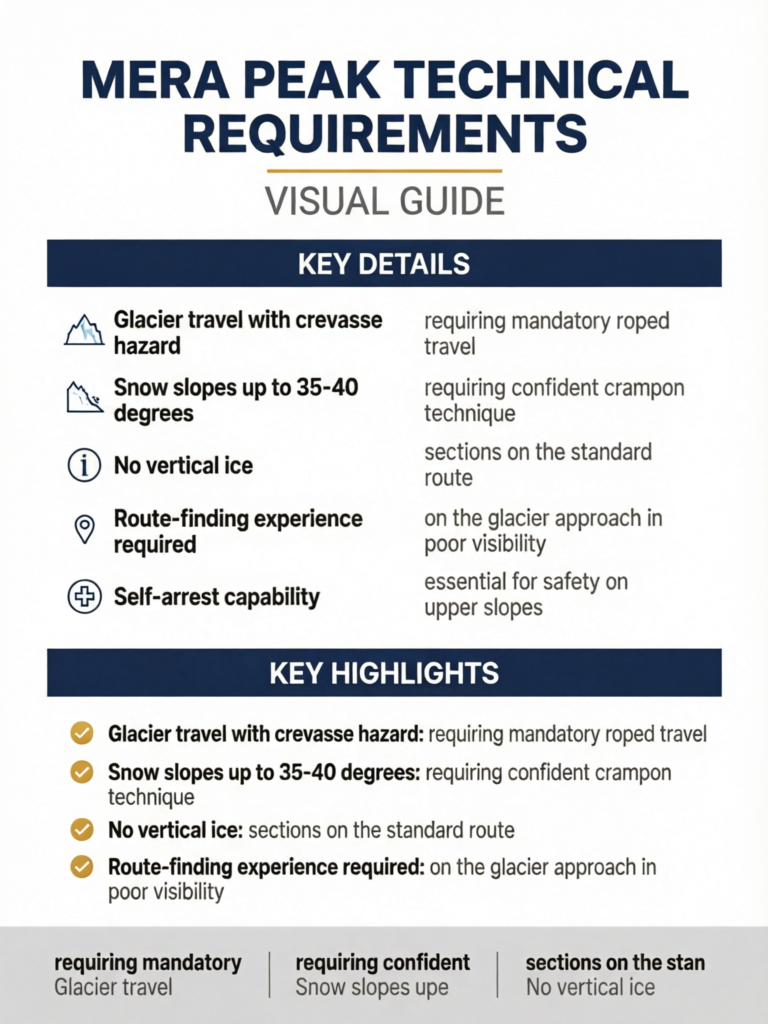
- Glacier travel with crevasse hazard requiring mandatory roped travel
- Snow slopes up to 35-40 degrees requiring confident crampon technique
- No vertical ice sections on the standard route
- No fixed ropes for the majority of the route (unlike Island Peak's headwall)
- Route-finding experience required on the glacier approach in poor visibility
- Self-arrest capability essential for safety on upper slopes
Why 'Non-Technical' Misleads
The term 'non-technical' in the context of Mera Peak means no rock climbing, no lead climbing, no ice pitches. It does NOT mean no skills required. A PD-graded glacier climb requires genuine mountaineering competency. Climbers who arrive expecting a snowshoe walk and encounter a crevassed glacier in poor visibility at 6,000m are not prepared for the mountain in front of them.
Why Mera Grades PD Despite Being Higher Than Island Peak
This is a question that confuses many aspiring climbers. Island Peak is 287 meters lower than Mera Peak but carries a PD+ grade. How can a lower mountain be more technically demanding?
The answer lies in route character, not altitude:
Island Peak's technical features that Mera lacks:
- A sustained 45-50 degree headwall (200-300m of steep ice and snow)
- Fixed ropes requiring jumar ascender technique
- An exposed summit ridge at knife-edge angle
- Rappelling or down-climbing on descent
- Rock sections mixed into the approach
Mera Peak's challenges in a different category:
- Greater absolute altitude (more severe hypoxia, longer duration at extreme altitude)
- Longer approach trek (greater accumulated fatigue before climbing begins)
- More extensive glacier travel (longer roped sections, more crevasse management)
- More demanding navigation (featureless terrain in poor visibility)
- Higher exposure to severe weather over a longer expedition duration
In climbing grading, technical difficulty refers to the mechanical demands of the moves themselves, not the suffering involved or the altitude at which those moves occur. Mera Peak demands less technical skill than Island Peak but more endurance, better glacier travel, and a stronger altitude response.
The Technical Sections: A Route-by-Route Analysis
Section 1: Zatrwa La Pass Crossing (4,610m)
Technical demands: Moderate trekking, no climbing equipment required. Duration: 2-3 hours of sustained uphill approach to the pass. Conditions: Often icy or snow-covered in autumn and spring, requiring careful footwork. Trekking poles are essential. In early spring or late autumn, thin crampons or Yaktrax may be useful on icy sections.
The Zatrwa La is not a technical climbing section, but it is a genuine challenge. At 4,610 meters, the steep approach to the pass serves as an altitude test and a physical primer for what follows. The descent into the Hinku Valley can be slippery on packed snow. Your fitness level, acclimatization status, and footwork comfort are all tested here before you reach the mountain.
Assessment: Trekking challenge, not climbing. No technical equipment required. High aerobic demand.
Section 2: Mera La Crossing (5,415m)
Technical demands: Basic glacier or snow travel, potential crampon use. Duration: 2-3 hours from Khare to the La. Conditions: The Mera La is a glaciated pass at 5,415 meters. Surface conditions vary by season and year -- sometimes firm snow that boots can bite into, sometimes icy sections requiring crampons, occasionally soft post-monsoon snow that is tiring but stable.
The crossing to the Mera La is where most climbers put on crampons for the first time in the expedition (if not during the Khare training day). The slope leading to the La gains altitude steadily at 25-30 degree angles. There are no fixed ropes -- you move under your own steam, roped to your guide.
What this section tests:
- Crampon fitting and basic walking technique
- Rope team protocol -- maintaining appropriate rope tension, responding to guide commands
- Pacing at altitude (many climbers go too fast and burn out before the high camp)
Assessment: First genuine mountaineering terrain. Crampons likely required. Slope angles to 30 degrees. Roped travel for glacier sections.
The Mera La Acclimatization Benefit
Your guide will likely take you to the Mera La during the Khare acclimatization day -- climbing to 5,415m and returning to sleep at 5,045m. This is one of the most effective acclimatization strategies on the route. The 370-meter altitude gain stimulates red blood cell production while you sleep lower and recover. If your guide offers an acclimatization hike to the La before your main crossing day, always accept.
Section 3: Mera Glacier Traverse to High Camp (5,415m to 5,800m)
Technical demands: Glacier travel, crevasse avoidance, sustained crampon work. Duration: 2-3 hours. Conditions: The Mera Glacier above the La is a broad, relatively moderate-angle glacier with crevasse zones that shift seasonally. Route-finding across the glacier requires experienced guide knowledge -- the safe passage around crevasses is not obvious from maps or photographs.
This is the first extended glacier travel section of the expedition and where most of the crevasse hazard exists. Snow bridges cover hidden crevasses; even the visible crevasses are difficult to assess for width and depth. Roped travel is mandatory and non-negotiable.
Technical elements:
- Reading glacier terrain (identifying crevasse zones, safe crossing points)
- Maintaining rope tension during team travel (crucial for crevasse fall arrest)
- Front-pointing on steeper transitional sections
- Self-arrest readiness: your ice axe is carried in self-arrest grip throughout
- Navigation: the glacier has few landmarks; in poor visibility it becomes extremely disorienting
Assessment: Core technical terrain of the expedition. Genuine crevasse hazard. Route-finding demanding. Equivalent to moderate European alpine glacier travel.
Crevasse Fall: The Primary Objective Hazard
The Mera Glacier contains crevasses, some visible and some hidden beneath snow bridges. Falling into a crevasse while unroped can be fatal. Even roped, extraction requires specific techniques and is physically demanding at altitude. Roped glacier travel is not a formality on Mera Peak -- it is the primary safety system against the mountain's most serious hazard. Never travel on the glacier unroped, even for short distances.
Section 4: High Camp to Summit (5,800m to 6,476m)
Technical demands: Sustained crampon work, moderate to steep snow slopes, altitude management. Duration: 4-6 hours ascent from High Camp. Conditions: The summit push traverses the upper Mera Glacier on slopes that increase from 25-30 degrees in the lower section to 35-40 degrees on the final approach to the summit plateau. The summit itself is a broad, flat area -- the technical difficulty is reaching it, not the summit moment itself.
Upper glacier demands:
- Front-pointing technique on 35-40 degree sections (cannot flat-foot at these angles)
- Ice axe in uphill hand at all times, self-arrest grip maintained
- Pacing at 6,000+ meters -- the hypoxic environment reduces every step to a deliberate act
- Cold management: temperatures -15°C to -25°C at dawn; wind chill can reach -35°C
- Route finding: high camp to summit requires compass bearing navigation if visibility drops
The summit plateau approach: The final section before the summit plateau narrows slightly and the angle increases. This is the most sustained steep section of the climb -- typically 30-45 minutes of front-pointing at the steepest angle of the entire route. There are no fixed ropes on the standard route here; you are on your guide's rope team, using your ice axe and crampons for upward progress and arrest security.
Assessment: Demanding sustained crampon terrain. Maximum slope angles of 35-40 degrees. No fixed ropes. Ice axe self-arrest capability essential. Altitude is the primary challenge.
Section 5: Summit Descent
Often underestimated. Summit day fatigue combined with steep terrain on the descent creates significant fall risk.
Key requirements on descent:
- Downclimbing technique (facing into the slope on steeper sections, using axe for security)
- Plunge-stepping on moderate snow angles
- Maintaining rope awareness when the team is descending together
- Mental composure when exhausted -- tunnel vision and reduced coordination are altitude effects
Most Accidents Happen on Descent
Globally, the majority of mountaineering accidents occur during descent. On Mera Peak, fatigue after the summit effort, softening snow as the sun rises, and reduced concentration combine to make the descent from the summit plateau to the glacier the highest-risk period of the day. Move deliberately, maintain ice axe security, and communicate with your guide.
Whiteout Navigation: Mera Peak's Hidden Technical Demand
The Mera Glacier is a relatively featureless environment. When cloud, spindrift, or storm reduces visibility, it becomes genuinely disorienting -- the horizon disappears, slope angles are difficult to perceive, and crevasse zones that were memorized in clear conditions become invisible.
How Guides Navigate in Poor Visibility
Experienced Mera Peak guides use several techniques:
Compass bearings: The route from Khare to High Camp and from High Camp to the summit follows specific compass bearings. An experienced guide memorizes these and can navigate by compass alone when visual reference disappears.
GPS waypoints: Modern guided expeditions use GPS receivers with waypoints at key route sections -- the Mera La, intermediate glacier checkpoints, the High Camp, and the summit approach line. This significantly reduces navigation error in whiteout.
Snow stake and wand marking: Some operators place bamboo wands or snow stakes along the upper route on the approach day to mark safe passage for the summit day. This is more common in poor-weather seasons.
Rope management: In whiteout conditions, the rope team shortens the rope between climbers. This reduces the risk of a team member stepping into a crevasse before the lead guide detects it.
When Guides Turn Back
Whiteout conditions on the Mera Glacier are a legitimate reason for turnaround. Route-finding errors in a crevassed environment are extremely dangerous. Reputable guides will turn the team around when visibility drops below safe navigating threshold -- typically when they cannot see more than 10-15 meters ahead on the glacier.
Ask Your Guide About Turnaround Protocols
Before summit day, have an explicit conversation with your guide about the conditions that will trigger a turnaround. This conversation normalizes the possibility of descent before the summit and removes the psychological pressure to push into dangerous conditions. A clear turnaround protocol, agreed in advance, is one of the most important safety decisions you make on the mountain.
Mera Peak vs Island Peak: Honest Technical Comparison
For climbers deciding between the two most popular Nepal trekking peaks, this comparison addresses the actual technical differences rather than the altitude-based perception that often dominates online discussion.
| Technical Factor | Mera Peak (6,476m) | Island Peak (6,189m) |
|---|---|---|
| Alpine grade | PD | PD+ |
| Maximum slope angle | 35-40 degrees | 45-50 degrees (headwall) |
| Fixed ropes | None on standard route | Yes -- headwall and summit ridge |
| Jumar/ascender required | No | Yes |
| Rappelling required | No | Yes (descent from summit ridge) |
| Exposed ridge | No | Yes -- summit ridge traverse |
| Glacier travel | Extensive | Moderate (Imja Glacier approach) |
| Route finding | Demanding in whiteout | Straightforward (fixed ropes indicate route) |
| Crevasse hazard | Moderate | Low (glacier approach only) |
| Summit height AMS risk | Higher (6,476m) | Lower (6,189m) |
| Technical skills focus | Glacier travel, crampon, self-arrest | Jumar, fixed rope, rock/snow mixed |
| Endurance demand | Very high (longer expedition) | High (but shorter overall) |
What this means in practice:
A climber who struggles on the Island Peak headwall typically struggles due to technique: the steep angle, the jumar mechanics, the exposure. A climber who struggles on Mera Peak typically struggles due to altitude and endurance: the accumulated fatigue, the thin air at 6,400 meters, the long summit day.
Island Peak is harder to climb technically. Mera Peak is harder to complete over the full expedition. Neither is easy. Both are serious mountaineering undertakings.
See our Mera Peak Climbing Guide and Peak Climbing Nepal Comprehensive Guide for detailed planning information on both peaks.
Skills Assessment: Are You Ready for Mera Peak?
Use this honest self-assessment before committing to the expedition.
Required Skills (Non-Negotiable)
Crampon walking: You must be able to strap on and remove crampons while wearing gloves, walk flat-footed on moderate slopes, and front-point on angles approaching 35-40 degrees. If you have never worn crampons, practice before departure -- even a single day on a snow slope or at an ice rink significantly reduces the learning curve on the mountain.
Ice axe carry and self-arrest: You must understand how to hold an ice axe in self-arrest grip, how to arrest a feet-first fall, and how to arrest a head-first fall. Practice this skill on a safe snow slope before the expedition.
Rope team travel: Moving roped to a guide across glacier terrain requires understanding rope management. You must maintain appropriate tension, not step on or cross the rope, and respond quickly if the guide stops. Practice walking roped with a partner on any terrain before the expedition.
Physical endurance: The 18-20 day expedition includes 8-10 days of serious trekking before the climbing begins. You must be capable of hiking 5-8 hours per day at moderate altitude for consecutive days with a 10-12kg pack. If you cannot currently do this, do not attempt the expedition without a dedicated training program. See our guide for comprehensive fitness preparation in the Mera Peak Climbing Guide.
Strongly Recommended Experience
Prior altitude above 4,500m: If you have never slept above 4,500 meters, you have no data on how your body responds to altitude. Some people acclimatize quickly; others suffer regardless of preparation. Completing the Everest Base Camp trek (sleeping at 5,364m at Kala Patthar) before a Mera Peak attempt provides invaluable personal data and genuine physiological preparation.
Multi-day trekking stamina: Trek performance over consecutive days is different from single-day fitness. Back-to-back trekking days of 6-7 hours reveal fatigue patterns, nutrition needs, and recovery capacity that single-day training cannot simulate.
Cold-weather camping experience: High Camp nights on Mera Peak reach -20°C to -30°C with wind. Managing your personal warmth -- proper layering, sleeping bag management, cold-weather hygiene -- in these conditions is a skill that is genuinely easier if you have camped in winter conditions previously.
Skills That Are NOT Required
To avoid overstating the technical bar:
- Rock climbing: No rock climbing on the standard route
- Ice climbing (vertical): No ice pitches
- Lead climbing: No protection placement required
- Jumar/ascender use: Unlike Island Peak, no fixed ropes for ascending
- Rappelling: No rappel descents on standard descent
- Navigation experience: Your guide handles all route-finding (though understanding the route helps)
One Day Course Dramatically Improves Readiness
If your crampon and ice axe experience is zero, enroll in a 1-day mountaineering basics course before departure. Outdoor education providers in the UK (Mountain Training Scotland, Plas y Brenin), the US (American Alpine Institute, REI Adventures), and the Alps run accessible intro-to-mountaineering days. A single day of supervised crampon and self-arrest practice transforms your confidence on Mera Peak's glacier sections.
How to Train for Mera Peak: A 4-6 Month Plan
Training for Mera Peak is primarily an endurance project, not a strength project. The mountain rewards climbers who can sustain moderate aerobic output for 5-8 hours a day, for consecutive days, at altitude -- then still have the reserves for a 4-6 hour summit push from High Camp. You are building durability, not peak power. Begin a structured program 4-6 months before your departure date.
What the Training Actually Targets
Mera Peak's summit day demands roughly 50% of your sea-level aerobic capacity because of hypoxia at 6,476m. Strong sea-level fitness gives you a margin to absorb that loss. The specific demands you train for are:
- Long trekking days: 8-10 days of serious trekking precede the climb, often 5-8 hours per day
- Consecutive days: back-to-back effort with limited recovery reveals fatigue patterns
- Load carrying: moving with a 10-12kg daypack over uneven, sometimes snow-covered terrain
- Steady aerobic output: conservative pacing (guides target heart rates below ~120 bpm on summit day) rewards a strong aerobic base over raw speed
The Weekly Structure
A practical program built around the proven mountaineering training pillars:
| Training block | Sessions per week | Purpose |
|---|---|---|
| Zone 2 aerobic base | 3-4 (45-90 min) | Build the low-intensity engine that sustains long days |
| Long weighted hike | 1 (progress to 5-7 hrs) | Simulate back-to-back trekking with a loaded pack |
| Back-to-back hike days | 1 weekend block/month | Train recovery and reveal nutrition/fatigue needs |
| Hill or stair intervals | 1 | Build climbing-specific leg endurance |
| Leg strength & durability | 1-2 | Protect knees on descent, support load carrying |
Progression: Start with what you can comfortably do, then add roughly 10% to your long-hike duration or load each week. For the underlying principles of building a trekking engine, see our guides on cardiovascular fitness for trekking and strength training for trekking in Nepal. In the final 8 weeks, your benchmark long day should approach 6-7 hours carrying 10-12kg on hilly terrain. Taper in the last 10-14 days before departure so you arrive in Kathmandu rested, not depleted.
Train the Descent, Not Just the Climb
Most Mera Peak training plans over-index on uphill fitness and neglect downhill durability -- yet the descent from the summit plateau is the highest-risk, most fatiguing part of the day. Include controlled downhill hiking with a pack in your long sessions. Strong quads and resilient knees reduce the trembling, tunnel-vision fatigue that causes most descent accidents.
Skills Training vs Fitness Training
Fitness and technical skills are separate training tracks. No amount of gym work teaches crampon footwork. Pair your aerobic program with a single day of supervised mountaineering basics -- crampon walking and ice-axe self-arrest -- before you leave home (see the skills checklist below). On the mountain, your guide runs a dedicated training day at Khare (5,045m) covering crampon fitting, roped travel, and fixed-rope or self-arrest practice before the summit push. For a full physical-preparation framework you can adapt, see our Mera Peak Climbing Guide and the structured Island Peak training requirements, which share the same endurance foundation.
The Best Training Trek Before Mera Peak
If you can fit in one preparatory trek, make it a high-altitude one. Completing the Everest Base Camp trek (sleeping at 5,000m+) before your Mera Peak attempt delivers exactly what gym training cannot: multi-day trekking stamina, real data on your altitude response, and acclimatization experience. It is the single most useful piece of "training for Mera Peak" you can do.
The Altitude Factor: Why 6,476m Changes Everything
Technical grade is one dimension of difficulty. Altitude is another, and at 6,476 meters, Mera Peak sits in a zone where the physiological effects of hypoxia become profoundly limiting regardless of fitness.
What Happens at 6,476m
At Mera Peak's summit, the barometric pressure is approximately 47% of sea-level pressure. Your lungs are breathing air with the same oxygen concentration as at sea level (20.9%) but at less than half the density. This means:
- Red blood cell oxygen saturation drops to 75-85% (sea-level normal: 98-99%)
- Maximum sustainable aerobic output is approximately 50% of sea-level capacity
- Every step on the summit approach requires deliberate, controlled effort
- Recovery from exertion takes substantially longer between steps
- Cognitive function is measurably impaired -- decision-making slows, risk assessment degrades
Acclimatization as a Technical Skill
Managing your body's acclimatization response is as much a technical skill as crampon technique. The acclimatization protocol for Mera Peak -- specifically the progression through Tangnag (4,350m), Khare (5,045m), the Mera La (5,415m) acclimatization day, and High Camp (5,800m) -- is designed to give your body time to produce additional red blood cells and adapt respiratory patterns before the final push.
Deviating from this protocol -- skipping acclimatization days, ascending too quickly, overexerting on rest days -- reduces your physiological preparation for 6,476 meters and is the single most common cause of failed summits. See our altitude sickness signs and turnaround rules guide for the specific warning signs that require descent.
Weather and Route Conditions by Season
Technical difficulty on Mera Peak is not fixed -- it varies with seasonal and daily weather conditions.
Autumn (October-November): Best Technical Conditions
The post-monsoon window offers the most stable technical conditions on the standard route:
- Firm snow on the upper glacier -- excellent crampon purchase
- Low wind speeds in optimal October conditions
- Long clear windows for summit attempts
- Crevasses relatively stable and well-defined
October is widely considered the best month for technical conditions on Mera Peak. Early November extends the good window; late November brings increasing wind and cold.
Spring (April-May): Warmer but Less Stable
Spring conditions introduce different technical challenges:
- Softer snow, particularly in May -- crampons punch through, progress is slower
- More cloud build-up by midday -- increased whiteout risk on afternoon approaches
- Crevasses may open wider as temperatures rise
- Warmer High Camp temperatures reduce frostbite risk
April is generally preferable to May for technical stability. The approaching monsoon in late May introduces precipitation risk and deteriorating glacier conditions.
Winter (December-February): Expert Territory
Winter Mera Peak is a different undertaking entirely:
- Sustained temperatures at High Camp of -30°C to -40°C
- High wind velocity increases effective temperature dramatically
- Crevasses may be better bridged by snow accumulation, but wind slab creates avalanche risk
- Short summit day windows due to limited daylight
- Suitable only for climbers with substantial cold-weather mountaineering experience
Frequently Asked Questions
- Mera Peak Climbing Guide: Complete Overview
- Peak Climbing Nepal: Comprehensive Guide
- Island Peak Climbing Guide
- Mera Peak Success Rates and Summit Factors
- Altitude Sickness Signs and Turnaround Rules
- Island Peak Training Requirements
- Cardiovascular Fitness for Trekking in Nepal
- Strength Training for Trekking in Nepal
- Peak Climbing Equipment Guide
- Travel Insurance for Nepal Trekking
- Everest Base Camp Route Guide