



Kyanjin Gompa: Complete Guide to Nepal's Highest Langtang Settlement
Kyanjin Gompa is a small monastery settlement at 3,870m (12,697 ft) at the head of the Langtang Valley in Nepal, three days' walk from Syabrubesi. It is the destination of the Langtang Valley trek, a base for day hikes to Kyanjin Ri (4,773m) and Tserko Ri (5,033m), and home to a Swiss-founded cheese factory. Most trekkers spend two to three nights here.
At the head of the Langtang Valley, where the trail runs out and the glaciers begin, sits Kyanjin Gompa. This small cluster of lodges and a centuries-old monastery at 3,870 meters is the destination that everyone on the Langtang Valley trek is working toward -- the place where you arrive, exhale, and look up to find yourself completely surrounded by the Himalayas.
Kyanjin Gompa is not a passing waypoint. It is a destination worth spending two, three, or even four nights exploring. From here, you can hike to two of the finest viewpoints in the Langtang region, visit the famous Swiss-established cheese factory, explore the monastery's painted prayer halls, walk toward the Langtang Glacier, and watch the alpenglow turn Langtang Lirung (7,227m) from gold to deep rose at dawn.
This guide covers everything you need to know about Kyanjin Gompa as a destination in its own right: what to do, where to stay, what to eat, how to acclimatize safely, and how to make the most of your time at this extraordinary mountain settlement.
3,870m (12,697 ft)
3 days from Syabrubesi
Kyanjin Ri (4,773m), Tserko Ri (5,033m), Langshisha Kharka (4,160m)
March-May, September-November
8-10 lodges, capacity ~150 trekkers
Open daily, established 1956
Syabrubesi (3 days' walk down)
Nepal Telecom intermittent
Langtang National Park Permit + TIMS
Day: 5-15°C (Oct) / Night: -5 to -15°C (Oct)
Getting to Kyanjin Gompa
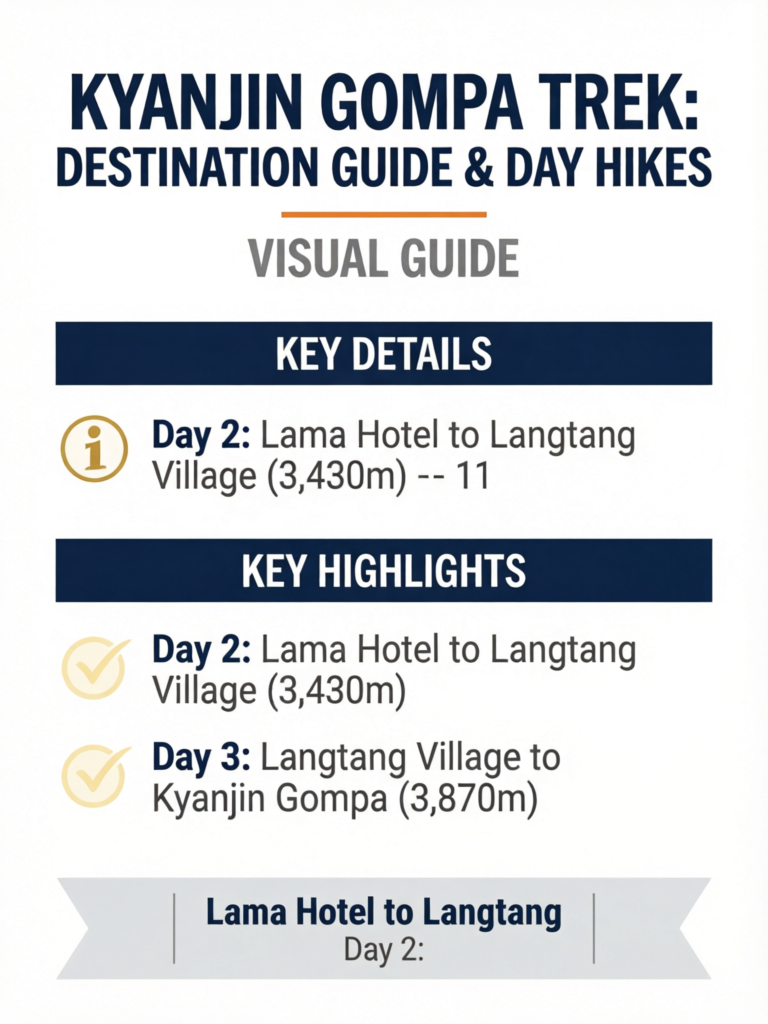
Kyanjin Gompa is the terminus of the standard Langtang Valley trek, reached after three days of walking from Syabrubesi. Most trekkers follow the 7-day Langtang Valley itinerary with the following approach:
- Day 1: Syabrubesi (1,460m) to Lama Hotel (2,380m) -- 14km, 6-7 hours
- Day 2: Lama Hotel to Langtang Village (3,430m) -- 11km, 5-6 hours
- Day 3: Langtang Village to Kyanjin Gompa (3,870m) -- 7km, 3-4 hours
Day 3 is intentionally short to allow your body time to adjust to the altitude. Most trekkers arrive at Kyanjin Gompa by noon, giving you a full afternoon to explore before any strenuous activity the following day. You will need a Langtang National Park permit to enter the valley, checked at the Dhunche and Ghatte Khola posts before you reach Kyanjin Gompa.
Arriving in Good Shape
The gradual ascent over three days -- 830m gain on Day 1, 1,050m on Day 2, and only 440m on Day 3 -- is designed for acclimatization. If you rushed and feel unwell on arrival at Kyanjin Gompa, take a rest day before attempting any day hikes. A day spent walking gently around the settlement, visiting the monastery, and resting at 3,870m is never wasted time.
The Kyanjin Gompa Settlement
Kyanjin Gompa is a compact settlement with about 20-25 permanent structures spread across an open yak pasture at the base of the mountains. It is one of the highest permanently inhabited places in the Langtang region, though many families descend to lower villages during the coldest winter months.
The Monastery
The monastery (gompa) that gives the settlement its name dates back several centuries, though the current structure has been rebuilt and restored multiple times, most recently after the 2015 earthquake. The gompa belongs to the Nyingma school of Tibetan Buddhism -- the oldest of the four major Tibetan Buddhist traditions.
Inside the prayer hall, you will find:
- Large painted thangkas depicting Padmasambhava, Avalokiteshvara, and protective deities
- Rows of butter lamps and offering bowls
- A central altar with a brass Buddha surrounded by ritual objects
- Ancient bronze statues that survived the earthquake
- Monks' quarters attached to the main building
The monastery is generally open to respectful visitors during daylight hours. Remove your shoes before entering, walk clockwise around the prayer hall, and make a small donation (NPR 200-500) before leaving. If monks are conducting morning or evening prayers, you may observe quietly from the doorway.
Monastery Timing
Monks at Kyanjin Gompa typically conduct morning prayers between 6:00 and 7:30 AM and evening prayers around 5:30 PM. Attending a prayer session -- even from the doorway, watching in respectful silence -- is one of the more memorable experiences available at Kyanjin Gompa. The low chanting, the butter lamps, and the distant sound of the wind combine to create an atmosphere that no photograph fully captures.
The Cheese Factory
The Kyanjin Gompa cheese factory is one of the Langtang Valley's most distinctive attractions, and nearly every trekker who reaches the settlement visits it. Established in 1956 as part of a Swiss-Nepali development cooperation project, the factory has been producing cheese continuously for nearly 70 years.
The factory uses milk from yaks and chauri (yak-cow crossbreeds) that graze in the surrounding high-altitude pastures. The traditional Alpine-style cheese-making techniques introduced by Swiss advisors in the 1950s have been adapted over decades to local conditions.
What to expect at the factory:
- Daily production typically begins around 7:00-9:00 AM (mornings are the best time to visit)
- Workers press curds into round molds and age the cheese in a cool storage room
- Fresh soft cheese (paneer-style yak cheese) and aged hard cheese (Swiss-style) are both available
- Cheese prices: NPR 700-1,000 per 250g block, NPR 2,500-3,500 per kg
- Small tasting portions are often offered free to visitors
The fresh soft cheese sold here is essentially a high-altitude paneer made from yak and chauri milk -- mild, crumbly, and best eaten within a day or two. Many lodges will fry it or add it to your dal bhat on request. The aged hard cheese keeps far longer and is the better choice if you want to carry some home.
The hard aged cheese makes excellent trail food for the return journey -- it keeps well for several days even without refrigeration at altitude. Many trekkers buy a block to share back in their lodges, sliced on crackers from their personal supplies.
Cheese Production Seasonality
Cheese production is highest during the monsoon months (June-August) when yaks are at high pasture and producing the most milk. During the main trekking seasons (October-November and March-May), production continues but at a reduced rate. Fresh soft cheese is most likely to be available in morning; aged hard cheese is available year-round. The factory sometimes runs low on stock late in the October peak season, so visit early in your stay.
Day Hikes from Kyanjin Gompa
This is the heart of the Kyanjin Gompa experience. Three main day hike options depart from the settlement, ranging from a gentle valley walk to a demanding climb approaching 5,000 meters.
Kyanjin Ri (4,773m) -- The Essential Hike
Kyanjin Ri is the rocky ridge rising directly behind the Kyanjin Gompa settlement. It is the most popular day hike from the settlement, suitable for most trekkers who have adequately acclimatized, and it delivers spectacular views of the entire upper Langtang Valley. For a detailed route description, difficulty comparison, and summit views, see our Langtang Ri ascent guide.
At a glance:
- Altitude: 4,773m
- Elevation gain from Kyanjin Gompa: 903m
- Round trip time: 3-5 hours
- Difficulty: Challenging (at altitude)
- Best for: Most trekkers who have acclimatized
The trail begins behind the main lodge cluster and climbs steeply through loose rock and short alpine grass. The upper section involves some scrambling over boulders before reaching the summit ridge. Views from the top encompass Langtang Lirung, Ganesh Himal, Dorje Lakpa, and the Langtang Glacier.
Tserko Ri (5,033m) -- The Ultimate Viewpoint
Tserko Ri is the highest readily accessible viewpoint in the Langtang Valley and rewards physically fit, well-acclimatized trekkers with one of the finest high-altitude panoramas in the entire region. The full guide to Tserko Ri -- including route description, turnaround advice, and what you can see -- is in our Langtang Ri ascent guide.
At a glance:
- Altitude: 5,033m
- Elevation gain from Kyanjin Gompa: 1,163m
- Round trip time: 6-8 hours
- Difficulty: Very Challenging
- Best for: Strong, experienced trekkers with good acclimatization
Altitude and Tserko Ri
Tserko Ri exceeds 5,000 meters. Even well-acclimatized trekkers can experience acute mountain sickness at this altitude. Watch for warning signs during the ascent: worsening headache, nausea, loss of coordination, or extreme breathlessness disproportionate to your effort. If any of these develop and do not improve with a brief rest, descend immediately. Tserko Ri is optional -- Kyanjin Ri delivers excellent views at a safer altitude.
Langshisha Kharka (4,160m) -- The Glacier Walk
If you want a gentler day away from the settlement that does not involve the steep climbs of Kyanjin Ri or Tserko Ri, the walk toward Langshisha Kharka is a perfect alternative. This route follows the valley floor northeast from Kyanjin Gompa, passing through high-altitude yak pastures and approaching the snout of the Langtang Glacier.
Route description:
- Follow the trail northeast from Kyanjin Gompa along the valley floor
- Pass through open meadows with views of the surrounding peaks
- Cross several seasonal streams fed by glacial melt
- Reach Langshisha Kharka (4,160m) after approximately 2-3 hours
- Return the same way (2-3 hours back)
What you see: Close-up views of the Langtang Glacier and surrounding glaciated peaks, Langtang Lirung's north face, and the high-altitude ecosystem with Himalayan tahr, snow pigeons, and seasonal wildflowers. This walk is particularly beautiful in early morning when the peaks are lit from the east and the pastures are quiet.
The Glacier Walk for Acclimatization
If you arrive at Kyanjin Gompa feeling good but not quite ready for the strenuous day hikes, the Langshisha Kharka walk is the ideal acclimatization activity. You gain 290 meters of altitude over a gentle gradient, which helps your body adjust while keeping you active. Many trekkers do this walk on their first afternoon at Kyanjin Gompa, then attempt Kyanjin Ri or Tserko Ri on their second morning.
Combining Both Hikes on Separate Days
If you are spending two full days at Kyanjin Gompa -- which is highly recommended -- consider this schedule:
| Day | Morning | Afternoon |
|---|---|---|
| First Day at Kyanjin | Langshisha Kharka walk for acclimatization | Cheese factory visit and monastery exploration |
| Second Day at Kyanjin | Early start for Kyanjin Ri (or Tserko Ri if fit) | Rest and recovery at lodge |
This two-day approach is the ideal way to experience Kyanjin Gompa fully. Most trekkers who stay only one night at the settlement wish they had scheduled more time.
Accommodation at Kyanjin Gompa
Kyanjin Gompa has approximately 8-10 operational lodges during trekking season, with a combined capacity of around 150 trekkers. During the October peak, lodges can fill up, particularly on weekends. The settlement is small enough that you can walk between all the lodges in 10 minutes to find the best available option.
| Lodge | Room Cost | Hot Shower | WiFi | Notes |
|---|---|---|---|---|
| Kyanjin Guest House | NPR 800-1,200 | NPR 500 | NPR 500 | Closest to monastery; popular |
| Hotel Yala Peak View | NPR 700-1,000 | NPR 500 | NPR 500 | Large dining room; groups welcome |
| Langtang Lirung Guest House | NPR 700-1,000 | NPR 500 | Limited | Quieter end of settlement |
| Kyangjin Ri Guesthouse | NPR 600-900 | NPR 400 | NPR 400 | Budget-friendly; basic rooms |
| Yak & Yeti Lodge | NPR 800-1,200 | NPR 500 | NPR 500 | Good mountain views from windows |
| Himalayan Lodge | NPR 700-1,000 | NPR 400 | NPR 400 | Well-maintained common area |
What to Expect from Accommodation
All lodges at Kyanjin Gompa operate as traditional tea houses. Rooms are twin-bedded with thin foam mattresses, pillows, and two or three blankets. Walls are typically plywood or thin timber, not well-insulated against the cold. At night in October, temperatures inside rooms can drop close to freezing.
Bring your own sleeping bag. Lodge blankets alone are insufficient for nights at 3,870m during the main trekking season. A sleeping bag rated to -10°C is the minimum; -15°C is more comfortable. You can rent sleeping bags in Kathmandu for approximately $1-2 per day.
Shared bathrooms are the norm. Most lodges have a mix of Western and squat-style toilets. Hot showers are available but solar-heated -- meaning they are warmest in mid-afternoon and cold in early morning. Budget NPR 400-500 per shower.
Booking Ahead in Peak Season
October is the only month when Kyanjin Gompa lodges can genuinely fill up. If you are trekking in the first two weeks of October (the absolute peak), ask your lodge in Langtang Village to radio or phone ahead and reserve a room at your preferred Kyanjin Gompa lodge. At all other times of year, simply walking in and asking for a room is fine.
Food and Dining
The menu at Kyanjin Gompa lodges is more extensive than you might expect at nearly 4,000m. Most lodges serve:
- Dal bhat: The staple meal, available at every lodge. NPR 500-700 per plate, unlimited refills
- Noodle soups: Thukpa and variations, warming after cold days on the trail
- Tibetan bread: Fried flatbread served with butter and honey for breakfast
- Potatoes: Boiled, fried, curried -- the most versatile item at altitude
- Pasta and noodles: Basic but available at most lodges
- Eggs: Fried, boiled, or scrambled; a reliable protein source
- Porridge and pancakes: Popular Western-style breakfasts
- Cheese: Fresh from the cheese factory -- ask your lodge to include it
Food prices increase significantly above Langtang Village. A full day's meals (breakfast, lunch, dinner) will cost NPR 1,500-2,500 ($12-19) at Kyanjin Gompa, compared to NPR 1,000-1,800 at Lama Hotel.
Eating for Altitude
At nearly 4,000m, your appetite often decreases and your body's ability to digest fats becomes slightly impaired. Focus on carbohydrates (rice, noodles, bread) which are easier to process at altitude. Dal bhat is nutritionally ideal -- the combination of rice, lentils, and vegetables provides a balanced energy source. Avoid heavy, fatty foods in the evening, stay well hydrated, and limit or eliminate alcohol which impairs acclimatization.
Weather at Kyanjin Gompa
Understanding Kyanjin Gompa's weather is essential for planning your day hikes, especially for Tserko Ri where the consequences of being caught in a storm are more serious.
Seasonal Overview
| Season | Day Temp | Night Temp | Visibility | Notes |
|---|---|---|---|---|
| October | 8-15°C | -5 to -10°C | Excellent | Best overall; book lodges early |
| November | 3-10°C | -10 to -15°C | Excellent | Cold but clear; fewer trekkers |
| December-Feb | -3 to 5°C | -15 to -20°C | Good | Very cold; some lodges close |
| March-April | 5-12°C | -5 to -8°C | Good | Rhododendrons below; reliable |
| May | 8-15°C | -2 to -5°C | Fair | Pre-monsoon haze builds |
| June-Sep | 5-15°C | 0 to 5°C | Poor | Monsoon clouds; not recommended |
Daily Weather Pattern
Kyanjin Gompa follows the classic Himalayan daily weather cycle during the main trekking seasons:
- Dawn to 9:00 AM: Crystal clear, calm, best light for photography
- 9:00 AM to noon: Cloud build-up begins, still largely clear
- Noon to 3:00 PM: Increasing cloud cover, occasional light snow above 4,500m
- 3:00 PM to sunset: Mixed conditions; can be clear or fully clouded
- Night: Generally clear, extreme cold, stunning stars
This daily pattern dictates that all serious day hikes should start by 5:30-6:00 AM. By the time clouds build around midday, you want to be on your way down, not still ascending.
Afternoon Weather and High Hikes
Never start the ascent of Kyanjin Ri or Tserko Ri after 7:00 AM if you are a slow hiker. Both summits should be reached by 10:00-11:00 AM at the latest. Afternoon cloud and snow at these altitudes can reduce visibility to near zero, making descent difficult and dangerous. If you wake up late, abandon the summit attempt for that day and rest instead.
Acclimatization at Kyanjin Gompa
Kyanjin Gompa sits at 3,870m, which is above the threshold where acute mountain sickness (AMS) can meaningfully affect otherwise healthy trekkers. The gradual approach from Syabrubesi over three days is designed to minimize this risk, but arriving at the settlement doesn't mean you are fully acclimatized.
Recognizing Altitude Sickness
The most common symptoms at Kyanjin Gompa's altitude include:
- Mild AMS (common and manageable): Headache, fatigue, slight nausea, disturbed sleep. These typically resolve with rest and hydration within 24 hours.
- Moderate AMS (requires monitoring): Persistent or worsening headache not relieved by ibuprofen, significant nausea or vomiting, dizziness when standing. Do not ascend further. If symptoms don't improve within 24 hours, descend.
- Severe AMS / HACE / HAPE (emergency): Confusion, inability to walk in a straight line, persistent cough with pink/frothy sputum, severe breathlessness at rest. Descend immediately. These are medical emergencies.
For a comprehensive guide to recognizing and responding to altitude sickness, see our altitude sickness guide.
The "Climb High, Sleep Low" Principle
The day hikes from Kyanjin Gompa follow the classic acclimatization principle: ascend to a higher altitude during the day, then return to sleep at your existing altitude. This stimulates acclimatization without the risk of sleeping at an altitude your body hasn't fully adjusted to.
When you summit Kyanjin Ri (4,773m) and return to sleep at Kyanjin Gompa (3,870m), you are practicing this principle perfectly. Your body benefits from the high-altitude exposure but recovers overnight at a more manageable elevation.
Diamox at Kyanjin Gompa
Acetazolamide (Diamox) is used by some trekkers to prevent and treat altitude sickness. If you are considering Diamox, consult your doctor before the trek and start the medication 1-2 days before reaching altitude. Common side effects include increased urination and tingling in fingers and toes. Diamox does not eliminate the need for gradual acclimatization -- it supplements it. Do not use it as an excuse to rush your ascent.
Kyanjin Gompa as an Acclimatization Hub and Climbing Base
Beyond its role as a trekking destination, Kyanjin Gompa is the natural acclimatization hub and staging point for climbers heading into the upper Langtang. Its altitude of 3,870m, combined with the higher day-hike viewpoints right above it, lets climbers and pass-trekkers adjust gradually before committing to anything above 5,000m. Many spend several nights here gathering supplies, hiring local support, and sleeping low while climbing high.
What Kyanjin Gompa is used as a base for:
- Yala Peak (5,732m): The most accessible trekking peak in the Langtang region, often climbed as an introduction to high-altitude mountaineering. Climbers acclimatize at Kyanjin Gompa, ascend Kyanjin Ri or Tserko Ri to prepare, then move to a high camp above the settlement. See our Yala Peak climbing guide for routes, costs, and experience required.
- Gangchenpo (Gangchempo) Peak (6,387m): A technical, pyramid-shaped peak requiring prior mountaineering experience, glacier travel, and a proper expedition setup.
- Ganja La Pass (5,122m): A serious, non-tourist-track crossing linking Kyanjin Gompa to the Helambu region (covered in the Gangja La section below).
- Tilman Pass (~5,300m): An even more remote, expedition-style pass for self-sufficient teams with technical skills.
Peak Climbing Is Not Trekking
Yala Peak, Gangchenpo, and the high passes above Kyanjin Gompa require crampons, ice axes, rope skills, and — for the named peaks — a NMA climbing permit and a qualified climbing guide. Do not attempt them as an extension of a standard teahouse trek. If your goal is mountaineering rather than viewpoints, book with a verified local agency that runs Langtang peak departures. Standard trekkers get equally spectacular views from Kyanjin Ri and Tserko Ri at far lower risk.
Extending from Kyanjin Gompa
Most trekkers at Kyanjin Gompa are on an out-and-back route that returns via Langtang Village to Syabrubesi. However, several extensions are worth considering if you have the time and fitness.
Toward the Langtang Glacier
Walking beyond Langshisha Kharka and approaching the Langtang Glacier snout is possible as a longer day hike. The glacier is retreating due to climate change but remains an impressive feature. This extension adds 1-2 hours to the Langshisha Kharka walk and requires good trail-finding ability, as the route becomes less defined beyond the kharka.
The Gangja La Pass (5,106m)
For very experienced, technically equipped trekkers with acclimatization to at least 5,000m, the Gangja La Pass connects Kyanjin Gompa to the Helambu region. This is a serious, non-tourist-track high pass crossing that requires crampons, ice axes, and local guide knowledge. It should not be attempted by standard trekkers.
Combining with Gosaikunda
One of the most rewarding extensions from the Langtang Valley is a connection to the Gosaikunda sacred lakes. After returning from Kyanjin Gompa to Syabrubesi, a short drive to Dhunche begins the Gosaikunda section. Having acclimatized at Kyanjin Gompa (3,870m), you will find the ascent to Gosaikunda (4,380m) significantly easier than trekkers coming directly from Kathmandu.
Practical Information
Cash and Money
There are no ATMs at Kyanjin Gompa or anywhere along the Langtang Valley trail. The nearest ATM is in Syabrubesi, and some trekkers report these machines running out of cash during October peak season. Withdraw sufficient cash in Kathmandu before the trek. For a full day-by-day spending estimate including permits, transport, and teahouse costs, see our Langtang Valley cost breakdown.
Recommended cash allowance for Kyanjin Gompa:
- Per day at Kyanjin Gompa: NPR 3,000-5,000 ($23-38)
- Per day during descent: NPR 2,000-3,500 ($15-27)
- Emergency buffer: NPR 10,000-15,000 ($77-115)
Communications
Nepal Telecom (NTC) provides the most reliable signal at Kyanjin Gompa, though it can be intermittent depending on weather conditions. NCell has little or no coverage in the upper valley. WiFi is available at most lodges for NPR 400-600 per day -- speeds are slow and dependent on satellite connections that can be disrupted by weather.
Download offline maps (Maps.me or OsmAnd) and any essential guidebooks before leaving Kathmandu. Keep your phone's battery above 50% at all times using your power bank.
Emergency Services
The Himalayan Rescue Association (HRA) does not have a permanent presence at Kyanjin Gompa, unlike their station at Pheriche in the Everest region. The nearest medical assistance is in Syabrubesi or Dhunche. Helicopter evacuation is available but expensive ($3,000-5,000 USD) and requires travel insurance that covers high-altitude evacuation.
In a medical emergency, contact your lodge owner who will have experience coordinating evacuation. Nepal Air Rescue and other operators can reach Kyanjin Gompa in suitable weather.
Travel Insurance is Non-Negotiable
Do not trek to Kyanjin Gompa without travel insurance that explicitly covers helicopter evacuation from altitudes above 4,000m. Check your policy carefully -- many basic travel policies exclude altitude-related incidents. Specialist trekking insurance from providers such as World Nomads, True Traveller, or BUPA typically covers evacuation from Kyanjin Gompa's altitude. A helicopter evacuation from the Langtang Valley typically costs $3,000-5,000 and will not be dispatched without confirmed insurance coverage or a cash deposit guarantee.
Photography at Kyanjin Gompa
Kyanjin Gompa is one of the most photogenic locations in the Langtang region. Key photography opportunities include:
- Alpenglow on Langtang Lirung: Dawn light turns the peak gold-pink for approximately 20-30 minutes. Be positioned and ready 15 minutes before sunrise.
- Monastery prayer sessions: Low, warm light from butter lamps creates atmospheric interior shots. Always ask permission before photographing monks.
- Cheese factory: The cheese-making process, the workers, and the stacked rounds of aging cheese make compelling documentary photographs.
- Yak herds: Yaks graze around the settlement. Early morning, when herders drive them out to pasture, is the best time for yak photography.
- Summit panoramas: From Kyanjin Ri or Tserko Ri, the 360-degree view is best photographed in the first 1-2 hours after dawn.
- Langtang Valley 7-Day Itinerary
- Kyanjin Ri & Tserko Ri Day Hikes Guide
- Langtang Valley Route Overview
- Langtang Region Complete Guide
- Gosaikunda Trek Guide
- Altitude Sickness: Signs & Turnaround Rules
- Langtang Valley Difficulty Assessment
- Langtang Valley Cost Breakdown
- Yala Peak Climbing Guide
- Langtang National Park Permit
- Best Trekking Agencies for Langtang Valley
- Best Time to Trek the Langtang Valley
- Tamang Heritage Trail Guide
Ready to Trek to Kyanjin Gompa?
How Many Days Should You Spend at Kyanjin Gompa?
Spend at least two nights at Kyanjin Gompa to fully experience the destination. One night allows you to summit Kyanjin Ri or Tserko Ri the next morning. A second night gives you a proper rest day to explore the cheese factory, visit the monastery, and walk toward the Langtang Glacier. Three nights allow you to attempt both viewpoint peaks and fully acclimatize.
Frequently Asked Questions
Is the Kyanjin Gompa cheese factory worth visiting?
Yes. The Swiss-established cheese factory (opened 1956) produces yak cheese using traditional methods. You can watch the production process and buy fresh cheese at source prices. It is one of the cultural highlights of the Langtang Valley trek.
What is the altitude of Kyanjin Gompa?
Kyanjin Gompa sits at 3,870m (12,697 ft). This is high enough to cause mild altitude sickness if you have not acclimatized properly during the 3-day approach from Syabrubesi. Follow the acclimatization schedule in our Langtang Valley itinerary.
Is there mobile phone coverage at Kyanjin Gompa?
Nepal Telecom provides intermittent coverage at Kyanjin Gompa. Signal is unreliable and data speeds are minimal. WiFi is available at some lodges for NPR 300-500 per session.
What is the best lodge at Kyanjin Gompa?
Kyanjin Gompa has 8-10 lodges with similar facilities. Hotel Yala Peak and Kyanjin Gompa Guest House are popular choices with good dining rooms and views. Arrive early in peak season (October-November) for room selection.
Can I walk to the Langtang Glacier from Kyanjin Gompa?
Yes. A half-day walk northeast from Kyanjin Gompa reaches the Langtang Glacier moraine at approximately 4,100m. The trail is unmarked beyond the yak pastures, so a guide is recommended for this extension.