
Lo Manthang Exploration Guide: Inside the Walled City
This Lo Manthang exploration guide covers everything inside the walled capital of Upper Mustang — its four medieval monasteries, the royal palace, the Tiji festival, the surrounding sky caves and day trips, plus how to get there, the restricted-area permit (USD 50/day), and where to stay. Lo Manthang sits at 3,810m and is the heart of Nepal's "Forbidden Kingdom" of Lo.
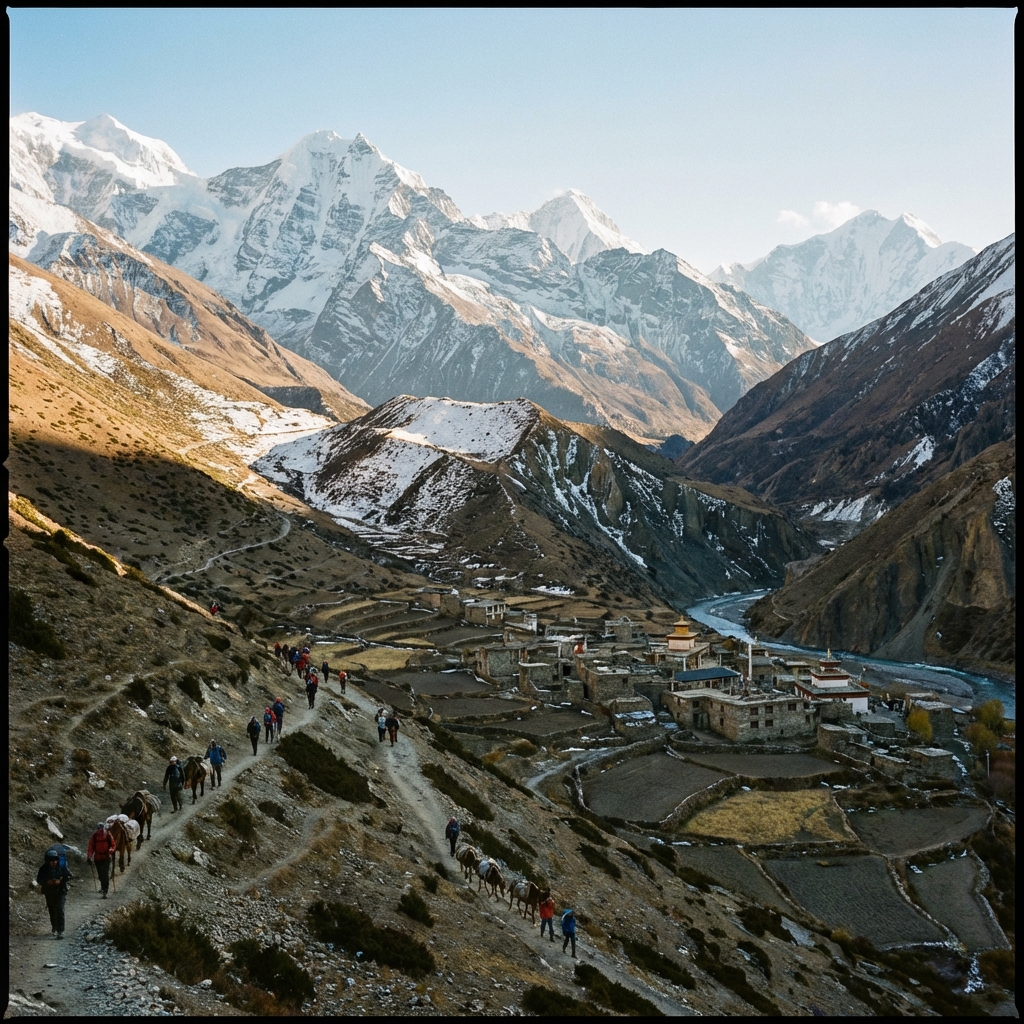
Lo Manthang is one of the last medieval walled cities in Asia still occupied and culturally intact. Viewed from the approach trail as you descend from the Lo La pass, the city appears suddenly across a flat, windswept plateau — a compact cluster of white-and-red buildings enclosed within ancient mud-brick walls, backed by the snow-dusted ridges of the Tibetan border ranges. After days of trekking through the dramatic eroded canyons of Upper Mustang, this first view of Lo Manthang produces one of trekking's most profound arrival moments.
The city was founded in 1380 CE by Ame Pal, the first King of Lo. He established not only the settlement but a political and cultural entity — the Kingdom of Lo — that maintained semi-independence from Nepal and Tibet for over six centuries, governing itself under a succession of monarchs and preserving a form of Tibetan Buddhist civilization that has largely vanished from the Tibetan plateau following the Chinese occupation.
Today, approximately 150 households live within Lo Manthang's walls, along with four active monasteries, the former royal palace, artisan workshops, and community spaces that have functioned largely as they have for hundreds of years. The royal family — though stripped of political authority when Nepal abolished its monarchy in 2008 — remains the cultural and spiritual heart of the community, and the current heir is widely referred to as "Raja" (King) by local residents.
This guide focuses specifically on exploring Lo Manthang itself: the four monasteries and their artworks, the royal palace, the surrounding cave complexes, day trip options, the extraordinary Tiji festival, and practical information on accommodation within the city walls.
1380 CE by Ame Pal, first King of Lo
3,810m (12,500 ft)
~150 households (approximately 500-700 residents)
4 active monasteries
5-6 days (via standard route)
USD 50/day (no minimum days), $50 per additional day
March-November; Tiji festival in May
Several guest houses, rooms $8-20/night
Jomsom (20-min flight from Pokhara)
Choser Caves, Ghar Gompa, Drakmar cliffs
The History of Lo Manthang
The Kingdom of Lo
Understanding Lo Manthang requires understanding the Kingdom of Lo — a political and cultural entity that defies simple categorization. The kingdom was Tibetan in language, religion, and ethnic character, but geographically within Nepal's borders. It paid tribute to Nepal and Tibet at different historical periods, maintained its own internal governance, and operated according to its own legal and cultural norms.
Founded in 1380 when the Tibetan ruler Ame Pal chose the plateau north of the Kali Gandaki gorge for his capital, the kingdom flourished as a strategic point on the ancient salt trade routes between the Tibetan plateau and the Indian subcontinent. Himalayan salt from Tibetan lakes was traded south for grain, and Lo Manthang controlled this trade, generating the wealth that funded its extraordinary monasteries and maintained its royal court.
The last King of Lo, Jigme Dorje Palbar Bista (Mustang Raja), ruled from his family's ancestral home until Nepal's transition to a federal republic in 2008, when the political role of all Nepalese royalty was formally abolished. He died in 2016. The current heir, Jigme Singhi Palbar Bista, continues to live in Lo Manthang and remains deeply respected — villagers seek his blessing, the royal household maintains ceremonial functions, and the family's involvement in the Tiji festival is central to its meaning.
The Salt Trade Legacy
The wealth of Lo Manthang was built on salt. For centuries, yak caravans carried Tibetan lake salt (which lacks iodine but was the only affordable salt for Himalayan communities) south through Lo Manthang to the lowlands. The economic disruption caused by the availability of cheap Indian iodized salt from the 1960s onward was a major factor in Lo Manthang's gradual depopulation and economic decline over the past half-century. Many of the monastery restoration projects you see today are partly an effort to rebuild the cultural infrastructure that depopulation was allowing to decay.
Conservation and Restoration
Lo Manthang's extraordinary artistic heritage — medieval murals, thangka paintings, sculpture collections, and architectural fabric — has been the focus of significant international conservation effort. The American Himalayan Foundation (AHF), working with Italian art conservator Luigi Fieni, has led the most comprehensive restoration work, focusing particularly on the Thubchen Gompa and Jampa Gompa murals.
The AHF's work in Lo Manthang is considered a model for high-altitude Himalayan heritage conservation. Fieni spent over two decades working with local artisans, training young Mustangi painters in traditional techniques while restoring murals using traditional materials (mineral pigments, natural binders) wherever possible. The results are visible in the extraordinary quality of the murals you will see in Thubchen Gompa — paintings that were barely visible under layers of smoke and deterioration a decade ago are now among the finest visible examples of 15th-century Tibetan Buddhist art in the world.
The Four Monasteries Inside the Walls
Lo Manthang's four monasteries are the heart of the city and the primary reason trekkers make the arduous journey to reach it. Each represents a different historical era and stylistic tradition, and together they constitute one of the finest collections of medieval Tibetan Buddhist art in existence.
1. Jampa Gompa (Jampa Lhakhang) — The Temple of the Future Buddha
Jampa Gompa is the oldest of Lo Manthang's monasteries, founded in 1447 CE. Its name — "Jampa" refers to Maitreya, the future Buddha — announces its central artistic and devotional focus: a massive three-story statue of Maitreya that dominates the main assembly hall.
The Maitreya statue is extraordinary by any measure. Standing approximately 10 meters tall (three stories), constructed of clay over a wooden armature, the figure's face gazes down at visitors with a serene expression that has survived 575 years. The statue was extensively repaired during the AHF conservation project, but the original form and proportions are preserved. The scale of the figure within the enclosed space of the assembly hall creates a genuinely overwhelming visual experience.
The murals surrounding the Maitreya figure represent one of the finest surviving examples of the Pala artistic tradition brought to Tibet from India — paintings characterized by elaborate lotus borders, multiple deity figures in hierarchical arrangements, and a color palette dominated by mineral reds, blues, and golds. Art historians consider some of the Jampa Gompa panels to be among the earliest extant examples of this style in Nepal.
Visiting Jampa Gompa:
- Entry donation: NPR 500-1,000 recommended
- Photography: Permitted with donation; no flash
- Opening hours: Approximately 9 AM to noon, 2-5 PM (varies by monk availability)
- Allow: 45-90 minutes for thorough exploration
2. Thubchen Gompa — The Great Assembly Hall
Thubchen Gompa is the largest monastery in Lo Manthang and the one most significantly transformed by the AHF conservation project. Built in 1447 CE (same period as Jampa Gompa), it served as the main communal monastery for the entire kingdom — a vast assembly hall where the community gathered for important ceremonies.
The interior of Thubchen is awe-inspiring. Massive wooden columns painted in the traditional style support a high ceiling, creating a cathedral-like space. The walls are covered in murals depicting Buddha's life, the 1,000 Buddhas, and elaborate mandala arrangements — paintings restored to their original brilliance by Luigi Fieni's team and now considered among the finest surviving examples of 15th-century Tibetan Buddhist mural art anywhere in the world.
Visiting Thubchen at the Right Time
The Thubchen Gompa murals are best seen in natural daylight — the western wall panels are particularly extraordinary in late morning when light enters through the clerestory windows. Flash photography is strictly prohibited and would damage the fragile mineral pigments. Bring a headlamp for examining lower sections of the murals, and consider carrying a compact LED light that produces no UV radiation. The caretaker monks can often position additional lighting if you request it respectfully.
Key artworks in Thubchen:
- The west wall mandala cycle (considered the artistic masterpiece of the complex)
- The biographical panels of Guru Rinpoche (Padmasambhava)
- The collection of ancient butter lamp holders, some dating to the 15th century
- The ceremonial musical instruments used during Tiji festival
3. Chode Gompa (Choede) — The Living Community Monastery
Chode Gompa is Lo Manthang's most actively used monastery — the place where daily prayers, life-cycle ceremonies, and community religious events are conducted. Unlike Jampa and Thubchen (which are more museum-like in character), Chode is emphatically a living religious institution, and visiting feels different accordingly.
The resident monks — approximately 10-15 depending on the season — conduct multiple daily prayer sessions in the assembly hall. The smell of juniper incense, the sound of butter lamps being tended, and the sight of monks preparing ritual implements for the day's activities create an atmosphere that is unmistakably alive rather than preserved.
Chode Gompa houses a significant collection of ancient texts — hand-copied sutras on traditional Tibetan paper, kept in painted wooden cabinets along the walls. These texts represent centuries of scholarly copying by monks and lay practitioners, and their preservation is itself a form of religious practice.
What to observe at Chode:
- Morning and evening prayer sessions (typically 6-8 AM and 5-7 PM; confirm current times with your guide)
- The collection of religious dance costumes and masks used during Tiji festival
- The monastery's scroll paintings, depicting protective deities and historical masters
- The kitchen area where butter tea is prepared for monks' daily sustenance
The Best Cultural Engagement in Lo Manthang
Rather than rushing between all four monasteries in a single day with your camera, consider spending an entire morning at Chode Gompa. Arrive before the morning prayer session begins, sit quietly at the back of the hall, and simply observe. The combination of monastic routine, ancient surroundings, and meditative atmosphere is more culturally meaningful than photographing all four monasteries superficially.
4. Rongchung Cave Monastery — The Hidden Practice Space
The smallest of Lo Manthang's monasteries, Rongchung (sometimes called Namgyal Gompa) is built into and around a natural cave in the cliff above the city's northern wall. The cave monastery typology — sacred space where human construction meets natural rock — is characteristic of Nyingma practice, in which natural features of the landscape carry inherent spiritual significance.
Rongchung houses a few resident monks or nuns (numbers vary seasonally) and functions primarily as a meditation and retreat space rather than a community monastery. The main chamber contains a shrine with ancient statues and painted panels, some in fragile but intact condition.
The approach to Rongchung offers the best aerial perspective on Lo Manthang's layout — from the cliff above, you can see the compact organization of the walled city, the rooftop terraces where residents dry food and gather, and the relationship between the monasteries and the royal palace at the city's center.
Access: Your guide can arrange access to Rongchung; it is not always open to casual visitors. A donation to the caretaker is appropriate.
The Royal Palace
The royal palace stands at the center of Lo Manthang, its higher walls and distinctive architecture marking it as the political and ceremonial center of the former kingdom. The current building dates to the 18th century, though earlier palace structures preceded it on the same site.
The palace is a multi-story rammed-earth structure with a traditional Tibetan flat-roof design. Carved wooden window frames in the traditional Lo style — intricate geometric and floral patterns painted in bright colors — are among the finest examples of Mustangi woodcarving visible in the city.
Visiting the Palace:
The royal family is still in residence when in Lo Manthang (they also spend time in Kathmandu and abroad). The palace is not a museum; it is a family home. Access for visitors depends entirely on the family's availability and willingness. Your guide, if they have established relationships with the royal household, may be able to arrange an audience or a brief visit to the receiving rooms where historical artifacts are displayed.
Do not expect or demand palace access as a standard tourist amenity. If access is arranged, treat it with the gravity it deserves: dress appropriately, follow your guide's precise instructions, and offer a kata (white ceremonial scarf) with both hands as a gesture of respect if meeting family members.
The Royal Family Today
The royal family maintains deep involvement in Lo Manthang's cultural and religious life despite the end of the monarchy's political role. The current heir participates in the Tiji festival, maintains the royal family's historical role as monastery patron, and has been involved in infrastructure development for the community. Local residents' continued use of the title "Raja" reflects genuine respect rather than political statement.
The Tiji Festival
Tiji (Tenchang Yishin Norbu) is Lo Manthang's most spectacular cultural event and one of the finest traditional festivals accessible to visitors in Nepal. Held annually for three days in May (dates follow the Tibetan lunar calendar and vary by 1-2 weeks each year), Tiji commemorates the victory of a deity named Dorje Jono over a demon that had caused water scarcity by devouring the sources of rivers.
What Happens During Tiji
Day 1: The festival opens with elaborate preparatory rituals at Chode Gompa. Monks in full ceremonial regalia — satin robes, large ceremonial hats, painted masks — perform the initial invocation of the protective deity. The monastery courtyard fills with the entire Lo Manthang community plus pilgrims from surrounding villages.
Day 2: The central masked dances (cham) tell the story of Dorje Jono's battle with the demon. Elaborately costumed monks perform the narrative through stylized choreography, accompanied by traditional instruments — large telescoping horns (dungchen), cymbals, drums, and oboes (gyaling). Each mask and costume has specific symbolic meaning that a knowledgeable guide can explain in real time.
Day 3: The culminating exorcism ritual expels the demon from the valley. A symbolic effigy representing the demon is destroyed in a ritual burning, signifying the restoration of water, fertility, and prosperity to the kingdom. The entire community participates in the final day's events.
For visitors: Tiji is one of Nepal's most authentic surviving cultural festivals precisely because it happens regardless of whether trekkers are present. It is not a performance staged for tourism; it is a religious ceremony the community conducts for its own spiritual reasons. Visitors are generally welcome to observe from designated areas, but follow your guide's specific instructions about positioning and photography.
Other Festivals in Lo Manthang
Tiji is the headline event, but Lo Manthang's ritual calendar runs year-round. Losar (Tibetan New Year) in February brings family gatherings, monastery prayers and masked dances. The Yartung horse festival at summer's end fills the plateau with horse races and community celebration across Mustang — see our Yartung festival guide for dates and what to expect. Smaller monastery prayer ceremonies happen throughout the trekking season, and your guide can tell you what is on during your visit.
Booking for Tiji Festival
The Tiji festival is the most popular time to visit Lo Manthang, and accommodation in and around the city fills months in advance. If you want to attend, contact agencies at least 4-6 months before the May festival dates. Confirm the exact dates for your year with your agency, as the Tibetan lunar calendar shifts the dates by 1-3 weeks annually. Expect to pay a premium for accommodation during the three festival days.
Cave Complexes and Day Trips from Lo Manthang
Lo Manthang serves as the base for several extraordinary day trip destinations in the surrounding landscape. Budget at least 2 full days in Lo Manthang to explore the city itself and one of these excursions.
Choser Caves and Sky Caves
The cave complexes around Choser (15-20 km north of Lo Manthang) represent one of the great archaeological mysteries of the Himalayas. These are not natural caves but human-made structures carved into the vertical cliff faces — honeycomb-like formations of interconnected rooms, some accessed through tunnels, others through openings 50-100 meters above the valley floor.
The sky cave puzzle: The upper tiers of these cave complexes, inaccessible today without technical climbing equipment, once housed human habitation or ceremonial use. Archaeological excavations in accessible lower chambers have uncovered human remains, Buddhist artifacts, manuscripts, and objects suggesting the caves were in use from approximately 1,000 BCE through to the 15th century CE. Who originally carved the highest chambers — and how they accessed them — remains genuinely unknown.
Recent archaeologically supervised excavations (carried out by a team including researchers from Kathmandu University and international institutions) have uncovered remarkable material: bronze objects, thangka fragments, woven textiles, and human bones that have been dated to multiple periods of use. Some excavated materials are now displayed in Lo Manthang's small community museum.
The full-day excursion: The standard cave excursion from Lo Manthang visits the accessible lower cave chambers at Choser and the nearby Ghar Gompa (Luri Gompa), returning via a different trail that offers distinct landscape views. Duration: 6-8 hours round trip. Difficulty: moderate (rolling terrain, no significant elevation gain).
Bring: Strong headlamp (essential for cave interiors), sturdy footwear with ankle support, water (no facilities at the caves), and your camera — the cave interiors have extraordinary light quality in the midday hours.
Ghar Gompa (Luri Gompa)
Considered the oldest monastery in the Mustang region, Ghar Gompa is carved into a dramatic cliff formation approximately 12 km northwest of Lo Manthang. The monastery's cave interior contains ancient murals in a distinct pre-Buddhist artistic style that predates the city of Lo Manthang by centuries.
The approach involves a slightly exposed trail that adds to the sense of adventure, and the cliff monastery setting — jutting from a vertical rock face with panoramic views across the plateau — is among the most dramatic architectural situations in the entire Himalaya.
Art historians consider Ghar Gompa's murals to be among the earliest surviving Buddhist paintings in Nepal, dating them to the 11th-12th century CE and identifying strong connections to Indian Buddhist art traditions. The figures have a distinctive stylistic character that differs markedly from the Tibetan Buddhist aesthetic visible in Lo Manthang's city monasteries.
Ghar Gompa Access
Access to Ghar Gompa may be restricted if conservation or restoration work is in progress. Check current access status with your guide before planning the excursion. When the monastery is open, entry typically requires a donation and is managed by a caretaker who lives in the nearby village. Flash photography is absolutely prohibited inside the cave chamber; the murals are extremely fragile.
Drakmar (Red Cliffs) Day Trip
The village of Drakmar sits beneath some of Upper Mustang's most spectacular geological formations — sheer vertical walls of deep crimson sedimentary rock that give the settlement its name (Drakmar means "red cliff" in Tibetan). According to local legend, the red color comes from the blood of a demon slain by Guru Rinpoche at this site.
The red cliffs of Drakmar are the most photographed geological feature in Upper Mustang. They are best seen in late afternoon when the setting sun intensifies the reds and creates dramatic shadow contrasts across the layered rock faces. The village itself has a handful of guest houses if you want to overnight here rather than day-trip from Lo Manthang.
Distance from Lo Manthang: 15-20 km south (also encountered on the standard return route, Day 9 of the 12-day Upper Mustang itinerary).
Tingkhar and Village Exploration
Tingkhar (3,820m) is a small village approximately 4 km north of Lo Manthang, visible from the city's northern wall. A morning walk to Tingkhar and its surroundings takes you into the quiet agricultural landscape north of the walled city, where farmers tend fields and herders manage yak herds at the plateau's edge.
This walk is less spectacular than the cave excursions but more intimate — Tingkhar sees very few visitors, and the pace of daily life here is particularly unhurried. The views north toward the Tibetan border ranges are excellent.
How to Get to Lo Manthang
There are two ways to reach Lo Manthang: trek in over several days, or take a jeep along the rough off-road track. Both start from Jomsom (a 20-minute flight from Pokhara) and both require the Upper Mustang restricted-area permit. Trekking is the slower, more rewarding, better-acclimatised option; the jeep is faster and suits families or travellers short on time.
Restricted-Area Permit Requirement
Lo Manthang lies inside a restricted zone. Every visitor needs the Upper Mustang Restricted Area Permit (USD 50 per day), plus the Annapurna Conservation Area Permit (NPR 3,000). The restricted permit must be arranged through a registered Nepali agency — independent solo trekking is not allowed beyond Kagbeni, and you must travel with at least one other trekker and a licensed guide. See our Upper Mustang permit guide for the exact paperwork, and the broader restricted area permits overview for how restricted zones work.
Option 1: Trek In (the classic route)
The standard trek follows the Kali Gandaki valley north from Jomsom through Kagbeni, Chele, Ghiling, Ghami and Tsarang, reaching Lo Manthang in 5-6 days of walking. This gradual ascent gives your body time to adapt to altitude and lets you absorb the canyons, chortens and ochre cliffs that make Upper Mustang so distinctive. Most trekkers return on a varied path via Drakmar and Ghiling, completing the full loop in about 12 days. For the day-by-day plan, see the Upper Mustang Trek Itinerary.
Option 2: Jeep In (the fast route)
A shared or private 4WD jeep can reach Lo Manthang from Jomsom in roughly one long day (8-10 hours on rough, dusty road) or two days at a relaxed pace with overnight stops. The jeep suits families, older travellers and anyone short on holiday time, and it follows much of the same valley the trekking route traces. The trade-off is comfort and acclimatisation: the rapid altitude gain to 3,810m gives your body little time to adjust, the road is bumpy and dust is constant. Helicopter charters are a third, premium option — see our Mustang helicopter tours guide.
Jeep vs Trek to Lo Manthang
| Factor | Trek In | Jeep In |
|---|---|---|
| Time to reach | 5-6 days walking | 1-2 days driving |
| Acclimatisation | Gradual, much safer | Rapid gain to 3,810m |
| Best for | Trekkers, photographers, culture lovers | Families, short trips, older travellers |
| Comfort | Physical effort, tea-house nights | Bumpy, dusty road |
| Permit needed | Upper Mustang RAP (USD 50/day) | Upper Mustang RAP (USD 50/day) |
| Scenery | Immersive, slow, varied returns | Faster, glimpsed from vehicle |
Which Should You Choose?
If your priority is the landscape, the culture and a healthy adjustment to altitude, trek in. If you have limited time or are travelling with children or older relatives, the jeep gets you to the walled city without the multi-day walk — just build in a rest day on arrival and watch for altitude symptoms. Either way, complete travel by early afternoon, before the Kali Gandaki wind and dust peak.
Accommodation Inside Lo Manthang
Lo Manthang offers several guest houses within or immediately adjacent to the city walls. For a destination of its remoteness, the accommodation quality is surprisingly reasonable.
Recommended Guest Houses
Lo Manthang Guest House: Probably the best-known accommodation within the city walls. Rooms are simple but clean, with private or shared bathrooms depending on availability. The owner has decades of experience hosting trekkers and provides excellent local information. Rooms: $10-20/night depending on room type.
Lotus Holiday Inn (Lo Manthang): Another well-regarded option within the walls. Solar heating provides warm water for showers on most days. The dining room serves reasonable food including dal bhat, thukpa, and simple Western options.
Royal Lo Manthang Guest House: Located closest to the royal palace. Owner has connections to the royal family and can sometimes facilitate special cultural experiences not available to guests at other accommodations.
Accommodation Realities
Lo Manthang's remoteness means certain expectations should be adjusted:
- Hot water: Available at most guest houses via solar heating, but only in the morning and early afternoon when sun has had time to heat the system. Request your shower timing accordingly.
- Electricity: Solar-powered limited electricity for charging devices. Pay NPR 200-400 per device charge.
- Wi-Fi: Some guest houses offer satellite Wi-Fi — it is slow and expensive (NPR 500-1,000 per day), but available.
- Food variety: Lo Manthang has the best food variety of any point on the Upper Mustang trek. Dal bhat, thukpa, momos, Tibetan bread, eggs, and basic Western items are all available. Local barley beer (chhang) is worth trying here.
- Cash: No ATMs. Carry sufficient NPR for your stay plus day trip expenses. Major guest houses accept USD at a poor exchange rate in emergencies, but NPR is preferable.
How Many Nights to Spend in Lo Manthang
Most Upper Mustang trekking itineraries allow 2 nights in Lo Manthang (one full exploration day plus the cave excursion day). Two nights is the minimum to do justice to both the city's monasteries and at least one day trip. If you can arrange 3 nights, you gain a full unhurried day for the Choser Caves excursion plus a leisurely exploration of all four monasteries and the royal palace. Three nights in Lo Manthang is the ideal allocation for trekkers seeking the deepest cultural experience.
Artisan Workshops and Cultural Products
Lo Manthang has a small but significant community of traditional artisans whose work connects directly to the city's living Buddhist culture.
Thangka Painters
Several Lo Manthang families maintain the tradition of thangka painting — the creation of traditional Buddhist scroll paintings on cloth using natural mineral pigments and gold. The AHF conservation project specifically trained local young artists in traditional techniques as part of the monastery restoration work, creating a small school of active painters whose work is both traditionally grounded and technically sophisticated.
Visiting an active thangka workshop — watching the underpainting, the rendering of deity figures according to traditional iconographic proportions, the application of mineral pigments — is one of the most fascinating cultural experiences in Lo Manthang. Quality thangkas take weeks or months to complete; what you see in workshops are works in progress.
Purchasing thangkas: Authentic Lo Manthang thangkas range from NPR 15,000-200,000+ depending on size, complexity, and quality. The price reflects weeks or months of skilled labor. Beware of commercially produced thangkas from Kathmandu that are sometimes presented as locally made; your guide can help you identify genuine locally produced work.
Metalwork
A small number of Lo Manthang craftspeople maintain the tradition of ritual metalwork — brass and copper butter lamps, offering bowls, ritual bells, and thunderbolts (vajra). The techniques used continue a tradition that has supplied Himalayan Buddhist monasteries for centuries.
Photography in Lo Manthang
Lo Manthang rewards careful, relationship-based photography over snapshot tourism.
Best photographic opportunities:
- The walled city from the approach trail, late morning, with mountains behind (the classic arrival view)
- Early morning light on the city's eastern walls, when the low sun rakes across the mud-brick texture
- Monastery interiors in natural light (bring a fast 50mm or 35mm lens, minimum f/1.8)
- The Tiji festival dancers in the monastery courtyard (midday light, open courtyard)
- Red Cliffs of Drakmar at golden hour (afternoon/evening)
- Choser cave formations in midday light when the sun illuminates the cliff face
- Farmers in the fields outside the city walls at any time
Photography ethics: Always ask permission before photographing individuals. Monks and elderly residents often prefer not to be photographed. Showing genuine interest in someone as a person — "Tashi Delek," a smile, a shared moment — consistently yields better photographic access than pointing a camera first and asking second. Show people your photographs on the camera screen; they are often curious about their own image.
For a full cultural guide to the Upper Mustang region, including the trail from Jomsom to Lo Manthang, see our Upper Mustang Cultural Trek guide. For the complete 12-day itinerary with daily logistics and practical tips, see the Upper Mustang Trek Itinerary.
- Upper Mustang Trek Itinerary (12 Days)
- Upper Mustang Cultural Trek: Tibetan Heritage Trail
- Best Trekking Agencies for Upper Mustang
- Upper Mustang Route Guide
- Mustang Region Overview
- Upper Mustang Restricted Area Permit
- Upper Mustang Cost Breakdown
- Mustang Helicopter Tours
- Yartung Festival in Mustang
- Monastery Etiquette for Nepal Trekking
- Best Off-Beaten-Path Treks in Nepal
- Nepal Trekking Packing List
- Altitude Sickness Prevention