Upper Mustang Cultural Trek
The Upper Mustang cultural trek is a 12-15 day journey through the former Kingdom of Lo, Nepal's most intact living Tibetan civilization. You walk village to village past 1,000-year-old cave paintings, monasteries, and mani walls to the walled city of Lo Manthang, with a USD 50/day restricted-area permit required.
Upper Mustang is Nepal's most concentrated living archive of Tibetan culture. While Tibet itself has undergone irreversible transformation under Chinese administration — monasteries destroyed, traditions disrupted, language pressured — the trans-Himalayan plateau north of the Annapurna and Dhaulagiri ranges remained beyond the reach of those changes. The Kingdom of Lo, geographically within Nepal's borders, maintained its Tibetan language, religious institutions, artistic traditions, and social structures with a continuity that Tibet could not sustain.
Walking the Upper Mustang trail is therefore not merely a journey through dramatic desert landscape -- for a full cost breakdown see our budget guide. It is a passage through a cultural record — a living archive of the civilization that flourished throughout the Tibetan plateau before the mid-20th century and that now survives most completely in remote enclaves like this one. Each village has its own distinctive architectural character, monastery tradition, and local customs. The cave paintings date back 1,000 years. The language spoken at Kagbeni is recognizably related to the language of 8th-century Tibetan Buddhist texts.
This guide provides a village-by-village cultural portrait of the Upper Mustang trail, organized around the specific heritage elements you will encounter at each stage of the journey. For the complete day-by-day logistical itinerary, see our Upper Mustang Trek Itinerary. For a detailed guide to Lo Manthang itself, see our Lo Manthang Exploration Guide.
Living Tibetan Buddhist civilization
Lo dialect (Tibetan language family)
Tibetan Buddhism (mixed Sakya, Nyingma, Kagyu traditions)
USD 50/day (no minimum days), $50/additional day
Lo Manthang (4 monasteries), Tsarang, Ghami, Choser Caves
Yak herding, barley farming, trade
Amchi medicine, horse festivals, sky burial, mani walls
Tiji festival (May), harvest time (September)
Fly Pokhara-Jomsom, trek north to Kagbeni and beyond
12-15 days for cultural engagement
How Difficult Is the Upper Mustang Cultural Trek?
The Upper Mustang cultural trek is rated moderate. There is no technical climbing and the high point — Lo Manthang at roughly 3,840m — is low by Nepal standards, so altitude sickness risk is lower than on Everest or Annapurna treks. The challenge is sustained effort: most days involve 5-7 hours of walking with 500-800m of cumulative ascent and descent across dusty, exposed terrain, plus relentless afternoon wind in the Kali Gandaki valley. Reasonable fitness, not experience, is what you need. For a fuller breakdown, see altitude sickness prevention and fitness requirements for Nepal trekking.
When Is the Best Time for the Upper Mustang Cultural Trek?
Upper Mustang sits in the rain shadow of the Annapurna and Dhaulagiri ranges, so it is trekkable when the rest of Nepal is closed by monsoon. The two standout cultural windows are May (the Tiji festival at Lo Manthang) and late August (the Yartung horse festival), and September-October brings the barley harvest and clearest skies. June-August are viable here precisely because of the rain shadow — a rare advantage. Winter (December-February) is harsh and cold, and many villagers migrate south, thinning the living culture you came to see. See trekking Nepal in May and the Yartung festival guide for timing details.
Cultural Trek vs. Standard Itinerary
This guide is the cultural companion to the logistics itinerary. If you want the day-by-day route, accommodation, and daily distances, pair it with our Upper Mustang trek itinerary. For total costs — permit, guide, flights, and tea houses — see the Upper Mustang cost breakdown. The restricted-area permit alone is USD 50 per day, the highest in Nepal, which is why most trekkers commit to a full 12-15 day cultural traverse rather than a rushed visit.
The Living Tibetan Heritage of Upper Mustang
What Makes Upper Mustang's Culture Unique
Tibetan Buddhist culture in Upper Mustang has three distinct characteristics that set it apart from other Himalayan cultural trekking destinations:
Continuity without interruption. Unlike most of Nepal's cultural trekking zones, where tourism has been a dominant force for 30-50 years, Upper Mustang's restricted area status (maintained from 1952 until 1992, then opened with expensive permit requirements) limited outside contact. The result is not a frozen or museumified culture but a living one that has evolved on its own terms rather than in response to tourist demand.
Scale and geographic completeness. Upper Mustang's cultural landscape encompasses not just a few prominent monasteries but an entire interconnected system: multiple villages with their own distinct characters, an extensive network of cave dwellings and meditation sites, a functioning agriculture and herding economy, traditional medicine practitioners, and a royal court. You are walking through a complete cultural ecosystem, not selected highlights.
Active artistic production. The thangka painting tradition, the metalwork workshops, and the ongoing monastery restoration work mean that traditional Mustangi art is being made today, not just preserved from the past. The American Himalayan Foundation's conservation program has trained a new generation of local painters who work in techniques continuous with the 600-year-old murals they are restoring.
The Lo Language
The language of Lo Manthang and Upper Mustang is not standard Tibetan but a distinct dialect called Lo Ke (Lo language) or Seke, spoken by approximately 5,000 people. It is mutually intelligible with Central Tibetan for many purposes but has distinct phonological features and vocabulary. Children in Lo Manthang learn Nepali at school and Tibetan at monasteries, making them often trilingual. Learning even a few Tibetan phrases — Tashi Delek (hello/blessings), Thujeche (thank you) — is warmly received.
Village-by-Village Cultural Portrait
Kagbeni (2,810m): The Gateway and Its History
Kagbeni is where the Upper Mustang restricted area begins, and its character announces the cultural world you are entering. The town sits at the confluence of the Kali Gandaki and Jhong Khola rivers — a strategic location that made it a trading hub for centuries.
The medieval town layout: Kagbeni's narrow alleys, low stone doorways, and interconnected flat-roofed buildings form a compact medieval urban fabric that has been remarkably well preserved. The alley network is disorienting to new arrivals — corridors lead through tunnels beneath houses, around courtyard enclosures, and past community water points. This labyrinthine quality is characteristic of Tibetan settlements built for both defensive and climatic purposes (the enclosed layout provides shelter from the ferocious Kali Gandaki winds).
Kag Chode Thupten Samphel Ling Gompa: The monastery above Kagbeni is one of the most atmospheric in the Lower Mustang area. Founded in the 15th century, it belongs to the Sakya school and houses approximately 30-40 monks. The monastery's annual festivals (particularly the Tiji-related ceremonies) draw communities from both Kagbeni and surrounding villages.
The crumbling dzong (fortress): Above the monastery, the ruined walls of an ancient fortress remind visitors that this landscape has been contested political territory. The dzong dates to the period when the Kingdom of Lo was established, and its commanding position above the river confluence reveals the strategic thinking of medieval Mustangi rulers.
Supply point and cultural transition: Stock up on any remaining items in Kagbeni — it is the last significant supply point before Lo Manthang. But spend time here rather than simply resupplying: the morning light on the monastery walls, the sound of ritual horns from the morning prayer session, and the experience of walking Kagbeni's medieval alleys before the afternoon wind begins are genuinely memorable.
Tangbe (2,900m): Apple Orchards and Ancient Agriculture
Tangbe is a small but culturally significant village that many trekkers pass quickly without appreciating its depth. The village is famous for its apple orchards — a relatively recent agricultural introduction (late 20th century) that has provided an important cash income for families in the era when the traditional salt trade declined.
Ancient agricultural irrigation: More significant than the apples is Tangbe's historic irrigation system. The village's terrace fields are watered through a network of channels that archaeologists estimate to be over 1,000 years old, carved from the hillside to capture snowmelt from the peaks above. This system — still functioning and still maintained by the community using traditional labor-sharing arrangements — is a living example of the agricultural engineering that made sustained human habitation possible in this arid landscape.
White-washed chortens: Tangbe has an exceptional concentration of well-maintained chortens in various traditional forms — gateway chortens (kangni), dome chortens (jarung khashor), and the multi-tiered forms associated with significant religious events. The village entrance is marked by a traditional gateway with two chortens flanking the trail, each precisely positioned according to religious geography principles.
Chhusang (2,980m): Cave Village at the Canyon Edge
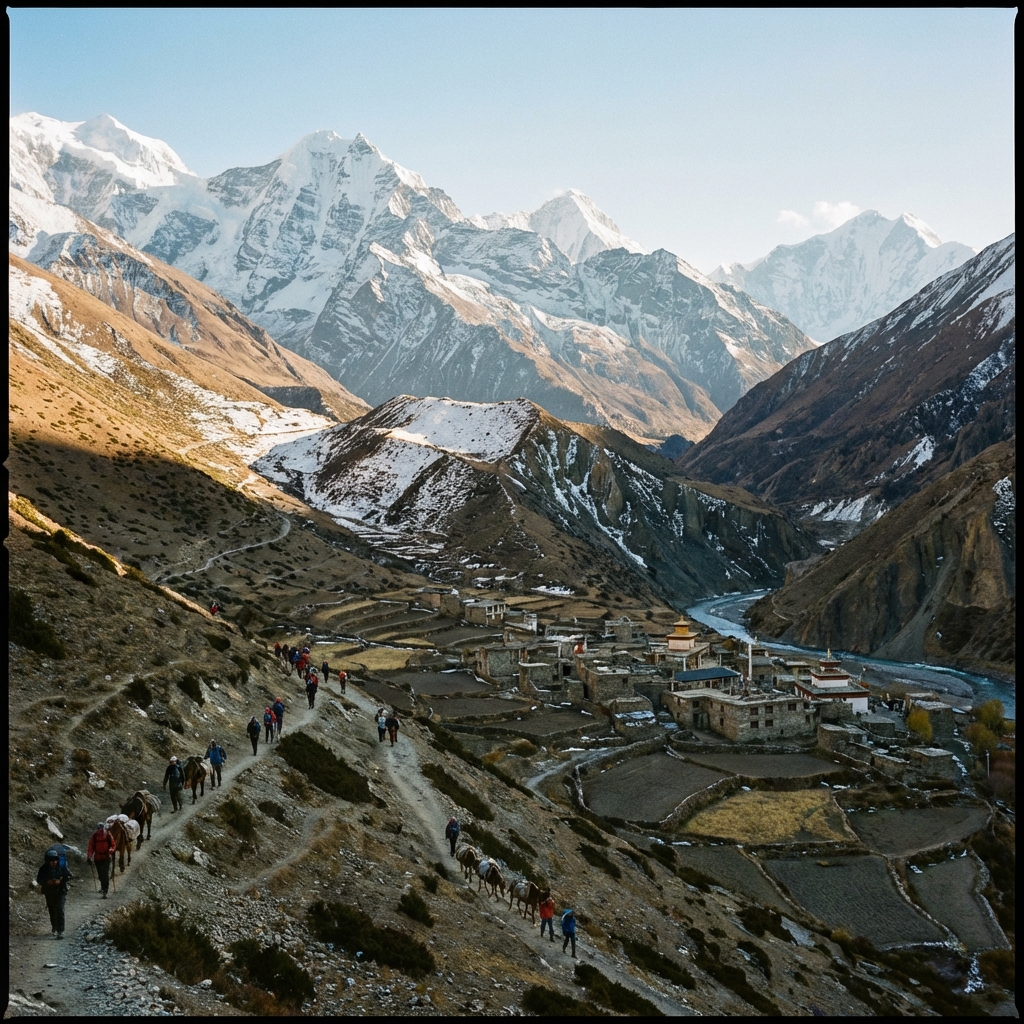
Chhusang sits at the junction where the Kali Gandaki gorge is at its most dramatic — sheer cliff faces rising several hundred meters above the river, the trail cut into the rock in sections. The village itself is notable for cave dwellings integrated into the cliff face above the settlement: some still in use as storage and occasional shelter, others abandoned but visually striking as evidence of the region's long human history.
Cave dwellings as cultural record: The cave habitations around Chhusang (and throughout Upper Mustang) present a puzzle that archaeologists are only beginning to unravel. Some caves were clearly domestic dwellings, others served as meditation retreat spaces, and the highest inaccessible chambers — honeycomb formations 50-100 meters above the valley floor — may have served purposes not yet understood. The cave habitation tradition appears to span 3,000+ years in this region, and Chhusang preserves some of the most accessible evidence of this long occupation.
Chele (3,050m): The First High-Altitude Village
Chele announces your arrival in the distinctly high-altitude cultural zone. The altitude, wind patterns, vegetation cover, and architectural style all shift noticeably here. The flat-roofed mud-brick buildings are built lower and heavier than in the lower valley — the construction reflects the challenges of wind and cold that dominate this environment for much of the year.
Architectural significance: Mustangi architecture in villages like Chele represents a building tradition that has been refined over centuries for the specific conditions of the Trans-Himalayan climate. The mud-brick construction provides excellent thermal mass (warm in day, releasing heat at night). Flat roofs serve as working spaces — grain is dried here, animals occasionally rest here, and festival activities sometimes use the rooftop network. The narrow window openings minimize heat loss while allowing sufficient light. Every element has a functional purpose shaped by extreme conditions.
Reading Mustangi Architecture
Look for three distinctive architectural features as you trek: (1) the juniper branches placed at the top of roof parapets, which are renewed at Losar (Tibetan New Year) as ritual protectors; (2) the prayer flag poles at each rooftop, with strings of prayer flags connecting neighboring houses in festival configurations; (3) the decorative carved wooden window frames, which are the most distinctive artistic expression of domestic architecture in the region. The quality and complexity of window carving can indicate a family's prosperity and status.
Samar (3,660m): The Orchard Village on the Plateau
Samar is a pleasant, relatively prosperous village with apple orchards (sharing the agricultural strategy of Tangbe below) and a well-maintained monastery. It sits in a sheltered hollow on the plateau, partially protected from the extreme wind exposure that characterizes much of the upper trail.
The Samar Monastery: The village gompa is a Sakya-school institution with regular monk residency. The prayer hall contains good-quality Tibetan Buddhist murals and an active shrine with butter lamps maintained daily. Unlike some monasteries in the region that have lost their monastic communities due to outmigration, Samar's monastery has remained active.
The Dri-Me Kunden Cave Temple: Above Samar, a short walk into the cliff face leads to a cave temple associated with the local protective deity tradition. This type of site — a natural cave transformed into a ritual space by adding a simple altar, prayer flags, and painted images — is ubiquitous in Mustang and represents the integration of natural landscape features into the Buddhist sacred geography.
Syangboche (3,800m): The Wind Village
Syangboche sits on an exposed plateau where the Kali Gandaki wind funnel delivers its strongest afternoon blasts. The village's architecture is markedly more defensive than lower settlements — buildings are lower, walls thicker, and the layout of the village itself creates a maze of wind breaks.
The wind and its cultural implications: The Kali Gandaki valley generates one of the strongest consistent wind patterns in the Himalayas, created by the dramatic temperature differential between the cold Tibetan plateau and the warm lowlands to the south. This wind shaped everything in Upper Mustang: the flat roofs weighted with stones, the prayer flags deployed in sheltered positions, the trekking culture (always moving in the morning, sheltering in the afternoon), and even the agricultural calendar (certain planting activities cannot be done on the windiest days). Understanding the wind as a cultural force — not just a weather inconvenience — deepens your appreciation of the landscape.
Ghami (3,520m): The Longest Mani Wall in Nepal
Ghami deserves particular attention for what sits just outside its eastern edge: the longest mani wall in Nepal, stretching over 500 meters and inscribed with thousands of individually carved prayer stones accumulated over centuries.
Mani walls as community practice: The mani wall at Ghami is not simply a religious monument — it is a record of community practice. Each carved stone represents a religious act by a specific person, a prayer accumulated in material form. The oldest stones date to the 14th-15th century, when the Kingdom of Lo was being established. The newest stones have been carved within the past few years. The wall represents an unbroken 600-year tradition of religious activity, with each generation adding its prayers to those of all who came before.
Walking the mani wall: Always walk clockwise (keeping the wall on your right). Take time to examine individual stones — the quality of carving varies from the crude to the exquisitely refined, reflecting the different skill levels and devotion of centuries of contributors. The Om Mani Padme Hum mantra (the six-syllable mantra of Chenrezig, the bodhisattva of compassion) is the most common inscription, but you will also see other mantras, divine names, and elaborate mandala inscriptions on larger stones.
Ghami Monastery: The village monastery is a Sakya institution with particularly good examples of the protective deity (dharmapala) paintings characteristic of this school. The wrathful deity imagery — colorful, fierce, and deliberately frightening — represents forces that protect Buddhist teachings and practitioners, not threats to outsiders.
Mani Wall Photography Ethics
The Ghami mani wall is one of the most photographed sites in Upper Mustang, and that popularity has created friction. Always walk clockwise around the wall before stopping to photograph it. Do not climb on the wall or rearrange stones for better composition. Do not photograph any individual who is using the wall for active prayer without asking permission. The wall is a sacred site in active use, not a photographic backdrop.
Tsarang (3,560m): The Second Kingdom
Tsarang (also spelled Charang) was historically the second-most important settlement in the Kingdom of Lo — a kind of provincial capital within the broader kingdom, with its own dzong (fortress), a significant monastery, and a community wealthy enough to maintain elaborate cultural institutions.
Tsarang Dzong: The fortress above the village is now in dramatic ruin, but its silhouette against the sky remains imposing. The dzong was the seat of regional administration during the Kingdom period and played a role in the complex political history of the Lo region, including periods of conflict between ruling factions within the kingdom.
Tsarang Monastery (Chhoede Gompa): The village monastery contains some of the finest murals in the Upper Mustang region outside of Lo Manthang. Particularly notable are the protector deity paintings in the inner sanctum — deeply saturated colors in dark red, blue, and gold, depicting fierce protective figures surrounded by flames and auspicious symbols. The Tsarang Monastery's collection of ancient texts (hand-copied on traditional Tibetan paper) is also significant.
Life in Tsarang: The village has a functioning agricultural community and offers one of the more intimate village atmospheres on the Upper Mustang trail. Residents may be encountered working in terraced fields, tending to livestock, or engaged in the domestic maintenance activities that occupy highland communities. The flat rooftops in late afternoon are used for drying grains, repairing tools, and socializing — aspects of daily life that make the village feel genuinely inhabited rather than preserved for display.
Tibetan Cultural Traditions Along the Trail
Amchi Medicine: Traditional Healing
One of the most distinctive cultural practices you may encounter in Upper Mustang is amchi medicine — the traditional Tibetan medical system practiced by trained amchi practitioners. Amchi medicine is a comprehensive medical tradition drawing on Indian Ayurveda, Chinese medicine, and indigenous Tibetan knowledge, systematized in the 8th-century text "Gyushi" (Four Tantras of Medicine).
An amchi is trained through a combination of formal study and apprenticeship, typically under a senior practitioner. Training includes memorization of the Gyushi, knowledge of hundreds of medicinal plants and minerals, diagnostic techniques (pulse reading, urine analysis, visual diagnosis), and preparation of compound medicines.
Several villages on the Upper Mustang trail have resident amchi, and your guide can arrange a consultation or observation if you are interested. The ECDC (Endangered Culture Development Centre) in Lo Manthang has worked to document and preserve amchi knowledge, which is at risk from both outmigration and the younger generation's preference for biomedical training.
What to know about amchi medicine: Tibetan medicine is a complete medical system with its own theoretical framework — it is not folk medicine or placebo treatment. Clinical trials of certain Tibetan medicines have demonstrated significant efficacy for specific conditions. Whether you would choose amchi treatment for a medical condition is your personal decision, but approaching the tradition with respect and curiosity rather than skepticism serves the cultural encounter better.
Observing an Amchi at Work
If your guide can arrange an introduction to a local amchi practitioner, it is one of the most memorable cultural encounters available in Upper Mustang. The diagnostic process — in which the amchi takes your pulse at multiple points simultaneously, observes the color and clarity of your tongue and eyes, and asks about sleep patterns and emotional states — reflects a medical framework that integrates physical, mental, and spiritual health in ways that biomedical frameworks do not. Come with genuine curiosity and an open mind.
The Horse Culture of Mustang
Horses have been central to Mustangi culture for centuries. The highlands provide excellent grazing for the hardy Mustangi horse breed, which is smaller and stouter than lowland horses but well-adapted to high-altitude terrain. Historically, horses were the transport backbone of the salt trade caravans, the preferred mount of the kingdom's ruling class, and a central symbol of social status.
Yartung Festival (Horse Festival): Held annually in late summer (typically August, dates vary), Yartung is Upper Mustang's other major festival besides Tiji. It features horse races on the plateau near Lo Manthang, traditional equestrian games, and communal celebration. Riders dress in elaborate traditional costumes, and the festival is as much about social display and community cohesion as about competitive riding.
Horses today: While motor vehicles now reach Lo Manthang via a rough road (part of the broader infrastructure development in Upper Mustang), horses remain a working presence in the landscape — used for agricultural tasks, transport on trails too rough for vehicles, and ceremonial purposes. The horse-and-rider imagery that recurs in Mustangi religious art (particularly depictions of war gods and protective deities) reflects the deep cultural integration of the animal.
Cave Paintings and Pre-Buddhist Heritage
Upper Mustang's cave complexes — particularly those at Choser (Choser Caves), Ghar Gompa, and sites near Tangbe — contain painted images that represent multiple historical periods and artistic traditions.
The oldest paintings: The earliest identifiable painted imagery in Upper Mustang's caves dates to approximately the 10th-12th centuries CE, during the period when Buddhism was being consolidated in the region. These early paintings have distinctive stylistic features connecting them to the Indian Pala Buddhist art tradition — elongated figures, elaborate lotus borders, specific deity iconographic conventions — before the distinctly Tibetan style became dominant.
Pre-Buddhist imagery: Some cave sites in Upper Mustang contain image-making that appears to predate Buddhist influence — geometric markings, animal figures, and abstract patterns that may be associated with Bon (the pre-Buddhist Tibetan religious tradition) or even earlier shamanic traditions. Interpreting these earlier images requires scholarly caution, but their presence suggests an even longer human occupation of the caves than the Buddhist-era paintings indicate.
The ongoing archaeological work: International archaeological teams in collaboration with the Nepal government have been documenting and in some cases excavating Upper Mustang's cave sites since the 1990s. The discoveries — including human remains, ancient manuscripts, and well-preserved organic materials — have significantly rewritten the understood history of the region. Ask your guide about the current state of research; some findings are now displayed in Lo Manthang's small community museum.
Sky Burials: Observed Respectfully
Some communities in Upper Mustang maintain the practice of jhator (Tibetan: "giving alms to the birds") — the ceremonial offering of human remains to vultures at designated sky burial sites. The practice reflects the Buddhist understanding of death as the release of consciousness from a physical vehicle: the body, having served its purpose, is returned to the food chain as an act of generosity.
Sky burials in the Mustang region are conducted at specific sites that are well known to local communities. As a trekker, you may see a sky burial site (a flat rock platform outside a village, often with whitened bone fragments visible from a distance) without witnessing the ceremony itself, which is private and not conducted for outside observation.
The appropriate response: Never attempt to approach, observe, or photograph a sky burial in progress. If you inadvertently find yourself near a ceremony, retreat immediately and quietly. Your guide will know the current burial sites and can route the trail to avoid active ceremonies. The practice is sacred and deeply private; treating it as a tourist spectacle is deeply offensive to the community.
The Salt Trade Legacy in Culture
The ancient Tibetan salt trade that built Lo Manthang's prosperity has left its traces in the landscape and culture even as the trade itself has largely ended.
Trail infrastructure: The "highway" that runs through Upper Mustang from Kagbeni to Lo Manthang and beyond to the Tibetan border was the salt trade route, and many of its physical characteristics — the carved passages through canyon walls, the water points at regular intervals, the small caravanserai settlements at day-journey intervals — reflect the needs of heavily loaded caravan transport rather than recreational trekking.
Cultural memory: The salt trade appears in oral traditions, in the ceremonial use of Tibetan salt at festivals, and in the vocabulary of the Lo dialect, where trade-related terms have survived even as the trade itself has faded. Older residents in Lo Manthang remember the final active caravan period in the 1970s-80s.
Eric Valli's documentation: The French filmmaker Eric Valli spent extended periods in the Dolpo and Mustang regions documenting the final years of the yak caravan trade, producing the Oscar-nominated film Himalaya (also released as Caravan, 1999). While the film was shot primarily in Dolpo, the cultural world it depicts is essentially the same as Upper Mustang's trading culture. Watching the film before your trek provides profound context for what you will encounter.
The New Road and Its Implications
A road now connects Jomsom to Lo Manthang — the first motorized access in the region's history. This road (completed in stages between 2010 and 2020) has brought both opportunities and disruptions. Goods prices in Lo Manthang have dropped significantly. Some residents who would previously have spent their entire lives in the valley now travel regularly to Pokhara and Kathmandu. Young people who once had no options beyond farming and herding now migrate for education and employment. The road is not uniformly welcomed; some community members feel it is accelerating the cultural changes that restricted access was designed to slow. The cultural world you encounter today is in transition in ways that were not true even a decade ago.
Heritage Sites Between Villages
The Kali Gandaki Gorge
The Kali Gandaki river valley is the world's deepest gorge by most measures — the river drops from the Tibetan plateau at 3,800m to the subtropical lowlands below, flanked by peaks (Annapurna, 8,091m; Dhaulagiri, 8,167m) that rise more than 4,000 meters above the valley floor. The gorge has been a trade route, a pilgrimage path, and a geological phenomenon for millennia.
Saligrams: The Kali Gandaki riverbed contains shaligrams — fossilized ammonites from an ancient ocean that existed where the Himalayas now stand (the Tethys Sea). These distinctive coiled fossils are sacred in both Hindu and Tibetan Buddhist traditions. Shaligrams are considered by Vaishnavite Hindus to be embodiments of Vishnu; in Tibetan Buddhism, they are associated with specific protective deities. You may see shaligrams on monastery altars in Upper Mustang. Collecting them from the riverbed is technically prohibited in the protected area, though small examples are sold as religious objects in Kagbeni's shops.
Ancient Chorten Complexes
Between the major villages, the trail passes numerous chorten complexes — groupings of stupas of various sizes and forms that mark significant points in the sacred geography of the route. Some of these complexes date to the earliest period of Buddhist influence in the region (11th-12th centuries) and contain the remains of significant religious practitioners.
The Nyi La pass chortens: At the Nyi La pass (3,950m) between Ghami and Tsarang, a grouping of chortens marks what was historically considered a significant threshold — entering the direct sphere of Lo Manthang's cultural influence. The pass views from this point are expansive, and the chorten complex has clearly been a site of pilgrimage and religious activity for centuries.
How Should You Plan Your Upper Mustang Cultural Trek?
What to Read Before Going
To maximize the cultural depth of your Upper Mustang experience, consider reading before your trek:
- Peter Matthiessen's "The Snow Leopard" (1978) — Set in adjacent Dolpo, but documents the same cultural world and spiritual landscape that you will encounter
- David Snellgrove's "Himalayan Pilgrimage" (1961) — Early academic account of travel through Mustang, providing historical baseline for cultural observations
- Luigi Fieni's documentation of the monastery restoration project (available through AHF publications) — Provides art historical context for the monastery murals
Cultural Sensitivity Essentials
Clockwise movement: Always walk clockwise around any chorten, mani wall, or prayer wheel. Counterclockwise movement is reserved for Bon religious practice and should not be done casually.
Entering monasteries: Remove shoes before any threshold. Do not point feet at altars or sacred images. No flash photography. Do not touch religious objects, texts, or artworks.
Festival observation: During Tiji or village festivals, follow your guide's precise instructions about positioning and photography. Some phases of ceremonies are open to visitors; others are not. Attempting to photograph restricted phases damages trust and potentially damages future trekkers' access.
Dress code: Cover shoulders and knees when entering monasteries and during festival periods. Wind and sun protection clothing that also respects local modesty norms is available at trekking shops in Pokhara and Kathmandu.
- Upper Mustang Trek Itinerary (12 Days)
- Lo Manthang Exploration: Inside the Walled City
- Best Cultural Treks in Nepal
- Monastery Etiquette for Nepal Trekking
- Mustang Region Overview
- Upper Mustang Restricted Area Permit
- Upper Mustang Cost Breakdown
- Yartung Festival in Mustang
- Nepal Trekking Permits Explained
- Best Trekking Agencies for Upper Mustang
- Prayer Flags, Mani Walls and Buddhist Symbols
- Tsum Valley Cultural Exploration
- Off-Beaten-Path Treks in Nepal