
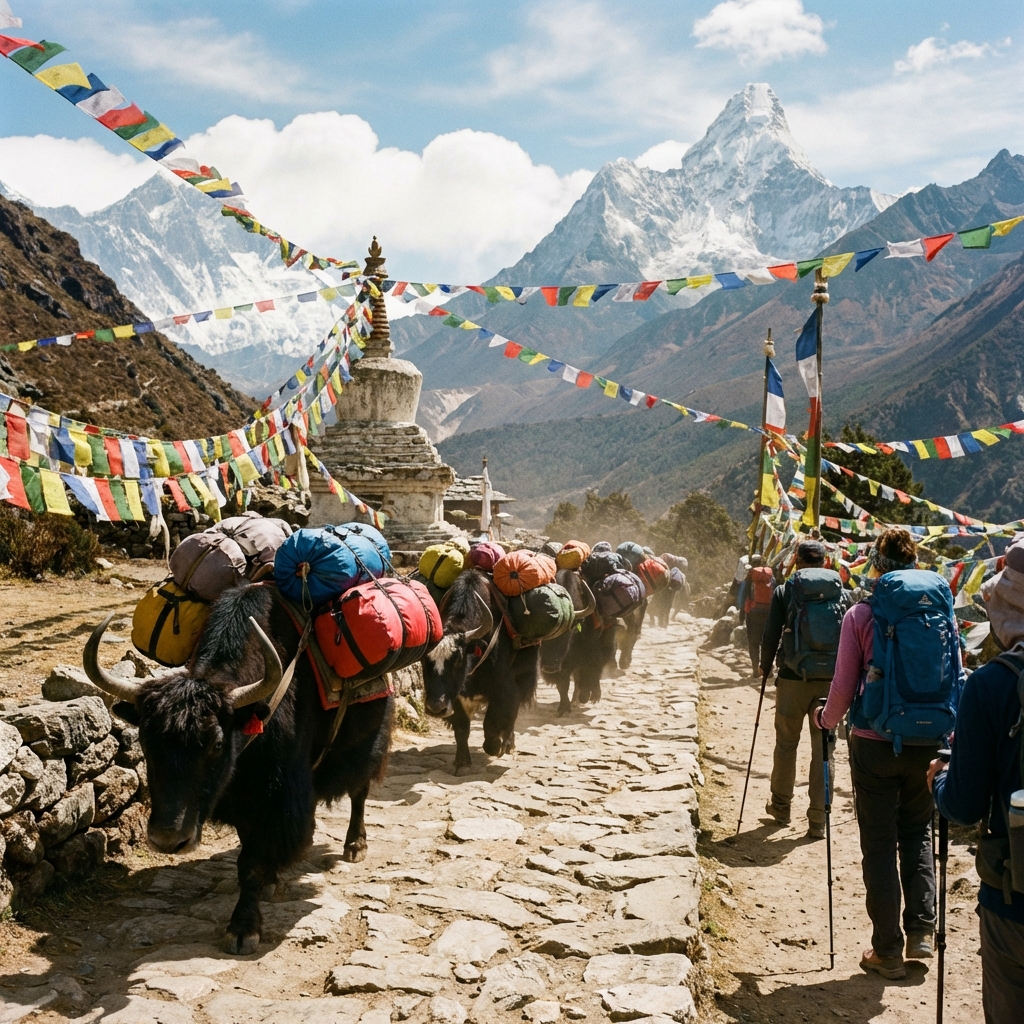
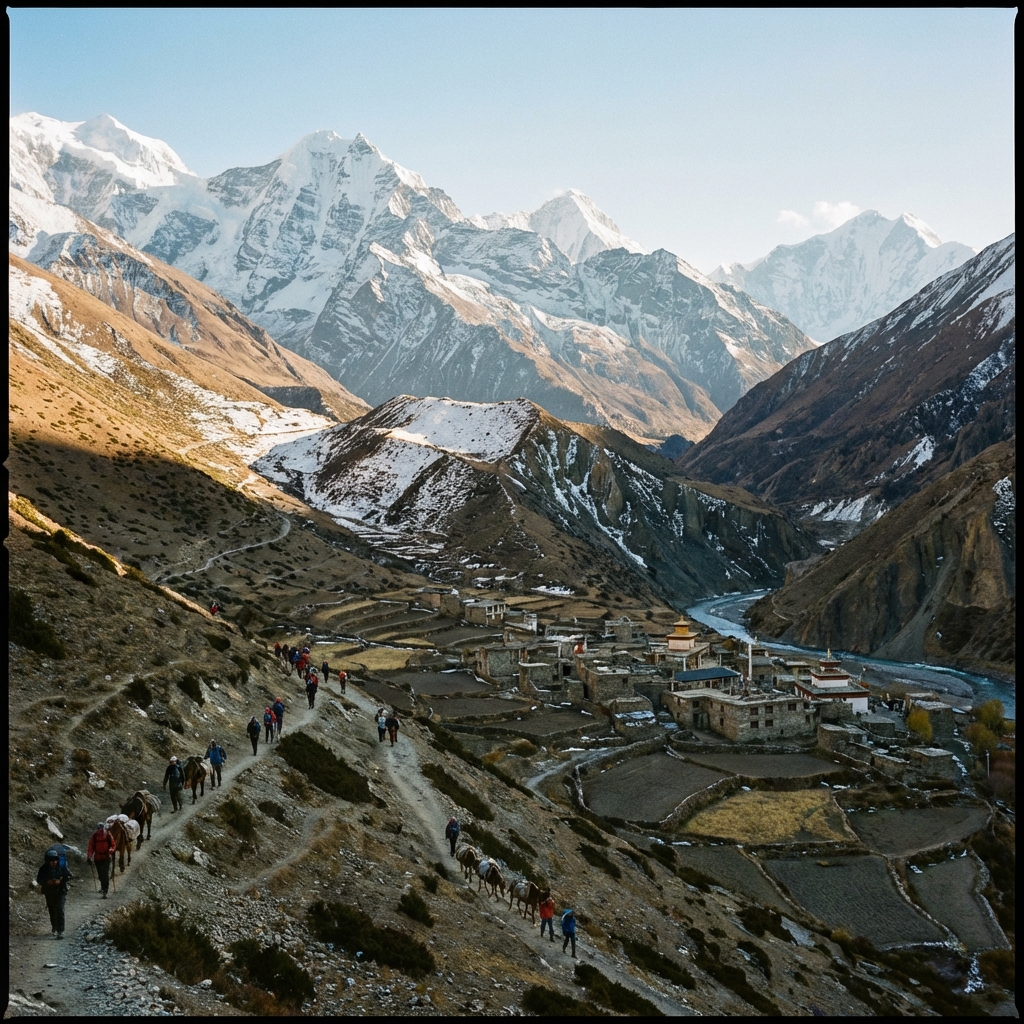
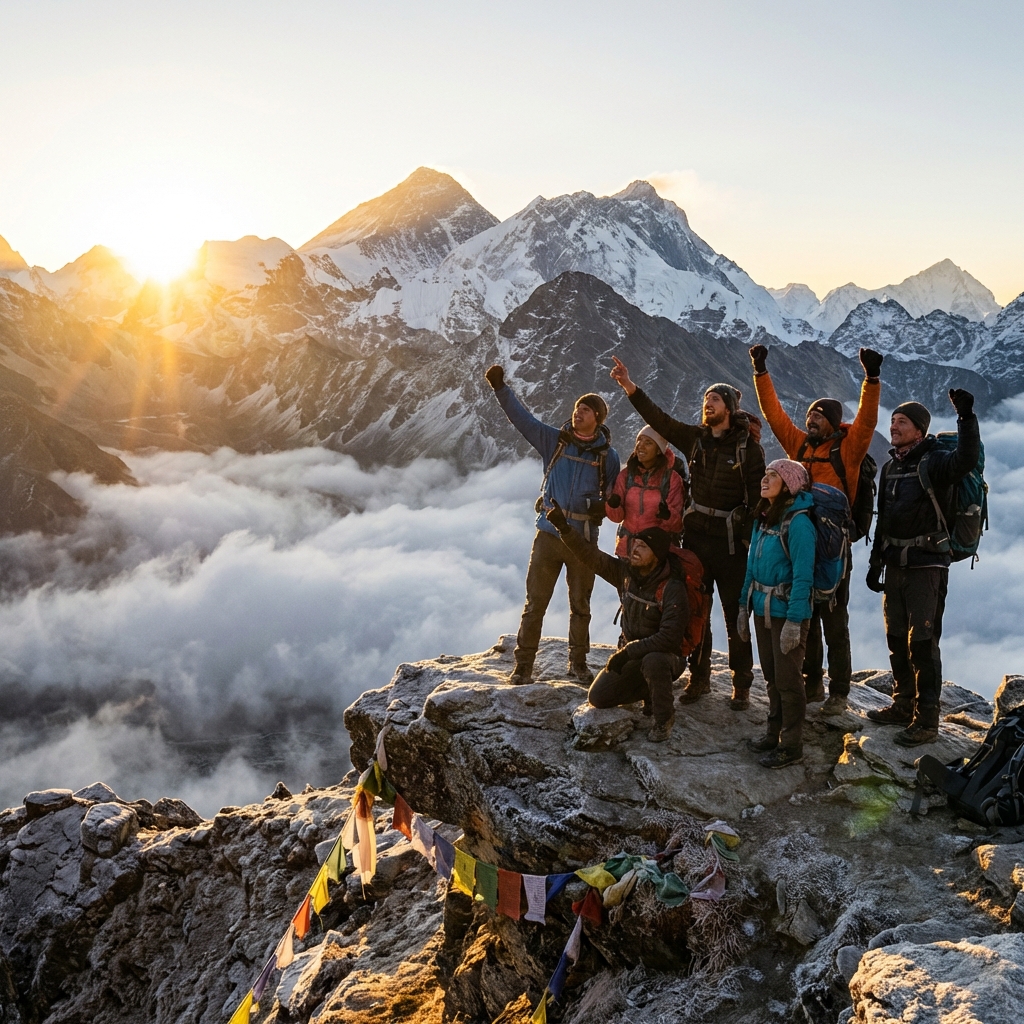
Mardi Himal Base Camp sits at 4,500m on the eastern spur of the Mardi Himal massif, close enough to Machhapuchhre (Fishtail Peak, 6,993m) to see individual seracs on its south face. This is one of the most dramatic high-altitude vantage points in the entire Annapurna region -- and one of the least visited.
While Annapurna Base Camp draws approximately 70,000 trekkers per year and Poon Hill receives comparable numbers, Mardi Himal Base Camp sees roughly 3,000-5,000 trekkers annually. On a weekday in shoulder season, you may have the ridge and the base camp entirely to yourself, with nothing between you and the unclimbed sacred summit of Machhapuchhre except thin air and silence.
The route to Mardi Himal Base Camp follows a single ridge from Kande (1,770m) above Pokhara through dense rhododendron and oak forest to a series of high camps -- Low Camp, Forest Camp, High Camp -- and finally the Upper Viewpoint at 4,500m, where the mountain fills the sky ahead. The ridge walk itself is the attraction: an elevated spine with views on both sides, Machhapuchhre impossibly close to the north, the Modi Khola valley far below, and the full Annapurna sanctuary range spread across the western horizon.
This guide covers the full base camp experience: the trail in detail, what to expect at each camp, camping versus tea house options, weather patterns, and how to maximize the extraordinary photography opportunities that this route offers.
4,500m (Upper Viewpoint / Mardi Himal Base Camp)
7-9 days from Pokhara (5-7 trekking days)
Approximately 55-65km
Moderate (altitude and daily distances)
October-November, March-May
ACAP ($23) + TIMS ($15)
~3,000-5,000 (vs ~70,000 on ABC)
~5km at Upper Viewpoint
Available with permitted camping operator
At Low Camp, High Camp, Upper Viewpoint (basic)
The Mardi Himal Ridge: What Makes This Trek Unique
The Machhapuchhre Close-Up
No other trek in Nepal approaches Machhapuchhre -- the sacred, unclimbed Fishtail peak -- as closely as Mardi Himal. The Annapurna Base Camp route offers views of Machhapuchhre from the south and beneath; the Mardi Himal ridge approaches it from the east, at a similar elevation, putting the trekker at near eye-level with the lower portions of the mountain's massif.
At the Upper Viewpoint (4,500m), Machhapuchhre's south face rises directly in front of you -- a nearly vertical wall of ice and rock rising 2,500m from the ridge where you stand to the unclimbed summit. The seracs, the couloirs, and the hanging ice fields are visible without binoculars. It is one of the most intimate mountain experiences available to a non-mountaineer anywhere in the Himalayas.
The Ridge Walk Experience
Unlike most Himalayan trekking routes that follow valleys, the Mardi Himal trail ascends a ridge. This creates a fundamentally different experience:
- Views on both sides simultaneously: The Modi Khola valley drops away to the west; the Seti River watershed falls to the east. On clear days, you can see both valley systems from the exposed ridgeline.
- Constant mountain perspective: Rather than occasional mountain views when the trail rounds a corner, the ridge walk provides continuous mountain panorama above treeline.
- Ecosystem transition: The single trail passes through five distinct vegetation zones in the ascent from Kande to Upper Viewpoint: subtropical forest, oak forest, rhododendron forest, rhododendron scrub, and high alpine tundra.
- Genuine remoteness feeling: With few other trekkers and no accompanying traffic of mule trains (unlike ABC), the ridge feels genuinely isolated.
Why Mardi Himal Stays Uncrowded
Despite offering mountain views that rival or exceed any other Annapurna trek, Mardi Himal remains uncrowded for a simple reason: it is less marketed. The trail was only formally opened to independent trekking in 2012 and lacks the decades of guidebook coverage that ABC and Poon Hill have accumulated. The tea house infrastructure above High Camp is more basic, and the route requires more self-sufficiency than the well-serviced ABC trail. These factors filter out casual trekkers, leaving the ridge primarily to those who specifically seek it out.
The Trail in Detail
Kande (1,770m) to Low Camp (2,985m) -- Day 1
Distance: 8km | Time: 4-5 hours | Elevation Gain: +1,215m
Getting to Kande: Kande is a small village on the ridge road above Pokhara, approximately 1 hour by road (taxi $8-12, or local bus). The trek begins where the road ends at the small Kande trailhead.
The initial trail from Kande is narrow and single-track, immediately entering dense subtropical forest. The first hour is steep -- a relentless climb through oak and chestnut forest on a well-maintained but physically demanding trail. The vegetation is lush, the air humid (at this elevation), and the forest sounds rich with birds.
Through the oak forest (1,770m to 2,200m): The dominant trees are Quercus leucotrichophora (Himalayan oak), their trunks covered in thick moss, with occasional clearings where Pokhara's valley is visible below. This lower section is the least dramatic part of the trek and the one that requires the most patience -- you are walking in forest with limited mountain visibility.
Entering rhododendron forest (2,200m to 2,985m): Around 2,200m, the oak gives way to dense rhododendron. Nepal's national flower (Rhododendron arboreum) grows here as full trees, not shrubs, with trunks 30-40cm in diameter. In spring (March-April), the blooms create a spectacular color display; in autumn, the leaves turn rich red-gold.
Low Camp (2,985m): A clearing in the forest with 4-5 tea houses -- the first settlement on the Mardi Himal ridge. Views of Machhapuchhre begin appearing through gaps in the canopy here, the first hints of what awaits above. Accommodation is basic but clean: wooden bunk beds, simple meals, a shared squat toilet. Solar charging available at the main lodge.
Pro Tip
Start Day 1 early (7:00-7:30 AM) to avoid walking in the heat of the lower forest sections. The subtropical forest between Kande and 2,000m is warm and humid -- uncomfortable in afternoon heat. By the time you reach Low Camp, afternoon clouds often build over the valley, obscuring the views that should begin appearing at this elevation.
Low Camp (2,985m) to High Camp (3,580m) -- Day 2
Distance: 6km | Time: 4-5 hours | Elevation Gain: +595m
Day 2 is where the Mardi Himal trek transforms from a forest walk into a high-altitude ridge experience. The trail continues from Low Camp through increasingly sparse rhododendron scrub to Forest Camp (an intermediate stop used by some trekkers) and then to High Camp on the open ridge.
Low Camp to Forest Camp (2,600m -- note: Forest Camp is below High Camp despite the name): This is a descent, not an ascent -- the trail dips into a sheltered forest valley between the Low Camp ridge and the main Mardi Himal ridge. Forest Camp is an alternative overnight used primarily by those doing the shorter 5-day version who descend via this route.
Forest Camp to High Camp (3,580m): From Forest Camp, the trail climbs steeply back onto the main ridge and the trees begin thinning. This is the most physically demanding section of Day 2, gaining 980m from Forest Camp to High Camp. The effort is repaid: at approximately 3,000m, the rhododendron scrub gives way to open ridge, and the full Annapurna mountain panorama opens for the first time.
High Camp (3,580m): The main hub of the Mardi Himal trek and the most dramatic overnight stop on the route. Six to eight tea houses sit on an exposed, wind-swept ridgeline. The 180-degree views from High Camp are extraordinary:
- Machhapuchhre (6,993m) directly across the ridge to the north -- closer than from any other accessible viewpoint, its twin summits clearly distinct
- Annapurna South (7,219m) and the full Annapurna sanctuary to the west
- Mardi Himal (5,587m) above and to the north-northeast -- the peak itself visible above the upper ridge
- The Modi Khola valley 2,700m below to the west, a deep green trench between the ranges
- Hiunchuli (6,441m) and Tent Peak (5,663m) completing the western panorama
Sunsets at High Camp are legendary among Mardi Himal trekkers -- the alpenglow on Machhapuchhre as the sun sets over Dhaulagiri turns the mountain first gold, then rose, then deep violet. Clear nights at 3,580m reveal a sky so dense with stars that the Milky Way casts visible shadows.
Sleeping at High Camp: Acclimatization Note
High Camp at 3,580m is the highest sleep altitude on the trek (Upper Viewpoint is visited as a day trip). Some trekkers experience mild altitude symptoms here: slight headache, reduced appetite, or disturbed sleep. This is normal and generally resolves after the first night. If you have significant symptoms -- severe headache, nausea, difficulty walking -- descend immediately. Do not push to Upper Viewpoint if you feel seriously unwell at High Camp.
High Camp (3,580m) to Upper Viewpoint / Mardi Himal Base Camp (4,500m) -- Day 3
Distance: 5km up, 5km return | Time: 3-4 hours ascent, 2-3 hours descent | Elevation Gain: +920m
The summit day. Depart High Camp by 5:30-6:00 AM for the best conditions -- clouds build rapidly on this ridge after 11 AM and can obscure the views completely by early afternoon.
The ascent: The trail from High Camp to Upper Viewpoint is well-marked in good weather -- follow the ridge crest and the cairns that trekkers have built over the years. The first section (3,580m to 4,000m) involves steep rocky terrain with some scrambling required in sections. Above 4,000m, the ridge becomes more open and the trail traverses across the upper slope rather than following the crest directly.
At approximately 4,000m: The final views of the Modi Khola valley to the west disappear, and the perspective shifts entirely to the mountain faces surrounding you. Machhapuchhre's south face now fills the northern sky.
Upper Viewpoint / Mardi Himal Base Camp (4,500m):
The trail ends at a broad, flat area at the base of Mardi Himal's southeast ridge. One or two basic tea house tents operate here during peak season (October-November, March-May). The name "Mardi Himal Base Camp" is used informally -- the actual technical climbing base camp for Mardi Himal peak (5,587m) is in a different location and requires climbing permits.
What you experience at this viewpoint:
- Machhapuchhre (6,993m) is directly ahead and roughly 5km away -- the closest any trekker can approach the sacred, unclimbed peak. The south face rises in a nearly vertical sweep from the ridge beneath your feet to the twin summit far above. You can see the icefalls, the seracs, and the couloirs without binoculars.
- Annapurna South (7,219m) and the full sanctuary range extend to the west
- Mardi Himal's own peak (5,587m) is above and behind you -- you are literally at the base of this mountain
- The Annapurna range including Annapurna I (8,091m), Annapurna III (7,555m), and Gangapurna (7,455m) complete the panorama
Time at the viewpoint: Allow 1-2 hours at the Upper Viewpoint before beginning descent. Eat, drink, photograph, and allow the scale of the mountains to register fully before you turn back.
Pro Tip
Bring a zoom lens or binoculars to Mardi Himal Upper Viewpoint. The proximity to Machhapuchhre makes it possible to photograph the mountain in extraordinary detail -- individual seracs, the route lines of previous climbing attempts (before the peak was closed), and the dramatic ice formations on the south face are all visible and photographable. No other non-technical viewpoint in Nepal offers this level of close-up mountain detail.
Return from Upper Viewpoint to Forest Camp: After returning to High Camp for lunch, continue the descent to Forest Camp (2,600m) -- a total descent of nearly 1,000m from the Upper Viewpoint. This is the longest and most physically demanding day of the trek: the ascent to Upper Viewpoint followed by the descent to Forest Camp in a single day. Start early, pace yourself, and use trekking poles throughout.
Camping vs Tea House at Mardi Himal
Tea House Option (Standard)
Tea houses exist at Low Camp, High Camp, and Upper Viewpoint (basic tent-style operations at the top). This is how most trekkers do the route.
| Camp | Tea Houses | Bed Quality | Food | Facilities |
|---|---|---|---|---|
| Low Camp | 4-5 | Basic bunk | Standard trekking menu | Solar charging, shared toilet |
| High Camp | 6-8 | Basic to moderate | Standard menu, limited choice | Solar charging, cold shower |
| Upper Viewpoint | 1-2 (tent/seasonal) | Very basic | Simple snacks and drinks | None |
| Forest Camp | 3-4 | Basic bunk | Standard menu | Solar charging |
Cost: NPR 300-600/night (bed only). Meal packages typically NPR 1,500-2,500/day.
Camping Option
Camping is possible on the Mardi Himal route with a registered trekking agency that holds camping permissions. This option provides:
- Your own tent (agency-supplied) at campsites near each village/camp
- Full cook support with a trekking kitchen and dedicated camp crew
- Better food quality than tea houses (fresh ingredients carried up)
- More privacy and flexibility with overnight locations
Camping is particularly appealing at Upper Viewpoint: Spending the night at 4,500m rather than descending to High Camp allows you to experience sunrise from the viewpoint -- when Machhapuchhre's face catches the first light -- an extraordinary experience unavailable to day-trippers from High Camp.
Camping cost: $40-80/day additional on top of the trekking package cost, depending on group size and agency. Solo camping is expensive; groups of 4-8 people make camping much more cost-effective per person.
Camping at Upper Viewpoint: Worth It
If budget and time allow, one camping night at Upper Viewpoint (4,500m) is one of the most memorable high-altitude experiences in Nepal trekking. The sunset on Machhapuchhre from 4,500m -- watched from your tent door with a hot drink from your camp kitchen -- rivals any experience on the ABC or EBC routes. Very few trekkers experience this because most use the tea house option and descend after the day visit.
Camping Logistics
To camp on the Mardi Himal route, arrange with a licensed trekking agency in Pokhara before the trek. Key requirements:
- Camping permits (arranged by agency)
- All equipment carried by porters (minimum 1 porter per 2 trekkers for camping kit)
- Designated camping zones (you cannot pitch a tent anywhere on the ridge)
- Full crew: cook, kitchen assistant, and guide in addition to porters
- Leave No Trace compliance: all waste carried out
Weather at Mardi Himal
Seasonal Conditions
October and November (Peak Season):
- Conditions: Best mountain views, stable weather, low precipitation
- Temperature at High Camp: 0°C to 10°C during day, -5°C to -15°C at night
- Wind: Moderate on the exposed ridge; High Camp is exposed to westerly winds
- Visibility: Generally excellent for 2-3 weeks; occasional cloud cover
- Crowding: Higher but still low compared to ABC (50-100 trekkers on trail vs 1,000+ on ABC)
March and April (Second Best):
- Conditions: Rhododendron blooms (spectacular on lower ridge), warming temperatures, building afternoon clouds
- Temperature at High Camp: 5°C to 15°C during day, -5°C to 5°C at night
- Wind: Variable; calmer than autumn
- Visibility: Clear mornings, clouds building after 11 AM. Start Upper Viewpoint ascent by 6:00 AM.
- Special: The rhododendron forest (Low Camp to High Camp) is at its most spectacular in March-April
May:
- Possible but increasingly humid; pre-monsoon clouds can obscure views for days at a time. Not recommended.
December-February:
- Cold and often clear. Some tea houses above Low Camp close in January. High Camp can be snow-covered and extremely cold. Only for experienced cold-weather trekkers.
June-September (Monsoon):
- Not recommended. Heavy rain, leeches below 3,000m, views permanently obscured, and trail conditions poor.
Wind at High Camp and Upper Viewpoint
The exposed Mardi Himal ridgeline is subject to strong westerly winds, particularly at High Camp and above. Wind speeds of 40-60 km/h are not unusual during unsettled weather, making the exposed ridge sections cold and physically taxing. Always carry a windproof outer layer regardless of the temperature when you set out. The Upper Viewpoint is fully exposed -- without wind protection, even a moderate wind at 4,500m makes the experience uncomfortable.
Photography at Mardi Himal
Mardi Himal is one of Nepal's finest photography treks and among the least photographically exploited. The combination of dramatic ridgeline composition, close Machhapuchhre proximity, and solitude (no crowds in frame) makes it exceptional.
Best Photography Locations
High Camp at sunset: The western horizon is dominated by the Annapurna range. As the sun descends behind Dhaulagiri, the alpenglow sweeps across Annapurna I, Annapurna South, and finally Machhapuchhre in sequence. The foreground of the wind-blown ridgeline grass and the distant peaks at golden hour creates the classic Mardi Himal image.
Upper Viewpoint, morning: The early morning light (6:00-8:00 AM) hits Machhapuchhre's south face at a low angle, creating dramatic shadow play across the ice formations. This is the best window for detail photography of the mountain face.
Forest sections, spring rhododendron: The rhododendron forest between Low Camp and High Camp in March-April offers intimate forest photography unlike anything available on the ABC or EBC routes.
Aerial-style views from the ridgeline: The drop of the Modi Khola valley 2,700m below provides classic "ridge with abyss" composition shots that convey the scale of the Annapurna terrain.
Photography Gear Recommendations
- Focal length: A 24-200mm zoom covers the full range needed from forest close-ups to distant peak photography. A 400mm+ telephoto reveals extraordinary detail on Machhapuchhre from the Upper Viewpoint.
- Filters: Circular polarizer for blue sky definition; ND filters for long-exposure cloud movement at High Camp
- Backup batteries: Cold temperatures (particularly at High Camp at night) drain batteries rapidly. Carry 2-3 charged spares.
- Tripod: Essential for low-light sunrise/sunset shots and long exposures. A lightweight carbon fiber travel tripod is adequate.
Mardi Himal Base Camp vs Annapurna Base Camp
These are the Annapurna region's two most popular high-altitude destinations. The right choice depends on what you are seeking.
| Factor | Mardi Himal Base Camp (4,500m) | Annapurna Base Camp (4,130m) |
|---|---|---|
| Altitude | 4,500m | 4,130m |
| Crowd level | Very low (3,000-5,000/year) | High (70,000+/year) |
| Machhapuchhre views | Extremely close (5km) | Mid-distance |
| Annapurna sanctuary | Views from outside | Inside the sanctuary |
| Trek duration | 7-9 days | 10-12 days |
| Tea house quality | Basic above Low Camp | Good to Chhomrong, basic above |
| Camping option | Yes, excellent | Limited |
| Physical challenge | Moderate | Moderate |
| Best for | Solitude, close mountain photography | Immersive sanctuary experience |
Recommendation: For trekkers with limited time (7-9 days) who want extraordinary mountain proximity with minimal crowds, Mardi Himal is the superior choice. For trekkers who want to be inside the mountain amphitheater with the full 360-degree sanctuary experience, ABC is the choice. Many repeat Nepal visitors do ABC on their first trip and Mardi Himal on their return.
Frequently Asked Questions
How close does the Mardi Himal trek get to Machhapuchhre?
At the Upper Viewpoint (4,500m), you are approximately 5km from Machhapuchhre's south face. This is the closest any trekking route gets to the sacred, unclimbed Fishtail peak, allowing you to see individual seracs and couloirs without binoculars.
Is camping allowed on the Mardi Himal ridge?
Yes, camping is permitted with a licensed camping operator. Some trekkers camp at the Upper Viewpoint for sunrise photography. Basic tea house accommodation is also available at Low Camp, High Camp, and the Upper Viewpoint.
When do the rhododendrons bloom on the Mardi Himal trail?
The rhododendron bloom peaks between mid-March and late April in the forest sections between Kande and Low Camp. The display is spectacular, with full-sized rhododendron trees creating tunnels of red and pink flowers along the trail.
How does Mardi Himal compare to ABC for mountain views?
Mardi Himal offers closer views of Machhapuchhre and a unique ridge perspective, while ABC provides the famous sanctuary amphitheatre surrounded by multiple 7,000-8,000m peaks. Both are exceptional but deliver fundamentally different experiences.
- Mardi Himal 7-Day Itinerary
- Mardi Himal Difficulty Assessment
- Best Time for Mardi Himal Trek
- Mardi Himal Route Overview
- Mardi Himal Cost Breakdown
- Best Trekking Agencies for Mardi Himal
- Annapurna Base Camp Route Overview
- Annapurna Region Overview
- Nepal Trekking Packing List
- Altitude Sickness Signs and Turnaround Rules