
Island Peak Best Time: Month-by-Month Climbing Guide
The best time to climb Island Peak (Imja Tse, 6,189m) is October to November (autumn), with April to May (spring) the strong second choice. Autumn delivers the most stable high-pressure weather, consolidated summit snow, and 80–90% success rates, while spring offers warmer temperatures and blooming valleys. The monsoon (June–August) and deep winter (late December–February) are not recommended for most climbers.
Island Peak is Nepal's most popular trekking peak and the first high-altitude climbing experience for thousands of mountaineers each year. It sits in the heart of the Khumbu, with a base camp at 5,100m and a summit ridge that combines glacier travel, fixed-rope climbing, and a final push to a snow and ice summit with one of the finest views in the Nepal Himalaya.
Getting the island peak best time right means balancing several factors at once: summit conditions (snow consolidation, wind), the EBC trek itinerary that almost every Island Peak climber combines it with, permit logistics, and the specific weather patterns that define the Khumbu's two trekking seasons. This guide breaks down every month, compares the two prime windows side by side, and shows you how the timing locks into a workable acclimatization schedule.
Quick Overview
6,189m (20,305ft)
October–November (autumn)
April–May (spring)
June–August (monsoon)
Nepal Mountaineering Association (NMA) Peak Climbing Permit
$250 USD per person (autumn), $125 (winter/spring)
5,100m
PD (Peu Difficile — moderate)
70–85% in good conditions
Crampon use, basic fixed-rope technique, glacier travel
What Is the Best Time to Climb Island Peak?
For most climbers, October to mid-November is the single best window to climb Island Peak. The post-monsoon high-pressure system parks itself over the Khumbu, the summit snowpack has consolidated, the jet stream sits north of the Himalayas (lighter summit winds), and the timing dovetails perfectly with the Everest Base Camp trek that supplies your acclimatization. April to May (spring) is the close runner-up, trading slightly less stable late-season weather for warmer days, longer daylight, and rhododendron-lined approach valleys.
Both seasons share the same core advantages every commercial operator looks for: stable weather, clear visibility, open Chukhung Valley teahouses, well-defined fixed ropes, and manageable temperatures. The off-seasons — monsoon and deep winter — strip away those advantages one by one. The sections below score each month so you can match the climb to your schedule, experience, and tolerance for crowds.
If your dates are flexible, target October 10–25 or April 15 to early May. These are the two highest-probability summit windows of the year for Island Peak, balancing weather stability against the worst of the crowds.
Spring vs Autumn: Side-by-Side Comparison
The two prime seasons are genuinely close. Autumn wins on weather stability and snow quality; spring wins on temperature and approach scenery. Use this table to decide which fits your priorities.
Bottom line: Choose autumn for the highest summit odds and the most reliable weather. Choose spring if you want warmer summit temperatures, longer climbing days, a lower permit fee, and the green-and-flowering Khumbu — and you're comfortable summiting before the noon cloud build-up.
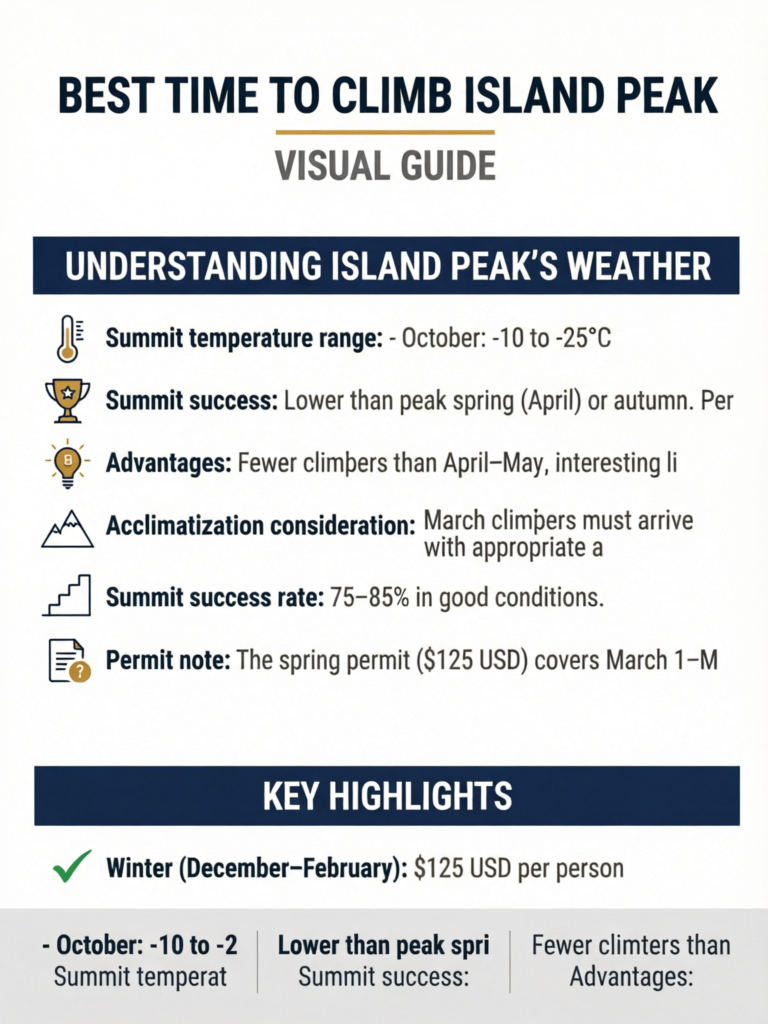
Understanding Island Peak's Weather
Island Peak's position in the Chukhung Valley — a side valley east of the main EBC trail — creates a specific microclimate. The valley is more sheltered than the main Khumbu but still subject to the same general weather patterns: jet stream influence in winter, monsoon from the south in summer, and the clear windows of autumn and spring.
Summit temperature range:
- October: -10 to -25°C
- November: -15 to -30°C
- April: -5 to -20°C
- May: 0 to -15°C
Wind at summit: Variable. The jet stream is farther north in autumn (less impact at 6,189m) and moves south in winter (stronger summit winds). Spring sees the jet stream passing north again. Summit wind speeds of 60–100 km/h are possible in November onward and in March.
Month-by-Month Assessment
January and February
Overall rating: Not recommended for most climbers
The Khumbu winter is harsh. Summit temperatures drop to -30°C. Wind speeds are extreme. Most commercial Island Peak expeditions do not operate in these months.
That said: Island Peak has been climbed in January and February by experienced alpinists and small private expeditions. The summit conditions require full winter mountaineering kit — thick insulated boots, heavyweight down suit, and the mental fortitude for extreme cold. Success is possible but the margin for error is narrow.
Logistical note: Some Chukhung Valley teahouses close in December–February. Verify lodge availability before planning a winter attempt.
Trekker numbers: Very few. If you prefer solitude and are experienced with winter conditions, February in particular offers excellent clarity and few other climbers.
March
Overall rating: Fair — improving through the month
March marks the beginning of the spring window. Jet stream influence is decreasing, temperatures are warming, and the fixed ropes installed by early expedition teams begin to appear on the mountain.
Weather: Unstable in early March; improving rapidly through the month. Cloud development begins in the afternoon, especially in the second half of the month. Summit wind is still significant.
Summit success: Lower than peak spring (April) or autumn. Perhaps 50–65% in good conditions.
Advantages: Fewer climbers than April–May, interesting light conditions for photography, the valley is beautiful in early spring with snow still present.
Acclimatization consideration: March climbers must arrive with appropriate acclimatization built up. The acclimatization day activities at Dingboche and Chhukung are essential preparation. The Chhukung Ri (5,550m) acclimatization hike from Dingboche provides excellent preparation at the correct altitude.
April
Overall rating: Excellent — peak spring season
April is the second-best month to climb Island Peak after October. The weather window is generally stable, temperatures are more forgiving than autumn (-5 to -15°C on summit), and the Khumbu is at its most beautiful with rhododendrons blooming in the lower valleys.
Weather: Good overall. Pre-monsoon clouds begin building in afternoon. Morning summit windows are reliable. The rule of "summit before noon" applies in April.
Summit success rate: 75–85% in good conditions.
Crowds: April is the peak spring season for both EBC trekking and Island Peak climbing. Expect 5–15 other climbing teams at base camp and potentially 20–30 people on the summit day. Fixed ropes may have queue waits.
Combination with EBC: April is excellent for the EBC plus Island Peak combination. The standard approach completes EBC first (passing through Namche, Tengboche, Dingboche, Gorak Shep, EBC, and Kala Patthar), then returns to Dingboche for the Chukhung Valley approach to Island Peak.
Permit note: The spring permit ($125 USD) covers March 1–May 31.
May
Overall rating: Good — pre-monsoon challenges increasing
May remains a viable Island Peak climbing window but with increasing pre-monsoon instability.
Early May (1–15): Conditions close to April quality. Afternoon cloud development more pronounced. Still viable for summit attempts.
Late May (16–31): Pre-monsoon weather becomes increasingly unstable. Afternoon thunderstorms can develop rapidly. Summit windows narrow. Only experienced climbers familiar with Himalayan weather patterns should plan late May attempts.
Temperatures: Warmest of any climbing month — summit temperatures may be above -10°C in May. This actually increases avalanche risk on the summit slopes as snow becomes less consolidated.
June, July, August
Overall rating: Not recommended
The monsoon closes Island Peak to all but the most determined or experienced climbers. Heavy snowfall covers the route, crevasse detection becomes extremely difficult, and weather windows are rare and short. Most commercial operators suspend Island Peak expeditions for this period.
Some trekkers visit Chukhung during September as the monsoon breaks — see below. If you are set on travelling to Nepal in these months, read our monsoon trekking guide for the lower-altitude routes that stay viable.
September
Overall rating: Fair to Good — late monsoon transition
The monsoon withdraws from Nepal progressively through September. High altitude areas like the Chukhung Valley clear earlier than lower elevations.
Early September: Conditions still monsoon-affected. Not recommended.
Late September: The post-monsoon clearing can be dramatic — days of crystal visibility following the final monsoon storms. Island Peak attempts in late September (25th onward) are possible and can be spectacular. The summit snowpack is fresh and consolidated from recent monsoon snowfall.
Risks: Avalanche risk is elevated immediately following heavy snowfall. A period of consolidation (5–7 days minimum of dry weather) should precede any attempt.
October
Overall rating: Outstanding — the prime autumn season
October is the best month to climb Island Peak. Post-monsoon skies are crystal clear, the fresh summit snowpack from the monsoon is consolidated, temperatures are demanding but manageable, and the logistics of the EBC trek timing align perfectly.
Weather: Outstanding. Stable high-pressure dominates the Khumbu through most of October. Mornings are clear and cold; afternoons may see some cloud but the summit is typically clear by the time climbers are descending.
Summit success rate: 80–90% in good conditions.
Temperature at summit: -10 to -20°C. Warm by Island Peak standards. Quality down gloves, a down suit, and good insulated boots are still essential.
Crowds: Peak season. Base camp will have 10–25 teams. A popular summit day (October 10–25) may see 40–60 people on the mountain. The fixed ropes at the crux can create queue waits. Starting your summit push by 1–2 AM (from Camp 1 at 5,600m) is standard to reach the technical section before peak activity.
Combination itinerary: Most commercial guided groups spend 18–22 days total: fly Kathmandu–Lukla, walk to Namche, acclimatize, continue to Dingboche (acclimatize), side trip to Chukhung Ri, continue to EBC and Kala Patthar, return to Chukhung, climb Island Peak (typically 3 days from Chukhung), return to Lukla.
Permit note: The autumn peak-season permit costs $250 USD per person (September–November).
November
Overall rating: Very Good (early) / Challenging (late)
Early November provides excellent conditions comparable to October. As the month progresses, winter settles into the Khumbu.
Early November (1–15): Excellent. Similar to October quality. Fewer climbers than peak October.
Late November (16–30): Conditions deteriorate. Summit temperatures drop to -25 to -30°C. Wind increases. Fixed ropes may be covered by snowfall. Success rates drop to 50–60%.
Advantage of November: The Khumbu is beautiful in November with dusting snow on peaks and very few crowds in the second half of the month.
How Season Affects Summit Success Rate
Island Peak's published summit success rates are strongly seasonal. The variable that moves the number most is summit wind and snow consolidation, both of which favour autumn.
- October–early November: 80–90% in good conditions. The highest-probability window of the year.
- April: 75–85%. Stable mornings; success drops if teams leave their summit push too late and get caught by afternoon cloud.
- May: Slightly lower than April due to warming snow and afternoon storms.
- March / late November: 50–65%. Wind and cold cut into the margin.
- Monsoon / deep winter: Sharply lower and rarely attempted commercially.
Three controllable factors raise your personal odds in any season: adequate acclimatization days before the climb, multiple buffer days so you can wait out a bad summit-day forecast, and using the high camp (Camp 1 at ~5,600m) rather than pushing from base camp. Most climbers who fail do so because of rushed itineraries and altitude illness, not because the mountain was too technical.
Pro Tip
Build at least two spare days into your schedule. Island Peak summit days are weather-dependent, and a single extra day to wait out high winds is often the difference between standing on the summit and turning around at the headwall.
How Hard Is Island Peak — and Does Season Change It?
Island Peak is graded PD (Peu Difficile) — moderate by alpine standards, but it is a genuine mountaineering objective, not a walk-up. You will use crampons and an ice axe, clip into fixed ropes on the headwall, cross a glacier with crevasses, and jumar a steep snow-and-ice section of roughly 100–120m below the summit ridge. Required skills are crampon technique, basic fixed-rope and jumar use, and glacier travel — most of which a competent guide can coach during the approach.
Season changes the difficulty in specific ways. In autumn the consolidated snow makes the glacier and headwall more predictable, but the cold is biting. In spring the warmer temperatures are kinder on the hands and feet, yet softening snow can raise avalanche risk on the summit slopes and the headwall can be slushier in the afternoon — reinforcing the "summit before noon" rule. In the off-seasons, hidden crevasses (monsoon) and brutal wind (winter) push the difficulty far beyond PD.
For a full breakdown of the climb itself and the kit you need, see our Island Peak climbing guide, equipment guide, and training requirements.
How to Reach Island Peak
There is essentially one gateway: Lukla, reached by a short mountain flight from Kathmandu (or, in peak season, from Ramechhap). From Lukla the approach is the classic Everest trail, which doubles as your acclimatization. A typical sequence:
Sample Itinerary
Fly Kathmandu → Lukla, trek to Phakding
Short mountain flight, gentle first walk to ~2,610m.
Phakding → Namche Bazaar
Climb to 3,440m, the Khumbu's main hub.
Namche acclimatization day
Hike to Everest View Hotel / Khumjung, sleep low.
Namche → Tengboche → Dingboche
Through Tengboche Monastery to Dingboche (4,410m).
Dingboche acclimatization
Hike Nagarjun or toward Chhukung Ri (5,550m).
Dingboche → Chhukung
Short stage to 4,730m, gateway to the Imja Valley.
Chhukung → Island Peak Base Camp
Trek to base camp at 5,100m; skills refresher.
Base Camp → High Camp (Camp 1)
Move up to ~5,600m for a shorter summit push.
Summit day & return
Pre-dawn start, glacier, headwall, summit (6,189m), descend.
Return trek to Lukla, fly to Kathmandu
Retrace the trail; buffer days for weather.
Most climbers fold the full Everest Base Camp trek into this — completing EBC and Kala Patthar first for superior acclimatization, then doubling back to the Imja Valley. That version runs 18–22 days. See the full Everest Base Camp route and Kala Patthar summit guide for the trekking half of the trip.
Acclimatization: Why Timing and Schedule Both Matter
Choosing the right season puts you on a clear mountain; building the right schedule keeps you healthy enough to climb it. Island Peak's base camp sits at 5,100m and the summit is 6,189m — altitudes where rushing is the single biggest cause of failed climbs and evacuations.
- Follow the EBC acclimatization rhythm: rest days at Namche (3,440m) and Dingboche (4,410m), and a side hike to Chhukung Ri (5,550m) before the climb.
- Combine with EBC where possible — reaching Kala Patthar (5,545m) and EBC before Island Peak gives you days above 5,000m that pay off on summit day.
- Watch for AMS, HAPE and HACE. Know the turnaround signs and never gain sleeping altitude while symptomatic. Our guides on the acclimatization day activities and the broader Everest region best time cover this in depth.
- Stay aware of help on the trail. Review the medical facilities on Nepal's trekking routes so you know where the nearest clinic and helicopter evacuation points are.
Altitude illness does not care which season you pick. Even in a perfect October window, a too-fast itinerary can end your climb. Prioritise acclimatization days over saving a day or two of cost.
Permit Information
Island Peak requires a peak climbing permit from the Nepal Mountaineering Association (NMA):
Costs:
- Spring (March–May): $125 USD per person
- Autumn (September–November): $250 USD per person
- Winter (December–February): $125 USD per person
Additional permits required: Sagarmatha National Park entry permit, and the Khumbu Pasang Lhamu Rural Municipality (local) permit that has replaced the TIMS card for most Everest-region trekkers.
Where to obtain: Nepal Mountaineering Association office, Hattisar, Kathmandu. Most commercial operators include permit costs in their package.
Expedition formalities: Island Peak is not restricted (unlike 8,000m peaks) but requires submitting a climbing team roster to the NMA. A licensed Sirdar (lead climbing guide) must be part of the team.
For the trekking-side permit you'll also need, see the Sagarmatha National Park permit guide. Booking with a verified local agency is the simplest way to have every permit, the NMA roster, and a licensed Sirdar handled for you.
What Does It Cost to Climb Island Peak?
Cost varies widely with group size, season, and service level, but the timing of your trip feeds directly into the budget. The autumn NMA permit ($250) is double the spring fee ($125), and peak-season teahouse and flight demand pushes prices up across both spring and autumn. Off-season attempts save little because most operators don't run them and private logistics become expensive.
Typical guided Island Peak packages (including the EBC approach, permits, guide, and Sirdar) reflect this seasonal premium. If budget is a major factor, spring's lower permit fee is a modest saving, but the bigger lever is group size — joining a fixed-departure team spreads guide and logistics costs across more climbers. For the full picture of how Khumbu costs stack up, see our EBC trek cost breakdown.
Should You Combine Island Peak with Everest Base Camp?
Yes — this is the standard and strongly recommended approach, and it's one more reason autumn and spring are the best times. Completing the Everest Base Camp trek first gives you days of progressive acclimatization above 4,000m, including Kala Patthar (5,545m), before you ever rope up. You arrive at Island Peak Base Camp far better adapted than a climber who approached directly.
The seasons that suit Island Peak are precisely the seasons that suit EBC, so a single trip covers both in one optimal weather window. Compare the two trekking peaks in our Island Peak vs Mera Peak guide if you're still choosing your first 6,000m objective, and read the Everest region best time overview to confirm your dates.
Related Resources
What Month Has the Best Summit Success Rate for Island Peak?
Late October and early November offer the highest summit success rates (80–90%) for Island Peak. The jet stream is positioned north of the Himalayas, reducing summit winds. Snow conditions are typically consolidated from the previous monsoon, and temperatures are cold but manageable (-10 to -25°C at summit). April is the second-best option with warmer temperatures but potentially less stable snow.
Frequently Asked Questions
Plan your Island Peak climb with a verified local agency
Get matched with NMA-licensed climbing operators who handle your permits, Sirdar, and EBC acclimatization itinerary for the autumn or spring window.