Island Peak (Imja Tse, 6,189m) sits at the intersection of high-altitude trekking and genuine mountaineering. The standard route requires technical equipment -- crampons, ice axe, harness, jumar, fixed rope clips -- that goes well beyond anything you pack for Everest Base Camp. Getting your gear right is not a matter of comfort. At 6,000 meters in pre-dawn darkness on a 45-50 degree headwall, equipment failure is a safety emergency.
This guide covers every item you need for Island Peak, organized by category. It addresses the critical decision most climbers face: what to purchase at home (ideally months in advance), what to rent in Kathmandu (often more practical and cost-effective for bulky technical items), and what your agency typically provides as group equipment. It also includes weight targets -- because every unnecessary gram you carry becomes more expensive as altitude increases.
Budget approximately $300-600 for gear rental in Kathmandu if you are not purchasing technical items. Budget $500-1,500 for new gear purchases if starting from a trekking-only kit. The total represents a fraction of your expedition cost and directly affects your safety.
6,189m (20,305 ft)
5,600m (18,373 ft)
-15°C to -25°C (wind chill lower)
Crampons, ice axe, harness, jumar, helmet
B2 or B3 rated (crampon-compatible)
-20°C comfort rating minimum
$200-500 for full technical kit
25-35L, lightweight
50-65L (porters carry to base camp)
Under 15kg in daypack on summit day
Technical Climbing Gear
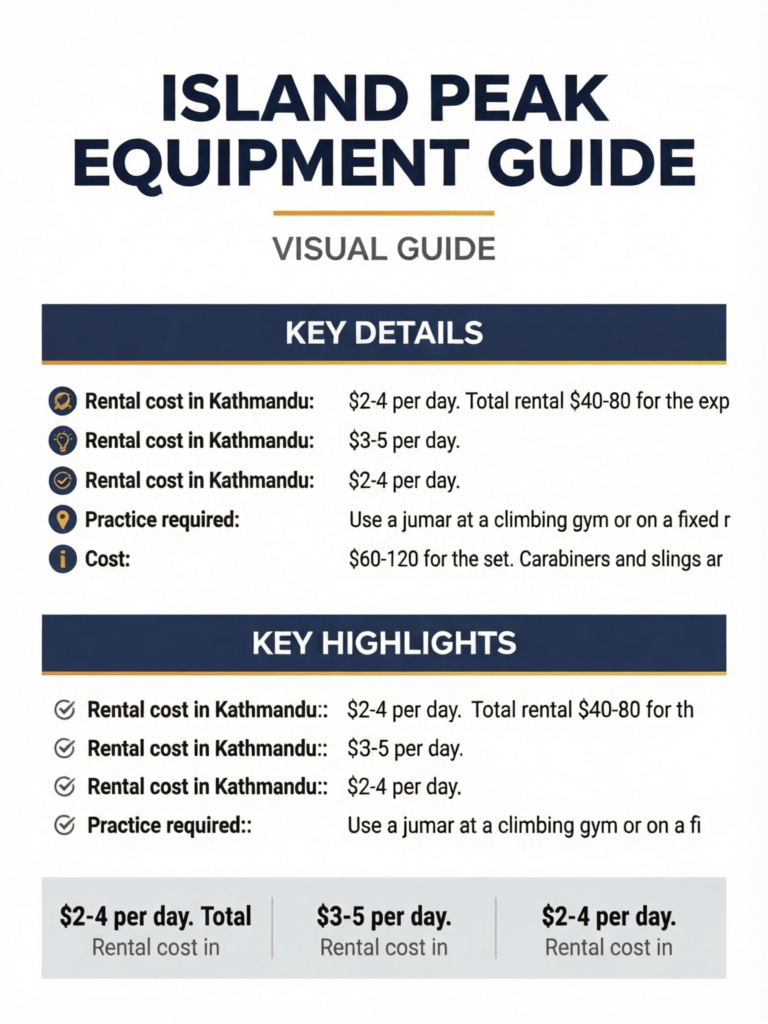
This is the category that defines Island Peak as a mountaineering objective rather than a trek. Every item in this section is non-negotiable for the summit attempt.
Mountaineering Boots
The single most important gear decision for Island Peak. Everything else adapts; boots determine your safety, warmth, and technical capability.
Minimum requirement: B2-rated (semi-rigid) or B3-rated (fully rigid) boots compatible with C2 or C3 crampons.
Why standard trekking boots fail: Trekking boots flex at the toe and heel, which prevents crampon attachment and makes front-pointing on steep ice impossible. The flexible sole also provides insufficient warmth insulation for temperatures of -20°C at High Camp.
B2 boots: Semi-rigid, compatible with semi-automatic crampons. Suitable for Island Peak on a moderate budget. Examples: La Sportiva Trango Tower GTX, Scarpa Zodiac Plus GTX, Salewa Ortler Pro.
B3 boots: Fully rigid, compatible with step-in crampons. The gold standard for Island Peak. More expensive but warmer, more precise on technical terrain, and compatible with all crampon systems. Examples: La Sportiva Nepal Cube GTX, Scarpa Mont Blanc Pro GTX, Asolo AFS 8000 evo.
Critical: Purchase boots 3-4 months before departure and break them in thoroughly during training. Rigid boots take significant time to conform to your foot. Attempting to summit Island Peak in boots worn for the first time in Nepal is a mistake that causes serious pain and potential injury.
Rental note: Mountaineering boot rental is available in Kathmandu's Thamel district but sizing selection is limited and previously rented boots may have worn liners. If you wear common European sizes (41-44), rental is viable. For large or small feet, purchase is strongly recommended.
Crampons
Crampons attach to your mountaineering boots and provide traction on snow and ice. Island Peak requires 12-point steel crampons for the headwall and summit ridge.
| Type | Binding | Compatible With | Best For |
|---|---|---|---|
| Step-in (automatic) | Welts at toe and heel | B3 boots only | Most precise fit |
| Semi-automatic | Front bail + rear strap | B2/B3 boots | Versatile, common rental |
| Strap-on | Full strap | Most boots | Not ideal for technical climbing |
Recommendation for Island Peak: Semi-automatic or step-in 12-point crampons with anti-balling plates (rubber inserts that prevent snow from balling under the crampon). Anti-balling plates are essential on the snow slopes above High Camp.
Brands: Grivel G12, Black Diamond Contact, Petzl Sarken, Camp Ice Master -- all are reliable options.
Rental cost in Kathmandu: $3-6 per day. For a 16-20 day expedition with 4-5 days using crampons, rental totals $50-120. Purchasing crampons costs $80-200 new.
Verdict: Rent if you will not use crampons regularly in future. Buy if you plan future mountaineering objectives.
Ice Axe
Used for balance on steep terrain, self-arrest if you slip, and as a security tool on the glacier approach to the headwall. Island Peak does not require the axe for technical ice climbing, but it is mandatory safety equipment.
Specifications: 55-65cm length (longer axes suit taller climbers and moderate-angle slopes), straight shaft preferred for walking/self-arrest use (technical curved axes are unnecessary here).
Leash: A wrist leash prevents dropping the axe if you stumble. Some climbers prefer no leash -- discuss with your guide before departure.
Brands: Petzl Summit, Black Diamond Raven, Grivel Air Tech Classic -- all perform well.
Rental cost in Kathmandu: $2-4 per day. Total rental $40-80 for the expedition.
Verdict: Rent unless you have plans for future alpine or mountaineering objectives.
Climbing Harness
The harness connects you to the rope on the glacier approach and, critically, to the fixed lines on the headwall. The jumar (ascender) clips to the rope above you while you are tied into the harness below -- the harness must fit correctly over all your layers.
Critical consideration: The harness must fit when you are wearing full summit day clothing -- base layer, mid layer, down suit or heavy down jacket and pants. Fitting a harness over thin trekking clothes in a gear shop and then trying to wear it over a puffy down suit on the mountain is a common mistake. Size up.
Adjustable leg loops: Essential for over-clothing fitting. Harnesses with fixed leg loops often cannot accommodate insulated pants.
Brands: Black Diamond Momentum (excellent value), Petzl Corax, Mammut Ophir, Arc'teryx FL-365.
Rental cost in Kathmandu: $3-5 per day.
Verdict: Rent or buy -- harnesses are lightweight and easy to pack. If you own a harness from rock climbing, ensure leg loops are adjustable before relying on it for Island Peak.
Helmet
Mandatory on Island Peak for protection against rockfall (particularly on the headwall and ridge sections), ice fragments from climbers above, and any impact from a fall.
Specifications: CE/UIAA certified climbing helmet. Ventilation is less critical than on summer rock routes -- warmth matters more. Full-coverage helmets or those with liner options are preferred.
Brands: Black Diamond Vector (light, ventilated), Petzl Sirocco (ultra-lightweight), Mammut Wall Rider, Black Diamond Half Dome (affordable).
Rental cost in Kathmandu: $2-4 per day.
Verdict: Rent if you do not own one. If buying, the Black Diamond Half Dome offers excellent protection at a low price point.
Jumar/Ascender
The jumar (mechanical rope ascender) is the defining technical tool on Island Peak's headwall. It clamps onto the fixed rope, slides upward freely, and locks when weight is applied -- allowing you to rest and move safely on the 45-50 degree slope.
How it works: One hand operates the jumar on the rope above you; a sling from your harness provides security when you stop. Your legs drive the upward movement; the jumar is support, not the primary power source.
Most agencies provide jumars as group equipment. Confirm with your operator. If purchasing your own: Petzl Basic (right-handed standard), CT Speleo (ambidextrous), Wild Country Ropeman (compact).
Practice required: Use a jumar at a climbing gym or on a fixed rope before the expedition. The technique of weighting the device, sliding it up, and maintaining balance on steep terrain is not intuitive on first contact.
Carabiners and Slings
Used to clip into fixed ropes for security, connect to your rope team, and clip the jumar sling to your harness.
Minimum for Island Peak:
- 2-3 locking carabiners (HMS/pear shape for maximum versatility)
- 2 x 120cm sewn slings (for connecting jumar sling and backup)
- 1 x 60cm sling
Brands: Any CE-certified hardware from Black Diamond, Petzl, DMM, Mammut, Wild Country.
Cost: $60-120 for the set. Carabiners and slings are inexpensive, lightweight, and not worth renting. Buy and keep them.
Agency Equipment Versus Personal Equipment
Clarify in writing with your agency which technical items they provide as group equipment (typically rope, snow stakes, and sometimes jumars) versus what you must bring personally (harness, helmet, carabiners, slings). Do not assume. Arrive in Kathmandu with a complete personal equipment list confirmed and cross-referenced against agency-supplied items.
Footwear System
Trekking Boots (Approach Section)
You will trek 8 days to reach Island Peak before switching to mountaineering boots for the climbing portion. Carry both if your porter capacity allows, or use mountaineering boots throughout (heavier and less comfortable for trekking, but eliminates the double-boot problem).
Approach boot requirements: Waterproof, ankle-supporting, broken-in, compatible with lightweight trekking crampons (optional, useful if the approach involves icy sections in shoulder seasons).
Recommendation: La Sportiva Nucleo High GTX, Salomon Quest 4 GTX, Scarpa Zodiac Plus GTX -- all work well as approach/trekking boots.
Gaiters
Gaiters keep snow out of the gap between boot and pant leg on summit day.
- Full gaiters: Reach the knee. Required for Island Peak snow conditions.
- Integrated crampon compatibility: Some gaiters integrate with crampon bail systems.
Brands: Outdoor Research, Salomon, Black Diamond. Cost: $50-120.
Clothing System
Island Peak demands a layering system that manages comfort across a 20-degree temperature range on the approach trek and sub-zero conditions on summit day. Do not underestimate the cold above 5,500 meters at 2-3 AM.
Base Layer
The foundation of your thermal management. Worn against skin; responsible for moisture management (moving sweat away from your body) while providing some warmth.
Summit day base layer:
- Top: Merino wool or synthetic (Polartec Power Dry, Patagonia Capilene) long-sleeve shirt
- Bottom: Merino wool or synthetic thermal leggings
Why merino wool: Regulates temperature better, resists odor for multi-day use, comfortable against skin. Dries more slowly than synthetic when wet.
Why synthetic: Dries faster, cheaper, more durable. Better if you sweat heavily.
Pack: 2-3 base layer sets for the trek, 1 dedicated summit day set.
Brands: Icebreaker (merino), Smartwool (merino), Patagonia Capilene (synthetic), Craft (synthetic).
Mid Layer
Provides primary insulation. On the approach trek, this is your main warmth layer for cold mornings and evenings. On summit day, it sits between base layer and outer/down layer.
Fleece jacket: 200-weight fleece or Polartec jacket. Versatile, fast-drying, continues insulating when damp. Patagonia R2, Arc'teryx Delta LT, Mammut Innominata.
Lightweight down jacket: For camp use and layering under the down suit. Packable jackets (Patagonia Down Sweater, Arc'teryx Cerium SL, Rab Microlight Alpine) compress to minimal volume.
Pack: 1 fleece jacket + 1 lightweight down jacket covers most combinations.
Hardshell Outer Layer
Wind and precipitation protection. On summit day, your hardshell goes over all insulating layers and protects against spindrift, wind, and light precipitation.
Requirements:
- Waterproof/breathable membrane (Gore-Tex, eVent, or equivalent)
- Helmet-compatible hood with adjustment
- Pit zips for ventilation during exertion
- Glove-friendly cuffs and closures
Top-tier brands: Arc'teryx Beta AR, Mammut Nordwand Advanced HS, Rab Latok Alpine.
Value options: Montane Alpine Resolve, Black Diamond Liquid Point, Outdoor Research Helium Rain.
Shell pants: Waterproof/breathable pants over insulating layers. Ensure they fit over your base layer, fleece, and down pants if used.
Summit Layer (Down Suit or Heavy Down System)
This is the most expensive clothing item for Island Peak and the one most commonly rented in Kathmandu.
Option 1: Down suit (one-piece): A single-piece expedition suit with integrated hood and insulation throughout. Simplest system; no gaps between jacket and pants. Brands: Rab Expedition 8000, PHD Minimus, Rab Generator Alpine. Purchase cost: $600-1,200+.
Option 2: Expedition down jacket + insulated pants: A 900+ fill-power expedition jacket paired with insulated down pants. More versatile (can use the jacket separately on other trips) but requires careful management of the gap between jacket and pants in wind. Jacket brands: Rab Neutrino Pro, PHD Ultra, Arc'teryx Cerium X Hoody. Pants brands: PHD Hispar, Rab Generator Alpine Pants.
Rental in Kathmandu: Down suits rent for $10-20 per day in Thamel. For a 5-7 day rental (summit push period only), total cost is $70-140. Quality rental down suits are available from reputable shops -- inspect insulation thickness, closures, and hood before renting. Book in advance during October and April.
Renting a Down Suit Is Smart Economics
A quality down suit costs $600-1,200 new and is a specialized item you may never use again if Island Peak is a one-time objective. Renting a verified, well-maintained down suit in Kathmandu for $100-150 is genuinely rational. Focus your purchasing budget on items you will use across multiple trips: hardshell, boots, base layers. See our complete Kathmandu gear rental guide for recommended shops and current prices.
Hands and Face Protection
Summit day glove system (critical):
- Liner gloves: Thin merino or synthetic gloves, worn under everything. Allow dexterity for clipping carabiners and operating camera.
- Insulated mid-gloves: Fleece or light insulated gloves for moderate cold. Worn alone on cold trekking days.
- Expedition mitts: Heavy insulated mitts (or lobster-claw gloves) for summit day. Protect against -25°C and wind chill. Examples: Black Diamond Mercury Mitt, Outdoor Research Alti Mitt.
Head protection:
- Warm hat (beanie): Merino wool or fleece, fitting under helmet
- Balaclava: Full face coverage for summit day. Merino or thin Polartec fleece.
- Sun hat: Baseball cap or wide-brim for approach trekking in sun
- Buff/neck gaiter: Versatile for wind protection and sun protection
Face:
- Sunglasses: Category 3-4 lens, UV400, wraparound fit. Glacier glare causes serious corneal injury.
- Glacier goggles: Fully sealed goggles for wind protection and spindrift on summit day. Julbo, Bolle, or Oakley glacier models.
- Sunscreen: SPF 50+ applied liberally every 2 hours at altitude. UV intensity increases approximately 4% per 300m gain.
Camping and Sleep System
Island Peak Base Camp and High Camp involve tent sleeping. Your agency provides tents; you provide your sleeping system.
Sleeping Bag
Temperature rating requirement: Comfort rating of -15°C to -20°C minimum. EN/ISO standard comfort rating (not "limit" rating).
At High Camp (5,600m), nighttime temperatures typically reach -15°C to -25°C. A sleeping bag rated only to 0°C or -5°C will leave you shivering through the night before your 1 AM summit wake-up.
Down vs synthetic: Down offers the best warmth-to-weight ratio and packs smaller. Synthetic retains some insulation when wet. For Nepal's relatively dry conditions, down is preferred.
Fill power: 700-fill down minimum; 800-850 fill down preferred for weight-efficient warmth.
Brands: Rab Neutrino 400, Western Mountaineering Alpinlite, PHD Minim 400, Mountain Hardwear Phantom.
Rental in Kathmandu: High-quality sleeping bags (-20°C) rent for $3-6 per day. Rental is viable if you do not already own a suitable bag and do not plan future cold-weather camping.
Sleeping Bag Liner
A silk or lightweight thermal liner adds 3-8°C to your sleeping bag's effective range. Weighs 100-200g. Particularly useful if your sleeping bag is at the lower end of the temperature range.
Brands: Sea to Summit Thermolite, Cocoon Silk Traveling. Cost: $40-80.
Sleeping Pad
Your agency provides foam pads at camps. However, bringing an inflatable sleeping pad (R-value 3.5+) adds significant warmth from below. The Therm-a-Rest NeoAir XTherm (R-value 7.3) is the benchmark; lighter alternatives include the Klymit Insulated Static V.
Technical Personal Items
Headlamp
Summit day begins at 1-2 AM. Your headlamp is a primary safety tool, not a convenience.
Requirements:
- Minimum 250 lumens brightness
- Red light mode (preserves night vision; useful for camp navigation)
- Reserve battery capacity for 6-8 hours minimum
- Cold-rated batteries or lithium batteries (alkaline batteries lose 50-70% capacity below -10°C)
Cold battery management: Store your headlamp (with batteries) inside your sleeping bag at night so batteries stay warm. Carry a set of lithium backup batteries.
Brands: Petzl Actik Core, Black Diamond Spot, Petzl Swift RL (rechargeable).
Trekking Poles
Reduce knee strain on descent (critical given the long downhill days on return), improve balance on uneven terrain, and assist with rhythm on long uphill sections.
Requirements: Adjustable (100-130cm range), anti-shock optional, snow baskets for soft snow conditions. Carbon poles are lighter; aluminum poles are more durable.
On technical terrain at High Camp and above, poles are stowed in your pack (you need hands for ropes and ice axe). They are primarily an approach and descent tool.
Brands: Black Diamond Trail, Leki Khumbu Lite, Salomon MTN Carbon.
Backpacks
Summit day pack (25-35L): Lightweight daypack carried on summit day with minimal essential items. Must fit closely to the body for steep terrain without snagging on fixed ropes. Weight in pack on summit day: 5-8kg maximum.
What goes in the summit day pack:
- Extra down layer
- Food and snacks (2,000-2,500 calories)
- Water (1-2L insulated)
- First aid essentials
- Camera
- Emergency bivouac layer
- Headlamp and extra batteries
Trekking pack (50-65L): Main pack carried on approach to Island Peak. Porters carry the bulk of camp equipment, allowing your trekking pack to hold 10-15kg (personal clothing, sleeping system, technical gear).
Water Management
Hydration: Drink 3-4 liters per day minimum at altitude. Dehydration dramatically worsens AMS symptoms.
Containers: 2 x 1L wide-mouth plastic bottles (wide mouth prevents freezing seal issues in cold). Insulated water bottle sleeves prevent freezing above 5,000m.
Purification: Water sources on the approach trek are not always safe. Carry water purification tablets (Aquatabs, Iodine) or a SteriPen UV purifier. Sawyer Squeeze filter is a lightweight alternative but can freeze at high altitude.
Hydration reservoirs: Not recommended above 4,500m -- the drinking tube freezes at high altitude.
Pre-Heat Water for Summit Day
Before your 1-2 AM summit start, fill your water bottles with warm (not hot) water from the camp stove. Wrap in insulating sleeves and carry inside your clothing layer for the first hour. Water frozen solid in your bottle at the headwall is one of the more preventable summit-day problems.
What to Rent in Kathmandu vs What to Buy at Home
This is the most practical decision most Island Peak climbers face. The general principle: rent specialized, bulky, or expensive items you will use rarely; buy items worn against skin, items requiring precise fit, and items where quality directly affects safety.
Rent in Kathmandu
| Item | Rental Cost/Day | Total Rental (Full Expedition) | Notes |
|---|---|---|---|
| Crampons (12-point) | $3-6 | $60-120 | Verify anti-balling plates included |
| Ice axe | $2-4 | $40-80 | Check pick condition |
| Down suit | $10-20 | $100-200 | Book in advance; inspect carefully |
| Sleeping bag (-20°C) | $3-6 | $60-120 | For those without suitable bag |
| Climbing harness | $3-5 | $60-100 | Must fit over summit-day layers |
| Helmet | $2-4 | $40-80 | Verify CE certification |
| Duffel bag (for porter) | $2-3 | $40-60 | Useful for organizing porter loads |
| Gaiters | $2-3 | $40-60 | If you do not own a suitable pair |
Best Kathmandu gear rental areas: Thamel district (north Kathmandu). Reliable rental shops include Rolwaling Trekking & Equipment, Adventure Equipment Rental, and multiple shops along Tridevi Marg. See our Kathmandu gear rental guide for current shop recommendations and pricing.
Booking timing: For autumn season (October-November), reserve rental gear 2-4 weeks in advance. The best down suits and fitting crampons are claimed early during peak season.
Buy at Home
| Item | Why Buy, Not Rent | Approximate Cost |
|---|---|---|
| Mountaineering boots (B2/B3) | Must be broken in; sizing critical; rental selection limited | $300-700 |
| Base layers (2-3 sets) | Worn against skin; personal hygiene | $80-200 |
| Liner gloves | Thin, personal hygiene essential | $20-40 |
| Insulated gloves/mitts | Critical fit and warmth; poor rental options | $60-150 |
| Hardshell jacket and pants | Personal fit critical; worn for 16+ days | $300-700 |
| Sunglasses and glacier goggles | Personal optical needs; hygiene | $80-200 |
| Headlamp | Personal reliability tool | $50-100 |
| Trekking poles | Significant approach benefit | $80-150 |
| Carabiners and slings | Lightweight; inexpensive; keep for future | $60-120 |
| Balaclava and warm hat | Personal hygiene; low cost | $30-60 |
| Sunscreen and lip balm | Consumable; bring from home | $20-40 |
Agency-Provided Group Equipment
Confirm with your specific operator, but reputable agencies typically provide:
- Main climbing ropes (fixed lines on headwall)
- Snow stakes and anchors
- Group first aid and emergency oxygen
- Camp stoves and cooking equipment
- Tents at base camp and high camp
- In some cases: jumars, group carabiners
Verify Group Equipment In Kathmandu
Before leaving Kathmandu, ask your agency lead guide to show you the group technical equipment that will accompany the expedition. Verify rope quality (check for sheath damage), snow stake condition, and first aid kit contents. A reputable agency will welcome this request; a concerning agency will be evasive.
Gear Weight Targets
Weight management is genuine safety management at altitude. Every kilogram your legs carry on the headwall corresponds to measurable additional cardiovascular load in an environment where you are already operating at 47% sea-level oxygen availability.
Summit Day Pack: Target Under 8kg
| Item | Approximate Weight |
|---|---|
| Water (1.5L) | 1.5kg |
| Food and snacks | 0.8-1.0kg |
| Extra down layer | 0.4-0.6kg |
| First aid (personal) | 0.3-0.4kg |
| Camera and accessories | 0.3-0.5kg |
| Headlamp + spare batteries | 0.2-0.3kg |
| Emergency bivouac layer | 0.2-0.3kg |
| Pack itself | 0.8-1.2kg |
| Total | 4.5-6.1kg + other items |
Trekking Pack: Target 12-15kg (After Porter Offload)
Porters carry tents, cooking equipment, and most camp gear. Your trekking pack should contain:
- Sleeping bag and liner
- Personal clothing
- Summit day pack contents
- Technical gear (harness, helmet, crampons, ice axe)
- Electronics
- Toiletries and first aid
Electronics and Photography
Thin air and extreme cold create specific electronics challenges:
Camera: Mirrorless or DSLR cameras perform well. Cold drains batteries rapidly -- keep spare batteries inside clothing layers. Cold-weather battery degradation at -20°C reduces capacity by 50-70%.
Smartphone: Functions as secondary camera and navigation. Store inside inner clothing pocket to maintain battery temperature.
Power banks: Carry 2 x 10,000mAh power banks. Cold kills power bank capacity as quickly as phone batteries.
Charging: Tea houses on the approach charge devices for NPR 200-500 per charge. Once on the mountain, charging depends on solar panels (if agency provides) or personal power banks.
Altitude apps: Install AccuWeather, Windy, and a barometric altimeter app before departure. Download offline maps (Maps.me, Gaia GPS) for the Khumbu region.
Protect Electronics From Condensation
When moving between cold outdoor temperatures and warm indoor spaces, condensation forms inside electronics. Use dry bags or zip-lock bags for sensitive electronics when transitioning environments. This is particularly important for cameras and laptops in Namche Bazaar and Kathmandu. Allow electronics to equilibrate gradually before opening bags indoors.
Toiletries and Hygiene
Weight consciousness applies here too. Consolidate to essentials:
- Toothbrush and toothpaste (travel size)
- Biodegradable soap (for river washing on approach)
- Hand sanitizer
- Toilet paper and lighter (pack out waste or burn TP as required)
- Personal medications (prescription and OTC)
- Blister kit (Compeed, Leukotape, needle and lighter for sterile drainage)
- Altitude medication (Diamox if prescribed -- consult travel medicine physician)
- NSAID (ibuprofen) and acetaminophen
- Antidiarrheal (loperamide) and oral rehydration salts
- Throat lozenges (dry mountain air causes pharyngitis)
- Micropore tape for minor lacerations
The Master Packing Checklist
Use this list as your final pre-departure check:
Technical Climbing (Purchase or Rent):
- Mountaineering boots (B2/B3) -- broken in
- 12-point crampons with anti-balling plates
- Ice axe (55-65cm) with leash
- Climbing harness with adjustable leg loops
- Climbing helmet (CE/UIAA certified)
- 2-3 locking carabiners (HMS/pear shape)
- 2 x 120cm slings, 1 x 60cm sling
- Jumar/ascender (confirm if agency provides)
Footwear:
- Mountaineering boots (above)
- Trekking boots (if using separate approach footwear)
- Full knee-height gaiters
- Trekking sandals or camp shoes (lightweight)
- 4-5 pairs trekking socks (merino wool)
- 2 pairs summit socks (heavyweight wool or synthetic)
- Liner socks (optional)
Clothing -- Approach and Camp:
- Base layer tops (2-3)
- Base layer bottoms (2-3)
- Fleece jacket or mid-layer
- Lightweight down jacket (packable)
- Hardshell jacket (Gore-Tex or equivalent)
- Hardshell pants
- Trekking pants (2 pairs)
Summit Day Clothing:
- Summit down suit or expedition down jacket
- Down pants (if using jacket system)
- Liner gloves
- Insulated mid-gloves
- Expedition mitts
- Balaclava
- Warm beanie
- Buff/neck gaiter
- Glacier goggles
- Sunglasses (Cat 3-4)
Sleep System:
- Sleeping bag (-20°C comfort rating)
- Sleeping bag liner
- Inflatable sleeping pad (optional)
Pack and Carry:
- Trekking pack (50-65L)
- Summit daypack (25-35L, lightweight)
- Trekking poles with snow baskets
- Duffel bag for porter loads
Safety and Navigation:
- Headlamp + spare batteries (lithium)
- Backup headlamp or light source
- Personal first aid kit
- Whistle
- Emergency bivouac (space blanket or bivy sack)
Hydration and Nutrition:
- 2 x 1L wide-mouth water bottles
- Insulated bottle sleeves
- Water purification (tablets or UV pen)
- Sunscreen SPF 50+ (2 tubes)
- Lip balm with SPF
- Summit day nutrition (snacks, gels, bars)
Electronics:
- Camera + spare batteries
- Power banks (2 x 10,000mAh)
- Charging cables
- Offline maps downloaded
- Island Peak Climbing Guide: Complete Overview
- Gear Rental in Kathmandu: Shop Guide
- Everest Base Camp Packing List
- Island Peak Training Requirements
- Mera Peak Equipment List
- Peak Climbing Nepal: Comprehensive Guide
- Travel Insurance for Nepal Trekking
- Altitude Sickness Signs and Turnaround Rules
- Nepal Trekking Packing List
- Best Time to Climb Island Peak
Planning Your Island Peak Expedition?
Can You Rent Climbing Gear for Island Peak in Kathmandu?
Yes. Most technical climbing gear for Island Peak can be rented in Kathmandu's Thamel district for $200-500 total. Crampons, ice axes, harnesses, jumars, helmets, and expedition sleeping bags are all available for rent. However, mountaineering boots are difficult to rent in uncommon sizes, and you should purchase and break in your boots at home 3-4 months before departure.
Frequently Asked Questions
What boots do I need for Island Peak?
You need B2 (semi-rigid) or B3 (fully rigid) mountaineering boots compatible with 12-point crampons. Standard trekking boots will not work -- they flex too much for crampon attachment and provide insufficient warmth at -20C. See our trekking boots guide for approach options.
Do I need my own harness and helmet for Island Peak?
Most agencies provide group equipment including ropes and fixed line hardware. However, you should have your own harness and helmet for proper fit and hygiene. Both are available for rental in Kathmandu for $2-5/day each.
What sleeping bag rating do I need for Island Peak?
A -20C comfort rating minimum. High Camp (5,600m) temperatures can drop to -25C. Rent expedition-grade sleeping bags in Kathmandu's Thamel for $2-4/day rather than purchasing a bag you may use once.
How heavy should my summit daypack be?
Target under 15kg in your summit day pack. Carry only essentials: water (1-1.5L), snacks, extra warm layers, harness, helmet, headlamp, sunscreen, and camera. Everything else stays at High Camp or Base Camp.
What sunglasses do I need for Island Peak?
Category 4 glacier glasses with side shields are mandatory. Snow reflection at 5,500-6,000m can cause snow blindness within hours. Bring a spare pair -- losing your only sunglasses above 5,000m is a serious safety issue.