
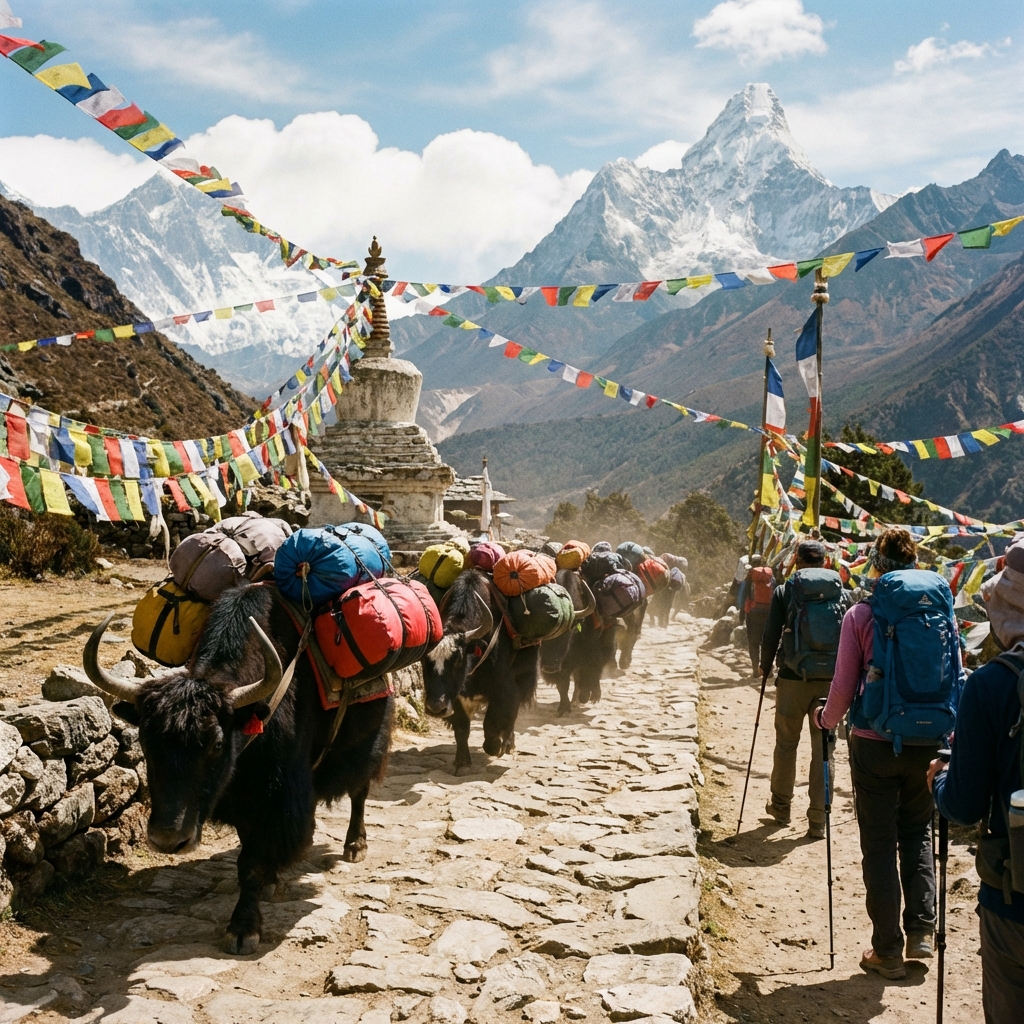
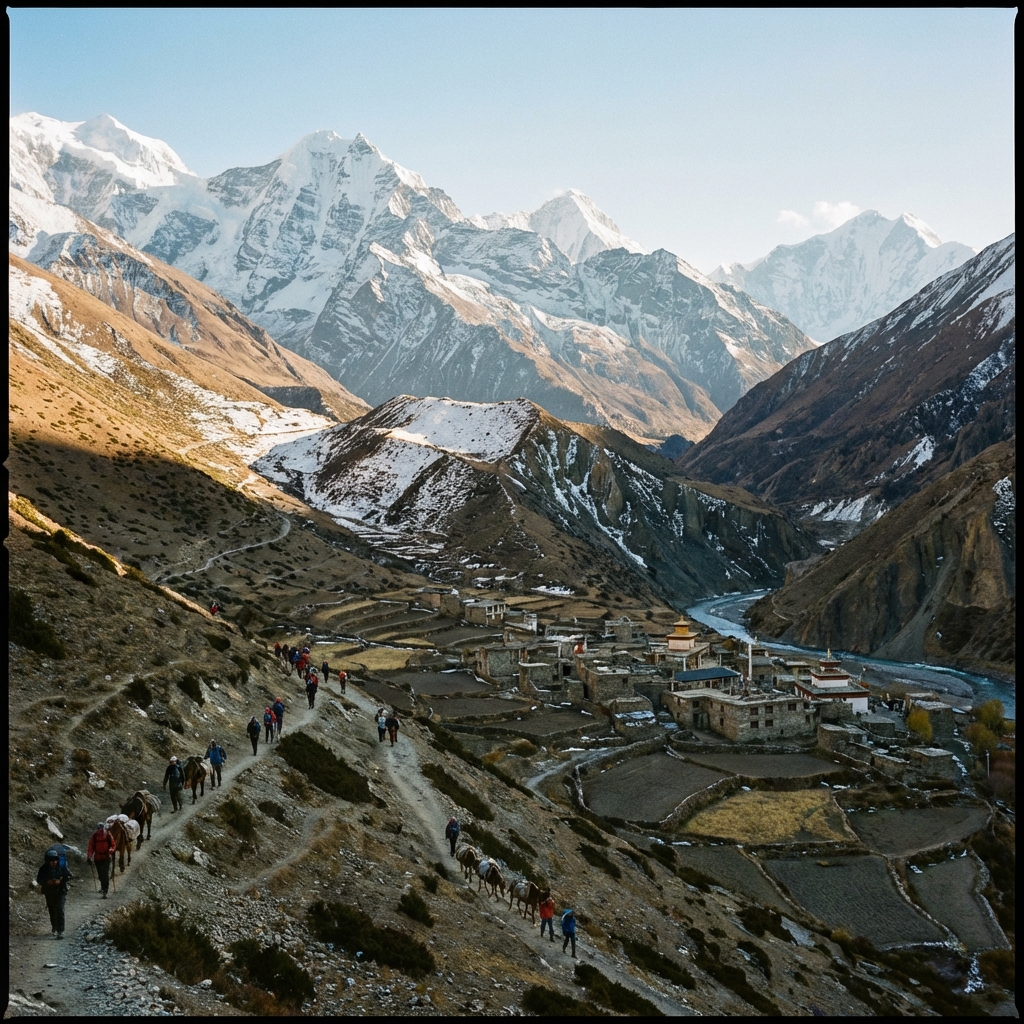
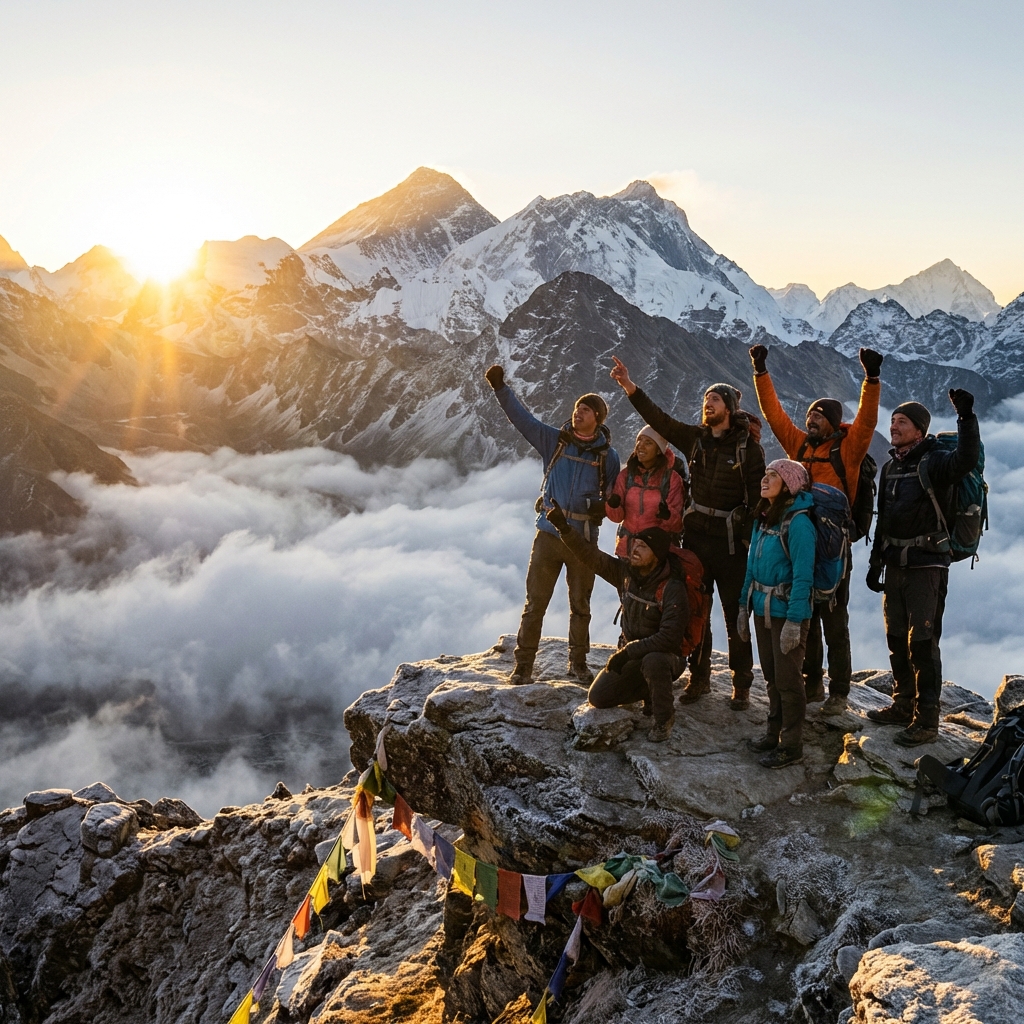
Standing at the Laurebina La pass (4,610m), you face a choice that defines the character of your entire trek. Behind you lies the Gosaikunda basin, its sacred lakes shining blue-silver against the barren alpine rock, prayer flags snapping in the thin wind. Ahead of you, the Helambu valley system drops away in a dramatic cascade of forested ridges, terraced fields, and distant green hills that seem almost tropical after the stark high-altitude world you have been traversing.
The Gosaikunda to Helambu traverse is one of Nepal's most satisfying one-way treks precisely because of this contrast. In four to five days of walking, you cross from an austere, sacred high-altitude landscape into lush, culturally rich Hyolmo Sherpa villages -- from bare rock and glacial lakes to rhododendron forests and Buddhist monasteries, from the world of Hindu pilgrimage to the world of Tibetan Buddhism. The transition is gradual but profound, and the path connecting these two distinct worlds passes through terrain that is both beautiful and challenging.
This guide provides the complete day-by-day itinerary, terrain descriptions, cultural context for both regions, and practical logistics for executing this cross-region traverse independently or with a guide.
8-10 days (Dhunche to Sundarijal)
One-way traverse (point-to-point)
4,610m (Laurebina La pass)
Dhunche (6-7 hours from Kathmandu by bus)
Sundarijal (2 hours from Kathmandu by taxi)
Moderate to Challenging
October-November, March-May
Langtang National Park Permit + TIMS
Yes, especially for Laurebina La crossing
Hindu pilgrimage + Hyolmo Buddhist villages
Why Do This Traverse?
Most Nepal treks follow an out-and-back route -- you walk to a destination and return the same way. The Gosaikunda to Helambu traverse is fundamentally different: you start in one world and end in another. No section is repeated. Every day brings new terrain, new villages, and new cultural encounters.
The one-way format also allows you to use transport only at the start and end of the trek. From Kathmandu, you take a bus to Dhunche (6-7 hours). After 8-10 days of walking, you emerge at Sundarijal on the outskirts of Kathmandu and take a 40-minute taxi back to Thamel. No return flight, no retracing your steps, no logistical backtracking.
This clean, linear structure makes the traverse particularly satisfying for trekkers who dislike the psychological effort of walking back the same trail they came in on.
The Terrain Transition
One of the traverse's most compelling features is the dramatic environmental shift as you descend from Gosaikunda into Helambu:
| Zone | Altitude | Vegetation | Character |
|---|---|---|---|
| Gosaikunda | 4,380m | Bare rock, alpine grass | Sacred, stark, otherworldly |
| Laurebina La | 4,610m | None; exposed ridge | Maximum altitude; dual views |
| Ghopte | 3,440m | Scrub, dwarf juniper | Descent begins |
| Kutumsang area | 2,470m | Dense rhododendron forest | Green, enclosed |
| Tarkeghyang | 2,740m | Mixed forest, terraces | Cultural richness begins |
| Melamchi Gaon | 2,530m | Subtropical vegetation | Village life, warmth |
| Sundarijal | 1,500m | Dense forest, waterfalls | Kathmandu environs |
Full Day-by-Day Itinerary
Day 1: Kathmandu to Dhunche (1,960m)
Mode: Bus or private jeep Time: 6-7 hours by bus, 5-6 hours by jeep
Take the early morning bus (6:30-7:00 AM) from Kathmandu's Machhapokhari bus park to Dhunche. The road follows the Trisuli River valley through dramatic gorge scenery before climbing to the Langtang National Park headquarters town.
In Dhunche, obtain your Langtang National Park Entry Permit at the checkpoint if you haven't already acquired it in Kathmandu. Spend the night at one of Dhunche's comfortable lodges -- these are the best facilities you will encounter until you descend into Helambu's lower villages.
Lodge options in Dhunche: Hotel Langtang View (NPR 600-1,200), Hotel Mountain Panorama (NPR 500-1,000), several others with similar facilities. All have hot water, WiFi, and reasonable restaurant menus.
Prepare in Dhunche
Dhunche is your last chance before the trek to withdraw cash (there is an ATM, though it sometimes runs out of notes in peak season), buy any missing gear or medications, and check trail and weather conditions with local teahouse owners. The 24 hours you spend here is also the beginning of your acclimatization at 1,960m.
Day 2: Dhunche to Sing Gompa (3,330m) -- 5-6 Hours
Elevation Gain: +1,370m Distance: ~11km Difficulty: Moderate-Challenging
The trail climbs steadily from Dhunche through one of the most impressive rhododendron forests in the Langtang region. In spring (March-April), this section is a riot of red, pink, and white blooms. In autumn, the forest canopy is green and cool, providing welcome shade during the sustained ascent.
Key waypoints:
- Deurali (2,800m): A small settlement with a tea house, reached after about 3 hours. Rest here before the final push to Sing Gompa.
- Sing Gompa (3,330m): A small monastery settlement with several tea houses and the famous Sing Gompa cheese factory.
The Sing Gompa cheese factory produces yak cheese using Swiss-influenced techniques introduced through a development program -- a parallel to the cheese factory at Kyanjin Gompa in the Langtang Valley. Visit the factory, taste the cheese, and buy a block for the trail.
Altitude Gain on Day 2
Gaining 1,370m in a single day is at the upper limit of safe acclimatization practice. Go slowly, drink at least 3 liters of water, eat regular snacks, and do not push for speed. If you arrive at Sing Gompa with a significant headache, rest here for an extra day rather than continuing to Gosaikunda the following morning. This extra day of acclimatization at Sing Gompa is the single most effective prevention measure for altitude sickness at the main lake.
Day 3: Sing Gompa to Gosaikunda (4,380m) -- 5-6 Hours
Elevation Gain: +1,050m Distance: ~8km Difficulty: Challenging (due to altitude)
The ascent from Sing Gompa to Gosaikunda is the most demanding single day of the entire traverse. The trail climbs through progressively sparser vegetation before reaching the open alpine zone above the treeline. The final approach crosses rocky, barren ground with the first views of the high peaks to the north.
Key waypoints:
- Saraswati Kunda (4,100m): The first sacred lake, visible from the trail. A significant milestone indicating you are entering the sacred zone.
- Bhairav Kunda (4,200m): Dark-watered and austere, this lake is named for the fierce manifestation of Shiva.
- Gosaikunda (4,380m): Arrival at the main sacred lake. The sense of arrival is dramatic -- after hours of ascent through barren terrain, the lake appears suddenly, vast and startlingly blue.
Afternoon activity: Rest and acclimatize. Visit the lakeside Shiva temple. Walk around the main lake in the late afternoon (allow 1.5-2 hours for a relaxed circuit). The evening light on the surrounding peaks is spectacular.
For detailed descriptions of all the lakes and their significance, see our Gosaikunda Lakes Circuit guide.
Day 4: Gosaikunda Acclimatization and Lake Exploration -- 4-5 Hours
Base Altitude: 4,380m Maximum Altitude Reached: 4,610m (Laurebina La ridge, if day-hiking)
This rest day at Gosaikunda serves two critical purposes: recovering from the strenuous Day 3 ascent and acclimatizing your body before the Laurebina La crossing on Day 5. It is also the best opportunity to explore the full lake system.
Recommended morning activity: Walk the full lake circuit, visiting Neel Kunda, Surya Kunda, and Bhairav Kunda in the clockwise direction. Spend time at each lake observing the changing character of water, rock, and light.
Recommended afternoon activity: Day hike partway up toward Laurebina La (you don't need to reach the pass) to preview the terrain and assess your acclimatization at higher altitude. Return to Gosaikunda before 3:00 PM.
Evening: Early dinner, early bed (8:30-9:00 PM). Tomorrow is a long, demanding day.
Why You Need This Acclimatization Day
Many trekkers on tight schedules try to eliminate the Day 4 rest day and push directly from Gosaikunda to Ghopte (via Laurebina La) the day after arriving from Sing Gompa. This is a serious mistake. The Laurebina La crossing at 4,610m after only one night at 4,380m substantially increases your AMS risk. Spend the extra day -- it makes the pass crossing safer, more enjoyable, and lets you properly explore the lake system you came to see.
Day 5: Gosaikunda to Ghopte (3,440m) via Laurebina La (4,610m) -- 7-8 Hours
Maximum Altitude: 4,610m (Laurebina La) Net Elevation Change: -940m (after crossing the pass) Distance: ~12km Difficulty: Very Challenging
This is the defining day of the traverse -- the crossing that transforms two separate treks into a single continuous journey. It is also the longest and most physically demanding day of the entire route.
Morning preparation: Eat a substantial breakfast by 6:00 AM. The lodge dining room will be cold; dress warmly. Start walking by 6:30-7:00 AM.
Gosaikunda to Laurebina La (1-1.5 hours): The ascent from the main lake to the pass gains 230m over moderate terrain. The trail is clear and marked with cairns. In late autumn or winter, this section may have ice or snow -- use trekking poles and move carefully.
At Laurebina La (4,610m): The pass is a narrow saddle in the ridge with the Gosaikunda basin spread below to the northwest and the Helambu valley system opening to the southeast. The view in both directions is extraordinary. The Gosaikunda lakes appear from above as jewels set in grey rock. Ahead, the forested ridges of Helambu tumble away toward the Kathmandu Valley.
Spend 10-15 minutes at the pass, then begin the descent. Do not linger too long -- Laurebina La is cold and exposed, and you have many hours of descent ahead.
The Descent (Helambu Side) -- 5-6 Hours: The first 200-300m of descent from the pass is the most technically demanding section of the entire traverse. The trail drops steeply over loose rock and can be icy in the mornings or after recent snowfall. Move slowly, use your poles, face into the slope on the steepest sections if necessary, and maintain three points of contact.
Below the initial steep section, the trail improves as you enter scrub vegetation and then dwarf juniper forest. The descent continues steadily to Ghopte (3,440m), a small settlement with two or three basic tea houses.
Laurebina La Descent Safety
This is the highest-risk section of the entire Gosaikunda to Helambu traverse. The descent from Laurebina La on the Helambu side is steep, loose, and can be icy or snowy in late autumn and winter. Multiple trekking accidents, including fatal falls, have occurred on this section. If conditions are wet, icy, or you cannot clearly see the trail ahead due to fog, do not descend. Return to Gosaikunda and wait for conditions to improve. A guide who knows this trail is strongly recommended for all trekkers.
Arrival at Ghopte: Most trekkers arrive between 2:00 and 4:00 PM, depending on their pace. Ghopte is a tiny settlement with basic lodges. Do not expect the comforts of Dhunche's lodges -- this is mountain outpost accommodation.
Day 6: Ghopte to Kutumsang (2,470m) -- 5-6 Hours
Elevation Loss: -970m Distance: ~14km Difficulty: Moderate (long descent through forest)
A significant descent through Helambu's characteristic rhododendron and oak forest. The transition from the bare alpine terrain above Ghopte to the enclosed, green forest below feels rapid and striking. By midday, you are in a completely different world from the one you left behind at Gosaikunda.
Key waypoints:
- Tharepati (3,650m): A small settlement with tea houses, reached after about 2 hours from Ghopte. This is the highest point on the standard Helambu circuit and the junction where the classic Helambu route connects. Many trekkers on the standard Helambu circuit turn north here toward the sacred lakes -- you are coming from the opposite direction.
- Kutumsang (2,470m): A modest village with several tea houses and a small monastery. The surroundings feel dramatically more temperate than anything since Dhunche.
By the time you reach Kutumsang, the air feels perceptibly warmer and more oxygen-rich. Many trekkers comment on feeling a sudden burst of energy in the lower altitude that they had not noticed was missing above 4,000m.
Day 7: Kutumsang to Chisapani (2,215m) -- 5-6 Hours
Elevation Change: -255m (but with significant ups and downs along the ridge) Distance: ~14km Difficulty: Moderate
This is primarily a ridge walk through beautiful mixed forest with intermittent views of the Himalayan range to the north. The trail undulates rather than descending steadily, crossing several subsidiary ridges before reaching Chisapani.
The Cultural Shift: This is where you begin to notice that you are no longer in the Gosaikunda/Langtang cultural zone. The villages along the ridge from Kutumsang to Chisapani are Hyolmo (Helambu Sherpa) settlements, and the cultural markers are noticeably different from the Tamang villages of the Langtang Valley. Monasteries here follow the Nyingma tradition, but the artistic styles, community practices, and even the architecture have a distinctly Hyolmo character.
Chisapani (2,215m) sits on a ridge above the Sundarijal catchment area. On clear mornings, the panoramic view from above the village encompasses Langtang Lirung (7,227m), Ganesh Himal, Dorje Lakpa, and on exceptional days, distant peaks toward the Everest region. This is one of the finest mountain views in the Helambu region, made more poignant by the fact that you have just walked from the foot of those same Langtang peaks.
Chisapani Sunrise
If you can manage only one early morning in Helambu, make it at Chisapani. The ridge above the village (5-10 minutes walk up from your lodge) faces directly toward the Langtang range. At sunrise, Langtang Lirung and the flanking peaks catch the dawn light before any valley mist rises. Bring a headlamp, walk up 20 minutes before sunrise, and you will experience one of the finest free panoramas within a day's walk of Kathmandu.
Day 8: Chisapani to Sundarijal (1,500m) -- 3-4 Hours, Then Taxi to Kathmandu
Elevation Loss: -715m Distance: ~10km Difficulty: Easy-Moderate
The final day of the traverse is a straightforward descent through Shivapuri National Park's dense forest to the Sundarijal water reservoir and the beginning of the Kathmandu Valley road network.
The descent: Well-maintained trail through mature oak, rhododendron, and pine forest. In the lower sections, you may hear or see various bird species -- Shivapuri National Park is excellent for birdwatching, with over 300 species recorded.
Sundarijal (1,500m): The trail ends at the Sundarijal water treatment plant and reservoir, where a metalled road begins. Taxis wait here regularly (especially in the morning) to take trekkers to Thamel.
Taxi to Thamel: NPR 800-1,200 ($6-9), approximately 40 minutes depending on traffic. You will be back in Kathmandu by midday or early afternoon, in time for a hot shower, a restaurant meal, and a celebratory beer after 8 days of mountain walking.
Understanding the Cultural Transition
The Gosaikunda to Helambu traverse crosses cultural boundaries that are as significant as the geographical ones. Understanding what you are moving through enriches the experience enormously.
The Gosaikunda Side: Hindu and Tamang
The landscape around Gosaikunda is primarily Hindu sacred geography, with Shiva as the presiding deity. Pilgrims along this trail -- even outside festival season -- are often local Tamang people and Hindu Brahmin-Chhetri pilgrims from the Kathmandu Valley. The Tamang communities of the Langtang region practice Tibetan Buddhism but also participate in the Hindu pilgrimage traditions around Gosaikunda, reflecting centuries of religious coexistence.
Prayer wheels, mani walls, and Buddhist stupas mark the trail from Dhunche upward. But the names of the lakes (Saraswati, Bhairav, Gosaikunda itself -- "Gosainkunda" combining "Gosain" [a name for Shiva] and "kunda" [pool]) are all drawn from the Hindu tradition.
The Helambu Side: Hyolmo Buddhism
As you descend from Laurebina La into Helambu, you enter Hyolmo cultural territory. The Hyolmo (also spelled Yolmo) are a Tibetan-origin people who have inhabited the Helambu region for several centuries. They practice the Nyingma school of Tibetan Buddhism and maintain cultural traditions that blend their Tibetan heritage with Nepali influences.
The monasteries you encounter in Tarkeghyang, Sermathang, and other Helambu villages are Nyingma institutions with thangka paintings, butter lamps, and religious objects that would look familiar to any visitor to Tibetan temples. The Hyolmo monks chant in Tibetan (not Nepali) and follow the Tibetan Buddhist liturgical calendar.
For trekkers coming from Gosaikunda, the shift is striking: you move from a landscape of Hindu pilgrimage to one of Tibetan Buddhist community life. The food, the language of prayer, the architectural styles, and the daily rhythms of village life are all different -- and both are fascinating.
The Sherpa-Hyolmo Connection
The Hyolmo people are often called "Helambu Sherpas" though they are a distinct ethnic group from the famous Khumbu Sherpas. Both groups share Tibetan Buddhist traditions and some similar cultural practices, but their languages, clan structures, and regional histories are different. When you hear locals referred to as Sherpa in Helambu, they are almost certainly Hyolmo, not Khumbu Sherpa. Understanding this distinction helps you engage more respectfully with the communities you are walking through.
Key Cultural Villages in Helambu
Tarkeghyang (2,740m)
The cultural heart of Helambu, reached by a half-day deviation from the main traverse route (worth doing if time allows). The large monastery at Tarkeghyang is one of the region's most important religious sites, recently restored with impressive thangka paintings and historical artifacts. Traditional stone houses with carved wooden windows line narrow lanes.
The village is not on the direct Gosaikunda-Sundarijal traverse route, but a one-day side trip to Tarkeghyang and back to the main route is possible with minor route adjustment.
Sermathang (2,590m)
A picturesque village with its own monastery and a government cheese factory (an interesting parallel to the cheese factories at Kyanjin Gompa and Sing Gompa). Well-maintained traditional homes and a growing network of local guides and homestays.
Melamchi Gaon (2,530m)
A larger, more accessible village with a health post, school, and regular bus connections to Kathmandu. An alternative exit point from the traverse if you want to return to the capital via a different route (bus from Melamchi Bazaar to Kathmandu takes 3-4 hours).
Permits, Logistics, and Costs
Permits Required
Both the Gosaikunda and Helambu regions fall within Langtang National Park, so a single Langtang National Park Entry Permit covers the entire traverse. You also need a TIMS card.
| Permit | Cost | Notes |
|---|---|---|
| Langtang National Park Entry | NPR 3,000 (~$23) | Single permit covers both regions |
| TIMS Card | NPR 2,000 (~$15) | Standard requirement |
| Total Permits | ~$38 | Among the lowest for any multi-day Nepal trek |
Transport Logistics
Start (Kathmandu to Dhunche): Bus from Machhapokhari bus park, 6:30-7:30 AM, NPR 600-800 ($5-6), 6-7 hours. Or shared jeep NPR 1,200-1,500 ($9-12). Or private jeep $100-140 for the vehicle.
End (Sundarijal to Kathmandu): Taxi, NPR 800-1,200 ($6-9), 40-60 minutes.
The point-to-point format means you pay transport costs at both ends, but the total is very reasonable: $11-15 for budget bus/taxi compared to $140+ for private vehicles at both ends.
Cost Breakdown: 8-Day Traverse
| Expense | Budget | Standard | Notes |
|---|---|---|---|
| Transport (total) | $15-25 | $50-100 | Bus + taxi vs. jeep + taxi |
| Permits | $38 | $38 | Same for all |
| Guide (8 days) | $0 | $200-280 | $25-35/day; recommended |
| Porter (8 days) | $0 | $130-175 | $16-22/day; optional |
| Accommodation (8 nights) | $35-65 | $65-130 | $4-8/night |
| Meals (9 days) | $90-160 | $160-250 | $10-18/day; decreases as altitude drops |
| Contingency | $30-50 | $50-100 | Tips, snacks, extras |
| Total | $208-338 | $693-1,073 | Per person |
Seasonal Planning
Best Season: October-November
October delivers the traverse at its finest: clear skies at Gosaikunda, dry trails on the descent, comfortable temperatures in the Helambu villages, and reliable transport connections. November is equally clear but noticeably colder, especially above 3,500m.
Spring (March-May): Excellent
Spring brings rhododendron blooms to both the Dhunche-Sing Gompa section and the Kutumsang-Chisapani descent. April is particularly beautiful with blooms at multiple elevations. The Laurebina La may have residual snow in March, requiring more care on the descent.
Monsoon (June-September): Generally Not Recommended
The Laurebina La descent becomes genuinely dangerous in wet conditions. Below 3,500m, leeches are abundant on the forested trails. Mountain views are almost entirely obscured. The traverse is not recommended in monsoon season except for experienced trekkers specifically timing for the Janai Purnima festival at Gosaikunda.
Winter (December-February): Difficult
Snow on Laurebina La and the approach trails makes the traverse significantly harder and potentially dangerous without crampons and a guide with winter experience. Not recommended for most trekkers.
Difficulty Assessment
The Gosaikunda to Helambu traverse is rated Moderate to Challenging. The specific challenge factors:
- Altitude: Maximum 4,610m at Laurebina La. Serious AMS risk if acclimatization is insufficient.
- Descent steepness: The Laurebina La Helambu-side descent is steep, rocky, and potentially icy.
- Duration: 8-10 days of sustained daily walking, typically 5-8 hours per day.
- Navigation: Mostly straightforward on well-used trails, but can be confusing in cloud or snow near Laurebina La.
- Remoteness: No road access between Dhunche and Sundarijal. Emergency evacuation from the high-altitude sections requires helicopter.
Who this trek is for:
- Moderately experienced trekkers who have been above 4,000m before
- Trekkers with 2+ weeks available for the Langtang-Gosaikunda-Helambu combination
- Those who want a complete, non-repetitive one-way mountain traverse
- Cultural travelers interested in both Hindu sacred geography and Hyolmo Buddhist village life
This trek is not suitable for:
- Complete beginners with no high-altitude experience
- Those with only 5-6 days available (the acclimatization days are not optional)
- Those uncomfortable with steep, rocky terrain on the descent from Laurebina La
The Grand Langtang Traverse
For maximum Langtang region experience, combine the Tamang Heritage Trail, Langtang Valley, Gosaikunda, and Helambu into a single 16-20 day grand traverse. Start with the Tamang Heritage Trail (cultural acclimatizer), then walk the Langtang Valley to Kyanjin Gompa (glacier scenery), return to Dhunche and ascend to Gosaikunda (sacred lakes), cross Laurebina La into Helambu (cultural villages), and exit at Sundarijal. This is Nepal's finest road-accessible multi-region traverse and requires no domestic flights.
Plan Your Gosaikunda to Helambu Traverse
How Hard Is the Laurebina Pass Crossing?
The Laurebina La (4,610m) crossing is the most physically demanding day of the Gosaikunda to Helambu traverse. You gain approximately 230m from Gosaikunda to the pass, then descend over 1,100m to Ghopte. The terrain is rocky and exposed near the pass, with potential snow in early spring and late autumn. Well-acclimatized trekkers with moderate fitness handle it comfortably, but the altitude and exposure make it challenging for those insufficiently prepared.
Frequently Asked Questions
How many days does the Gosaikunda to Helambu trek take?
The full traverse from Dhunche to Sundarijal takes 8-10 days. This includes 3 days ascending to Gosaikunda, 1 day crossing Laurebina La, and 4-5 days descending through the Helambu villages to Sundarijal near Kathmandu.
Do I need a guide for the Gosaikunda to Helambu traverse?
A guide is strongly recommended, especially for the Laurebina La crossing where the trail can be obscured by snow or cloud. The Helambu descent has multiple trail junctions that are confusing without local knowledge. See our guide hiring guide.
What permits are required for this trek?
You need a Langtang National Park Entry Permit (NPR 3,000 for foreigners) and a TIMS card. Both can be obtained in Kathmandu before departure or at the park checkpoint in Dhunche.
Can I do this trek during monsoon season?
The monsoon (June-August) makes this trek challenging due to rain, leeches on lower trails, and reduced visibility at the pass. However, the Helambu section receives less monsoon rainfall than other regions and is viable for experienced trekkers.
What is the best season for the Gosaikunda to Helambu traverse?
October-November offers the clearest skies and most comfortable temperatures. March-May provides warmer weather and rhododendron blooms in the forest sections. Avoid December-February unless prepared for snow at the pass.