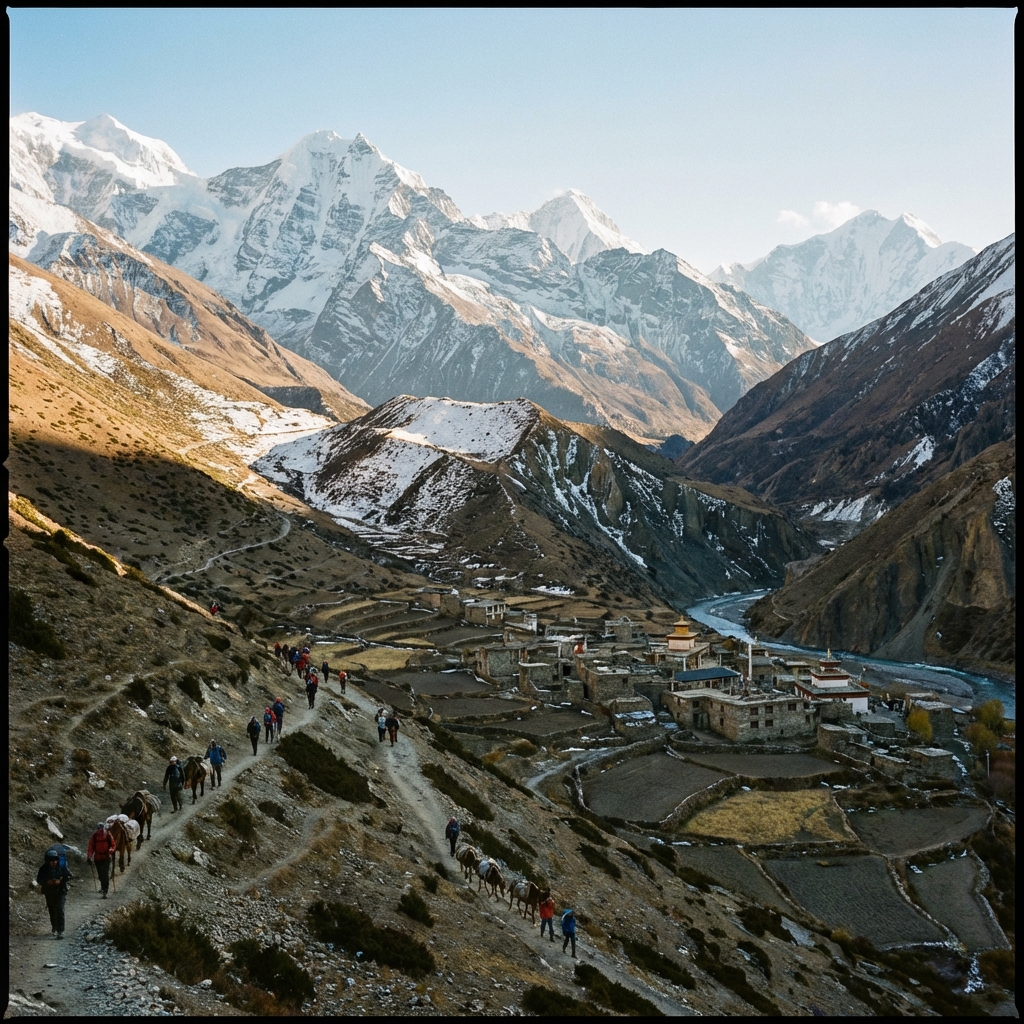
The Manaslu Conservation Area encompasses 1,663 square kilometers of northern Gorkha district, sheltering one of Nepal's most biodiverse and culturally layered landscapes. Established in 1998, the area stretches from subtropical valleys at 600 meters to the base of Manaslu (8,163m), the world's eighth-highest mountain, and includes the complete watershed of the Budhi Gandaki River. Within these boundaries live snow leopards, red pandas, and dozens of threatened bird species, as well as Tibetan Buddhist communities whose way of life has remained largely unchanged for centuries.
The conservation area is not a national park in the strict sense. It is a multiple-use protected area where local communities can continue farming, grazing, and harvesting forest resources sustainably, while external trekkers face strict permit requirements and behavioral regulations. This distinction matters for trekkers: the Manaslu Circuit passes through communities that share the land with wildlife, and responsible visitor behavior directly influences both ecological health and community attitudes toward conservation.
Understanding the permit system, the ecological zones you traverse, the wildlife you might encounter, and the regulations governing your stay is not bureaucratic box-ticking. It is the foundation of a trekking experience that benefits rather than harms this extraordinary place. This guide covers everything you need to know before setting foot on the trail.
1,663 km² (northern Gorkha district)
1998 by Nepal Government
NPR 3,000 (~$23) per week
$35/week (Oct-Nov), $25/week (other months)
2 trekkers (restricted area rule)
Mandatory licensed guide
600m (Arughat) to 8,163m (Manaslu summit)
Snow leopard, red panda, Himalayan tahr, musk deer
5 distinct vegetation belts
October-November, March-May
The Conservation Area's Establishment and Purpose
Why Manaslu Received Protected Status
The Manaslu region was designated a conservation area rather than a national park largely because of its dense human population. Unlike Sagarmatha (Everest) National Park or Shey Phoksundo National Park, where permanent settlements are minimal, the Budhi Gandaki valley and its tributaries are home to tens of thousands of residents in villages ranging from the subtropical lowlands to the high-altitude pastures near the Tibetan border.
A strict national park designation would have criminalized subsistence farming, firewood collection, and livestock grazing practices that communities have depended on for generations. The conservation area model instead focuses on sustainable use, working with communities to develop livelihoods compatible with wildlife protection rather than in conflict with it.
The Manaslu Conservation Area Project (MCAP), managed by the King Mahendra Trust for Nature Conservation (now the National Trust for Nature Conservation), operates community-based conservation programs, anti-poaching patrols, habitat restoration projects, and eco-tourism initiatives throughout the area.
Conservation Area vs. National Park
The Manaslu Conservation Area differs from Nepal's national parks in that local communities retain land use rights within it. Trekkers still need permits, regulations still apply, and wildlife remains protected, but the governance model is community-centered rather than purely preservation-focused. Your permit fees directly fund community development programs, ranger salaries, and habitat conservation work.
The Restricted Area Overlay
Within the Manaslu Conservation Area, a significant portion of the upper circuit — including the villages of Samagaon, Samdo, and the Tsum Valley — falls under an additional "Restricted Area" designation. This layer requires a separate restricted area permit (RAP) beyond the MCAP permit and imposes the two-trekker minimum group requirement and mandatory guide rule.
The restricted area designation reflects both ecological sensitivity (the upper zones are critical snow leopard and blue sheep habitat) and cultural protection concerns — many of the high-altitude communities have requested controlled visitor access to limit disruption to their traditional way of life.
The Permit System in Detail
Permit 1: Manaslu Conservation Area Permit (MCAP)
Every trekker entering the Manaslu Conservation Area must obtain an MCAP permit, regardless of which section of the trail they are trekking.
Cost: NPR 3,000 (approximately $23) for the first week, with an additional NPR 3,000 charged for each subsequent week of stay within the conservation area.
Where to obtain: Through a licensed trekking agency in Kathmandu. The permit is issued by the National Trust for Nature Conservation (NTNC) and requires:
- Passport copy with valid Nepal visa
- Passport-sized photograph
- Completed application form (your agency handles this)
Processing time: 1-2 working days when submitted through a reputable agency. Some agencies maintain standing permits and can process faster.
Permit checkpoints: Your MCAP permit is checked at the entry point to the conservation area at Jagat village, and at several ranger stations along the trail. Always carry the original document.
Permit 2: Restricted Area Permit (RAP)
Trekkers continuing beyond the lower Budhi Gandaki valley — specifically those heading to Samagaon, Samdo, Larkya La, or into Tsum Valley — require a Restricted Area Permit in addition to the MCAP.
Cost:
- September to November (peak season): $35 per person per week
- December to August (off-peak): $25 per person per week
Minimum group requirement: The restricted area regulations mandate a minimum of 2 trekkers. Solo trekkers must either find a partner or, in practice, pay for a second permit and have their guide count as the second group member (though this varies by agency interpretation). Confirm the current enforcement policy with your agency before booking.
Mandatory guide: A licensed trekking guide issued by the Nepal Tourism Board is required for all restricted area trekking. Agencies must verify their guide's licensing with the Department of Immigration during the permit application.
Processing: Like the MCAP, the RAP must be obtained through a registered trekking agency. It cannot be purchased at the trailhead or at border checkpoints.
Permit Enforcement is Strict
Unlike some trekking regions in Nepal where permit checks are perfunctory, the Manaslu restricted area has multiple staffed checkpoints where rangers thoroughly verify permits, cross-check group composition, and confirm guide credentials. Trekking without proper permits can result in fines, mandatory escorted return to Kathmandu, and banning from future restricted area permits. Do not attempt to enter without complete documentation.
TIMS Card
A Trekkers' Information Management System (TIMS) card is required for the Manaslu Circuit, in addition to the MCAP and RAP. Cost: approximately $20. Your agency obtains this in Kathmandu alongside the other permits.
Permit Costs at a Glance
| Permit | Cost | Duration |
|---|---|---|
| MCAP (Conservation Area Entry) | NPR 3,000 (~$23) | Per week |
| Restricted Area Permit (Oct-Nov) | $35/person | Per week |
| Restricted Area Permit (other months) | $25/person | Per week |
| TIMS Card | ~$20 | Whole trek |
For the full national context of Nepal's trekking permit system, see our Nepal trekking permits guide.
Budget for Two Weeks of Permits
Most Manaslu Circuit treks (including Tsum Valley) run 14-20 days, meaning you will pay for two weeks of both the MCAP and RAP. Budget approximately $100-130 per person for permits alone during peak season. This is separate from your agency fee, which often includes permit costs — verify exactly what is included when comparing agency quotes.
Wildlife of the Manaslu Conservation Area
The Manaslu Conservation Area's vertical range — from subtropical forest at 600m to glacial zones above 5,000m — supports extraordinary biodiversity. The area's isolation from heavily populated lowlands and its protected status have allowed wildlife populations to remain relatively healthy compared to other Himalayan regions.
Snow Leopard (Panthera uncia)
The snow leopard is the conservation area's apex predator and most iconic wildlife symbol. Reliable population estimates for the Manaslu area are difficult to establish, but camera trap studies by the MCAP project have confirmed breeding populations in the upper Budhi Gandaki valley, the Tsum Valley, and the high ridges above Samagaon.
Where to look: Snow leopards inhabit terrain between 3,000m and 5,000m, predominantly on rocky cliff faces and ridges above the treeline. Early morning and late afternoon are peak activity periods. The area around Samagaon, the ridges above Samdo, and the upper Tsum Valley offer the best probability of sightings.
Realistic expectations: Snow leopard sightings are never guaranteed. Even experienced field biologists conducting dedicated surveys may go weeks without a confirmed sighting. For trekkers, a sighting is a rare and extraordinary event — perhaps one in twenty to thirty trekkers in high-quality habitat will spot one. However, paw prints and scrape marks in snow are common above 4,000m, and these signs are themselves remarkable to encounter.
Conservation status: Vulnerable (IUCN Red List). An estimated 400-650 snow leopards live in Nepal, with the Manaslu and Annapurna Conservation Area harboring some of the densest populations outside of Dolpo.
Snow Leopard Prey and Habitat
Snow leopard populations are directly linked to the abundance of blue sheep (bharal), their primary prey. Blue sheep are very common in the Manaslu Conservation Area above 3,500m — trekkers regularly spot herds of 20-50 animals on the rocky slopes above Samagaon and Samdo. Where you see many blue sheep, snow leopards are rarely far away.
Red Panda (Ailurus fulgens)
The red panda is one of Nepal's most charming and least-seen mammals. This small, fox-sized creature with russet fur and a ringed tail inhabits temperate mixed forest between 2,000m and 4,000m, feeding almost exclusively on bamboo shoots and leaves.
Where to look: The forests between Jagat (1,340m) and Namrung (2,630m) offer the best red panda habitat in the conservation area. Specifically, areas with dense bamboo understory within rhododendron and oak-fir forest. Red pandas are crepuscular (most active at dawn and dusk) and arboreal, spending much of their time in trees.
Conservation status: Endangered (IUCN Red List). Habitat loss from deforestation and hunting for their distinctive fur has drastically reduced populations. The Manaslu Conservation Area provides one of the better-protected habitats in Nepal.
Sighting tips: Move quietly through forest sections in the early morning. Look upward into dense bamboo thickets and tree canopy rather than on the trail itself. A red panda sighting on the Manaslu trail is a genuine highlight and reported by perhaps 5-10% of trekkers who are actively looking.
Himalayan Tahr (Hemitragus jemlahicus)
The Himalayan tahr is a stocky wild goat with impressive curved horns found on steep rocky terrain between 2,500m and 5,000m. Males are particularly impressive, with long flowing manes and heavy builds. Herds of 5-20 animals are regularly spotted on the cliff faces and rocky slopes above the trail.
Where to look: Rocky slopes above the treeline throughout the upper circuit. The terrain between Namrung and Samagaon offers frequent sightings, as does the area around Lho village where the forested slopes give way to alpine grazing land.
Himalayan Musk Deer (Moschus leucogaster)
The musk deer is a small, solitary deer that inhabits dense forest and alpine scrub between 2,400m and 4,300m. Males have distinctive long tusk-like upper canines and produce one of the most valuable natural substances by weight — musk, used in traditional medicine. Poaching for musk has devastated populations across the Himalayas.
Conservation status: Endangered (IUCN Red List). The Manaslu Conservation Area's ranger patrols have significantly reduced poaching within the protected zone, and the local population appears stable.
Blue Sheep (Bharal) — Pseudois nayaur
Not a true sheep or goat but an intermediate species, blue sheep are among the most commonly spotted large mammals on the Manaslu Circuit. Herds of 20-80 animals are a regular sight on the open rocky slopes above 3,500m. Their grey-blue coloration provides remarkable camouflage against the rocky terrain.
Best sighting locations: Above Namrung, on the slopes around Samagaon and Samdo, and throughout the upper Tsum Valley.
Other Notable Mammals
| Species | Habitat | Sighting Likelihood |
|---|---|---|
| Himalayan Wolf | High alpine areas above 4,000m | Rare |
| Common Leopard | Lower forest zones below 3,000m | Rare |
| Ghoral | Rocky slopes 2,000-4,000m | Occasional |
| Serow | Dense forest and cliffs | Rare |
| Himalayan Black Bear | Forest zones 1,500-3,500m | Occasional |
| Yellow-throated Marten | Forest zones | Occasional |
Birdlife
The Manaslu Conservation Area hosts over 200 recorded bird species. Key highlights include:
- Lammergeier (Bearded Vulture): Unmistakable with its 2.5m wingspan; seen soaring above valleys throughout the trek
- Snow Partridge: Common on open slopes above 4,000m
- Tibetan Snowcock: Large, noisy bird of alpine zones; often heard before seen
- Blood Pheasant: Strikingly colored; found in rhododendron forest zones
- Himalayan Monal: Nepal's national bird; iridescent male unmistakable in alpine forests
- Red-billed Chough: Acrobatic black bird with red bill; common around lodges at altitude
- Crimson-breasted Woodpecker: Found in lower mixed forest
Wildlife Watching Ethics
Never approach wildlife, attempt to feed animals, or create disturbance to get a better photograph. Snow leopards and red pandas in particular are highly sensitive to human disturbance, and harassment can force animals to abandon territories or denning sites. Use binoculars and a telephoto lens, maintain silence, and observe from a respectful distance. Your guide can advise on appropriate distances for each species.
Flora Zones and Vegetation
The Manaslu Conservation Area's extraordinary altitudinal range creates five distinct vegetation zones, each with its own characteristic plant communities.
Zone 1: Subtropical Forest (600m-1,800m)
The lowest elevations along the Budhi Gandaki River harbor subtropical vegetation dominated by sal trees (Shorea robusta), tropical figs, bamboo, and banana. This zone is hot and humid, particularly during the pre-monsoon months. The undergrowth is dense with ferns, orchids, and climbing plants.
Trekking section: Arughat to Machha Khola
Zone 2: Lower Temperate Forest (1,800m-2,600m)
The transition zone between subtropical and temperate forests is characterized by oak (Quercus semecarpifolia), chestnut, alder, and dense rhododendron understory. This is prime habitat for red pandas, where bamboo grows thickly in the shade of larger trees. Orchids (including several endemic Himalayan species) are found here in spring.
Trekking section: Machha Khola to Namrung
Zone 3: Upper Temperate/Subalpine Forest (2,600m-3,600m)
Above Namrung, rhododendron species begin to dominate — particularly the large-leafed Rhododendron arboreum, which produces spectacular red blooms in March and April. Blue pine (Pinus wallichiana), silver fir, and juniper are also common. This zone is where the trail transitions from forested valleys to increasingly open terrain.
Trekking section: Namrung to Samagaon
Highlight: During spring (March-April), the rhododendron bloom transforms the forest into vivid red and pink color. The combination of rhododendrons in bloom against the backdrop of snow-capped peaks around Lho village is one of the most photographed scenes on the entire Manaslu Circuit.
Zone 4: Alpine Scrub and Meadow (3,600m-4,500m)
Above the treeline, vegetation transitions to dwarf juniper shrubs, alpine grasses, wild thyme, edelweiss, and colorful alpine wildflowers including gentians, primulas, and potentillas. Yak herders graze their animals on these high meadows during summer months.
Trekking section: Samagaon to Dharamsala
Zone 5: Nival Zone (above 4,500m)
Above the perpetual snowline, vegetation becomes increasingly sparse — isolated cushion plants, mosses, and lichens clinging to rock faces represent the highest botanical communities in the conservation area. The Larkya La pass at 5,160m is largely bare rock, snow, and ice.
Best Season for Flora
Spring (March-May) is the best season for wildflowers and rhododendron blooms. The lower forest zones are most spectacular in late March and April when Rhododendron arboreum flowers. Alpine meadows peak in July-August, but the monsoon makes trekking conditions difficult in lower sections. Autumn (October-November) sees the meadows in their post-bloom state but offers the clearest skies.
Conservation Regulations for Trekkers
The Manaslu Conservation Area Project enforces specific behavioral regulations for all visitors. These are not suggestions — violations can result in fines and permit cancellation.
Forest and Vegetation Regulations
Strictly prohibited:
- Cutting, collecting, or damaging any tree, shrub, or plant within the conservation area
- Collecting orchids, medicinal plants, moss, or any botanical specimens
- Starting open fires outside of designated lodge fire areas
- Using firewood for tent camping (all camping groups must use kerosene or gas stoves)
For tea house trekkers: Lodges within the conservation area are permitted to use firewood in their kitchens and limited firewood in dining room heaters. However, request that the kitchen not burn excessive wood on your behalf, particularly at higher elevations where tree cover is sparse.
Wildlife Regulations
Strictly prohibited:
- Hunting or trapping any animal within the conservation area
- Disturbing wildlife, including approaching nesting birds or animals with young
- Feeding wildlife of any kind
- Removing eggs, shells, bones, or any animal parts
- Keeping wild animals captive (including injured animals — report to rangers instead)
Waste and Pollution Regulations
Required:
- All non-biodegradable waste must be carried out of the conservation area. This includes plastic wrappers, bottles, batteries, and packaging
- Human waste must be deposited in designated toilets at lodges. In wilderness areas, waste must be buried at least 50m from water sources
- Burning plastics is prohibited
Prohibited:
- Disposing of any waste in rivers, streams, or water sources
- Littering on trails
- Using detergents or soap directly in rivers or streams
Cultural Site Regulations
The MCAP regulations specifically address the protection of cultural heritage within the conservation area:
- Do not remove any carved stones, mani wall stones, or archaeological artifacts
- Do not deface or mark ancient structures
- Follow monastery photography rules (generally no interior photography without permission, never use flash near murals)
- Walk clockwise around all chortens, mani walls, and prayer wheels
Penalty for Wildlife Violations
Nepal's National Parks and Wildlife Conservation Act 1973 (amended 2017) provides for fines of NPR 100,000 to 1,000,000 and imprisonment of 5-15 years for poaching or killing protected species. Even inadvertent disturbance of nesting endangered species can attract fines. These laws apply within conservation areas as well as national parks.
Campfire and Fuel Regulations
Open campfires are prohibited in the Manaslu Conservation Area above 3,000m. The regulation reflects the slow regeneration rate of subalpine vegetation at high altitude and the pressure that large trekking groups place on fuel wood supply.
For organized camping groups (primarily Upper Manaslu circuit):
- Kerosene or LPG (gas) stoves are mandatory
- Kitchen crew must carry fuel from lower villages
- Any campfire use must be in designated areas approved by local communities
For tea house trekkers:
- Lodges manage their own fuel use according to MCAP guidelines
- Request gas or electric cooking where available
Responsible Trekking in the Conservation Area
Beyond the specific regulations, responsible trekking in the Manaslu Conservation Area involves a broader set of behaviors that respect both the natural environment and the local communities.
Supporting Community-Based Conservation
The MCAP's most effective conservation tool is economic: when local communities benefit financially from wildlife protection, they become conservation's strongest advocates. As a trekker, you contribute to this directly by:
- Staying in locally-owned lodges rather than large commercial enterprises. The revenue differential between a community lodge and a Kathmandu-owned operation can determine whether a family invests in conservation-compatible income versus resource extraction.
- Buying locally produced food and beverages where available. Chhang (local barley beer) from a village home or buckwheat bread from a local family supports agricultural systems that maintain the cultural landscape.
- Employing local guides and porters rather than those brought from Kathmandu. The village guides in Samagaon and Tsum Valley have local ecological knowledge that urban guides cannot match.
Minimizing Ecological Footprint
| Practice | Why It Matters in Manaslu |
|---|---|
| Use water purification tablets or filter | Plastic bottle disposal in remote areas has no solution |
| Shower once per week, not daily | Wood-heated showers consume significant firewood |
| Eat dal bhat rather than imported food | Reduces supply chain pressure on the trail |
| Request no individual packaging | Small packaging creates disproportionate waste in remote areas |
| Turn off charging points when done | Solar power is limited; other trekkers need it too |
The Porter Welfare Issue
The Manaslu Circuit has historically had poor porter welfare standards compared to routes like the Annapurna Circuit. Verify before booking that your agency: pays porters the TAAN minimum wage (NPR 1,500-2,000/day), provides porters with proper equipment (sleeping bags, clothing rated for the altitude they reach), and carries porter insurance. Ethical agencies do this as standard; budget agencies often cut corners that hurt their local staff.
Community Conservation Programs
The MCAP works with local communities on several active programs that trekkers directly support through their permit fees:
Community Forest Programs
Villages within the conservation area manage their own community forests under guidance from the MCAP. These forests are protected from commercial logging while allowing sustainable harvest of firewood, fodder, and non-timber forest products. The result is forest recovery in areas that were severely degraded in the 1980s and 1990s.
Anti-Poaching Patrols
MCAP rangers conduct regular patrols in the high-altitude zones to prevent poaching of snow leopards, musk deer, and red pandas. Community members are employed as conservation scouts, creating economic incentive for wildlife protection.
Livestock Insurance Programs
Snow leopard attacks on livestock are a significant source of human-wildlife conflict. The MCAP operates a livestock insurance scheme that compensates herders for losses, reducing the incentive to retaliate against predators. This program has measurably reduced snow leopard killing in the conservation area.
Where Your Permit Money Goes
The revenue from MCAP and RAP permits is split between the national government (50%), local district development funds (30%), and direct community development programs (20%). The community portion funds schools, water systems, trails, and the ranger patrol program. This funding model is one reason that Manaslu villages are generally supportive of trekking tourism despite the disruption it causes.
Conservation Challenges
The Manaslu Conservation Area faces significant ongoing challenges that trekkers should understand:
Climate Change Impacts
Glacial retreat is visible throughout the upper circuit. The glaciers visible from Samagaon and on the approach to Larkya La have retreated measurably over the past two decades, reducing the water supply to downstream communities and altering the alpine ecosystem. Higher snowlines are shifting snow leopard and blue sheep habitat upward, compressing their viable territory.
Tourism Pressure
The Manaslu Circuit has grown significantly in popularity since 2010, with trekker numbers increasing from a few hundred per year to several thousand annually. This growth brings economic benefits but also increased pressure on firewood supplies, water sources, and wildlife disturbance. The restricted area permit and mandatory guide requirements are both partly designed to manage this growth.
Illegal Wildlife Trade
Despite improved enforcement, poaching for musk (from musk deer), snow leopard skins, and traditional medicine ingredients continues to be a threat. Trekkers can help by reporting any observed poaching activity or illegal wildlife products for sale to their guide or directly to MCAP rangers.
Getting to the Manaslu Conservation Area
The standard starting point for the Manaslu Circuit is Soti Khola (730m), reached by a 7-8 hour jeep drive from Kathmandu via Gorkha and Arughat. Alternatively, some trekkers start from Arughat Bazaar (approximately 550m), adding 1-2 days of walking through the lower Budhi Gandaki valley.
The conservation area entry checkpoint at Jagat (1,340m) is where your MCAP permit is first checked by rangers. Ensure all permits are in order before reaching this point.
For complete trekking logistics, day-by-day itinerary, and practical planning information, see our Manaslu Circuit 14-day itinerary and the main Manaslu Circuit route guide.
Frequently Asked Questions
Do I need both the MCAP and Restricted Area Permit?
Yes, if you are trekking the full Manaslu Circuit beyond the lower Budhi Gandaki. The MCAP covers the conservation area entry, while the RAP is required for the restricted zone above Jagat including Samagaon, Samdo, and the Larkya La crossing.
Can I trek the Manaslu Circuit solo?
No. The restricted area regulations require a minimum group of two trekkers with a licensed guide arranged through a registered trekking agency. Solo trekking is not permitted in the restricted zone.
When is the best time to see snow leopards in the Manaslu area?
Snow leopard sightings are extremely rare but most likely between November and March when the animals descend to lower elevations following blue sheep herds. The high pastures above Samagaon and Samdo are the most likely habitat areas.
How are permit fees used for conservation?
MCAP fees fund community-based conservation programs run by the National Trust for Nature Conservation, including anti-poaching patrols, habitat restoration, ranger salaries, and eco-tourism initiatives in local communities.
- Manaslu Circuit Route Guide
- Manaslu Circuit 14-Day Itinerary
- Nepal Trekking Permits Explained
- Nepal National Parks and Conservation Areas
- Tsum Valley Trek Guide
- Manaslu Circuit + Tsum Valley Combined Trek
- Best Trekking Agencies for Manaslu Circuit
- Altitude Sickness Prevention and Treatment
- Larkya La Pass Guide
- Nepal Trekking Packing List