



Choosing between Langtang Valley and Annapurna Base Camp represents one of the most interesting decisions for moderate trekkers in Nepal—and for good reason. Unlike the obvious choice between a beginner trek like Poon Hill and the challenging Everest Base Camp, Langtang and ABC are remarkably similar on paper: both are moderate difficulty, both reach 4,000+ meters, both offer spectacular mountain views, both complete in 7-14 days, and both showcase rich cultural traditions.
Yet despite these similarities, these treks deliver fundamentally different experiences. The choice between Langtang's tranquil valley of glaciers just hours from Kathmandu and ABC's iconic amphitheater ringed by 7,000-8,000m giants speaks to deeper questions: Do you value accessibility or remote immersion? Do you prefer supporting earthquake recovery or exploring Nepal's most developed trekking infrastructure? Are you drawn to Tamang Buddhist culture or Gurung mountain villages? Do you want to avoid crowds or embrace the social atmosphere of a popular route?
This comprehensive 10,000+ word guide provides data-driven analysis across every decision factor. We've compared current costs, analyzed altitude profiles, interviewed guides from both regions, surveyed hundreds of trekkers, and walked both routes multiple times in different seasons. Whether you're a first-time moderate trekker, a photographer seeking untouched landscapes, or an experienced hiker choosing your next adventure, this guide delivers the detailed comparison you need.
The executive summary: Langtang Valley suits those wanting easier logistics from Kathmandu (no Pokhara travel), fewer crowds (60% less traffic than ABC), meaningful cultural immersion with Tamang communities rebuilding after the 2015 earthquake, slightly lower costs, and authentic mountain experiences. ABC suits those prioritizing the iconic sanctuary amphitheater experience, willingness to handle the Pokhara connection, comfort with moderate crowds, and desire for the most ecologically diverse trek in Nepal (jungle to glacier). Both are exceptional moderate treks—but they appeal to different priorities.
Quick Comparison: Langtang Valley vs ABC at a Glance
| Feature | Langtang Valley | Abc |
|---|---|---|
| Duration | 7-10 days (flexible options) | 10-14 days (standard with Poon Hill) |
| Maximum Altitude | 5,033m (16,512 ft) at Tserko Ri | 4,130m (13,550 ft) at Annapurna Base Camp |
| Highest Sleep Altitude | 3,870m (Kyanjin Gompa) | 4,130m (ABC - one night) |
| Total Distance | 60 km (37 miles) round trip | 110-115 km (68-71 miles) round trip |
| Difficulty Rating | Moderate | Moderate (slightly higher than Langtang) |
| Altitude Sickness Risk | Moderate (Tserko Ri 5,033m, optional) | Low-Moderate (4,130m, 2-3 days above 3,500m) |
| Daily Trekking Time | 3-6 hours per day (shorter than ABC) | 5-7 hours per day |
| Access from Kathmandu | 7-8 hour drive direct (no flights needed) | 7-8 hour drive to Pokhara, then 1.5 hour drive to trailhead |
| Cost (All-Inclusive) | $800-1,800 (most affordable major trek) | $1,200-2,500 |
| Permits Required | Langtang National Park ($23) + TIMS (NPR 2,000) | ACAP ($23) + TIMS (NPR 2,000) |
| Best Seasons | Oct-Nov, Mar-May (clearer, less monsoon impact) | Oct-Nov, Mar-May (rhododendrons stunning) |
| Crowd Levels | Low-Moderate (60% fewer trekkers than ABC) | Moderate (popular, but spread over longer route) |
| Teahouse Quality | Good (rebuilt post-2015, basic at altitude) | Excellent (well-developed, basic at ABC) |
| Cultural Experience | Excellent Tamang culture, cheese factory, monasteries, earthquake recovery story | Very Good Gurung culture (Chomrong, Ghandruk - but rushed through) |
| Ecological Diversity | Good (forest to glacier, less dramatic transition) | Excellent (jungle to glacier, five distinct zones) |
| Mountain Scenery | Excellent (Langtang Lirung 7,227m, Tibet border peaks, glaciers) | Spectacular (360° amphitheater, Annapurna I 8,091m, Machapuchare) |
| Remote Feel | High (quieter trails, authentic villages) | Moderate (well-trodden route, developed infrastructure) |
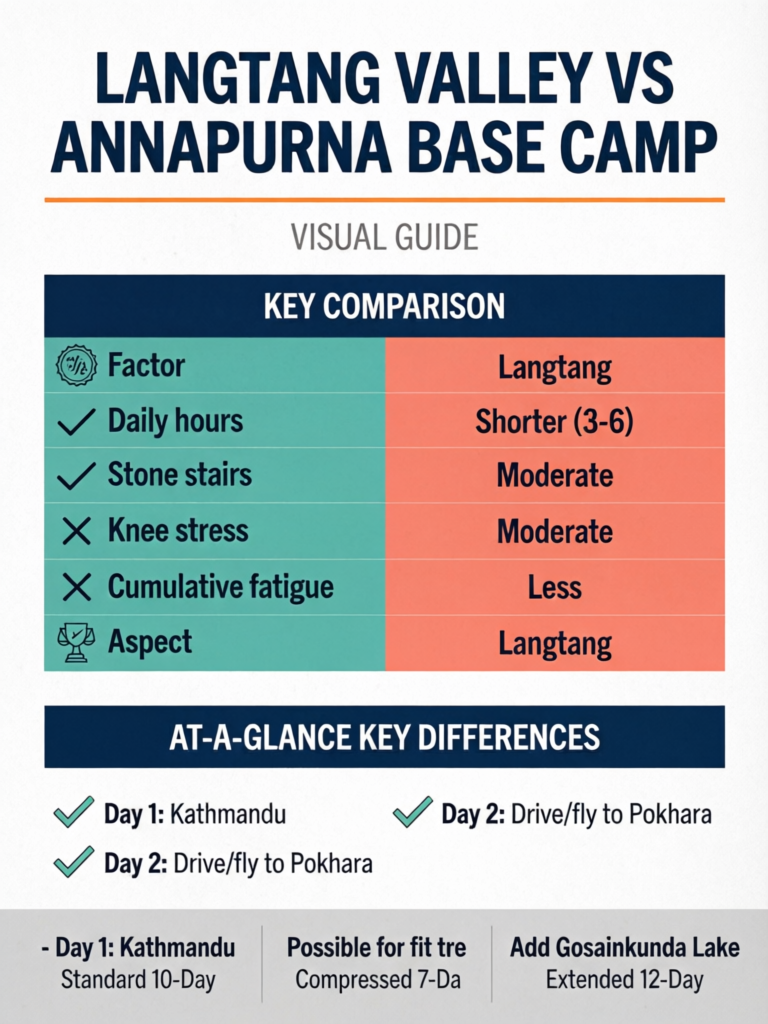
At-a-Glance Key Differences
Langtang's Tserko Ri is 903m higher than ABC (but optional day hike)
ABC sleeps 260m higher than Kyanjin Gompa (4,130m vs 3,870m)
Langtang can be 3-4 days shorter than standard ABC itinerary
Langtang typically costs 20-40% less than ABC
Langtang receives ~40% of ABC's annual trekker numbers
Langtang: 7-8 hrs from Kathmandu; ABC: 14-16 hrs total (via Pokhara)
Langtang: Tamang Buddhist culture; ABC: Gurung culture (less time in villages)
Langtang Langtang Village was devastated by the 2015 earthquake but has been fully rebuilt with earthquake-resistant structures on a site ~100m higher than the original village. Trails and teahouses are fully restored and safe for trekking, rebuilt - your visit supports recovery; ABC largely unaffected
Langtang: Kyanjin Gompa valley + Tserko Ri sunrise; ABC: Sanctuary amphitheater
Langtang is the clear winner for those seeking quieter trails
ABC offers more dramatic ecological transitions
Langtang wins (direct from Kathmandu, no Pokhara connection needed)
1. Duration Comparison: Similar but Different
Both treks can be completed within 7-14 days, but the structure differs.
Langtang Valley: 7-10 Days
Standard 10-Day Itinerary:
- Day 1: Kathmandu
- Day 2: Drive to Syabrubesi (7-8 hrs)
- Days 3-5: Trek to Kyanjin Gompa (3,870m)
- Days 6-7: Acclimatization (Kyanjin Ri, Tserko Ri)
- Days 8-9: Return trek to Syabrubesi
- Day 10: Drive to Kathmandu
Compressed 7-Day: Possible for fit trekkers (skip acclimatization day) Extended 12-Day: Add Gosainkunda Lakes
Key advantage: Direct from Kathmandu, no secondary city needed
Annapurna Base Camp: 10-14 Days
Standard 12-Day Itinerary:
- Day 1: Kathmandu
- Day 2: Drive/fly to Pokhara
- Days 3-9: Trek to ABC (4,130m) via Poon Hill, Chomrong
- Days 10-11: Return trek, drive to Pokhara
- Day 12: Return to Kathmandu
Short 10-Day: Skip Poon Hill section (start from Jhinu) Extended 14-Day: Leisurely pace, more village time
Key consideration: Requires Pokhara connection (adds 1-2 days)
Duration Winner: Langtang for time-limited trekkers
Langtang saves 2-4 days through direct Kathmandu access and shorter trekking distances.
Pro Tip
Time-limited trekkers with 7-10 days total: Langtang delivers a complete Himalayan experience without the Pokhara detour. If you have 12-14 days, ABC's extra time allows for the iconic sanctuary experience plus Poon Hill.
2. Difficulty: Both Moderate, Different Challenges
Physical Demands
Langtang:
- Daily trekking: 3-6 hours (shorter days)
- Total distance: 60 km
- Steepest day: Lama Hotel to Langtang Village (950m gain)
- Challenge: Tserko Ri (1,163m gain at altitude, but optional)
ABC:
- Daily trekking: 5-7 hours (longer days)
- Total distance: 110 km
- Steepest day: Tikhedhunga to Ghorepani (1,320m gain, 3,300 steps)
- Challenge: More cumulative elevation, extensive stairs
Difficulty Comparison
| Factor | Langtang | ABC |
|---|---|---|
| Daily hours | Shorter (3-6) | Longer (5-7) |
| Stone stairs | Moderate | Extensive (3,300+ steps) |
| Knee stress | Moderate | High (long descents) |
| Cumulative fatigue | Less | More (more consecutive days) |
ABC is slightly more physically demanding due to longer daily hours and extensive stair sections. Langtang offers shorter days but higher optional summit.
Both require similar baseline fitness: ability to walk 10-15 km daily with 800-1,000m elevation gain.
3. Altitude: Higher Peak vs Higher Sleep
This is where the comparison gets nuanced.
Langtang Altitude Profile
- Maximum altitude: 5,033m (Tserko Ri)
- Sleep altitude: 3,870m (Kyanjin Gompa)
- Key advantage: Sleep lower, climb higher (optional)
- Acclimatization: 2-3 nights at Kyanjin Gompa
- AMS risk: Moderate (10-12% mild symptoms)
Altitude strategy: The Tserko Ri summit is an optional day hike. You can skip it if feeling poorly and still complete the trek successfully. You sleep at safer 3,870m.
ABC Altitude Profile
- Maximum altitude: 4,130m (Annapurna Base Camp)
- Sleep altitude: 4,130m (same as max)
- Key challenge: Must sleep at maximum altitude
- Summit day gain: 900m from Deurali (3,230m)
- AMS risk: Low-moderate (10-15% mild symptoms)
Altitude strategy: ABC is the destination—if altitude affects you severely, you may need to descend before reaching it. Less flexibility than Langtang.
Altitude Winner: Depends on your perspective
- For altitude-sensitive: Langtang (lower sleep altitude)
- For conservative approach: ABC (lower maximum altitude)
- For flexibility: Langtang (optional high summit)
Altitude Considerations
Langtang's Tserko Ri (5,033m) is higher than ABC (4,130m), but it's an optional day hike—you return to sleep at 3,870m. ABC requires sleeping at 4,130m with less acclimatization time. Both are moderate altitude with proper itineraries. Discuss Diamox with your doctor if concerned about altitude sickness.
4. Scenery: Valley of Glaciers vs Sanctuary Amphitheater
Both offer world-class mountain views with different character.
Langtang Valley Scenery
Mountain Views:
- Langtang Lirung (7,227m) - dominant presence
- Gangchhenpo, Dorje Lakpa, Naya Kanga (6,000m+ peaks)
- Tibet border peaks visible from Tserko Ri
- Shishapangma (8,027m) on very clear days
Landscape Character:
- Intimate valley feel (mountains feel close)
- Accessible glaciers (walk onto Langtang Glacier)
- Wide valley floor with yak pastures
- Tibetan Buddhist elements (prayer flags, monasteries)
- Wilder, less-developed atmosphere
Photographic Highlights:
- Tserko Ri 360° sunrise panorama
- Langtang Lirung's massive north face
- Kyanjin Gompa with peak backdrop
- Glacier close-ups
- Cultural elements (monastery, cheese factory)
ABC Scenery
Mountain Views:
- Annapurna I (8,091m) - world's 10th highest
- Machapuchare (6,993m) - iconic fishtail summit
- Annapurna South, Hiunchuli, Gangapurna (7,000m+ peaks)
- 360° amphitheater at ABC
- Poon Hill panorama (Dhaulagiri to Annapurna range)
Landscape Character:
- Overwhelming scale (surrounded by giants)
- Sacred sanctuary atmosphere
- Five ecological zones (jungle to glacier)
- Extensive rhododendron forests (spring)
- Well-developed infrastructure visible
Photographic Highlights:
- ABC 360° amphitheater at sunrise
- Machapuchare from multiple angles
- Annapurna I's south face
- Poon Hill sunrise panorama
- Rhododendron tunnels (March-April)
Scenery Comparison
| Aspect | Langtang | ABC |
|---|---|---|
| Highest peak visible | 7,227m (Langtang Lirung) | 8,091m (Annapurna I) |
| Mountain proximity | Intimate, close | Overwhelming, surrounding |
| Glacier access | Walk onto glacier | Distant views |
| Ecological diversity | Good (3 zones) | Excellent (5 zones) |
| Rhododendrons | Good | Spectacular (more extensive) |
| Iconic factor | Moderate (less known) | High (world-famous amphitheater) |
| Solitude for photos | Easy (fewer crowds) | Requires patience (busy viewpoints) |
Scenery Winner: Tie (different but equal quality)
ABC wins for: 8,000m peak, dramatic amphitheater, rhododendron forests Langtang wins for: Intimate glacier access, uncrowded compositions, wild atmosphere
5. Crowds: 60% Fewer Trekkers on Langtang
This is one of the most significant practical differences.
Langtang Crowds
Annual trekkers: ~25,000-30,000 (recovering from 2015 low) Peak season: 10-30 trekkers per day on trail Viewpoints: Tserko Ri: 10-20 people at sunrise Lodge availability: Usually available (walk-in) Atmosphere: Quiet, intimate, authentic
Why Langtang is quieter:
- 2015 earthquake reduced tourism (slowly recovering)
- No Pokhara tourism infrastructure benefit
- Less marketing/promotion
- Perceived as "second-tier" (wrongly)
ABC Crowds
Annual trekkers: ~65,000-75,000 Peak season: 50-150+ trekkers per day Viewpoints: Poon Hill: 100-300 people; ABC: 100-200 trekkers Lodge availability: Book ahead recommended (peak season) Atmosphere: Social, communal, lively
Why ABC is busier:
- Second most popular trek in Nepal
- Benefits from Pokhara tourism
- Well-established marketing
- "Classic" Nepal trek status
Crowd Comparison
Langtang receives roughly 40% of ABC's annual traffic.
| Metric | Langtang | ABC |
|---|---|---|
| Annual trekkers | 25,000-30,000 | 65,000-75,000 |
| Daily encounters | 10-30 | 50-150+ |
| Viewpoint crowds | Minimal | Significant |
| Lodge competition | Low | Moderate-high |
| Trail "highway" feel | Rare | Common |
Crowds Winner: Langtang by a landslide
If avoiding crowds is a priority, Langtang is the clear choice.
Pro Tip
Crowd-sensitive trekkers: Langtang offers the same quality mountain experience with 60% fewer people. You'll recognize most trekkers you meet, have easier photography, and experience more authentic cultural interactions. ABC's crowds aren't oppressive, but the difference is real and noticeable.
6. Cultural Experience: Tamang Buddhist vs Gurung
Both offer rich cultural immersion, but depth and focus differ.
Langtang: Tamang Culture & Earthquake Recovery
Ethnic group: Tamang (Tibetan Buddhist origins)
Cultural highlights:
- Kyanjin Gompa monastery: Active Buddhist monastery, daily prayers
- Cheese factory: Nepal's first yak cheese operation (1955, Swiss-assisted)
- Earthquake memorial: Solemn visit to original Langtang Village site
- Tamang villages: Traditional stone houses, prayer wheels
- Recovery story: Direct support for families rebuilding after 2015
Religious/spiritual:
- Active monastery you can visit
- Prayer flags, mani walls, chortens throughout
- Tibetan Buddhist ceremonies
- Spiritual landscape (sacred peaks)
Cultural immersion time:
- 2-3 nights at Kyanjin Gompa (cultural heart)
- Time for monastery visits, cheese factory tour
- Conversations with lodge owners
- Less rushed through villages
Unique to Langtang: The 2015 earthquake devastated Langtang Village (350+ deaths). The rebuilt village represents remarkable resilience. Your visit directly supports recovery—every meal, every lodge night contributes to rebuilding lives. This adds profound emotional significance.
ABC: Gurung Culture
Ethnic group: Gurung (Buddhist/animist, famous Gurkha soldiers)
Cultural highlights:
- Chomrong: Largest Gurung village, gateway to sanctuary
- Ghandruk: Nepal's most famous heritage village (slight detour)
- Gurung museum: ACAP center with cultural exhibits (Ghandruk)
- Jhinu hot springs: Natural hot springs with local significance
- Traditional villages: Terraced farming, stone architecture
Religious/spiritual:
- Buddhist gompas in villages
- Shamanic traditions (bombo practitioners)
- Sacred Machapuchare (climbing forbidden)
- Sanctuary considered sacred ground
Cultural immersion time:
- 1 night Chomrong (typically rushed)
- Ghandruk often skipped or brief
- Focus on reaching ABC rather than villages
- Less time for deep cultural exchange
Note: To truly experience Gurung culture on ABC, you must intentionally add village time—don't just pass through.
Cultural Winner: Langtang (for depth and authenticity)
Langtang naturally provides more cultural immersion time. ABC's Gurung culture is rich but often rushed in standard itineraries.
Choose Langtang for culture if:
- Interested in Tibetan Buddhist monasteries
- Want time for meaningful village interactions
- Moved by earthquake recovery stories
- Prefer less commercialized exchanges
Choose ABC for culture if:
- Interested in Gurkha/Gurung heritage
- Want to visit famous Ghandruk heritage village
- Willing to add extra days for villages
- Interested in hot springs cultural experience
7. Logistics & Access: Direct vs Pokhara Connection
Practical considerations significantly impact trek choice.
Langtang: Direct from Kathmandu
Access:
- Distance: 140 km from Kathmandu
- Time: 7-8 hours by road
- Options: Local bus ($5-8), tourist bus ($15-20), jeep ($80-120)
- Road: Paved to Dhunche, rough to Syabrubesi
Advantages:
- No secondary city needed (saves 1-2 days)
- No internal flights required
- Direct logistics (Kathmandu → Trek → Kathmandu)
- Lower transport costs
- Weather-independent (no flight delays)
Challenges:
- Long drive (motion sickness for some)
- Rough road sections
- Monsoon landslide risk
- No flight option
Time from Kathmandu to trekking: 1 day
ABC: Via Pokhara
Access:
- Kathmandu to Pokhara: 200 km, 6-8 hrs drive or 25-min flight ($100-150)
- Pokhara to Nayapul: 42 km, 1.5 hrs drive
- Total: 14-16 hours from Kathmandu
Advantages:
- Pokhara visit adds value (lakeside, restaurants, activities)
- Flight option available (scenic, saves time)
- Better trailhead facilities
- Multiple start/end points
- Excellent road to Nayapul
Challenges:
- Extra travel day needed
- Pokhara accommodation cost ($15-60)
- More complex logistics
- Higher transport costs
Time from Kathmandu to trekking: 2 days
Logistics Winner: Langtang (for simplicity and time-efficiency)
Langtang's direct access saves 1-2 days and $50-150 in transport/accommodation.
ABC's Pokhara connection adds value if you want to visit Nepal's adventure capital, but it's an extra step.
Time-Efficiency Analysis
For trekkers with exactly 10 days total in Nepal: Langtang allows 7 days trekking, 2 days driving, 1 buffer. ABC needs 12+ days to do properly. If time is your limiting factor, Langtang delivers more mountain time.
8. Cost: 20-40% Savings on Langtang
Budget is a practical consideration.
Langtang Costs (2026)
Package tours:
- Budget: $800-1,100
- Mid-range: $1,200-1,500
- Premium: $1,600-1,800
Independent trekking (10 days):
- Permits: $23 (Langtang NP) + NPR 2,000 (TIMS)
- Transport: $15-40 RT
- Daily costs: $24-50 (accommodation, meals, extras)
- Guide: $25-35/day (optional but recommended)
- Porter: $20-25/day
- Total: $800-1,500
ABC Costs (2026)
Package tours:
- Budget: $1,200-1,500
- Mid-range: $1,600-2,000
- Premium: $2,200-2,500
Independent trekking (12 days):
- Permits: $23 (ACAP) + NPR 2,000 (TIMS)
- Transport: $50-80 RT (more with Pokhara flight)
- Pokhara stay: $30-60 (2 nights)
- Daily costs: $25-70
- Guide: $25-35/day
- Porter: $20-25/day
- Total: $1,200-2,500
Cost Comparison
| Category | Langtang | ABC | Savings |
|---|---|---|---|
| Permits | $23 | $23 | $0 |
| Transport | $15-40 | $50-150 | $35-110 |
| City stay | $0 | $30-60 | $30-60 |
| Daily costs | $24-50 | $25-70 | Similar |
| Trek days | 7 | 8-9 | 1-2 days |
| Total (budget) | $800-1,100 | $1,200-1,500 | $300-400 |
| Total (mid-range) | $1,200-1,500 | $1,600-2,000 | $300-500 |
Langtang costs 20-40% less than ABC.
Why Langtang Is Cheaper
- No Pokhara connection (saves transport + accommodation)
- Shorter duration (fewer guide/porter days)
- Less commercialized (lower prices)
- Simpler logistics (fewer connection costs)
Cost Winner: Langtang (best value major trek in Nepal)
Langtang delivers comparable mountain quality at significantly lower cost.
Choose Langtang if: Budget-conscious, want maximum value Choose ABC if: Budget flexible, value Pokhara experience
9. Best Time to Trek: Similar Seasons, Subtle Differences
Both share optimal seasons with slight variations.
Shared Peak Seasons
Autumn (October-November):
- Weather: Clear, dry, stable for both
- Visibility: Excellent mountain views
- Crowds: Langtang low-moderate; ABC moderate-high
- Best for: Mountain photography, clear skies
Spring (March-May):
- Weather: Warming, pre-monsoon clouds by May
- Rhododendrons: Good (Langtang); Spectacular (ABC—more extensive)
- Crowds: Langtang low-moderate; ABC moderate-high (April peak)
- Best for: Flower enthusiasts, warmer conditions
Seasonal Differences
Winter (December-February):
- Langtang: Possible but cold (-15°C nights). Some lodges open.
- ABC: Challenging (snow above Deurali, avalanche risk, closures)
- Winner: Langtang more viable
Monsoon (June-September):
- Both: Not recommended (heavy rain, landslides, leeches, poor visibility)
- Langtang: Slightly less monsoon impact (Tibet rain shadow)
Month-by-Month
| Month | Langtang | ABC | Better Choice |
|---|---|---|---|
| Oct | Excellent (quieter) | Excellent (busy) | Langtang (fewer crowds) |
| Nov | Excellent | Excellent | Similar |
| Mar | Excellent | Excellent (rhodos starting) | ABC (flowers) |
| Apr | Excellent | Excellent (peak rhodos) | ABC (spectacular blooms) |
| Dec-Feb | Cold but viable | Very challenging | Langtang |
| Jun-Aug | Not recommended | Not recommended | Neither |
Best Time Winner: Tie
Both excel in October-November and March-May. ABC superior for spring rhododendrons. Langtang superior for winter trekking.
10. Supporting Earthquake Recovery: Langtang's Unique Significance
This factor is unique to Langtang and may influence your decision.
The 2015 Earthquake Impact
On April 25, 2015, a massive earthquake triggered an avalanche that buried Langtang Village under millions of tons of ice and rock. Over 350 people died—176 local Tamang residents, ~100 domestic tourists, and dozens of foreign trekkers and guides. Entire families were lost. The destruction was complete.
The Remarkable Recovery
Within months, survivors began returning. Within years, the trail was rebuilt and new teahouses constructed. The new Langtang Village sits slightly above the original site with earthquake-resistant construction.
Current status (2025):
- Trail fully restored
- Teahouse capacity returned to pre-earthquake levels
- Memorial site honoring victims
- Improved infrastructure
How Your Visit Supports Recovery
Tourism is the economic lifeline of Langtang communities. Your visit directly supports families rebuilding their lives:
- Every teahouse stay supports lodge owners who lost family members
- Every meal purchased contributes to recovery
- Every guide/porter hire provides employment
- Your presence demonstrates solidarity
This isn't charity—it's meaningful economic support controlled by the community.
The Emotional Dimension
Many trekkers report that understanding this history adds profound emotional significance to the journey. Visiting the memorial at the original village site is moving. Conversations with survivors about their experiences are powerful. Your respectful presence honors those lost and supports those rebuilding.
ABC Was Largely Unaffected
The 2015 earthquake caused some damage in the Annapurna region, but nothing comparable to Langtang's devastation. ABC trails and villages were largely intact and operational within weeks.
The Recovery Factor in Your Decision
Choose Langtang if:
- You want your tourism dollars to have maximum community impact
- You're moved by stories of resilience and recovery
- You appreciate the emotional depth this adds to the journey
- You want to demonstrate solidarity through responsible tourism
This doesn't make Langtang "better"—but it's a unique factor that may align with your values.
Responsible Tourism in Langtang
When trekking Langtang, maximize your positive impact: Stay at locally-owned teahouses, eat meals where you sleep, purchase local products (cheese, handicrafts), hire local guides/porters from Tamang communities, pay fair prices (don't aggressively bargain), and share Langtang's story with other trekkers. Your visit supports remarkable recovery.
11. Tea House Quality & Infrastructure
Langtang
Accommodation:
- Rebuilt post-2015 (new construction)
- Basic to good quality
- Simple rooms, foam mattresses
- Shared bathrooms (squat toilets)
- Wood stoves in dining halls
- Improving annually
Amenities:
- WiFi: Limited, spotty above Langtang Village
- Hot showers: Available ($2-5)
- Electricity: Solar/generators, limited
- Menu variety: Basic (dal bhat, noodles, momos)
- Phone signal: Weak above Syabrubesi
Character: Authentic, family-run, less commercialized
ABC
Accommodation:
- Well-established infrastructure
- Good to excellent quality (lower elevations)
- Better mattresses and blankets
- Mix of squat and Western toilets
- Warmer dining halls
Amenities:
- WiFi: More reliable ($2-5)
- Hot showers: Common ($2-5)
- Electricity: Better availability
- Menu variety: Extensive (Western options)
- Phone signal: Better coverage
Character: Well-developed, professional, commercial
Infrastructure Winner: ABC (more developed, reliable amenities)
But Langtang's simpler infrastructure has authentic charm. Choose based on priorities: comfort vs authenticity.
Which Trek Is Harder?
Both are moderate treks, but they challenge you differently. ABC reaches 4,130m with sustained uphill through the Modi Khola gorge over 7-12 days. Langtang Valley offers a higher optional summit at Tserko Ri (5,033m) but a gentler main trail to Kyanjin Gompa (3,870m) over 5-7 days. If you attempt Tserko Ri, Langtang is harder. On the standard itinerary, ABC is slightly more demanding due to the steep stone steps and longer duration. See our trekking boots guide for footwear advice.
Which Trek Is Cheaper?
Langtang is 20-40% cheaper than ABC. The main savings come from transport: Langtang's trailhead is a $10-15 bus ride from Kathmandu, while ABC requires travel to Pokhara first ($15-30) plus transport to the trailhead. Langtang permits are also slightly cheaper. A budget Langtang trek costs $400-700 vs ABC's $600-1,000. See our Langtang National Park permit guide for permit details.
Which Trek Has Better Views?
ABC's glacial amphitheater surrounded by Annapurna I (8,091m), Machapuchare, and Annapurna South is one of Nepal's most spectacular single viewpoints. Langtang offers intimate views of Langtang Lirung (7,227m) and the Langtang Glacier from Kyanjin Ri and Tserko Ri. ABC wins for sheer dramatic impact at the destination; Langtang wins for a quieter, more personal mountain experience with 60% fewer trekkers. Pack right with our layering system guide.
12. Who Should Choose Which Trek?
Choose Langtang Valley Trek If:
Time-Limited Professionals:
- 7-10 days maximum
- Want complete Himalayan experience
- Prefer direct Kathmandu logistics
Budget-Conscious Travelers:
- $800-1,200 total budget
- Want maximum value-for-money
- Don't need high-end amenities
Crowd-Averse Trekkers:
- Strongly prefer solitude
- Dislike trekking "highways"
- Want uncrowded photography
Cultural Immersion Seekers:
- Interested in Tibetan Buddhist culture
- Want time for deep village interactions
- Moved by recovery stories
Earthquake Recovery Supporters:
- Want tourism to have maximum community impact
- Value supporting rebuilding efforts
- Appreciate emotional significance
First-Time High-Altitude (Cautious):
- Concerned about altitude sickness
- Want lower sleep altitude (3,870m)
- Prefer flexibility (optional Tserko Ri)
Repeat Nepal Visitors:
- Already did ABC/EBC
- Seeking less-traveled routes
- Want to compare regions/cultures
Choose Annapurna Base Camp Trek If:
Comprehensive Experience Seekers:
- 12-14 days available
- Want most ecologically diverse trek
- Value journey depth over efficiency
First-Time Nepal Trekkers:
- Want "classic" Nepal experience
- Appreciate developed infrastructure
- Comfortable with crowds
Pokhara Enthusiasts:
- Want to visit adventure capital
- Appreciate city + trek combination
- See Pokhara as value-add
Nature & Ecology Lovers:
- Prioritize biodiversity
- Excited by five ecological zones
- Spring rhododendrons major draw
Iconic Experience Collectors:
- Want to stand below Annapurna I (8,091m)
- Seek most dramatic amphitheater
- Photographing Machapuchare important
Social Trekkers:
- Enjoy meeting fellow trekkers
- Appreciate communal atmosphere
- Find motivation in social environment
Flower Enthusiasts:
- Trekking in March-April for blooms
- Want extensive rhododendron forests
- Photography focused on flora
Frequently Asked Questions
Which trek is more difficult? Both are moderate difficulty. ABC is slightly more physically demanding (longer daily hours, more cumulative distance, extensive stairs). Langtang has higher optional summit (Tserko Ri 5,033m) but shorter daily treks. If you can complete one, you can likely complete the other.
Which has higher altitude sickness risk? Both have moderate risk (10-15% mild symptoms). Langtang's Tserko Ri (5,033m) is higher but is optional day hike—you sleep at lower 3,870m. ABC requires sleeping at 4,130m. Marginal advantage to Langtang for altitude-sensitive trekkers.
Which is cheaper? Langtang costs 20-40% less than ABC ($300-500 savings). Main savings: no Pokhara connection, shorter duration, less commercialized pricing.
Which has better mountain views? Different but equal quality. ABC: 8,000m Annapurna I, dramatic amphitheater, Machapuchare. Langtang: intimate glacier valley, accessible glaciers, wilder atmosphere. Choose based on preference for scale vs intimacy.
Which is less crowded? Langtang by far. Receives ~40% of ABC's annual trekkers. Encounter 10-30 people/day vs 50-150+ on ABC. If avoiding crowds is priority, Langtang is clear winner.
Which has better cultural experience? Langtang offers deeper Tamang Buddhist cultural immersion (active monastery, cheese factory, multi-night village stays, earthquake recovery story). ABC offers Gurung culture but often rushed through. Langtang wins for cultural depth.
How do I get to each trailhead? Langtang: 7-8 hour drive direct from Kathmandu to Syabrubesi. ABC: Drive/fly to Pokhara (7-8 hrs or 25 min), then 1.5 hrs to Nayapul. Langtang simpler and faster.
Can I do both treks in one Nepal trip? Yes, with 20-25 days total. Do ABC (12-14 days), rest in Kathmandu (1-2 days), then Langtang (7-10 days). This provides comprehensive experience of both regions.
Which trek is better for first-timers? Both suitable. ABC has more developed infrastructure, slightly lower altitude, and social atmosphere (may feel reassuring). Langtang has shorter days, quieter trails, and more flexible pacing. Train properly for either.
When is the best time for each trek? Both best in October-November (autumn) and March-May (spring). ABC superior for spring rhododendrons. Langtang more viable in winter. Both avoid monsoon (June-September).
Which trek has better tea houses? ABC has more developed, comfortable lodges with better amenities (WiFi, hot showers, menu variety). Langtang has good but more basic, authentic lodges. Choose based on comfort vs authenticity priority.
How does my visit support earthquake recovery in Langtang? Your teahouse stays, meals, and guide/porter employment directly support Tamang families rebuilding after the 2015 earthquake. Tourism is their economic lifeline—your visit contributes meaningfully to ongoing recovery.
Can I trek independently with a mandatory licensed guide? Legally, Nepal requires guides for treks in national parks (2026 regulation). Practically, both trails are well-marked, but licensed guides are now mandatory. Budget $25-35/day for guide services.
Which trek requires booking further in advance? ABC in peak season (October-November, March-April) benefits from 4-8 week advance booking for best guide/lodge availability. Langtang more flexible due to lower crowds—2-4 weeks typically sufficient.
Which trek is better for photography? Langtang: Easier uncrowded compositions, glacier access, Tibetan cultural elements, wilder atmosphere. ABC: Iconic peaks (Annapurna I, Machapuchare), rhododendrons, dramatic amphitheater, but crowded viewpoints require patience. Both excellent for different subjects.
Final Recommendation: Making Your Choice
After this comprehensive comparison, here's the bottom line:
Choose Langtang Valley Trek If:
You have 7-10 days and want direct logistics from Kathmandu. You value quieter trails (60% fewer crowds), authentic cultural immersion with Tamang communities, and supporting earthquake recovery where your tourism has maximum impact. You prefer intimate mountain experiences where peaks feel close, want the option to sleep lower (3,870m) while climbing higher (5,033m Tserko Ri), and appreciate that Langtang costs 20-40% less while delivering comparable quality. You're a photographer seeking uncrowded shots or drawn to Tibetan Buddhist elements, or you're time-limited but want a complete 4,000m+ Himalayan experience.
Langtang is for trekkers who prioritize: accessibility, authenticity, value, fewer crowds, cultural depth, and supporting recovery.
Choose Annapurna Base Camp Trek If:
You have 12-14 days and want the most ecologically diverse trek in Nepal (five zones: jungle to glacier). You want to stand in the sanctuary of Annapurna I (8,091m) surrounded by a 360° ring of 7,000-8,000m giants. You appreciate well-developed infrastructure, reliable amenities, and the social atmosphere of a popular route. You're visiting Pokhara and see the extra travel day as added value. You're excited about spring rhododendron forests, or you want the most photographically iconic Himalayan views (even with crowded viewpoints). You prefer the security of highly established systems and maximum route flexibility.
ABC is for trekkers who prioritize: ecological diversity, iconic amphitheater, infrastructure quality, Pokhara connection, and comprehensive journey depth.
Both Treks Offer:
- Moderate difficulty (proper training required)
- 4,000m+ altitude experiences
- World-class mountain scenery
- Rich cultural traditions
- Excellent teahouse systems
- October-November and March-May optimal seasons
- Life-changing Himalayan adventures
You Can't Go Wrong
Both Langtang Valley and Annapurna Base Camp rank among Nepal's finest moderate treks. Thousands complete each annually with transformative experiences. The "best" trek is the one matching your priorities: time, budget, crowds, logistics, scenery style, and personal values.
If still undecided after this guide, ask yourself:
- "Do I have 7-10 days or 12-14 days?"
- "Do I want quiet trails or social atmosphere?"
- "Do I prioritize Kathmandu-direct or seeing Pokhara?"
- "Do I prefer intimate valleys or overwhelming amphitheaters?"
- "Do I want to support earthquake recovery?"
Your answers will guide you clearly to Langtang or ABC.
And if you have 3-4 weeks? Do both. Experience the tranquil glacier valley and the dramatic sanctuary amphitheater. Compare Tamang and Gurung cultures. Walk from jungle to glacier on two different journeys.
Whatever you choose, you're about to embark on an unforgettable Himalayan adventure.
Namaste, and safe travels.
Related Routes & Guides
Trek Guides:
- Langtang Valley Trek: Complete Guide
- Annapurna Base Camp Trek: Complete Guide
- Gosainkunda Trek (Langtang Extension)
- Poon Hill Trek
- Everest Base Camp Trek
Comparison Guides:
Regional Guides:
Practical Guides:
- Nepal Trekking Permits Explained
- Best Time to Trek Nepal
- Altitude Sickness Prevention
- Nepal Trekking Packing List
- How to Choose a Trekking Agency
- Budget Trekking in Nepal
This comprehensive comparison guide is maintained by the Nepal Trekking Team with input from guides who have led both Langtang Valley and Annapurna Base Camp treks hundreds of times, verified data from local agencies and tourism authorities, insights from post-earthquake recovery monitoring, and feedback from trekkers. Last updated February 2026.
Special acknowledgment to the Tamang communities of Langtang Valley for their remarkable resilience and recovery, and to the Gurung communities of the Annapurna region for preserving their cultural heritage while welcoming trekkers from around the world.